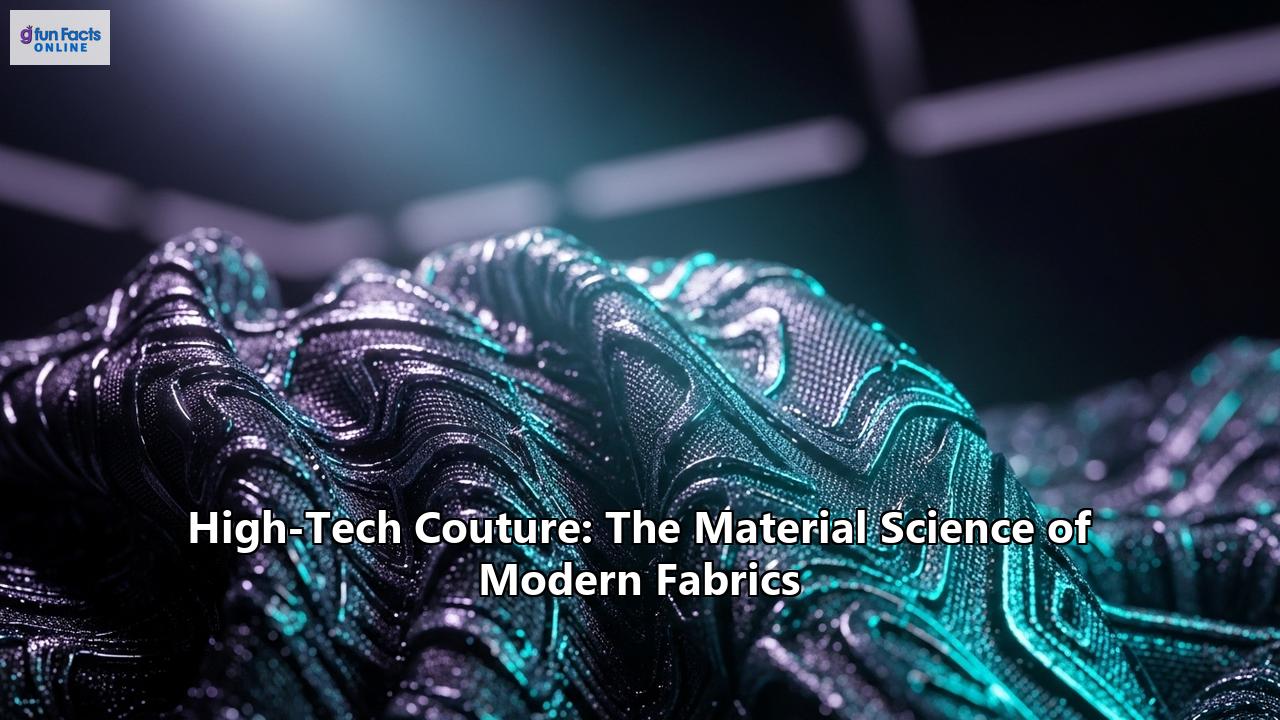
High-Tech Couture: The Material Science of Modern Fabrics
The hushed world of haute couture, traditionally a domain of silk, satin, and meticulous hand-stitching, is undergoing a seismic revolution. In ateliers and laboratories across the globe, a new generation of materials is being born, blurring the lines between fashion, science, and technology. This is the world of high-tech couture, where the rustle of chiffon is met with the whisper of fiber optics and the drape of a garment is dictated not just by a designer's vision, but by the very molecular structure of the fabric itself. We are moving beyond passive textiles into an era of active, intelligent, and responsive clothing that is reshaping our understanding of what we wear.
This transformation is not merely about aesthetics; it's a fundamental shift powered by materials science. It delves into nanotechnology, biomimicry, and biotechnology to create fabrics that can think, feel, and adapt. These are textiles that can change color with the temperature, monitor the wearer's health, or are grown in a lab from mushroom roots, offering a sustainable alternative to traditional leather. The story of modern fabric is the story of innovation, a narrative woven from the threads of scientific discovery and artistic genius, promising a future where our clothes are as smart, dynamic, and conscious as the world around them.
The Genesis of Tech in Textiles: A Brief History
The intersection of technology and fashion is not a 21st-century phenomenon. The journey began in the 19th century with an invention that irrevocably altered the course of clothing: the sewing machine. Patented by Elias Howe in 1846, the sewing machine replaced the painstaking process of hand-stitching, which had remained largely unchanged for 20,000 years. This mechanization enabled the mass production of garments, drastically increasing efficiency and making clothing more accessible and affordable to the general population.
The next great leap came in the early 20th century with the advent of synthetic fibers. Nylon, first introduced in 1938 as a man-made substitute for silk, and polyester, which followed in 1941, offered unprecedented durability, wrinkle resistance, and ease of care. These materials, born from chemical ingenuity, expanded the creative possibilities for designers and met the demands of increasingly busy modern lifestyles. The development of spandex in the 1970s further revolutionized fashion, introducing a level of stretch and form-fitting comfort that opened up entirely new silhouettes. These early advancements, from mechanical automation to polymer chemistry, laid the crucial groundwork for the high-tech material science revolution we are witnessing today, proving that at its core, fashion has always been driven by technology.
The New Material Palette: Redefining Luxury with Intelligent Textiles
The contemporary definition of luxury in fashion is expanding beyond rare materials and meticulous craftsmanship to include functionality, intelligence, and sustainability. The new material palette features "smart fabrics" or "intelligent textiles"—materials that are not merely passive coverings but active systems designed to interact with the wearer and the environment. These fabrics can be broadly categorized into three revolutionary groups: Aesthetic Innovators, Performance Enhancers, and Sustainable Solutions.
Aesthetic Innovators: Fabrics That Dazzle and TransformThese materials are designed to create dynamic visual experiences, turning garments into canvases for personal expression.
- Thermochromic and Photochromic Fabrics: Imagine a dress that changes color with a shift in temperature or a jacket that transforms its pattern when exposed to sunlight. This is the reality of thermochromic and photochromic textiles. These fabrics are embedded with microcapsules containing dyes that undergo a reversible chemical transformation in response to heat (thermo) or UV light (photo), causing them to change color. This technology allows for clothing that is interactive and ever-changing.
- Illuminated Fabrics: Designers are weaving light directly into their creations using fiber optics and LEDs. Brands like CuteCircuit have become famous for their illuminated haute couture gowns, which can display animations and patterns controlled by a smartphone app. This is achieved by weaving thousands of tiny, micro-LEDs into the fabric, creating a textile that is also a display screen, allowing the wearer to download new patterns and effectively change their outfit without buying a new one.
This category moves fashion from a purely decorative function to a utilitarian one, enhancing the wearer's comfort, safety, and well-being.
- Temperature-Regulating Fabrics: Initially developed for demanding environments like space travel, these materials are now entering high fashion. They utilize phase-change materials (PCMs) that can absorb, store, and release heat. When the wearer's body temperature rises, the PCM melts, absorbing excess heat. As the body cools, the PCM solidifies, releasing the stored heat to provide warmth, thus maintaining thermal comfort across different environments.
- Self-Healing and Protective Fabrics: Researchers are developing textiles that can repair small tears or punctures, dramatically extending the lifespan of a garment. This emerging technology often mimics biological processes, using microcapsules embedded in the fabric that rupture upon damage, releasing a healing agent that seals the tear. Furthermore, materials like Kevlar and Dyneema, known for their exceptional strength, are being reimagined for high-fashion contexts, offering unparalleled durability.
- Biometric-Sensing Fabrics: By embedding conductive threads and miniature sensors into textiles, clothing can now monitor vital signs like heart rate, stress levels, and respiratory rate. This turns the garment into a wearable health-monitoring device, seamlessly integrating wellness technology into daily life.
Perhaps the most critical area of material innovation is in sustainability, where science is offering solutions to the fashion industry's significant environmental impact.
- Bio-Based and Lab-Grown Materials: The search for alternatives to resource-intensive materials has led to a boom in bio-fabrication. Companies are now creating leather-like materials from pineapple leaf fibers (Piñatex), mushroom mycelium (Mylo), and apple or cactus waste. These plant-based textiles often repurpose agricultural byproducts and are biodegradable. Similarly, textiles are being developed from ocean-sourced materials like seaweed and algae, which require minimal fresh water and no pesticides to grow.
- Advanced Recycling: Technology is transforming waste into high-quality new materials. Chemical recycling processes can break down old garments, like those made of cotton or polyester, to their basic molecular components. These components are then used to create new fibers, such as Circulose, a pulp made from discarded clothing that can be used to produce new fabrics. This "closed-loop" system reduces landfill waste and lessens the industry's reliance on virgin resources.
- Waterless Dyeing: Traditional textile dyeing is a notoriously water-intensive and polluting process. Innovative techniques like supercritical CO2 dyeing are changing this. This method uses carbon dioxide in a pressurized, fluid-like state as the solvent to carry the dye, which penetrates the fabric deeply. After the process, the CO2 is depressurized and recycled. This technology drastically cuts water consumption and eliminates the release of harmful chemical effluents.
The Science of Glamour: How High-Tech Fabrics Work
The magic of these futuristic fabrics is rooted in profound scientific principles. From manipulating matter at the atomic level to drawing inspiration from the natural world, materials scientists are engineering textiles with properties once thought to be science fiction.
Nanotechnology: Engineering at the Atomic ScaleNanotechnology involves manipulating materials on an atomic and molecular scale, and its application in textiles has unlocked a host of new functionalities.
- Enhanced Properties: By applying nano-coatings or embedding nanoparticles into fibers, fabrics can be imbued with remarkable characteristics. For example, coatings that create a nanoscopic "lotus effect" mimic the surface of a lotus leaf, causing water to bead up and roll off, resulting in highly water-repellent and self-cleaning textiles. Silver nanoparticles can be integrated to provide powerful antimicrobial properties, ideal for sportswear or medical textiles. Other nanoparticles can offer UV protection without changing the fabric's feel or breathability.
- Conductivity: Nanotechnology is also key to creating conductive fabrics, which are essential for e-textiles and wearable technology. Coating fibers with nanoparticles of silver or gold can make them conductive, allowing them to function like wires without the rigidity, enabling the integration of circuits, sensors, and LEDs directly into the weave of the fabric.
Biomimicry is an approach to innovation that seeks sustainable solutions to human challenges by emulating nature's time-tested patterns and strategies. Designers and scientists are looking to the natural world for inspiration.
- Structural Marvels: The iridescence of a butterfly's wing, which is created by its physical structure rather than pigment, has inspired fabrics that shimmer and change color without dyes. The incredible strength and elasticity of spider silk, a protein-based fiber, is being replicated in labs through genetically engineered yeast to produce bio-silk that is both strong and biodegradable.
- Cruelty-Free Alternatives: The structure of animal fur and feathers is being studied and replicated using 3D printing to create highly effective, cruelty-free insulation materials for apparel. This not only addresses ethical concerns but also allows for the customization of thermal properties based on the specific design.
The seamless integration of electronics is transforming passive garments into active, responsive platforms.
- Fiber Optics and LEDs: Luminous textiles are often created by weaving fine optical fibers alongside traditional threads. Light is then channeled through these fibers from a small, concealed source, causing the fabric to glow. Alternatively, thousands of microscopic LEDs can be embedded into the textile itself.
- Challenges and Solutions: A primary challenge is ensuring these tech-infused garments are practical. This means they must be flexible, comfortable, and, crucially, washable. Innovations in encapsulation and flexible circuitry are addressing these issues. Powering these garments is another hurdle, with solutions ranging from small, rechargeable battery packs to research into energy-harvesting textiles that can generate power from the wearer's movement or from sunlight.
New manufacturing techniques are revolutionizing how garments are designed and constructed.
- 3D Printing (Additive Manufacturing): This technology allows designers to create complex, three-dimensional structures and even print entire garments layer by layer. It eliminates waste from cutting fabric and enables the creation of forms impossible to achieve with traditional methods. Designers like Iris van Herpen have famously used 3D printing to craft intricate, sculptural dresses that look more like wearable art than clothing.
- 4D Printing: The next frontier is 4D printing, where the fourth dimension is time. This involves printing with smart materials that are programmed to change shape or self-assemble over time when exposed to a specific stimulus, such as water, heat, or light. This could lead to clothes that adapt their fit perfectly to the wearer or furniture that assembles itself.
The Pioneers of High-Tech Couture
While these technologies are developed in labs, it is the vision of pioneering designers and fashion houses that brings them to life on the runway, demonstrating their artistic and expressive potential.
Iris van Herpen: The Architect of Futurist FashionOften hailed as the leading figure in high-tech couture, Dutch designer Iris van Herpen treats fashion as an interdisciplinary art form. Her work is a synthesis of meticulous craftsmanship and groundbreaking technology. She consistently collaborates with scientists, architects, and technologists to push the boundaries of what is possible.
- Signature Techniques: Van Herpen is renowned for her use of 3D printing to create garments of breathtaking complexity, often resembling natural forms like crystalline structures or aquatic organisms. She also employs laser cutting with surgical precision and works with an array of unconventional materials, including silicone, metallic powders, and custom-developed resins, to achieve her otherworldly aesthetic. Collections like 'Crystallization' and 'Sensory Seas' are masterclasses in how science can inform and elevate fashion design.
The British-Cypriot designer Hussein Chalayan is celebrated for his intellectually rigorous and conceptual approach to fashion. His work often explores themes of identity, culture, and technology, resulting in pieces that are as much performance art as they are clothing.
- Transformative Garments: Chalayan is famous for his transformative designs, such as his "Afterwords" collection which featured a coffee table that morphed into a wooden skirt. He also created a series of dresses made from water-soluble fabric that dissolved on the runway when showered with water, commenting on the transient nature of life and possessions.
Dutch designer Anouk Wipprecht operates at the radical intersection of fashion, robotics, and interaction design. Her "fashion-tech" creations are not passive garments but intelligent, robotic systems that interact with the wearer and their surroundings.
- Interactive and Responsive Designs: Her well-known "Spider Dress" features robotic limbs on the shoulders that extend to defend the wearer's personal space when they sense someone approaching too quickly. Wipprecht uses a combination of sensors, microcontrollers, and 3D-printed components to create these cybernetic garments that question the relationship between our bodies, our clothes, and our environment.
Founded by Francesca Rosella and Ryan Genz, CuteCircuit is a fashion house that has been a consistent pioneer in wearable technology, specializing in interactive and illuminated clothing.
- Bringing Light to Fashion: They have dressed celebrities like Katy Perry and Nicole Scherzinger in their signature LED gowns, which can be controlled via a smartphone to change color and display animations. Crucially, CuteCircuit is also focused on bringing this technology to ready-to-wear fashion, developing garments that are both technologically advanced and practical enough for everyday use, including being washable.
The Sustainable Revolution: High-Tech for a Better Planet
The fashion industry is one of the world's largest polluters, but the same scientific ingenuity driving aesthetic and performance innovations is also providing powerful tools for sustainability. Material science is at the forefront of creating a more ethical and environmentally responsible fashion future.
Bio-Fabrication: Growing the Future of TextilesBio-fabrication involves using living organisms like bacteria, yeast, algae, and fungi to grow materials. This represents a paradigm shift from traditional agriculture-based and petrochemical-based production.
- Lab-Grown Leather and Silk: Companies like Bolt Threads have developed Mylo™, a leather alternative grown from mycelium, the root structure of mushrooms, which is cultivated on beds of agricultural waste. This process is significantly faster and less resource-intensive than raising cattle. Similarly, Microsilk™ is produced by genetically engineered yeast that ferments sugar to create a protein identical to that of spider silk.
- Algae and Bacteria: AlgiKnit is creating durable, biodegradable yarns from kelp, a highly regenerative seaweed that grows without the need for fresh water, pesticides, or arable land. Meanwhile, researchers are exploring the use of bacterial cellulose, a byproduct of kombucha fermentation, to grow leather-like sheets that are fully biodegradable.
While mechanical recycling of materials like PET bottles into polyester has been around for some time, its scope is limited. Chemical recycling offers a more powerful solution for creating a circular economy.
- From Clothes Back to Molecules: Companies like Renewcell (with its product Circulose) and Evrnu are pioneering processes that take post-consumer textile waste—like old cotton jeans and t-shirts—and use solvents to dissolve it, breaking the fabric down to its constituent polymer, cellulose. This pulp is then used to spin new, high-quality fibers that are indistinguishable from virgin materials. This "closing the loop" approach prevents clothing from ending up in landfills and reduces the enormous water and land footprint of conventional cotton farming.
A growing movement is focused on transforming waste from other industries into valuable textiles.
- From Farm to Fabric: Piñatex, made from the fibers of pineapple leaves that are typically discarded during harvest, provides an additional income stream for farming communities and creates a durable, vegan alternative to leather. Similarly, Orange Fiber has developed a process to create a silky, vitamin-C-rich fabric from the citrus peel waste generated by the juice industry.
The Future of the Wardrobe: What's Next?
The convergence of material science and fashion is accelerating, pointing toward a future that is even more integrated, personalized, and biologically attuned.
Living and Dynamic TextilesThe next frontier may be truly "living" textiles. Imagine garments that can photosynthesize like a plant, converting carbon dioxide into oxygen as you go about your day. Researchers are already developing fabrics embedded with microalgae that can do just this. The concept of self-repair will likely evolve from chemical agents to biological ones, where fabrics containing engineered microorganisms can "heal" themselves by growing new fibers over a tear.
Deeper Digital and Sensory IntegrationOur clothing will become a more seamless interface with our digital lives.
- Haptic Feedback: Garments will do more than just display information; they will allow us to feel it. Haptic feedback systems woven into clothing could provide navigational cues through gentle vibrations, create more immersive virtual reality experiences, or offer new forms of communication.
- The Internet of Things (IoT): When our clothes are connected to the internet, they become part of a larger network. Your jacket could communicate with your home's thermostat to adjust the temperature before you arrive, or your workout clothes could automatically upload your performance data to your fitness app and even suggest post-workout meals.
Advanced manufacturing will shift the paradigm from mass production to mass personalization. 4D printing will enable the creation of "flat-pack" clothes that could be shipped and then activated (e.g., by applying heat) to take on their final, perfect-fit form. This, combined with advanced body scanning technology, means garments could be produced on-demand to a customer's exact measurements and specifications, drastically reducing waste from overproduction and unsold inventory.
Conclusion: The Fabric of Our FutureThe world of high-tech couture and advanced material science is weaving a new narrative for fashion. It is a story where the beauty of a garment is measured not only by its aesthetic appeal but also by its intelligence, its functionality, and its conscience. The innovations of today—color-changing fabrics, self-healing materials, and textiles grown from fungi—are not mere novelties; they are the prototypes for the wardrobe of tomorrow.
This revolution is transforming the very essence of clothing, moving it from a static object to a dynamic partner in our lives. As science and design continue their intimate collaboration, they are unlocking a future of limitless possibilities. The clothes we wear will not just reflect our style; they will enhance our lives, monitor our health, and protect our planet. The future of fashion is being stitched together in the lab and the atelier, one intelligent fiber at a time.
Reference:
- https://designslc.com/blogs/the-fabric-show-blog/the-future-of-fabrics-exploring-smart-textiles-in-design
- https://www.lefashionpost.com/2025/03/04/sustainable-style-revolution-how-innovation-textiles-are-reshaping-fashions-future/
- https://www.numberanalytics.com/blog/tech-meets-trend-fashion-history
- https://www.starternoise.com/the-history-of-fashion-technology/
- https://www.numberanalytics.com/blog/tech-in-fashion-history
- https://fashion-era.com/general/fashion-technology
- https://www.fitnyc.edu/museum/exhibitions/fashion-and-technology.php
- https://www.throckmortonjones.com/explore/articles/innovative-threads-the-top-10-smart-fabrics-transforming-fashion-and-technology/
- https://www.dezeen.com/2014/08/29/movie-francesca-rosella-cutecircuit-digital-fashion-smart-textiles/
- https://voguesplash.com/?p=1600
- https://www.artisanfurniture.us/blog/textile-innovation/
- https://heuritech.com/articles/fashion-fabric-innovations/
- https://www.luxemagazineswitzerland.com/post/the-intersection-of-fashion-and-technology-smart-fabrics-for-2025
- https://fashionista.com/2024/04/fashion-material-fabric-innovation-bio-based-alternatives
- https://www.4ocean.com/blogs/industry-news/sustainable-fashion-innovations-in-eco-friendly-textiles
- https://thegreenhubonline.com/future-fabrics-the-incredible-textiles-youll-soon-be-wearing/
- https://www.hausvoneden.com/sustainability/sustainable-material-innovations/
- https://www.numberanalytics.com/blog/materials-science-textiles-future
- https://thefashionglobe.com/future-of-fashion-science-tech-math/
- https://www.tms.org/pubs/journals/jom/0507/byko-0507.html
- https://www.aatcc.org/news2023-3a/
- https://medium.com/@adrianlungu06/futuristic-fabrics-the-textile-revolution-of-2024-6e36239fefb9