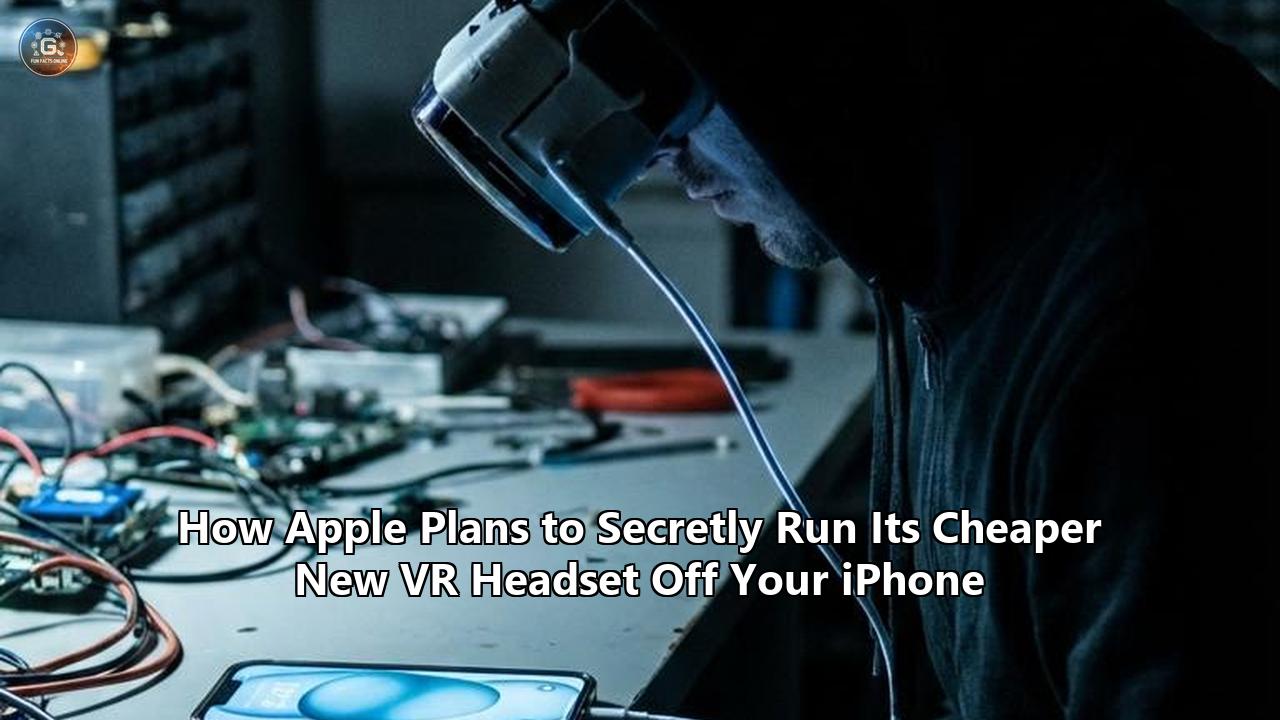
Deep inside Apple’s supply chain, the blueprints for the next era of spatial computing have undergone a radical, unpublicized transformation. After months of rumors suggesting a pivot away from the ultra-premium Vision Pro, new manufacturing leaks and prototype specifications emerging in early 2026 reveal exactly how Apple plans to build its highly anticipated, mass-market mixed reality device. The strategy relies on a compromise that Cupertino engineers once considered heresy: aggressively tethering the upcoming Apple VR headset to the computer already sitting in your pocket.
According to internal component orders and software architecture buried deep within recent iOS developer betas, the device codenamed N107 will not function as an independent standalone computer. Instead, to slash the current $3,500 retail price nearly in half and shed the crippling weight of the original model, Apple has gutted the internal processing silicon. The headset will essentially act as a remarkably advanced external display and sensor array, offloading its heavy computational lifting, spatial rendering, and battery requirements directly to a tethered iPhone or Mac.
This hardware shift represents a foundational pivot in Apple’s wearable strategy. The original Vision Pro was designed to be a self-contained marvel, packing a desktop-class M2 chip and a dedicated R1 sensor-processing chip directly behind the user’s eyes. But that ambition collided violently with the laws of physics, thermodynamics, and consumer economics. By removing the heavy, heat-generating processors and the elaborate cooling systems required to keep them from burning the user's face, Apple is attempting to solve the comfort and cost crisis that plagued its first generation of spatial computing.
But an investigative look at the supply chain data, thermal management limits, and proprietary cable designs reveals a much more complex reality. Apple is not just making a cheaper headset; it is fundamentally rewiring its ecosystem to make your iPhone the mandatory, hardwired engine of its augmented future.
The Thermal Realities of "Face Computers"
To understand why the N107 prototype exists in its current tethered form, you have to look at the autopsy of the original Vision Pro’s consumer reception. When it launched, the device weighed nearly 1.5 pounds (roughly 600 to 650 grams depending on the strap). It required an external aluminum battery pack to keep the weight from being even more severe, yet users still complained of significant neck strain and sinus pressure after mere hours of use.
The culprit wasn't just the glass and aluminum construction; it was the silicon. The M2 and R1 chips process billions of pixels per second to render high-fidelity, dual-4K passthrough video. Processing that much data generates massive amounts of heat. To disperse that heat, the Vision Pro utilizes internal fans and a heavy thermal chassis.
"Stand-alone VR is a nice idea, but in practice, tethered VR has always proven much better because untethered headsets generate heat directly in front of your eyes," notes Sascha Corti, a mixed reality expert and software engineer who has extensively documented headset architectures. "The processing unit sits right on your face, requiring heavy cooling mechanisms that make using them for longer periods physically uncomfortable."
Supply chain analysts point out that the only mathematical way to achieve Apple’s internal mandate—dropping the headset’s weight below 400 grams while cutting the price down to the $1,500 to $2,000 range—was to rip the brain out of the machine.
By offloading the compute cycle to an external device, Apple drastically reduces the bill of materials inside the headset. The fans can be shrunk or removed. The logic board size is slashed. The thermal shielding is lightened. But moving the processor out of the headset creates a new, incredibly complex engineering nightmare: the data bridge.
The Anatomy of the Tether and the 12-Pin Secret
Running a high-resolution, zero-latency virtual reality environment off a smartphone requires data transfer speeds that dwarf traditional USB-C capabilities. You are not simply streaming a movie; you are transmitting uncompressed dual-4K video streams to the headset, while simultaneously pulling 3D spatial mapping data, hand-tracking coordinates, and eye-tracking telemetry back to the phone to be processed in real-time. If the round-trip latency exceeds 12 to 20 milliseconds, the user experiences intense motion sickness.
Evidence of how Apple intends to bridge this gap surfaced in recent hardware leaks regarding a proprietary connection standard. Manufacturing insiders have identified a custom 12-pin locking cable mechanism associated with the N107 project, an upgrade from the 8-pin magnetic puck used on the original Vision Pro battery pack.
This cable is not merely transferring power; it is a massive data pipeline.
"If you look at the throughput required to drive dual Micro-OLED displays at 90Hz while ingesting data from a dozen optical cameras and LiDAR scanners, standard Thunderbolt 4 struggles to keep latency low enough without aggressive compression," explains a former Apple hardware engineer speaking on condition of anonymity. "The iPhone’s A-series Pro chips are powerful enough to handle the graphics rendering, but getting the rendered frames from the user's pocket to their eyes without dropping a single frame requires a dedicated, hardwired protocol. Wireless is absolutely out of the question for this volume of data."
Apple has quietly been laying the groundwork for this capability inside the iPhone. Recent A-series Pro chips have featured dramatically upgraded hardware-accelerated video encoding and neural engines specifically tuned for spatial video. What was initially marketed as a way to capture 3D videos for the Vision Pro was actually a trojan horse: the silicon architecture necessary to eventually generate and render interactive 3D environments from the phone itself.
The Ultimate Ecosystem Lock-In
While the headline is that the new Apple VR headset will be cheaper, the financial reality of this tethered strategy reveals a brilliant, if ruthless, hardware upsell mechanism.
By removing the M-series chip from the headset, Apple ties the performance of the device directly to the performance of the user's iPhone. If you want a cheaper headset, you must supply the computer. But a standard iPhone 13 or 14 lacks the GPU cores, neural engine bandwidth, and thermal dissipation necessary to run a continuous mixed-reality environment.
Industry analysts project that the N107 headset will strictly require a newer generation device—likely an iPhone 17 Pro or an upcoming iteration of the iPhone 18—to function. The headset itself may cost $1,500, but the required host device adds another $1,000 to $1,200 to the true cost of entry.
This creates an aggressive upgrade supercycle. For years, iPhone users have delayed upgrading their handsets as year-over-year smartphone improvements have plateaued. By transforming the iPhone into the mandatory processing engine for spatial computing, Apple instantly provides the ultimate justification for consumers to purchase their highest-tier Pro phones.
Furthermore, this tethered approach guarantees that the headset will theoretically "upgrade" itself every time the user buys a new phone. As next-generation iPhones gain better GPUs and faster neural engines, the processing power driving the headset naturally improves.
Siphoning Power: The Battery Dilemma
Processing power is only half the equation; the other half is electricity. The original Vision Pro featured an external battery pack roughly the size and weight of a thick smartphone, yielding barely two hours of usage.
If the N107 headset uses the iPhone as its battery, Apple faces a brutal power management crisis. The iPhone’s internal battery is already heavily taxed by cellular connectivity, background tasks, and high-brightness displays. Forcing it to simultaneously power a 12-pin data tether, render dual 4K mixed-reality environments, and illuminate high-density micro-OLED screens will drain a standard smartphone battery in minutes, not hours.
Early beta code within iOS power management frameworks indicates Apple is exploring several mitigation strategies. First, the headset will likely feature a small, lightweight internal capacitor or micro-battery—just enough to keep the displays on and prevent the system from crashing if the tether is momentarily disconnected or if the iPhone drops below critical power thresholds.
Second, Apple is experimenting with aggressive thermal throttling on the iPhone while tethered. When the headset is plugged in, the iPhone's own screen will immediately lock and power down. Background app refreshes, cellular polling, and non-essential iOS processes will be suspended, directing nearly all of the battery’s output and the A-chip's thermal budget exclusively to the headset operation.
Even with these software optimizations, relying on the iPhone battery creates severe long-term degradation risks. Lithium-ion batteries degrade rapidly when exposed to continuous high-drain, high-heat cycles. Running a VR headset off a phone will subject the phone's battery to intense chemical stress. Supply chain reports indicate Apple has been exploring new, denser battery chemistries and advanced heat dissipation shielding for its upcoming iPhone lines specifically to survive the sustained thermal load of operating the headset.
If Apple fails to perfectly manage this heat, they risk a scenario where users cook their expensive iPhone batteries just by watching a few 3D movies, leading to a surge of premature battery replacements at the Genius Bar.
Sacrificing the Holy Grail: What Apple Cut
To reach the consumer price point, tethering to the phone is not enough. The bill of materials for the headset itself had to be drastically pruned.
Investigating the leaked schematics of the N107 shows exactly where Apple’s industrial design team made their painful compromises:
1. The Death of EyeSightThe most striking visual feature of the Vision Pro was EyeSight—a lenticular OLED display mounted on the outside of the headset that digitally recreated the user's eyes to people in the room. It was Jony Ive’s dream of maintaining human connection in a digital space. It was also incredibly expensive, heavy, and power-hungry. In the N107, EyeSight is entirely gone. The front of the headset will likely feature a smooth, opaque composite plastic or lightweight glass, similar to the Meta Quest 3, completely hiding the user’s face. This single removal saves significant weight, strips out a costly display, and removes the need for the internal cameras that previously tracked the user's eye movements solely for projecting them outward.
2. A Narrower Field of ViewBloomberg’s Mark Gurman and other supply chain trackers have indicated that Apple is testing narrower Field of View (FOV) optics for the cheaper model. The current Vision Pro has a sprawling, immersive canvas. By narrowing the FOV by even 10 or 15 degrees, Apple can use smaller, cheaper Micro-OLED panels. Smaller panels mean fewer pixels to push, which directly lowers the computational burden placed on the tethered iPhone.
3. Materials and ManufacturingThe Vision Pro feels like a premium Apple product because it is machined from custom aluminum alloy and laminated glass. But metal is heavy and glass shatters. The mass-market Apple VR headset will heavily utilize high-grade polymers and injected plastics. While it may lose the "premium" cold-metal feel, the transition to plastic is essential for shedding the final 150 grams required to make the device comfortable for a two-hour movie.
The Enterprise Alternative: The Mac-Tethered Powerhouse
While the consumer narrative focuses on the iPhone tether, Apple’s internal roadmaps reveal a bifurcated strategy. Alongside the cheaper iPhone-tethered N107, evidence points to another, specialized headset variant aimed squarely at professional users.
This model, rumored to be an ultra-lightweight display device without heavy internal processing, is designed to tether directly to a desktop or laptop Mac. Apple has realized that one of the most popular uses for the current Vision Pro is the Mac Virtual Display feature, which allows users to beam their macOS desktop into a massive spatial canvas. However, the current wireless implementation suffers from occasional latency spikes and compression artifacts.
By creating a dedicated, hardwired Mac-tethered headset, Apple aims to deliver a zero-latency, uncompressed workstation environment. This device would completely bypass the iPhone, utilizing the massive power of the Mac’s M4 or M5 silicon to render ultra-high-definition enterprise applications, 3D modeling software, and complex video editing timelines.
This dual-pronged strategy—a cheaper consumer device powered by the iPhone, and a pro-level spatial monitor powered by the Mac—illustrates a crucial realization in Cupertino: spatial computing is currently too demanding to exist completely on its own. It must become a peripheral to the established computing hierarchy.
The Stigma of the Wire
Despite the engineering logic, the marketing challenge Apple faces is monumental. In the broader virtual reality industry, "tethered" is a dirty word.
For years, the industry narrative has been driven by the liberation of wireless VR, championed by Meta’s highly successful Quest lineup. Meta CEO Mark Zuckerberg has heavily criticized tethered headsets as a step backward, promoting the freedom of movement that standalone headsets provide. The Quest 3, which retails for a fraction of the Vision Pro’s cost, manages to be completely wireless, processing its own games and applications internally.
Apple’s marketing department will never use the word "tethered." Instead, expect language framing the cable as a "seamless continuity" or an "umbilical link" to the power of the iPhone. Apple will argue that while competitors offer standalone headsets, those devices are forced to use compromised, low-power mobile chips (like the Snapdragon XR2) that cannot render the photorealistic environments or flawless passthrough video that Apple demands.
By utilizing the iPhone, Apple will claim it is providing desktop-class spatial computing in a lightweight package, positioning the wire not as a restriction, but as a conduit for unparalleled visual fidelity. Furthermore, users are accustomed to keeping their phones in their pockets. Routing a thin, braided cable from a headset down the user's back into a pocket is a biomechanical compromise Apple believes consumers will accept in exchange for dramatic weight reduction on the face.
What Happens Next
The timeline for this transformation is rapidly compressing. Supply chain sources point to mass production pipelines actively tooling up for the newer, lighter components. Apple is acutely aware that the spatial computing market cannot survive on $3,500 developer kits alone. The technology needs a mainstream beachhead, and the company views late 2025 or early 2026 as the critical window to capture the market before competitors firmly establish dominance.
The impending launch of the tethered Apple VR headset will be a litmus test for the future of wearable computing. It will answer a fundamental question: Are consumers willing to physically wire themselves to their smartphones in order to access augmented reality?
If successful, Apple will have solved the weight and cost issues that plague VR, simultaneously cementing the iPhone as the indispensable hub of all personal computing for the next decade. If the tether proves too cumbersome, or if the battery drain on the iPhone is too severe, Apple may find that compromising on Jony Ive's original standalone vision was a fatal miscalculation.
As developers prepare for upcoming WWDC software announcements, all eyes are on the subtle changes to iOS power management and external display protocols. The code is already being written. The hardware prototypes are already being tested. The standalone era of the Vision Pro was a proof of concept; the true spatial computing revolution, it seems, will require you to plug in.
Reference:
- https://www.macrumors.com/2024/06/24/cheaper-apple-vision-pro-tethered-iphone-mac/
- https://corti.com/a-cheaper-apple-vision-device-tethered-to-iphone-or-mac/
- https://www.youtube.com/watch?v=dc4M3nwQXHU
- https://www.tweaktown.com/news/104592/apple-vision-pro-models-coming-one-is-lighter-affordable-other-tethered-with-zero-latency/index.html
- https://www.youtube.com/watch?v=t6lLULH28zg
- https://www.youtube.com/watch?v=n4e5sa-Wssg
- https://www.dexerto.com/tech/apple-vision-pro-2-everything-we-know-so-far-2795503/
- https://appleinsider.com/articles/24/06/23/an-apple-vision-pro-successor-may-need-to-be-tethered-to-an-iphone-or-mac
- https://9to5mac.com/2024/06/24/tethered-apple-vision-headset/
- https://www.techradar.com/audio/earbuds-airpods/apple-is-exploring-removable-batteries-for-ios-devices-but-our-airpods-need-it-most
- https://www.cbsnews.com/news/apple-apologizes-for-slowing-down-old-iphones-cuts-price-of-replacement-batteries/
- https://www.reddit.com/r/applesucks/comments/171rfyk/apple_using_cheaper_batteries_in_iphone_14_and_15/
- https://appleinsider.com/articles/20/08/21/apple-to-offset-cost-of-5g-iphone-components-with-cheaper-battery-tech
- https://www.uploadvr.com/apple-vision-pro-2-reportedly-cheaper-lighter-mac-tethered-headset-coming-too/