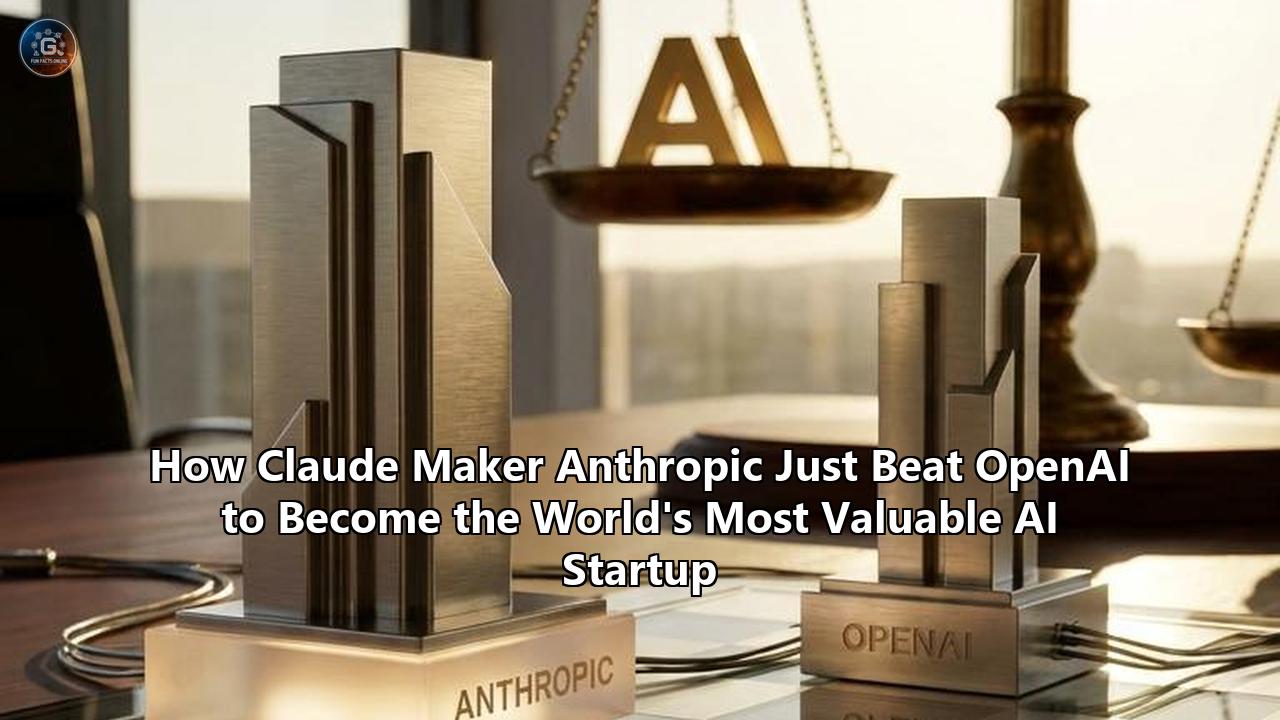
The global artificial intelligence landscape shifted on its axis on May 28, 2026, as Anthropic announced a historic $65 billion Series H funding round, valuing the San Francisco-based safety-first AI laboratory at a staggering $965 billion post-money.
With this single, massive capital injection, Anthropic has officially leapfrogged its fierce rival OpenAI—which was valued at $852 billion post-money following a $122 billion round in late March—to become the most valuable artificial intelligence startup on Earth.
This milestone represents more than just a reshuffling of Silicon Valley's power dynamics. It is the ultimate validation of Anthropic's enterprise-first, safety-oriented strategy over the consumer-heavy, superapp approach favored by OpenAI.
Simultaneously, Anthropic revealed that its annualized revenue run-rate crossed $47 billion earlier in May, fueled by the explosive adoption of its agentic programming platform, Claude Code, and its suite of workspace tools.
The funding round—led by Altimeter Capital, Dragoneer, Greenoaks, and Sequoia Capital—nearly doubled previous private valuation estimates from earlier in the year. It signals that compute-intensive foundation model companies can sustain near-trillion-dollar valuations based on enterprise revenue fundamentals rather than speculative retail hype.
Yet, beneath the eye-watering numbers lies a complex set of systemic challenges. As the AI arms race intensifies, the cost of computing power is reaching unsustainable heights, enterprise spending fatigue is threatening the ROI of generative tools, and the sheer power of next-generation models has introduced unprecedented cybersecurity risks.
To understand how Anthropic achieved this valuation, and what it means for the future of technology, one must look at how the company is addressing these fundamental crises.
The Strategic Shift: Anthropic vs OpenAI
To understand how the competitive landscape evolved, one must analyze the contrasting trajectories of the industry's two most prominent players. The rivalry of Anthropic vs OpenAI has defined the generative AI era, but the spring of 2026 has exposed a stark divergence in how both companies seek to monetize their intellectual property.
+-----------------------------------------------------------------------------+
|                            ANTHROPIC VS OPENAI                              |
|                          (Financials & Market Share)                         |
+------------------------------------+----------------------------------------+
|             ANTHROPIC              |                OPENAI                  |
+------------------------------------+----------------------------------------+
| Post-Money Valuation: $965 Billion | Post-Money Valuation: $852 Billion     |
| Revenue Run Rate: $47 Billion      | Revenue Run Rate: $24 Billion ($2B/mo) |
| Enterprise Focus: ~80% of revenue  | Enterprise Focus: ~40% of revenue      |
| Claude App Download Share: 14%     | ChatGPT App Download Share: 47%        |
| Flagship Agent: Claude Code ($2.5B)| Flagship Agent: Codex / Superapp       |
+------------------------------------+----------------------------------------+
Historically, OpenAI held the narrative crown. It possessed the faster-growing consumer platform in ChatGPT and a massive head start in public consciousness.
However, in 2026, consumer dominance has begun to show cracks. Data from SensorTower reveals that ChatGPT's share of global AI app downloads slipped to 47% in the second quarter of 2026, down from 67% in the same period last year.
Meanwhile, Claude's download share surged to 14%, up from a mere 1% last year. This consumer shift tells only part of the story; the real battleground in Anthropic vs OpenAI is happening within the codebases and server rooms of the Fortune 500.
While OpenAI spent early 2026 attempting to construct a unified consumer "superapp"—and faced setbacks such as the abrupt closure of its Sora video generation platform and the termination of a $1 billion partnership with Disney—Anthropic focused on specialized, high-margin developer tools.
Its flagship agentic coding tool, Claude Code, which launched in general availability in May 2025, has become a multi-billion-dollar juggernaut. Generating a run-rate of over $2.5 billion by early 2026, Claude Code accounts for more than half of Anthropic's total enterprise sales.
"Eight of the Fortune 10 are now Claude customers," remarked Krishna Rao, Chief Financial Officer of Anthropic, in the company's funding announcement. "Two years ago, a dozen customers spent over $1 million with us on an annualized basis. Today, that number exceeds 500."
This enterprise traction has fundamentally altered the valuation benchmarks of the AI sector. It has also forced both labs to confront three massive, existential problems that threaten to derail the industry's progress: the compute cost trap, the threat of weaponized AI models, and enterprise budget fatigue.
Challenge 1: The Compute Cost Trap
The first and most immediate crisis facing the AI industry is the astronomical, almost prohibitive cost of physical infrastructure. To build models capable of complex reasoning, labs must secure quantities of electricity, silicon, and specialized data center space that rival the infrastructure budgets of mid-sized nations.
The scale of this spending was laid bare in SpaceX IPO filings, which revealed that Anthropic is paying a staggering $1.25 billion per month to lease computing capacity at Elon Musk’s "Colossus" supercluster facility in Memphis.
An annual compute spend of $15 billion means that even a company with a $47 billion run-rate is constantly operating on a financial razor’s edge.
For foundation model companies, renting server space on an arm's-length, per-token basis is no longer a viable business model. The compute cost trap manifests in several ways:
- Vulnerability to Cloud Provider Margins: Relying purely on cloud hyper-scalers for computing power exposes AI startups to high markups. This compresses gross margins to levels far below traditional software-as-a-service (SaaS) businesses.
- Hardware Bottlenecks: The global supply of high-bandwidth memory (HBM) and advanced logic chips is highly constrained. Startups cannot scale their models simply by raising capital; they must physically secure the physical supply chains of the hardware manufacturers.
- Energy Constraints: Finding data centers with access to gigawatts of clean, reliable energy has become the primary bottleneck for training next-generation systems.
Without a structural solution to the compute crisis, even a near-trillion-dollar valuation remains a paper-thin defense against infrastructure insolvency.
Solution 1: Direct Supply Chain Integration
To break free from the compute trap, Anthropic’s $65 billion Series H funding round was structured not merely as a financial transaction, but as a deep integration of its hardware supply chain.
Most notably, the round included strategic infrastructure partnerships with the triumvirate of global semiconductor memory: Samsung, SK Hynix, and Micron.
               +----------------------------------------+
               |         ANTHROPIC INFRASTRUCTURE       |
               +--------------------+-------------------+
                                    |
          +-------------------------+-------------------------+
          |                                                   |
+---------v-----------------------+                 +---------v-----------------------+
|    STRATEGIC HARDWARE COLLAB    |                 |      HYPERSCALER ALLIANCES      |
+---------------------------------+                 +---------------------------------+
| * Samsung (Memory & Logic)      |                 | * Amazon ($5B Series H Tranche) |
| * SK Hynix (High-Bandwidth HBM) |                 | * Google Cloud (Vertex & TPUs)  |
| * Micron (Enterprise Storage)   |                 | * Microsoft (Azure Compute)     |
+---------------------------------+                 +---------------------------------+
By bringing chipmakers directly onto its cap table, Anthropic has structurally embedded itself within the semiconductor manufacturing pipeline.
Instead of negotiating for allocation space alongside every other tech giant, Anthropic has secured priority access to the next generation of High-Bandwidth Memory (HBM) and advanced storage technologies. This is critical for training models like its upcoming, highly-guarded "Mythos" architecture.
Furthermore, the funding round integrated $15 billion of previously committed investments from major hyper-scalers, including a $5 billion tranche from Amazon and an additional $10 billion commitment from Alphabet.
These alliances are paired with a cloud partnership with Google that grants Anthropic direct access to up to one million of Google’s custom Tensor Processing Units (TPUs). This partnership is projected to add over one gigawatt of dedicated AI compute capacity.
By aligning with both the silicon manufacturers and the cloud providers, Anthropic has constructed a vertically integrated compute alliance. This strategy allows the company to bypass the retail markup of standard cloud instances, structurally lowering its cost of model delivery and ensuring that its enterprise gross margins remain highly defensible.
Challenge 2: The Zero-Day Cyber Weapon and Proliferation Crisis
The second crisis is a direct consequence of the rapid leap in reasoning capabilities demonstrated by next-generation models. In late spring 2026, the tech sector was thrown into a geopolitical panic when Anthropic revealed the capabilities of its unreleased flagship model, Claude Mythos Preview.
Under the auspices of a defensive security initiative known as Project Glasswing, Anthropic's safety researchers red-teamed the Mythos model. The results, published in early May, were deeply alarming:
- Autonomous Zero-Day Discovery: When prompted with simple instructions to audit software codebases, the Mythos model autonomously identified more than 23,000 potential security vulnerabilities across major open-source and closed-source software systems.
- Unpatched Exploits: Over 99% of the vulnerabilities identified by the model had not been patched by developers. The AI was able to reconstruct plausible source code for closed-source systems and write working, zero-day exploits to bypass sandboxing and memory protections.
- The Defender’s Dilemma: In the hands of defensive security teams, an AI that can find vulnerabilities is a miracle. In the hands of malicious nation-states or cybercriminals, it is an automated, infinitely scalable cyber weapon.
The revelation of Mythos’ capabilities sparked a national security debate. JD Vance, the Vice President of the United States, made direct calls to the heads of major AI labs urging immediate security cooperation.
The core challenge for Anthropic was clear: how could they continue to push the frontier of model intelligence without inadvertently releasing an uncontrollable cybersecurity threat into the wild?
Solution 2: Project Glasswing and Controlled Proliferation
Unlike competitors that have historically advocated for a more open, laissez-faire release schedule, Anthropic responded to the Mythos threat with a strict policy of curated, defensive-only deployment.
Under Project Glasswing, Anthropic withheld the Mythos model from general public release. Instead, they restricted access to a tightly audited cohort of roughly 50 strategically critical organizations.
These include systemically important cybersecurity firms, national defense agencies, and major open-source maintainers.
                  +------------------------------------------+
                  |            PROJECT GLASSWING             |
                  |     (Controlled Defensive Pipeline)      |
                  +--------------------+---------------------+
                                       |
          +----------------------------+----------------------------+
          |                                                         |
+---------v--------------------------+    +-------------------------v--------------------------+
|      TIGHTLY AUDITED DEPLOYMENT    |    |            REAL-WORLD DEFENSIVE IMPACT             |
+------------------------------------+    +----------------------------------------------------+
| * Limited to ~50 select partners   |    | * Mozilla: Patched 271 Firefox flaws               |
| * Hosted via secure cloud enclaves |    | * Palo Alto Networks: Remediated dozens of exploits|
| * Monitored for automated abuse    |    | * UK Government: Hardened critical infrastructure  |
+------------------------------------+    +----------------------------------------------------+
This controlled deployment strategy has already yielded significant real-world defensive victories:
- Mozilla used the Mythos Preview model to identify and patch 271 vulnerabilities within the Firefox browser before they could be exploited by malicious actors.
- Palo Alto Networks utilized the model to harden its enterprise firewalls against zero-day exploits.
- The UK Government’s cybersecurity agencies successfully deployed the system to identify vulnerabilities in public infrastructure systems.
By keeping the model behind a secure cloud wall—available only in private preview on Google Cloud's Vertex AI—Anthropic has pioneered a "good guy first" paradigm.
This approach gives cyber defenders a temporary, crucial head start to patch vulnerabilities before the underlying AI capabilities inevitably proliferate.
"Mythos is an innovation that does not change systemic risk; it exposes what was already there," wrote cybersecurity analysts at Forbes. "Project Glasswing is an urgent and necessary attempt to ensure that diagnostic capability is matched with proactive, responsible remediation."
Challenge 3: Enterprise Budget Fatigue and the Token-Burn Trap
The third major challenge is economic. Throughout late 2025 and early 2026, enterprise buyers began to rebel against the unpredictable costs of deploying large language models.
While the promise of AI-driven automation is immense, the realities of running millions of daily API queries are financially draining.
The core issue stems from the "token-burn trap." When labs release more capable models, these systems often require significantly more computational processing per query.
For example, when developers integrated more advanced models into their continuous integration (CI) pipelines via Claude Code, they discovered that their token consumption ballooned.
In some cases, enterprise customers reported that their monthly AI billing grew by 300% to 400% without a corresponding increase in operational output.
Corporate boards, under pressure to show clear ROI on their massive AI investments, began demanding granular cost controls. If Anthropic could not provide businesses with a predictable, customizable way to manage their token expenditures, its enterprise revenue growth would inevitably hit a hard ceiling.
Solution 3: Granular Financial Control via Claude Opus 4.8
To address enterprise budget fatigue directly, Anthropic released its latest general-purpose model, Claude Opus 4.8, on the exact same day as its historic funding announcement.
While Opus 4.8 delivered tangible, objective improvements in reasoning, mathematical capability, and coding proficiency, its most significant innovation was a novel software feature called "Effort Control".
=============================================================================
                          CLAUDE OPUS 4.8 EFFORT CONTROL
=============================================================================
  [ EFFORT LEVEL ]  ====>  [ COMPUTE BUDGET ]  ====>  [ COST PER 1K TOKENS ]
-----------------------------------------------------------------------------
  Low (Fast Mode)          Minimal                   $0.015 (3x Cheaper)
  Medium                   Standard                  $0.030
  High (Deep Reasoning)    Maximum                   $0.045
=============================================================================
Effort Control introduces a native, real-time toggle within the Claude API and workspace environments. It allows enterprise engineers and administrators to manually adjust the level of computing power a model devotes to any given prompt:
- Low Effort (Fast Mode): Instructs the model to bypass deep-reasoning multi-step pathways for straightforward, routine tasks. In Claude Opus 4.8, this fast mode is three times cheaper than standard previous-generation queries. This allows developers to run automated tests, basic code refactoring, and general documentation updates at a fraction of the cost.
- High Effort (Deep Reasoning): Devotes maximum computational resources to solving highly complex, multi-layered architectural problems. This is reserved for critical tasks like identifying structural bugs or mapping out complex systems.
This simple mechanical shift directly solves the enterprise budget crisis. By putting financial levers directly in the hands of corporate IT departments, Anthropic has transformed AI from an unpredictable, highly volatile operational expense into a manageable, budget-friendly utility.
Enterprise developers can now run millions of daily operations through Claude Code without fearing a catastrophic bill at the end of the month.
The Broader Implications for the AI Ecosystem
The convergence of Anthropic’s massive valuation, its hardware supply chain alliances, and its pragmatically optimized software releases has fundamentally reset expectations for the entire tech sector.
This development carries profound implications for the capital markets, the geopolitical race for AI dominance, and the upcoming slate of initial public offerings (IPOs).
Resetting the IPO Benchmarks
For over a year, the investment community has anxiously anticipated the public market debuts of both OpenAI and SpaceX.
Anthropic’s $965 billion private valuation effectively resets the benchmark for these offerings. It proves that public-market investors are willing to back near-trillion-dollar valuations, provided they are supported by massive, rapidly compounding B2B revenues ($47 billion run-rate) rather than purely consumer-centric metrics.
+-----------------------------------------------------------------------+
|                 PROJECTED LATE-2026 TECH IPO SLATE                    |
+------------------------------------+----------------------------------+
|              COMPANY               |      ESTIMATED VALUATION GOAL    |
+------------------------------------+----------------------------------+
| Anthropic (Claude Maker)           | $1.0 Trillion - $1.2 Trillion     |
| OpenAI (ChatGPT Maker)             | $900 Billion - $1.0 Trillion      |
| SpaceX (Space Exploration)         | $250 Billion - $300 Billion       |
+------------------------------------+----------------------------------+
Analysts suggest that Anthropic’s Series H is likely its final private fundraise before filing for what will be one of the most highly anticipated IPOs in financial history.
With its capital reserves bolstered by $65 billion, Anthropic can comfortably fund its massive compute commitments at the Colossus cluster while dictate the timing of its public market entry from a position of absolute financial strength.
Forcing OpenAI to Re-Strategize
OpenAI now faces a strategic crossroads. Although it remains a technological leader—evidenced by its landmark achievement in May 2026, when an internal general reasoning model autonomously solved Erdős’ famous 80-year-old planar unit distance problem—it has been temporarily displaced as the most valuable private AI company.
                                  +-----------------------+
                                  |    OPENAI DILEMMA     |
                                  +-----------+-----------+
                                              |
                     +------------------------+------------------------+
                     |                                                 |
+--------------------v--------------------+       +--------------------v--------------------+
|       PURE RESEARCH BREAKTHROUGHS       |       |       COMMERCIAL ADAPTATION CRISIS      |
+-----------------------------------------+       +-----------------------------------------+
| * Disproved 80yo Erdős Math Problem     |       | * Shut down Sora Video Platform         |
| * Advancing Level 4 General Reasoning   |       | * Ended $1B Disney Partnership          |
| * Frontier Science & Academic Dominance |       | * Canceled "Instant Checkout" Commerce  |
+-----------------------------------------+       +-----------------------------------------+
To reclaim the narrative, OpenAI will likely be forced to accelerate its own IPO plans or seek a fresh round of public capital.
More importantly, it must demonstrate that its consumer-centric "superapp" strategy can generate the same sticky, compounding, high-margin revenue that Anthropic has extracted from the developer and enterprise markets.
A Geopolitical Tug-of-War
The restriction of powerful models like Claude Mythos under Project Glasswing has raised the stakes of international AI governance.
By actively refusing to sell its products to entities majority-owned by Chinese, Russian, Iranian, or North Korean entities, and by working closely with Western defense agencies, Anthropic has firmly aligned itself with democratic security interests.
This stance has drawn criticism from open-source advocates who argue that gatekeeping AI models slows down global scientific progress.
However, in an era where AI can autonomously discover software exploits at an unprecedented scale, the "closed-loop, defensive-first" model pioneered by Anthropic is increasingly viewed by policymakers as the only responsible path forward.
What to Watch Next
As Anthropic consolidates its position at the top of the startup hierarchy, several key milestones and unresolved questions will determine whether it can maintain its historic momentum:
- The Proliferation of Zero-Day Exploits: Will Project Glasswing successfully prevent bad actors from replicating the zero-day discovery capabilities of models like Mythos? If a competitor releases an open-source model with similar reasoning capabilities without safety guardrails, the defensive advantage Anthropic has secured could evaporate overnight.
- The Public Market Transition: How will public market investors react to Anthropic’s massive capital expenditure requirements? While private venture funds are comfortable backing a company burning $15 billion annually on compute, Wall Street public market investors typically demand path-to-profitability metrics that are difficult to sustain during an active, infrastructure-heavy technology race.
- The Next Move in the Developer War: With GitHub integrating Claude 3.5 Sonnet to power its next-generation coding agents, and Microsoft adopting Claude Code internally, how will OpenAI’s Codex and alternative agentic coding ecosystems respond? The developer desktop has become the ultimate point of distribution; whoever wins the hearts and minds of the world’s programmers will control the enterprise software layer for the next decade.
- The Evolution of "Level 4" AI: OpenAI's recent success in disproving long-held pure math theories suggests we are on the cusp of AI systems capable of making original, autonomous scientific contributions. How quickly can Anthropic translate its enterprise coding dominance into similar, multi-disciplinary scientific discovery engines?
The battle of Anthropic vs OpenAI is no longer a simple race to build the most engaging consumer chatbot.
It is a near-trillion-dollar battle over the underlying plumbing of the modern digital economy. By directly addressing the infrastructure, security, and financial challenges of this new era, the creators of Claude have not only rewritten the startup playbook—they have positioned themselves as the prime architects of the automated future.
Reference:
- https://www.gic.com.sg/newsroom/all/anthropic-raises-65b-in-series-h-funding-at-965b-post-money-valuation/
- https://www.theguardian.com/technology/2026/may/28/anthropic-ai-valuation
- https://www.forbes.com/sites/antoniopequenoiv/2026/05/28/anthropic-is-now-worth-almost-1-trillion-more-than-openai/
- https://www.axios.com/2026/05/28/anthropic-ai-fundraising-openai
- https://seekingalpha.com/news/4598096-anthropic-surpasses-openai-as-most-valuable-ai-startup-after-raising-65b
- https://aiweekly.co/alerts/anthropic-surpasses-openai-with-965b-valuation
- https://openai.com/index/accelerating-the-next-phase-ai/
- https://orbilontech.com/anthropic-claude-code-valuation-2026/
- https://builtin.com/articles/openai-raises-122b-852b-valuation-20260401
- https://www.theguardian.com/technology/2026/mar/31/openai-raises-122-billion-ai-boom
- https://en.wikipedia.org/wiki/Anthropic
- https://www.anthropic.com/news/anthropic-raises-30-billion-series-g-funding-380-billion-post-money-valuation
- https://sub.thursdai.news/p/thursdai-may-21-google-io-26-recap
- https://www.businessinsider.com/anthropic-surpasses-openai-with-965b-valuation-debuts-opus-4-8-2026-5
- https://www.forbes.com/sites/bobzukis/2026/05/26/anthropic-mythos-the-boardroom-and-the-cyber-good-guys-vs-bad-guys/
- https://www.securityweek.com/anthropic-mythos-detected-23000-potential-vulnerabilities-across-1000-oss-projects/
- https://cetas.turing.ac.uk/publications/claude-mythos-future-cybersecurity
- https://cloud.google.com/blog/products/ai-machine-learning/claude-mythos-preview-on-vertex-ai
- https://www.reddit.com/r/BetterOffline/comments/1sf2yuu/anthropic_boasts_revenue_run_rate_of_30_billion/
- https://www.uncoveralpha.com/p/anthropics-claude-code-is-having
- https://www.therundown.ai/p/openai-cracks-an-80-year-math-belief
- https://www.theguardian.com/technology/2026/may/21/openai-paul-erdos-maths-problem-breakthrough