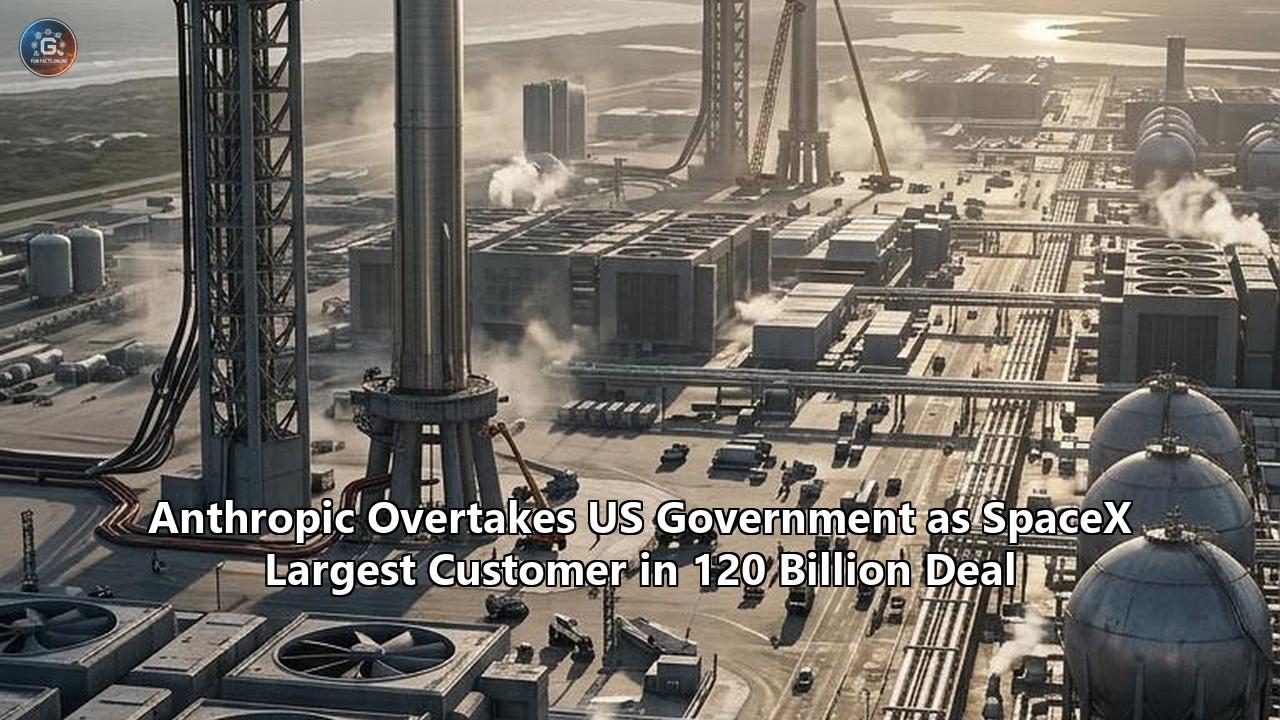
The balance of power in commercial technology shifted sharply this week as regulatory disclosures revealed that artificial intelligence developer Anthropic has overtaken the United States Federal Government as SpaceX’s single largest customer. The milestone is anchored to an astronomical computing agreement valued at up to $120.5 billion through 2029, binding the maker of the Claude model family directly to Elon Musk’s sprawling infrastructure empire.
The scale of the commercial realignment emerged through a sequence of interlocking corporate filings with the Securities and Exchange Commission, capped by a Bloomberg report confirming that the mysterious "Customer B"—cited in SpaceX’s third-quarter financial report as the source of more than a third of its total corporate revenue—is Anthropic.
According to SpaceX’s Form 10-Q filed for the quarter ending September 30, 2026, Customer B generated 34.5% of the company's total $14.575 billion in quarterly sales, funneling approximately $5.03 billion into SpaceX’s balance sheet over a 90-day span. Every dollar of that sum was recognized within SpaceX’s newly minted AI infrastructure division, Super Intelligence. By comparison, SpaceX’s heritage launch business—the bedrock operation that lifts Falcon 9 rockets, flies national security missions for the Space Force, and transports astronauts for NASA—generated $1.77 billion during the same period, representing just 12% of total corporate revenues. Anthropic alone paid SpaceX nearly three times more in the third quarter than the entire spaceflight division earned from all sovereign governments and commercial launch clients combined.
Anthropic’s own Form S-1 registration statement, filed on October 26 ahead of its proposed initial public offering on the Nasdaq under the ticker ANT, laid out the full financial contours of what it termed the "SpaceXAI Arrangements". The AI research lab disclosed that it has entered into binding multi-year agreements with SpaceX.AI LLC—a wholly owned subsidiary established following SpaceX’s absorption of Musk’s xAI venture earlier this year—to secure dedicated access to Nvidia graphics processing units across high-density facilities in Memphis, Tennessee.
Once all contracted compute capacity is delivered by December 2026, Anthropic's monthly fee will surge to approximately $3.1 billion, or an annualized spending run rate of $37.2 billion.
The revelation fundamentally recalibrates both companies. SpaceX, long valued by public and private markets alike as an aerospace and orbital communications giant, now derives more than half of its total turnover from hosting enterprise AI compute clusters. Anthropic, founded in 2021 by former OpenAI researchers as a safety-first Public Benefit Corporation, has simultaneously tied its immediate commercial scaling to the hardware controlled by Musk—a vocal technological rival whose own AI enterprise directly competes with Claude.
Financial analysts, infrastructure architects, and antitrust attorneys are now parsing the broader market ramifications: the emergence of extreme customer concentration inside SpaceX, the fragile stability of high-yield AI compute leasing covenants, and the symbolic demotion of the American taxpayer as the primary financial sponsor of the world's most valuable private-turned-public technology powerhouse.
Anatomy of the $120.5 Billion Commitment
The financial commitments detailed in Anthropic’s S-1 prospectus expose one of the largest hardware leasing arrangements ever executed in corporate history. What began in May 2026 as a targeted agreement to absorb compute capacity from SpaceX's Colossus 1 facility in South Memphis has ballooned across subsequent amendments into a staggering financial obligation.
                     ANTHROPIC - SPACEX CONTRACT TRAJECTORY
  =============================================================================
  Date           Milestone                          Contract Ceiling / Run Rate
  -----------------------------------------------------------------------------
  May 2026       Initial Colossus 1 deal            ~$1.25B / mo (~$45B total)
  June 2026      SpaceX IPO (Nasdaq: SPCX)          AI segment reclassified
  Sept 2026      Confidential S-1 draft             $84.5B ceiling
  Oct 22, 2026   SpaceX Q3 Form 10-Q filed          Customer B hits 34.5% revenue
  Oct 26, 2026   Anthropic public Form S-1          Up to $120.5B through 2029
  Dec 2026       Projected full capacity delivery   ~$3.1B / mo (~$37.2B/year)
  Early 2027     Non-cancelable protections lapse   90-day bilateral exit right
  =============================================================================
Under the revised covenants executed between May and October 2026, Anthropic agreed to spend an aggregate ceiling of up to $120.5 billion extending through 2029. The escalation in the contract's headline ceiling—rising from an initial $45 billion framework to $84.5 billion in confidential pre-filing drafts, and finally settling at $120.5 billion—reflects Anthropic's accelerating appetite for silicon as it rolled out Claude 3.5 Sonnet, upgraded its Opus tier, and launched Claude Code for automated software development.
The payment schedule is strictly tethered to the physical commissioning of hardware racks. While capacity ramps through the autumn of 2026, Anthropic’s expenditure escalates dynamically. At full deployment, scheduled for December 2026, Anthropic will wire approximately $3.1 billion every thirty days to SpaceX.AI LLC.
However, beneath the headline figure sits a contract covenant that introduces severe long-term volatility for SpaceX's revenue line. While early media summaries characterized the $120.5 billion figure as guaranteed forward revenue, Anthropic’s S-1 filing outlines specific non-cancelable dates. The initial non-cancelable periods end in January 2027 and March 2027 for the respective tranches of hardware.
Following those milestone dates, the agreement allows either party to cancel remaining capacity upon 90 days’ advance written notice.
"This is not a traditional, locked-in telecom take-or-pay contract," says Kutgun Maral, senior media and technology analyst at Evercore ISI. "The headline commitment gives SpaceX enormous runway to leverage its compute division in the short term, but the 90-day walkaway covenant expiring in early 2027 introduces an asymmetric cliff. If power pricing changes, if next-generation silicon shifts unit economics, or if Anthropic simply manages to stand up enough alternative compute on its own hyperscaler relationships, SpaceX could see a $37 billion annualized revenue stream evaporate on three months' notice."
The pricing structure translates to unprecedented operational volume. The monthly fee of $3.1 billion represents roughly 21% of SpaceX’s entire guided quarterly revenue for the opening period of 2027, which management set between $33 billion and $37 billion during its late October earnings presentation. If fully drawn down across the next 36 months, the Anthropic SpaceX deal would represent the largest transfer of capital between an artificial intelligence application developer and a physical compute operator on record.
From Launchpads to Server Racks: The Financial Remaking of SpaceX
The emergence of Anthropic as SpaceX's financial anchor marks the completion of a total corporate repositioning that began quietly in February 2026, when SpaceX acquired Musk’s AI startup, xAI, in an all-stock transaction. At the time, market observers questioned the rationale of folding an artificial intelligence research group into a space transportation and satellite communications firm. The Q3 2026 financial report filed on October 22 resolved any lingering confusion.
SpaceX reported total quarterly revenue of $14.575 billion, marking a 161% year-over-year surge from the $5.6 billion recognized in the third quarter of 2025. Operating profit climbed to $2.8 billion, with corporate net income reaching $4.4 billion—aided substantially by tax credits and investment revaluations.
                 SPACEX Q3 2026 REVENUE MIX ($14.575 BILLION)
  =============================================================================
  Segment                Revenue ($B)   Share (%)   YoY Growth   Key Drivers
  -----------------------------------------------------------------------------
  Super Intelligence     $7.560         51.9%       +830%        Customer B, Google
  Starlink Connectivity  $5.248         36.0%       +69%         Aviation, Maritime
  Rocket Launch Manifest $1.767         12.1%       Flat         Falcon 9, Starship
  -----------------------------------------------------------------------------
  Total                  $14.575        100.0%      +161%        Corporate-wide
  =============================================================================
The driving engine of this top-line surge was not rockets or satellites, but the Super Intelligence segment. The division generated $7.560 billion, up 830% compared to equivalent private restatements from the prior year. The segment swung into the black for the first time in company history, booking an operating profit of $431 million despite absorbing $1.2 billion in non-cash, share-based compensation expenses tied to SpaceX’s recent acquisition of AI coding assistant startup Cursor.
The third-quarter figures demonstrate the scale of SpaceX’s dependency on a single enterprise client. Taking Anthropic’s 34.5% share of total corporate revenue—translating to $5.028 billion—reveals that Anthropic alone represented 66.5% of the Super Intelligence division’s entire revenue intake for the quarter. The remaining $2.53 billion of segment revenue was split among smaller enterprise leases, including a reported $920 million monthly agreement signed with Google in June 2026 for 110,000 GPUs, enterprise subscriptions for Cursor, and internal transfer fees allocated to the Grok project.
  SpaceX Super Intelligence Segment Revenue ($7.56B total)
  ┌────────────────────────────────────────────────────────┐
  │ Anthropic (Customer B): $5.028B (66.5%)                │
  ├────────────────────────────────────────────────────────┤
  │ Google GPU Lease: ~$920M/mo run rate                   │
  ├────────────────────────────────────────────────────────┤
  │ Cursor, Grok, and Enterprise SI: ~$1.61B               │
  └────────────────────────────────────────────────────────┘
The contrast with SpaceX’s traditional launch business is stark. Throughout the first nine months of 2026, SpaceX conducted 113 orbital missions across its Falcon 9, Falcon Heavy, and Starship architectures. However, according to segment footnotes in the 10-Q, 84 of those 113 launches—nearly 75%—were internal missions dedicated to lifting Starlink broadband satellites and military Starshield payloads.
The external commercial and sovereign launch business brought in $1.767 billion in Q3. For years, Wall Street models presumed that Starlink broadband would eventually fund the company’s capital-intensive Starship development and long-range planetary ambitions. Instead, the market for enterprise compute leasing has overtaken orbital infrastructure at an astonishing velocity.
"Musk has essentially engineered the world's most aggressive 'neocloud' inside an aerospace conglomerate," notes Dan Ives, managing director of equity research at Wedbush Securities. "By leveraging xAI's rapid facility deployment in the American South, SpaceX turned an internal compute shortage into a multi-billion-dollar merchant cash register. SpaceX is no longer just a space exploration company with a communications arm; it is an AI utility company that happens to operate launchpads."
The capital markets have rewarded the transformation. Following its historic $85.7 billion initial public offering on Nasdaq in June 2026—which listed the company under the ticker SPCX—SpaceX shares hovered near $162 in late October, giving the combined entity a public market valuation near $2.2 trillion. Over half of that market valuation is now supported by multiples assigned to the Super Intelligence division, making the health of the Anthropic SpaceX deal vital to maintaining SpaceX's public market premium.
Power, Turbines, and Silicon: The Memphis Physical Reality
To understand why an AI research lab based in San Francisco would commit tens of billions of dollars to an aerospace contractor, one must look south to Shelby County, Tennessee. There, across industrial zoning districts along the Mississippi River, SpaceX operates the compute infrastructure that made the commercial agreement possible: the Colossus data center complex.
                     COLOSSUS DATA CENTER COMPLEX (SHELBY COUNTY)
  =============================================================================
  Facility      Location               Silicon Base        IT Load      Status
  -----------------------------------------------------------------------------
  Colossus 1    Paul R. Lowry Road     220,000+ GPUs       340 MW       Operational
                (South Memphis)        H100 / H200 / B200               (Anthropic)
  Colossus 2    5420 Tulane Road       350,000+ GPUs       946 MW       Scaling
  (Macrohard)   (Whitehaven)           GB200 / GB300                    (Mixed use)
  Expansion     Southaven, MS border   Targeting GB300 /   1,530+ MW    Under
  (Colossus 3)                         Vera Rubin          (projected)  Construction
  =============================================================================
In the computational race that escalated throughout 2025 and 2026, the primary bottleneck for frontier AI development ceased to be algorithmic design; it became access to energized megawatts and high-density liquid cooling. While legacy cloud hyperscalers like Amazon Web Services, Microsoft Azure, and Google Cloud faced multi-year lead times to secure electrical utility interconnects from regional grid operators, Musk’s team executed an end-run around standard infrastructure timelines.
Colossus 1 was constructed in South Memphis inside a 785,000-square-foot former Electrolux home appliance manufacturing plant located at 3231 Paul R. Lowry Road. Rather than waiting years for local municipal utility Memphis Light, Gas and Water (MLGW) to construct specialized high-voltage sub-stations, xAI installed the initial 100,000 Nvidia H100 GPUs in an unprecedented 122 days.
To bridge the massive power gap between the site's initial 8-megawatt utility connection and the 300-plus megawatts required by dense clusters of H100 and H200 chips, the facility brought in 14 trailer-mounted mobile natural gas turbines alongside sprawling banks of Tesla Megapack industrial lithium-iron-phosphate battery enclosures.
According to satellite telemetry and independent infrastructure analysis published by Epoch AI and SemiAnalysis, Colossus 1 achieved an operational IT power capacity of roughly 340 megawatts, housing more than 220,000 active Nvidia processors interconnected over advanced optical networking meshes. When Anthropic signed its baseline compute lease with SpaceX in May 2026, it contracted for virtually 100% of the operational capacity of the Colossus 1 site.
The partnership expanded dramatically as SpaceX broke ground on Colossus 2—a secondary mega-site known internally as "Macrohard," situated on a former industrial parcel at 5420 Tulane Road in the Whitehaven neighborhood of Memphis. Colossus 2 was engineered from the slab up for liquid-cooled Nvidia Blackwell architectures, specifically GB200 NVL72 and GB300 server cabinets.
To power Macrohard, SpaceX avoided grid delays by establishing dedicated power generation units right across the state boundary line in Southaven, Mississippi. SemiAnalysis reporting reveals that the Southaven generation infrastructure expanded from an initial 495 megawatts to over 1.7 gigawatts of off-grid and supplementary power generation by late summer 2026.
During an investor conference call following SpaceX's Q3 earnings release, Musk outlined the deployment roadmap for the Super Intelligence compute fleet:
"We had roughly 1.7 gigawatts of nameplate compute energized at the close of the third quarter," Musk told analysts. "We are on track to bring between 2.5 and 3.0 gigawatts online before the end of the year. Next year, our plan is to deploy roughly 0.8 gigawatts every single month, delivering an incremental 10 gigawatts of capacity. When you have that volume of compute connected with direct liquid cooling and dedicated turbine backup, you are the only entity on Earth that can hand an enterprise client several hundred thousand Blackwell chips on a thirty-day delivery notice."
For Anthropic, the physical availability of that compute in Memphis proved irresistible. Building an equivalent private data center campus would have demanded at least 18 to 24 months of site acquisition, environmental permitting, utility queue negotiations, and construction. SpaceX already had energized racks sitting on raised floors, ready to ingest model weights.
The Pressure Behind Claude: Why Anthropic Needed Silicon at Any Price
From Anthropic’s perspective, the decision to sign a $120.5 billion infrastructure pact with an arch-rival was born out of an intense capacity crisis.
Speaking at a private industry executive summit in San Francisco in May 2026, Anthropic co-founder and Chief Executive Officer Dario Amodei laid bare the structural mismatch between enterprise demand for Claude and the computational capacity required to deliver it.
"We entered the fiscal year projecting a healthy 10x growth trajectory across our API endpoints, which we believed our cloud partners could accommodate," Amodei remarked. "In reality, we experienced an 80x demand explosion across our commercial channels. The single governing constraint on Anthropic's enterprise revenue is not customer acquisition, not model alignment, and not market interest; it is the raw physical availability of compute. In this industry, if you miscalculate your compute needs and experience service degradation, enterprise clients will abandon your API overnight."
               ANTHROPIC FINANCIAL AND ENTERPRISE HYPERSCALE
  =============================================================================
  Metric                          First Half 2025        First Half 2026
  -----------------------------------------------------------------------------
  H1 Revenue                      $1.16 Billion          $16.29 Billion
  Growth Rate (YoY)               —                      1,304%
  Enterprise Clients (>$100k)     950 accounts           11,900 accounts
  Annualized Revenue Run Rate     ~$2.4 Billion          >$47.0 Billion (May)
  Total Compute Commitments       ~$15 Billion           $542 Billion - $567B
  =============================================================================
Anthropic’s S-1 filing paints a vivid picture of this explosive corporate growth. The company booked $16.29 billion in revenue across the first six months of 2026—a 1,304% climb from the $1.16 billion recognized during the same window in 2025. Trailing-twelve-month enterprise clients generating more than $100,000 in annualized billings jumped from 950 in late 2025 to over 11,900 by the end of September 2026. By late summer, private briefings with prospective IPO investors placed Anthropic's annualized run-rate revenue well above $65 billion.
This enterprise surge was largely driven by two products: the Claude 3.5 Sonnet architecture and Claude Code, an agentic coding platform that directly interfaces with developer terminals to plan, write, test, and debug codebases autonomously.
Unlike traditional consumer chatbots that process single-turn text queries, autonomous coding agents and enterprise reasoning pipelines generate millions of tokens in recursive validation loops. A single complex developer prompt can trigger dozens of automated tool-use steps, code-compilation checks, and intermediate reasoning chains.
This continuous operational demand shifted Anthropic’s compute profile. Pre-training a frontier foundation model requires months of uninterrupted, synchronized GPU operations. But running real-time agentic inference for hundreds of thousands of corporate developers demands thousands of gigawatts of sustained, low-latency inferencing throughput.
The immediate impact of the Anthropic SpaceX deal was felt by developers within hours of its signing. In May 2026, upon securing full access to Colossus 1, Anthropic doubled Claude Code usage limits for Pro, Team, and Enterprise accounts, permanently lifted peak-hour throttling on its Claude 3.5 Sonnet model, and expanded rate limits for its top-tier Claude Opus API by up to fifteen-fold.
Without SpaceX’s Memphis capacity, Anthropic would have been forced to implement aggressive compute rationing, stalling its commercial enterprise momentum precisely as it prepared to launch its multi-trillion-dollar IPO roadshow.
Anthropic's Half-Trillion-Dollar Supply Chain
While the $120.5 billion SpaceX compute commitment dominates headlines due to the political and competitive rivalry between Musk and Amodei, Anthropic’s S-1 filing makes clear that SpaceX is only one pillar of an unprecedented multi-cloud hedging strategy.
In aggregate, Anthropic disclosed between $542 billion and $567 billion in forward compute and hardware commitments spanning the next decade.
               ANTHROPIC FORWARD INFRASTRUCTURE COMMITMENTS
  =============================================================================
  Provider / Vendor      Contract Ceiling    Duration        Silicon Platform
  -----------------------------------------------------------------------------
  Broadcom Leases        $161.2 Billion      Through 2030+   Custom AI ASICs
  SpaceX.AI LLC          $120.5 Billion      Through 2029    Nvidia H100/B200/GB300
  Google Cloud           $114.5 Billion      Through 2033    Google TPU clusters
  Amazon Web Services    $110.0 Billion      Through 2036    AWS Trainium / Nvidia
  Neocloud Vendors*      $86.0 Billion       Through 2028    Tier-2 Data Centers
  Microsoft Azure        $44.9 Billion       Through 2033    Nvidia GPU instances
  TPU Pipeline Reserve   $125B - $150B       2028 - 2031     Next-gen Google TPUs
  -----------------------------------------------------------------------------
  Total Compute Pipeline: Exceeds $540 Billion across audited forward schedules
  *Includes reported commitments to specialized operators including Lambda and Nscale.
  =============================================================================
The scale of these multi-cloud commitments reveals how Anthropic has constructed a defensive buffer against platform dependence:
- Google Cloud ($114.5 Billion through 2033): Anthropic maintains long-term capacity agreements across Google’s global data center network, utilizing Google’s proprietary Tensor Processing Units (TPUs) alongside Nvidia GPU infrastructure. The S-1 notes that Anthropic has committed to an additional $125 billion to $150 billion in potential future TPU allocations between 2028 and 2031 to insulate itself from third-party GPU margins.
- Amazon Web Services ($110.0 Billion through 2036): Stemming from Amazon’s early strategic investments in Anthropic, this decade-long agreement commits the AI lab to deploying models on AWS Annapurna Labs silicon—specifically Trainium 2 and Trainium 3 chips—alongside extensive EC2 GPU capacity.
- Broadcom Equipment Leases ($161.2 Billion): Disclosed on page 142 of the S-1, this capital expenditure schedule covers custom silicon development, network switching hardware, and application-specific integrated circuits (ASICs) engineered to run proprietary inference workloads at lower electrical footprints.
- Microsoft Azure ($44.9 Billion through 2033): Restructured in late 2025, this covenant guarantees Anthropic access to Azure’s compute nodes under terms that forbid unilateral cancellation unless Microsoft suffers an uncured material service breach.
- Neocloud Operators ($86.0 Billion): Prior draft prospectuses detailed large lease agreements with secondary compute brokers and operators, including Lambda Labs and Nscale, securing medium-term clusters to balance regional inference loads.
The critical difference between Anthropic's traditional cloud partnerships and the Anthropic SpaceX deal lies in contract duration and termination flexibility. While Anthropic’s deals with Amazon, Google, and Microsoft feature multi-year lock-ins extending into the mid-2030s, the SpaceX agreement was negotiated as a high-volume, rapid-delivery merchant lease. It provides massive, immediate compute throughput today, but allows Anthropic to cut its ties in early 2027 if its hyperscaler clusters or proprietary ASIC architectures come online ahead of schedule.
Hostile Interdependence: The Friction Between Musk and Amodei
The deepening commercial alliance between Anthropic and SpaceX creates one of the most paradoxical relationships in modern corporate history.
Dario Amodei, together with his sister Daniela Amodei and a cadre of senior researchers, founded Anthropic in 2021 after departing OpenAI over deep disagreements regarding safety protocols and commercialization velocity. Anthropic was incorporated as a Delaware Public Benefit Corporation, establishing a Long-Term Benefit Trust empowered to review corporate governance and, under certain thresholds, override the board of directors to safeguard societal safety.
Musk, by contrast, co-founded OpenAI in 2015, left its board in 2018, and has spent recent years aggressively criticizing modern AI labs. Musk has pursued a sprawling $134 billion breach-of-contract lawsuit against OpenAI and Sam Altman, alleging that the venture abandoned its original open-source charter. In early 2026, Musk publicly referred to Anthropic's safety-first governance as "performative virtue signaling" and called the company's corporate structure fundamentally flawed.
                THE STRATEGIC CONTRAST: MUSK VS. AMODEI
  =============================================================================
  Dimension            Elon Musk (SpaceX / xAI)       Dario Amodei (Anthropic)
  -----------------------------------------------------------------------------
  Corporate Entity     Public aerospace corp (SPCX)   Public Benefit Corp (ANT)
  Safety Philosophy    Maximalist truth-seeking       Responsible Scaling Policy
                       (anti-woke / unconstrained)    (constitutional guardrails)
  Flagship Model       Grok 3 / Grok 4                Claude 3.5 Sonnet / Opus
  Compute Strategy     Vertical integration           Multi-cloud compute buyer
                       (owns turbines & data centers) (outsources all hardware)
  Strategic Stance     Infrastructure merchant &      Algorithmic pure-play &
                       frontier AI competitor         enterprise platform
  =============================================================================
Yet, three months after those verbal broadsides, commercial realities forced both men to the bargaining table. Musk needed guaranteed, deep-pocketed anchor tenants to monetize his rapid, capital-intensive data center investments before SpaceX’s June 2026 public listing. Amodei, facing compute rationing that threatened Claude's market share, required massive GPU clusters that only Musk could deploy on short notice.
The corporate entanglement reached surreal heights in September 2026. Following the high-profile resignation of an AI safety researcher who warned that frontier labs were escalating existential risks, Amodei published a 3,800-word open memorandum urging the AI industry to voluntarily "slow down" and establish coordinated safety checkpoints.
Within hours, Musk responded publicly on X with a brief endorsement: "Dario is right." Shortly thereafter, OpenAI’s Sam Altman echoed the sentiment, writing, "I agree with Dario."
For a brief moment, the public was presented with the image of three fierce AI competitors agreeing to throttle technological development for the common good. Yet behind the scenes, capital deployment told the opposite story. Even as Musk, Amodei, and Altman voiced support for caution, Anthropic was drafting SEC paperwork committing $120.5 billion to buy compute from Musk, SpaceX was securing a $40 billion private debt lease to order hundreds of thousands of next-generation chips, and all three companies were accelerating model release schedules.
The operational co-existence inside Colossus remains uneasy. The very same physical building in South Memphis that trains xAI’s Grok—a direct competitor to Claude—is housing the server racks that process Anthropic’s enterprise inferencing workloads. Both teams rely on the same power lines, the same liquid cooling infrastructure, and the same local engineering crews, creating an intense corporate co-dependency between rivals racing to build the first transformative artificial intelligence systems.
Wall Street, Debt Leases, and Customer Concentration Risk
The financial engineering required to support this massive infrastructure buildout has drawn intense scrutiny from credit agencies and equity analysts. Neither Anthropic nor SpaceX is financing this expansion using standard operating cash flow alone.
On October 26, 2026, simultaneous with Anthropic’s public S-1 filing, SpaceX filed a Current Report on Form 8-K disclosing that it had secured an approximately $40 billion master finance lease for advanced GPUs and infrastructure.
The financing syndicate was arranged by Goldman Sachs, which acted as sole structuring agent, with the capital facility managed and underwritten by Apollo Global Management. Additional anchor commitments were provided by BlackRock, KKR, and Goldman Sachs Asset Management.
The transaction represents the largest committed private equipment lease in technology history. Under the terms of the structure, Apollo and its partners will purchase hundreds of thousands of Nvidia Vera Rubin GPUs directly from the manufacturer and lease them to SpaceX over multi-year terms.
                     SPACEX $40B MASTER FINANCE LEASE
  =============================================================================
  Structuring Agent:   Goldman Sachs & Co. LLC
  Lead Asset Manager:  Apollo Global Management, Inc.
  Anchor Investors:    BlackRock, KKR, Goldman Sachs Asset Management
  Underlying Assets:   Nvidia Vera Rubin GPUs, high-density server racks
  Facility Timing:     Closing Q4 2026; delivery first half 2027
  Intended Target:     Terrestrial infrastructure expansion toward 10 GW
  =============================================================================
In commentary included in the corporate release, SpaceX management defended the aggressive balance sheet leverage:
"As demand for compute continues to accelerate, we are seeing payback periods on our Super Intelligence infrastructure investments of under twelve months," the company stated. "This lease diversifies our capital structure and addresses a notable portion of the funding required to get additional compute online at record speeds. It ensures we can power Grok for hundreds of millions of consumers while serving key cloud hosting clients."
However, Wall Street analysts are sounding the alarm over the extreme customer concentration revealed by the 10-Q.
With Anthropic generating 34.5% of SpaceX’s total corporate revenues and over two-thirds of its AI division sales, SpaceX has tied its operational stability directly to the fortunes of a single startup.
           SPACEX CUSTOMER REVENUE EXPOSURE (Q3 2026)
  ┌────────────────────────────────────────────────────────┐
  │ Customer B (Anthropic): 34.5% ($5.028B)                │
  ├────────────────────────────────────────────────────────┤
  │ Commercial Starlink Subscribers: ~30.0%                │
  ├────────────────────────────────────────────────────────┤
  │ Sovereign Govts (NASA, DoD, Space Force): ~18.5%       │
  ├────────────────────────────────────────────────────────┤
  │ Commercial Launch & Enterprise AI: ~17.0%              │
  └────────────────────────────────────────────────────────┘
"Customer concentration above 10% always triggers a formal risk factor in SEC reporting, but concentration exceeding 30% inside a $2 trillion enterprise is almost unprecedented outside of defense suppliers," explains Malik Ahmed Khan, senior equity analyst at Morningstar. "SpaceX is borrowing tens of billions of dollars through Apollo to purchase hardware designed to serve Anthropic. But if Anthropic hits the cancellation button in March 2027, SpaceX is left holding the debt service on massive GPU clusters that must be repurposed overnight in an increasingly volatile secondary compute market."
This dynamic intersects directly with broader industry concerns about compute market saturation. Just days before the filings dropped, Musk took to X to predict a looming shakeout among secondary compute brokers:
"More than 200 neoclouds are going to see guppy-level death and consolidation over the next 18 months," Musk warned. "Debt-financed GPU aggregators without proprietary power, unique cooling, and direct customer relationships will be crushed under interest payments."
Yet financial critics point out that SpaceX itself is exposed to the exact dynamics Musk warned against. By funding its silicon expansion with a $40 billion Apollo lease while granting its primary tenant a 90-day bilateral termination right expiring in early 2027, SpaceX is exposed to substantial refinancing risk if enterprise AI compute pricing drops.
The Demotion of the Sovereign Customer: Geopolitical Realignment
Beyond corporate finance and server architectures, the Anthropic SpaceX deal represents a symbolic milestone in the evolution of American enterprise: the official displacement of the United States Government as SpaceX's primary patron.
For the first twenty-four years of SpaceX’s existence, the federal government was the lifeblood of the company. NASA's Commercial Orbital Transportation Services (COTS) contracts rescued SpaceX from insolvency in 2008 following three consecutive Falcon 1 launch failures.
Subsequent multibillion-dollar programs—including the Commercial Resupply Services (CRS) contract, Commercial Crew transportation to the International Space Station, the National Security Space Launch (NSSL) awards from the Space Force, and the Human Landing System (HLS) contract for the Artemis lunar missions—firmly established the United States Government as SpaceX’s dominant client.
In 2020, government launch manifests and military communications represented more than 70% of SpaceX’s total top-line earnings. By 2024, the commercial expansion of the Starlink broadband network pushed commercial revenue ahead of sovereign sales for the first time.
Now, with the third-quarter 2026 financial disclosure, the sovereign state has been decisively demoted.
               SPACEX REVENUE COMPOSITION HISTORIC SHIFT
  =============================================================================
  Era           Dominant Revenue Source              Approximate Share
  -----------------------------------------------------------------------------
  2010 - 2018   US Federal Government (NASA, DoD)    70% - 85%
  2019 - 2023   Commercial Launch & US Government    45% Govt / 55% Comm.
  2024 - 2025   Starlink Satellite Broadband         55% Starlink / 25% Govt
  Q3 2026       Enterprise AI Compute (Anthropic)    34.5% Single AI Client /
                                                     <20% Total US Govt
  =============================================================================
In Q3 2026, total combined federal procurement across NASA, the Department of Defense, the Space Force, and intelligence community payloads accounted for less than 20% of SpaceX's consolidated corporate intake. A single, venture-backed generative AI software company paid SpaceX twice as much in three months as the entire American defense and civilian space establishment combined.
This economic transformation carries profound defense and geopolitical ramifications:
- Procurement Priority: As enterprise AI hosting generates higher operating margins than rigid government cost-plus or fixed-price launch contracts, SpaceX’s top operational talent, capital allocation, and supply chain focus are pivoting toward terrestrial computing infrastructure.
- Infrastructure Leverage: The U.S. national security apparatus increasingly relies on Starlink and Starshield for orbital reconnaissance and battlefield tactical data links. However, the corporate parent of those networks is now anchored to commercial revenue generated by consumer and enterprise AI applications.
- National Compute Disparity: The $120.5 billion value of the Anthropic compute arrangement dwarfs the federal government’s entire public funding allocation for AI research under the National Artificial Intelligence Research Resource (NAIRR) and related CHIPS Act programs. The private compute clusters in Memphis possess vastly more floating-point operations per second than the combined computing installations of all American national laboratories.
The shift illustrates a new economic reality: the private sector's computational arms race has achieved a capital scale that completely outstrips traditional sovereign state budgets.
Grid Politics, Air Quality, and the Battle for Shelby County
As the financial capital coursing through the Anthropic SpaceX deal breaks historical records, the physical impact of the transaction is sparking intense regulatory, legal, and environmental conflict across Memphis and Shelby County, Tennessee.
The rapid operationalization of Colossus 1 and Colossus 2 required an unprecedented influx of electrical power, testing local utility infrastructure to its limits. Community advocacy groups, environmental organizations, and local residents have organized legal challenges against the facility’s reliance on off-grid fossil fuel generation.
                     COLOSSUS ENVIRONMENTAL PROFILE (MEMPHIS)
  =============================================================================
  Issue Dimension        Infrastructure Detail            Community Concern
  -----------------------------------------------------------------------------
  Turbine Emissions      14+ mobile gas turbines          NOx, particulate matter,
                         in South Memphis                 urban ozone formation
  Water Consumption      High-density evaporative         Depletion of pristine
                         cooling towers                   Memphis Sand Aquifer
  Grid Demands           Over 1.2 GW combined draw        Pressure on MLGW local
                         from local regional utilities    grid and household rates
  Interstate Siting      1.7 GW power installation in     Regulatory arbitrage
                         Southaven, Mississippi           avoiding EPA oversight
  =============================================================================
The primary flashpoint centers on the mobile natural gas turbines deployed at the Paul R. Lowry Road site. In petitions submitted to the Environmental Protection Agency (EPA) Region 4 office and the Shelby County Health Department, organizations including the Southern Environmental Law Center (SELC) contend that xAI installed and operated industrial-grade gas turbines without obtaining the necessary New Source Review prevention-of-significant-deterioration permits required under the federal Clean Air Act.
"South Memphis has historically shouldered an unequal burden of industrial pollution, hosting chemical plants, oil refineries, and wastewater operations," says Wardell Henderson, a community organizer with the Memphis Environmental Justice Coalition. "Now, a multi-trillion-dollar corporation moves into an old oven factory to run artificial intelligence programs for California technology firms, and immediately fires up dozens of gas turbines in our backyard. The community is breathing the nitrogen oxide emissions while the economic profits flow straight to Nasdaq."
Water utilization represents another critical vulnerability. High-density server clusters running GB200 and GB300 chips generate unprecedented thermal heat, requiring either closed-loop liquid chillers or massive evaporative cooling systems. MLGW disclosures indicate that the Colossus campus has requested water allocations running into millions of gallons daily from the local municipal system, drawing directly from the subterranean Memphis Sand Aquifer—an artesian reservoir prized for pristine, naturally filtered drinking water.
SpaceX has responded to these concerns by moving rapidly to transition away from temporary generation. The company has accelerated construction of permanent electrical substations tied to the Tennessee Valley Authority (TVA) power grid, while deploying hundreds of Tesla Megapack batteries to balance peak loads and reduce turbine runtime.
Furthermore, by establishing the primary power plant for Colossus 2 across the state line in Southaven, Mississippi, SpaceX utilized neighboring state energy regulations to bring nearly 1.7 gigawatts of generation capacity online outside the immediate jurisdiction of Memphis regulators.
The regulatory battle in Tennessee serves as a stark reminder of the physical limits facing the AI revolution. While financial prospectuses describe compute capacity in abstract billions of dollars, every single model floating-point operation ultimately depends on real-world megawatts, high-voltage transformers, water pipelines, and neighborhood utility agreements.
What to Watch Next: The 2026–2027 Milestones
As the tech sector digests the news that Anthropic is now bankrolling over a third of SpaceX’s corporate top line, attention turns to critical operational, financial, and regulatory deadlines that will determine whether this massive infrastructure bet succeeds.
                         UPCOMING CRITICAL MILESTONES
  =============================================================================
  Timeframe      Target Event                       Significance
  -----------------------------------------------------------------------------
  Nov 2026       Anthropic Public IPO Debut         Nasdaq listing under "ANT";
                 (Nasdaq: ANT)                      tests $1.5T-$2.0T valuation
  Dec 2026       Full Capacity Handover             SpaceX must hit ~$3.1B/month
                 Milestone                          delivery deadline
  Q4 2026        Apollo $40B Lease Closing          Finalizes hardware financing
                                                    for Nvidia Vera Rubin chips
  Jan / Mar 2027 Expiration of Initial Contract     Non-cancelable clauses lapse;
                 Protections                        90-day bilateral exits open
  Q1 2027        SpaceX Guided Revenue Run Rate     First quarter measuring
                 ($33B - $37B Target)               peak compute deployment
  Mid-2027       TVA Grid Interconnect Activation   Permanent power transitions;
                                                    phasing out local gas turbines
  =============================================================================
1. The Anthropic IPO Roadshow and Public Debut (November 2026)
Following its October 26 S-1 submission, Anthropic is slated to launch its formal investment roadshow, targeting a public trading debut on the Nasdaq under the symbol ANT before the end of November. The company is reportedly seeking an equity valuation between $1.5 trillion and $2.0 trillion. Institutional investors will scrutinize the sustainability of Anthropic's $542 billion-plus total compute obligations. How the public market values an enterprise software maker that commits over $37 billion annually to a hardware business owned by its top commercial rival will establish new valuation benchmarks for the entire AI industry.
2. The December 2026 Full-Capacity Delivery Threshold
The contract terms between Anthropic and SpaceX state that the $3.1 billion monthly payment run rate only takes full effect once SpaceX delivers all contracted compute capacity, which Anthropic explicitly stated it expects in December 2026. SpaceX engineers must successfully power on and network hundreds of thousands of GB200 and GB300 processors inside Colossus 2 without experiencing thermal throttling, cooling failures, or network packet drops. If delivery slips, Anthropic’s fee structure scales down, threatening SpaceX’s aggressive fourth-quarter revenue targets.
3. The Apollo Master Finance Lease Closing
SpaceX’s $40 billion equipment lease managed by Apollo Global Management remains subject to standard closing conditions ahead of year-end 2026. The delivery of Nvidia's Vera Rubin generation silicon in the first half of 2027 relies directly on the stability of this private debt syndication. Wall Street credit markets will monitor whether institutional debt appetites remain robust as interest rates and hardware depreciation risks evolve.
4. The 2027 Cancellation Cliff
The most significant operational unknown arrives in the first quarter of 2027. In January and March 2027, the initial non-cancelable periods for the respective SpaceXAI contracts expire.
From that moment forward, either party can cancel remaining capacity with 90 days’ written notice.
If Anthropic’s in-house silicon initiatives with Broadcom yield efficient alternatives, or if its multi-billion-dollar TPU pipelines with Google become operational, Anthropic could exercise its termination right to exert severe downward pricing pressure on SpaceX. Conversely, if Musk decides that xAI needs internal access to every single rack in Memphis to train next-generation Grok architectures, SpaceX holds the equal right to hand Anthropic a 90-day eviction notice.
5. Federal and Environmental Regulatory Resolutions
Legal challenges currently advancing through the Shelby County Chancery Court and the EPA Region 4 office regarding natural gas emissions and industrial water withdrawal will likely reach initial rulings by spring 2027. The outcome will determine whether high-density AI data centers can continue to rely on rapid, off-grid fossil turbine generation to bypass utility backlogs, or whether future compute deployments will be constrained by the speed of regional grid infrastructure.
The emergence of the Anthropic SpaceX deal marks an unprecedented convergence of artificial intelligence, high-stakes finance, and infrastructure engineering. By displacing sovereign space exploration as SpaceX’s core economic driver, the transaction illustrates the immense capital scale of the frontier AI race.
For now, the alliance between Musk’s data center machines and Amodei’s algorithmic models provides both companies with the scale they require to dominate their respective fields. But beneath the headline billions sits a volatile commercial relationship, governed by narrow escape clauses, massive debt structures, and intense platform rivalry. As the initial contractual lockups approach their expiration in early 2027, the technology industry will discover whether this colossal compute partnership represents the bedrock foundation of next-generation artificial intelligence, or the most precarious high-wire act in modern enterprise history.
Reference:
- https://seekingalpha.com/news/4660687-spacex-is-said-to-earn-more-than-a-third-of-revenue-from-anthropic
- https://thenextweb.com/news/anthropic-spacex-largest-customer-customer-b
- https://cellcog.ai/blog/anthropic-spacex-largest-customer/
- https://www.basenor.com/blogs/news/anthropic-to-pay-spacex-up-to-120-5b-for-ai-compute-through-2029
- https://www.stocktitan.net/articles/how-does-spacex-make-money
- https://roo.beehiiv.com/p/anthropic-ipo-s-1-filing
- https://www.anthropic.com/news/s1-sec
- https://note.com/hirokimiyano/n/nd5ac0300cf62?hl=en
- https://www.axios.com/2026/05/07/musk-anthropic-compute-spacex-ai
- https://cryptobriefing.com/spacex-anthropic-largest-single-customer/
- https://beam.ai/agentic-insights/anthropic-x-spacex-colossus-why-300-megawatts-of-compute-is-an-agent-demand-story
- https://finance.biggo.com/news/6de05186-ad6a-4be9-bdb5-245f6f827658
- https://memeburn.com/spacex-anthropic-deal-120-5b-and-a-90-day-exit-in-2027/
- https://keeptrack.space/deep-dive/who-owns-spacex
- https://kakashiii111.substack.com/p/a-look-at-spacexs-q3-2026-results
- https://tradersunion.com/news/companies/show/4020842-anthropic-spacex-largest-ai-customer/
- https://daily.dev/posts/anthropic-is-spacex-s-biggest-customer-bringing-in-a-third-of-revenue-xhacbxyh0
- https://en.wikipedia.org/wiki/Colossus_(data_center))
- https://www.inc.com/phil-rosen/anthropic-spacex-record-ipo-capital-raise-stock-market-outlook/91426017
- https://www.google.com/search?q=time+in+Shelby+County,+US
- https://www.techtarget.com/news/Colossus-data-center-buildouts-Can-they-ever-be-duplicated/834010/
- https://epoch.ai/data/ai-data-centers/directory/colossus-1
- https://epoch.ai/data/ai-data-centers/directory/colossus-2
- https://www.thevccorner.com/p/anthropic-s1-ipo-filing
- https://www.morningstar.com/stocks/3-charts-anthropics-historic-ipo-filing
- https://leverageshares.com/us/anthropic-ipo-tracker/
- https://www.siliconreport.com/anthropic-commits-up-to-120-5b-to-spacex-for-gpu-compute
- https://www.progressiverobot.com/2026/09/12/musk-backs-amodei-pace-frontier-ai-development/
- https://ir.spacex.com/updates/releases-details/2026/SPACEX-SECURES-40-BILLION-IN-THE-LARGEST-GPU-FINANCING-EVER-2026-EnDqGhTAB3/
- https://www.basenor.com/blogs/news/anthropic-to-pay-spacex-up-to-120-5b-for-ai-compute-through-2029