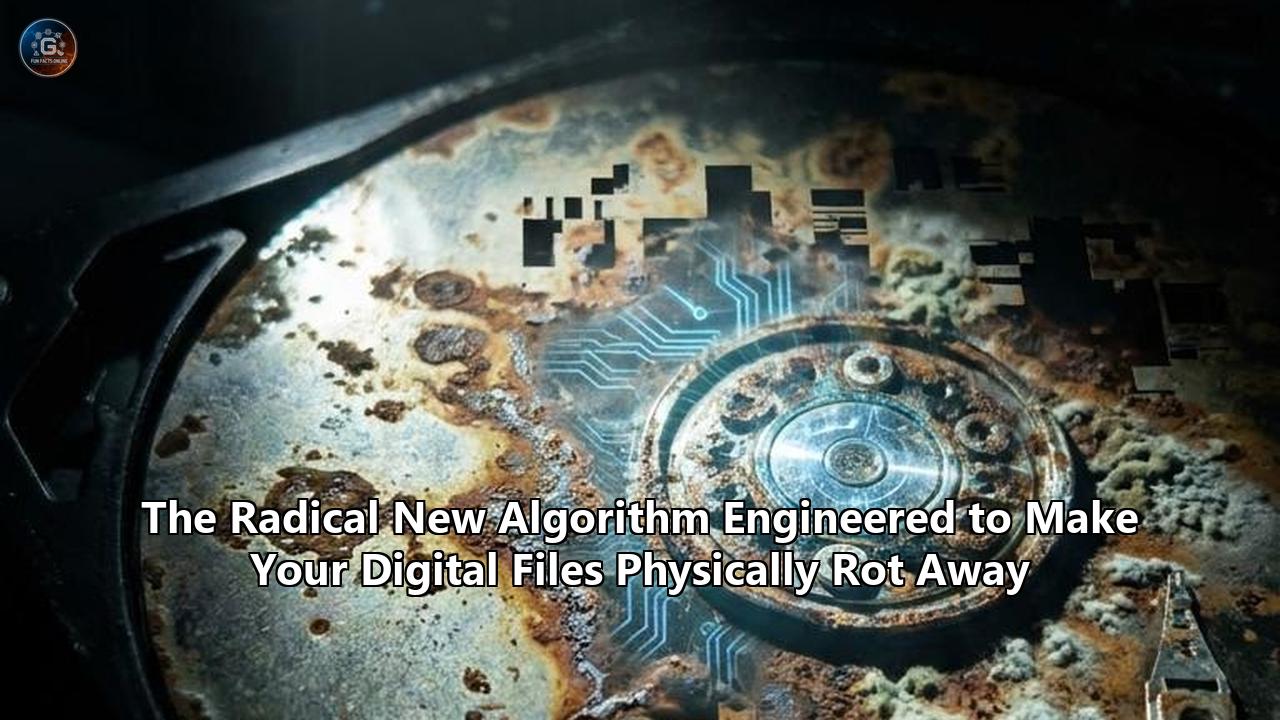
On May 12, 2026, Chronos Data, a Stockholm-based digital infrastructure collective, activated the "Oblivion Protocol" across its consumer and enterprise cloud platforms. Users logging in found a new, unyielding architecture governing their oldest, unaccessed data. Rather than sitting in pristine, energy-hungry cold storage, files untouched for 36 months were physically degrading. High-resolution images acquired subtle, grainy artifacts. Legacy text documents rendered with occasional corrupted characters. Audio recordings accumulated faint, irreversible static. If left completely unaccessed for an additional 12 months, these files would dissolve entirely into raw, unrecoverable noise, freeing up server space and terminating their carbon footprint.
At the heart of this rollout is a proprietary digital file decay algorithm, a piece of code explicitly engineered to simulate physical rot in a binary environment.
The immediate reaction was deeply polarized. Digital archivists, who have spent the last three decades fighting natural data degradation, labeled the protocol an act of cultural vandalism. Climate scientists and data ethicists, conversely, hailed it as a necessary intervention against the massive ecological cost of maintaining "zombie data." By transforming cloud storage from a stagnant vault into an ecosystem requiring active maintenance, Chronos Data has forced a public reckoning with the illusion of infinite digital permanence.
This event serves as a critical case study. The deployment of the Oblivion Protocol provides a lens through which we can analyze our unsustainable relationship with data accumulation, the physical limitations of cloud computing, and the emerging economic models that prioritize transience over eternal retention.
The Architecture of Artificial Entropy
To understand the impact of the Chronos Data deployment, one must first dissect the mechanics of data degradation. In traditional computing, "bit rot" is an accidental, insidious failure. It occurs when the physical media storing digital information—magnetic hard drives, solid-state drives (SSDs), or optical discs—naturally degrades. Magnetic orientations weaken, electrical charges in flash storage bleed over time, and optical media oxidizes. When the physical layer fails, the 1s and 0s flip. A software application interpreting that corrupted bitstream will output a glitchy image, a broken application, or a completely unreadable file.
To combat natural bit rot, the tech industry relies heavily on checksums and redundancy. A checksum is a mathematical value generated by running a file through a hashing algorithm, such as SHA-256. If a single bit in the file flips due to physical degradation, the checksum changes dramatically. Modern data centers constantly scrub their storage arrays, generating new checksums and comparing them against the originals. If a discrepancy is found, the system pulls a pristine copy from a backup server and overwrites the corrupted data. This requires immense computing power, continuous hardware cycling, and massive energy expenditure.
Chronos Data inverted this paradigm.
The digital file decay algorithm does not wait for hardware to fail. It is a proactive, software-layer execution of entropy.
How the Protocol Executes Decay
According to the technical documentation released alongside the Oblivion Protocol, the system operates through a multi-stage process governed by metadata timestamps and localized processing:
- The Dormancy Trigger: The algorithm continuously monitors "last accessed" metadata. A file that is merely backed up but never opened, shared, or indexed by a user application enters a dormant state. Chronos Data set the initial threshold at 36 months.
- Controlled Lossy Compression: Once triggered, the algorithm does not simply delete the file. Deletion is binary; decay is analog. The system applies a micro-pass of lossy compression. For an image file, it selectively strips out extraneous color data and reduces pixel density.
- Cryptographic Checksum Alteration: In a standard storage environment, altering the file would trigger a fixity error, causing the system to automatically repair the file from a backup. The Oblivion Protocol intercepts this response. It intentionally updates the master checksum to reflect the newly degraded state, effectively telling the server, "This damage is intentional; do not repair it."
- Escalating Degradation: If the file remains unaccessed, the algorithm triggers further degradation cycles every 90 days. Text files lose formatting and eventually drop random characters. Video files experience frame drops and heavy macroblocking.
- Terminal Dissolution: At month 48 of zero user interaction, the file reaches terminal decay. The algorithm overwrites the remaining bitstream with randomized cryptographic noise, rendering it unrecoverable, and reallocates the physical server space.
"We are reintroducing the concept of time into the digital realm," Dr. Elias Vane, Lead Architect at Chronos Data, stated during the May 12 press briefing. "Physical objects require care to survive. A photograph left in the sun will fade. A letter left in a damp basement will rot. The internet removed the friction of preservation, but it offloaded the cost of that preservation onto the physical environment. We are simply returning the cost of memory to the user."
The Ecological Imperative: The Cloud is Running Out of Sky
The primary catalyst for the Oblivion Protocol is not philosophical, but ecological. The term "the cloud" suggests something ethereal and weightless. The physical reality of cloud computing is an expanding network of hyperscale data centers composed of steel, concrete, lithium, and millions of spinning magnetic disks, consuming an ever-growing percentage of global electricity.
By the first quarter of 2026, the energy demands of artificial intelligence training and global data storage have pushed regional power grids to their absolute limits. Data centers require vast amounts of electricity not just to power the servers, but to cool them. Water consumption for thermal management in arid regions has already triggered municipal lawsuits against major tech conglomerates.
The Burden of Dark Data
The specific target of the digital file decay algorithm is "dark data." Industry analysts define dark data as information that organizations and individuals collect, process, and store during regular activities, but generally fail to use for other purposes.
A 2025 audit of global enterprise storage revealed that approximately 68% of all data sitting on corporate servers is dark. This includes:
- Duplicate machine logs from decommissioned software environments.
- Multiple iterations of the same high-resolution video file from marketing campaigns dating back a decade.
- Former employees' inbox archives containing thousands of mundane logistical emails.
- Automated IoT sensor telemetry data that holds no historical or predictive value.
In the consumer space, the ratio is worse. The average smartphone user in 2026 backs up gigabytes of burst-photography mistakes, blurry screenshots, and duplicate videos. Because default cloud settings prioritize automatic synchronization, this digital detritus is immediately uploaded to a server farm. Once there, it is replicated across at least three geographic locations to ensure redundancy.
Maintaining a flawless, high-fidelity copy of a blurry photograph of a parking space from 2018 requires continuous electrical draw. The servers holding that photo must be powered, cooled, and occasionally replaced as the physical hardware ages.
Chronos Data's intervention forces a brutal economic and ecological logic onto this behavior. If a user does not care enough about a file to look at it for three years, the environment should not be forced to bear the carbon footprint of preserving it in absolute perfection. By initiating the decay sequence, the servers gradually reduce the storage footprint of the file, eventually eliminating it entirely and reducing the overall electrical load of the data center.
The Preservation Paradox: A Case Study in Archival Outrage
The immediate backlash to the Oblivion Protocol came from the people tasked with preserving human history. The International Association of Labour History Institutions (IALHI) and the Internet Archive published swift condemnations of the algorithm.
The tension highlights a core principle in the field of information science: The Preservation Paradox. Digital files are incredibly easy to duplicate, but notoriously difficult to maintain. Unlike a carved stone tablet or a vellum manuscript, which can survive for centuries through benign neglect, a digital file requires constant, active intervention to survive. If the hardware running the file breaks down, or the proprietary software required to open the file goes bankrupt, the information is lost.
Archivists spend millions of dollars and countless hours fighting digital rot. The idea of an algorithm engineered to accelerate it is viewed as an existential threat to historical memory.
The Historical Context: Vinegar Syndrome and Nitrate Fires
To understand the archivists' panic, we must look at the history of physical media decay. Prior to the 1950s, motion pictures were recorded on nitrate film stock. Nitrate is highly flammable, and as it degrades, it can spontaneously combust. Countless silent films were lost in massive archival fires.
When the industry shifted to safety film (acetate base), they believed the problem was solved. However, acetate film falls victim to "vinegar syndrome," a chemical degradation process where the film shrinks, warps, and emits a strong acetic acid odor. Once vinegar syndrome begins, it is irreversible and contagious to other film reels stored in the same environment.
Physical archivists have spent decades battling these chemical realities, storing reels in climate-controlled, sub-freezing vaults. The digital revolution was supposed to be the cure for physical entropy. A digital file, theoretically, could be copied infinitely without any generational loss.
"Introducing intentional decay into a stable digital ecosystem is a rejection of the greatest technological achievement of the 21st century," argued Dr. Aris Thorne, a digital preservationist at the University of Toronto, during a May 14 symposium responding to the Chronos Data release. "History is not only made by the files we actively look at every day. History is hidden in the mundane, forgotten records. If we allow algorithms to decide what survives based on engagement metrics, we will erase the very context future historians need to understand our era."
The Counter-Argument: Active Curation
Chronos Data’s response to the archival community hinges on the definition of "value." The digital file decay algorithm does not target actively curated archives; it targets neglect.
If an archivist, or an individual user, wants to preserve a file indefinitely, the protocol allows them to do so. They merely have to interact with it. Opening a file, tagging it, or moving it to a designated "Heritage Tier" resets the decay timer.
This mechanism forces a shift from passive accumulation to active curation. In the physical world, museums do not keep every single receipt, grocery list, and blurry Polaroid ever generated by a population. Curators make active, deliberate choices about what warrants the expense of preservation. The Oblivion Protocol attempts to enforce that same curatorial discipline on the digital public.
The Psychological Weight of Infinite Memory
Beyond the ecological and technical implications, the May 2026 deployment of the decay algorithm exposes a profound shift in digital psychology. Human cognition is intrinsically tied to forgetting. Forgetting is not a flaw in the human brain; it is a critical optimization feature that allows us to process trauma, adapt to new environments, and prioritize relevant information over noise.
Digital infrastructure, until now, has operated in direct opposition to human cognitive design.
The Rise of Digital Hoarding
Over the last fifteen years, psychiatrists have identified "Digital Hoarding" as a distinct sub-category of hoarding disorder. It is characterized by the accumulation of digital files to the point of acute distress, driven by an intense fear of deleting something that might one day be useful.
The seamless nature of cloud synchronization exacerbates this condition. Because the physical manifestation of the hoard is invisible—contained within the sleek glass and metal of a smartphone rather than stacked in piles of yellowing newspapers in a living room—the psychological weight builds silently. Users report intense anxiety over their digital footprints: tens of thousands of unread emails, overlapping messaging app histories, and sprawling photo libraries that are too massive to ever actually review.
The Oblivion Protocol acts as a harsh but effective psychological release valve.
By automating the decay of forgotten data, the system relieves the user of the burden of decision-making. Deleting a photo feels final and violent. Allowing a photo to slowly fade away over a period of four years mirrors the natural, gentle fading of human memory.
Early telemetry data leaked from Chronos Data's beta testing in late 2025 indicated that users exposed to the decaying interface actually reported higher satisfaction with their remaining files. When a user sees a file beginning to artifact and degrade, it acts as a forcing function. They must ask themselves: Do I care enough to save this? If the answer is no, they let it go. The files that survive the filter are imbued with higher subjective value precisely because they required effort to maintain.
Corporate Strategy: The Legal and Economic Upside of Decay
While consumer psychology and ecological preservation make for excellent public relations, the rapid adoption of the Chronos Data framework by enterprise clients reveals a colder, more pragmatic economic reality. For corporate entities, data is increasingly viewed not as an asset, but as a toxic liability.
In the early 2010s, the dominant business philosophy was "data is the new oil." Companies hoarded every conceivable datapoint on their users, employees, and internal operations, assuming that future analytics or AI tools would eventually extract value from the raw accumulation.
By 2026, the regulatory and legal landscape has fundamentally altered that calculus.
The Cost of Discovery and Breach Mitigation
In the event of a corporate lawsuit, the legal process of "e-discovery" requires companies to produce relevant digital records. If a company retains a decade's worth of internal Slack messages, casual emails, and messy draft documents, opposing counsel will demand to comb through all of it. The legal cost of processing, reviewing, and redacting millions of irrelevant, ancient files often dwarfs the actual penalties of the lawsuit itself.
Furthermore, sweeping data privacy regulations enforce strict penalties for retaining consumer data beyond its necessary business purpose. When a cyberattack occurs—and they occur with unrelenting frequency—the attackers steal whatever is sitting on the servers. If a company is breached and hackers leak the financial details of customers from a dormant database that hasn't been accessed since 2019, the regulatory fines and reputational damage are catastrophic.
Secure deletion policies have always existed, but they are frequently ignored, poorly implemented, or stalled by executives terrified of deleting something they might theoretically need.
The implementation of a digital file decay algorithm solves this corporate paralysis at the structural level.
By configuring enterprise servers to automatically degrade and destroy internal communications, project drafts, and user telemetry data after a specific timeframe, the company mechanically purges its own liabilities. It acts as an automated risk-mitigation engine. If regulators or hostile lawyers come looking for five-year-old internal communications, the company can point to the protocol: the data no longer exists, not because it was manually destroyed in a panic to hide evidence, but because the systemic entropy of the network dissolved it.
We can view this as a macro-evolution of "ephemeral messaging." Platforms like WhatsApp previously introduced features where data is temporary and designed to be discarded after a specific period, utilizing specialized data processing in isolated environments to ensure messages vanish without a trace. The Oblivion Protocol scales this concept from individual text messages to the entire corporate infrastructure.
Case Study Application: The Healthcare Sector
To extract concrete lessons from this shift, we must examine how specific industries will adapt to the Chronos Data precedent. The healthcare sector provides a compelling example of the tension between necessary retention and mandatory decay.
Hospitals generate staggering volumes of data: high-resolution MRI scans, continuous genomic sequencing, patient telemetry, and administrative logs. Medical retention laws dictate that certain records must be kept for the lifespan of the patient, and often several years beyond.
However, not all medical data holds long-term value. The raw, second-by-second telemetry data of a stable patient's heart rate during a routine 2023 overnight observation takes up massive server space but has virtually zero diagnostic value by 2026.
If a hospital network integrates a decay algorithm, they must establish rigorous, multi-tiered data taxonomies:
- Tier 1 (Immutable): Surgical records, final diagnoses, and verified genomic data are heavily shielded with aggressive fixity checks and constant checksum validations. Entropy is strictly blocked.
- Tier 2 (Decaying): Raw, high-volume sensor telemetry is tagged for decay. If researchers do not actively flag the data for an ongoing longitudinal study within 24 months, the files begin their lossy compression cycles, eventually freeing up the highly expensive, HIPAA-compliant server space.
The lesson here is that artificial decay forces organizations to actually understand their own data architectures. You cannot apply automated rot to a system if you do not know where your critical assets live. The threat of decay forces a level of data hygiene that compliance mandates alone have failed to achieve.
The Mutual Degeneration of Reason: AI and Algorithmic Amnesia
There is a final, highly theoretical layer to the deployment of this technology, one that involves the interaction between decaying human data and the artificial intelligence models that feed on it.
Researchers in late 2025 began documenting a phenomenon they termed "algorithmic amnesia" or "digital rot" within large language models. When AI models are trained on repetitive, shallow, or AI-generated data, they begin to suffer from a form of cognitive entropy. The models become highly polarized, their outputs lose semantic precision, and they enter a recursive loop of worsening quality—a hybrid ecosystem where human cognitive shortcuts and machine learning flaws amplify one another.
If a vast percentage of the historical internet begins to physically degrade via the Oblivion Protocol, what happens to the training sets of tomorrow?
If only the most frequently accessed, highly engaging, viral content is actively preserved by human interaction, and all the mundane, nuanced, deep-context data is allowed to rot away, future AI models will be trained exclusively on the most sensational fragments of our culture.
The digital file decay algorithm essentially functions as a massive, species-level attention filter. It ensures that only the data that currently commands our attention will survive into the future. By tying the physical survival of data to human engagement metrics, we risk hollowing out the foundation of our shared knowledge. The archives of the 2030s may not contain a balanced representation of the 2020s; they will contain only the memes, the outrage, and the most heavily trafficked corporate intellectual property. The quiet, unclicked margins of digital life will simply turn to static.
Extracting Core Principles: What This Event Teaches Us
The May 12 activation of the Oblivion Protocol is more than a software update; it is a fundamental shift in the geometry of digital life. By analyzing the technical mechanisms, the ecological drivers, and the corporate incentives surrounding this event, we can extract several enduring principles for the next decade of digital infrastructure:
1. The End of Default PermanenceFor the first thirty years of the commercial internet, the foundational assumption was that data, once created, would exist forever unless explicitly deleted. The Chronos Data launch flips this default. Going forward, permanence will not be a given; it will be a premium feature that requires active energy, financial expenditure, and curatorial intent.
2. Friction as a Feature, Not a BugTechnological progress has historically been defined by the removal of friction. Unlimited storage, automatic backups, and background synchronization removed all friction from memory curation. The reintroduction of artificial entropy proves that absolute frictionlessness is toxic. Friction—the act of having to choose what to save and what to let rot—is necessary for assigning value and maintaining psychological and ecological balance.
3. Liability Will Drive Data ArchitectureThe widespread adoption of digital decay will not be driven by consumer demand for philosophical data minimalism. It will be driven by corporate risk management. The legal and regulatory hazards of hoarding massive amounts of dark data are now outweighing the theoretical analytic value of that data. Decay will become a standard compliance tool.
4. The Redefinition of Archival LaborThe role of the archivist must evolve. In an era where algorithms are designed to clear-cut dormant data, preservationists can no longer rely on passive ingestion. They must become active combatants against the automated decay cycles, requiring new technical methodologies to bypass or spoof "last accessed" timestamps to protect culturally significant but rarely viewed files.
What to Watch For Next
The Chronos Data launch is a fracture point. As we move through the latter half of 2026, the ripple effects of this deployment will become highly visible across multiple sectors.
The immediate next milestone will be legislative. European regulators are currently observing the enterprise adoption of the protocol. It is highly probable that within the next 18 months, we will see proposals for mandatory "Data Expiration" laws applied to hyperscale cloud providers. Rather than merely capping the carbon emissions of data centers, governments may mandate that unaccessed, non-critical commercial data must be subjected to a decay protocol to force a reduction in baseline energy load.
Simultaneously, we must watch the consumer hardware market. As cloud storage becomes transient, there will likely be a massive resurgence in physical, offline storage media. Consumers who mistrust the automated rot of the cloud will return to purchasing localized, disconnected hard drives to maintain their own personal archives, essentially moving the burden of bit rot back into their own homes.
Finally, the integration of AI curatorial agents represents the next frontier of this technology. Future iterations of the protocol will not rely solely on simple time-based triggers. Tech conglomerates will deploy localized, on-device AI to analyze a user's biometric response, viewing habits, and semantic context to determine which files hold emotional weight and which are disposable. The system will independently decide what to preserve in perfect fidelity and what to slowly feed to the digital static.
We have crossed the threshold into an era where our technology no longer promises us immortality. Instead, it has learned to imitate our mortality, forcing us to reckon with the heavy, necessary cost of holding on.
Reference:
- https://1800officesolutions.com/what-is/bit-rot-corruption-in-your-files/
- https://www.rsinc.com/bit-rot.php
- https://www.tasteray.com/articles/movie-deterioration-movies
- https://www.backlog-archivists.com/blog/tkjt7gtgdbx61tdgxc6fx7tn406oji
- https://socialhistoryportal.org/news/articles/311897
- https://ai.meta.com/static-resource/private-processing-technical-whitepaper
- https://medium.com/e-s-lab/brain-rot-vs-digital-rot-or-the-mutual-degeneration-of-reason-be945d775532