
The sun beats down on the Supe Valley, a ribbon of green defiance cutting through the beige desolation of the Peruvian coastal desert. Here, the dust of five millennia does not just cover the ground; it composes the very air, thick with the silence of a civilization that rose before the Great Pyramids of Giza were even a blueprint in a pharaoh's mind. For decades, the Sacred City of Caral has monopolized the world’s attention as the "Mother City" of the Americas. But just one kilometer to the west, hidden beneath a gnarled shroud of dry huarango trees and thorny scrub, a secret has been waiting.
It is a secret of stone and shadow, of geometry and geology. It is the story of Chupacigarro, and more specifically, its newly unearthed "monoliths"—the vertical guardians that are rewriting the history of how the first Americans reached for the sky.
This is not merely a tale of excavation; it is a journey into the Vertical Architecture of the ancient Andes. It is an exploration of a worldview where the "upward" direction was not just about engineering, but about survival, divinity, and the eternal connection between the living earth and the watching ancestors.
I. The Green Shroud and the Stone Giant
The discovery began not with a bang, but with the scratch of a trowel and the buzz of chainsaws clearing the dense thicket. Dr. Ruth Shady, the indefatigable guardian of the Caral-Supe legacy, led a multidisciplinary team into the area known as "Sector F" of the Chupacigarro archaeological site. To the untrained eye, the mounds here looked like nothing more than natural hills, shaped perhaps by the wind that scours the valley floor. But the archaeologist’s eye sees patterns where nature sees chaos.
As the team stripped away the layers of vegetation—the dry huarango trees that had sent their roots deep into the ancient masonry—a form began to emerge. It was not a chaotic pile of rocks, but a deliberate, disciplined structure. A quadrangular pyramidal building, covering an impressive 38.59 hectares, shook off its green shroud.
But it was what stood within the walls that drew the breath from the researchers’ lungs.
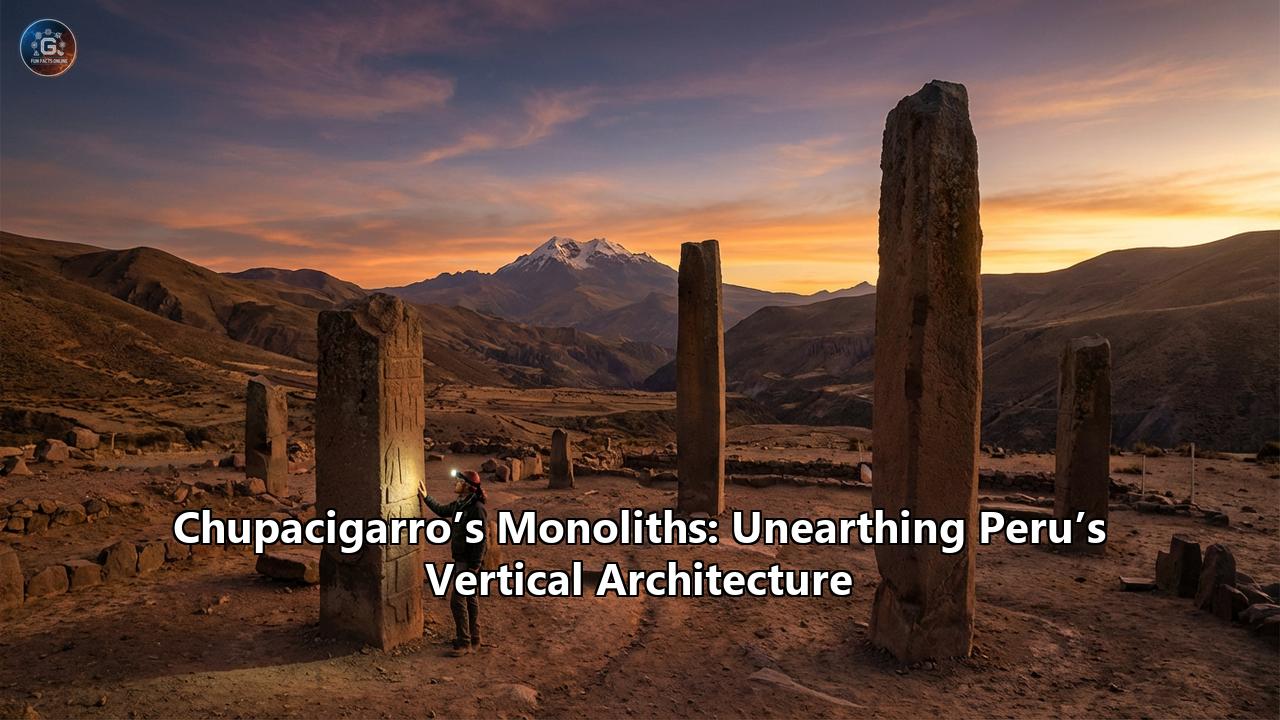
Embedded in the corners of the platforms and marking the central staircase were massive, solitary stones. These were not mere bricks in a wall; they were huancas. Standing vertical, defiant, and distinct, these monoliths were the anchors of the building’s soul. They were the physical manifestation of a concept that would dominate Andean culture for the next 4,000 years: the sacredness of the upright stone.
This discovery at Chupacigarro changes the texture of what we know about the Supe Valley. While Caral is famous for its harmonious sunken plazas and fire altars, Chupacigarro’s new pyramid suggests a site of distinct, perhaps complementary, power. The presence of these huancas—large, vertical megaliths—indicates that the architects here were not just building a platform for the living, but a lightning rod for the divine.
II. The Huanca: The First Vertical Architecture
To understand the magnitude of the Chupacigarro discovery, one must first understand the huanca. In the Quechua worldview that would emerge millennia later, but whose roots are clearly visible here in the dust of 3000 BCE, a huanca is more than a rock. It is a petrified ancestor. It is a guardian.
In the harsh, seismically active landscape of the Andes, verticality is a challenge. Gravity is a jealous god, constantly pulling things down. To raise a stone upright and keep it there is an act of supreme will and engineering. The huancas found at Chupacigarro served a dual purpose: structural and ceremonial.
Structurally, they acted as the "bones" of the pyramid. By placing these massive monoliths at the corners and flanking the central staircase, the builders created stress anchors that could absorb the energy of earthquakes—a constant threat in this region. The smaller masonry walls were woven between these giants, creating a flexible yet rigid system that has survived five thousand years of tremors. Ceremonially, the huanca is the axis mundi. In a flat valley floor, the huanca breaks the horizon. It mimics the mountain peaks (the apus) that loom in the distance. By placing these stones at the entrance of the temple, the ancients were creating a threshold. You were not just walking up a set of stairs; you were passing between the stone guardians, perhaps the founding ancestors of the clan, who stood eternally watching the plaza below.The discovery of these monoliths in situ at Chupacigarro provides a rare glimpse into the origin of this tradition. We see here the infancy of a monumental style that would later evolve into the stelae of Chavín, the monoliths of Tiwanaku, and the intricate masonry of the Inca. This is the "Patient Zero" of Andean monumentalism.
III. The Sechín Enigma: A Face in the Earth
If the pyramid and its monoliths were the only discovery, it would be enough to secure Chupacigarro’s fame. But the site held another, darker secret.
Visible only from specific high vantage points within the settlement, archaeologists identified a massive geoglyph. It is a profile of a human head, etched into the earth with angular stones. But it is not the serene, closed-eyed face of a Caral deity.
The face measures 62.1 by 30.3 meters—a titan stamped onto the desert floor. The eye is closed, the mouth gapes open, and from the head flows what appears to be hair blown by a violent wind, or perhaps—more chillingly—blood.
This imagery strikes a discordant note in the "Pax Caral." The Caral civilization has long been touted as a peaceful society, a "commercial" empire built on trade rather than war, noting the absence of battlements or weapons in the archaeological record. But the style of this geoglyph is unmistakably Sechín.
The Sechín culture (or Casma-Sechín), located to the north, is famous for its "temple of terror" at Cerro Sechín, where stone monoliths depict a grisly procession of warrior-priests and dismembered bodies—severed heads, eyes gouged out, intestines spilling like garlands. It is a culture that seems to celebrate, or at least ritualize, visceral violence.
Finding a Sechín-style geoglyph at Chupacigarro is like finding a Viking rune carved into the wall of a Roman villa. It suggests a complexity to the Supe Valley’s history that we have glossed over.
- Was this a mark of influence from the north?
- Was Chupacigarro a "border town" where different ideologies met?
- Or does the "gaping mouth" and "flowing blood" represent not war, but ritual sacrifice—a blood offering to the thirsty earth in a time of drought?
The juxtaposition is striking: the huanca (symbol of stability, ancestry, and protection) standing guard near a geoglyph that screams of instability, death, and fluid chaos. It paints a picture of Chupacigarro not as a static ruin, but as a dynamic stage where different cultural currents collided.
IV. The Vertical Archipelago: A Metaphor for Survival
The concept of "verticality" in the Andes goes beyond architecture. In 1972, the anthropologist John Murra coined the term "Vertical Archipelago" to describe the economic genius of Andean people. Unlike Old World civilizations that spread horizontally across vast flat plains (like Mesopotamia or the Nile), Andean civilizations had to master the vertical.
They lived in a world where traveling 100 kilometers east didn't just change your location; it changed your planet. You went from arid coastal desert, to fertile valley, to high-altitude Puna, to snow-capped peaks, and down into the Amazonian cloud forest.
Chupacigarro, like Caral, was an engine of this vertical integration.
The "Vertical Architecture" we see in the stone monoliths is a mirror of their "Vertical Economics."
- The Coast (0 m): Supplied the protein—anchovies and sardines—that fueled the labor force.
- The Valley (Chupacigarro/Caral): Produced the cotton (for nets and clothes) and gourds (for floats).
- The Highlands: Supplied camelid wool, colored stones, and hallucinogenic snuff used in rituals.
The new pyramid at Chupacigarro likely served as a node in this vertical lattice. The layout—a central plaza surrounded by 12 public buildings on hilltops—suggests a place of gathering where these different "vertical islands" met. The huancas may have even represented the different communities or ayllus coming together, each vertical stone a totem of a clan from a different altitude, standing side-by-side in the neutral ground of the temple.
V. Inside the Excavation: Unpeeling the Layers
The work at Sector F was grueling. The huarango tree is a formidable adversary. Its wood is hard as iron, and its roots can penetrate stone masonry, prying blocks apart over centuries. Dr. Shady’s team had to act as surgeons, removing the biological cancer without killing the patient.
As the vegetation was cleared, the "skin" of the pyramid was revealed to be plastered and painted. Andean pyramids were not the bare stone ruins we see today; they were vibrant, garish spectacles. Imagine the Chupacigarro pyramid in its prime: walls plastered in shades of white, yellow, or red, gleaming under the relentless sun. The huancas at the corners might have been left bare—raw stone contrasting with the smooth plaster—or perhaps draped in textiles, the "clothing" of the ancestors.
The central staircase, flanked by these monoliths, would have been the theater of power. We can imagine the scene:
The high priest ascends. The plaza below is filled with the smoke of burning offerings—mussel shells, cotton seeds, and san pedro cactus. The priest stops between the two guardian huancas. To the crowd below, he is framed by the stone ancestors. He is no longer a man; he is a link in the vertical chain that connects the water in the ground to the rain in the sky.
VI. A Civilization of Architects and Astronomers
The people of Chupacigarro were not mere stone-stackers. They were sophisticated astronomers. The orientation of the new pyramid, like others in the Supe Valley, is likely aligned with the stars.
In a world without written texts, architecture is the library. The angle of a wall, the placement of a monolith, the shadow cast by a huanca on the solstice—these were the records of the seasons. The "vertical architecture" was a functional calendar. When the shadow of the great huanca hit a specific mark on the plaza floor, it was time to plant the cotton. When it hit another, it was time to harvest.
The "sunken circular plaza," a hallmark of the Caral-Supe culture found also at Chupacigarro, complements the vertical pyramid. It represents the "underworld" or the womb of the earth. The architectural dialogue is between the Hanan (Upper/Vertical/Pyramid) and the Hurin (Lower/Sunken/Plaza).
- The Pyramid reaches for the sky (masculine/solar).
- The Sunken Plaza digs into the earth (feminine/terrestrial).
The newly discovered structure reinforces this duality. The high platforms with their phallic huancas contrast with the sunken circular courts found nearby. It is a built geometry of cosmic balance.
VII. The Legacy: From Supe to Cusco
Why does this discovery matter to us, five thousand years later?
Because Chupacigarro is the draft for the masterpiece that was the Inca Empire. When we look at the famous walls of Cusco, or the Intihuatana (Hitching Post of the Sun) at Machu Picchu, we are seeing the great-great-grandchildren of the Chupacigarro huancas.
The Incas worshipped stones. They believed that the stone was the entity. When the Spanish arrived, they were baffled that the Incas didn't just worship idols made of stone, but the rough, unhewn rocks themselves. The Chupacigarro discovery proves this animistic connection to the raw material of the earth is one of the oldest continuous religious traditions in the Americas.
The "vertical architecture" unearthed here is the ancestor of the skyscraper, but with a different soul. We build up to save space or show off wealth. They built up to talk to the gods.
VIII. Conclusion: The Speaking Stones
As the dust settles on the excavation of Sector F, Chupacigarro stands not as a silent ruin, but as a testament to human ingenuity. It reminds us that 5,000 years ago, people in Peru were not just surviving; they were thinking, planning, and building for eternity.
They understood that to live in a land of shaking earth and shifting waters, you needed anchors. You needed the huanca.
The removal of the huarango trees has revealed more than just a wall; it has revealed a lineage. From the gaping mouth of the Sechín geoglyph to the silent vigil of the granite monoliths, Chupacigarro is a bridge across time. It invites us to stand at the foot of the central staircase, look up past the stone guardians, and see the sky exactly as they did: a vast, vertical mystery waiting to be engaged.
The monoliths have been unearthed. And if we listen closely to the wind whistling through the Supe Valley, we might just hear them speak.
Reference:
- https://thenomadsketchbook.com/2025/07/01/neo-andean-futurism-architecture-a-journey-through-bolivias-vertical-identity/
- https://en.wikipedia.org/wiki/Huanca_(monolith))
- https://www.earthasweknowit.com/pages/caral_supe
- https://www.metmuseum.org/essays/cerro-sechin-stone-sculpture
- https://www.jqjacobs.net/andes/cosmology.html
- https://en.wikipedia.org/wiki/Caral
- https://www.peru-explorer.com/what-was-special-about-inca-stonework-ancient-mysteries.htm
- https://en.wikipedia.org/wiki/Casma%E2%80%93Sechin_culture
- https://en.wikipedia.org/wiki/Cerro_Sech%C3%ADn