
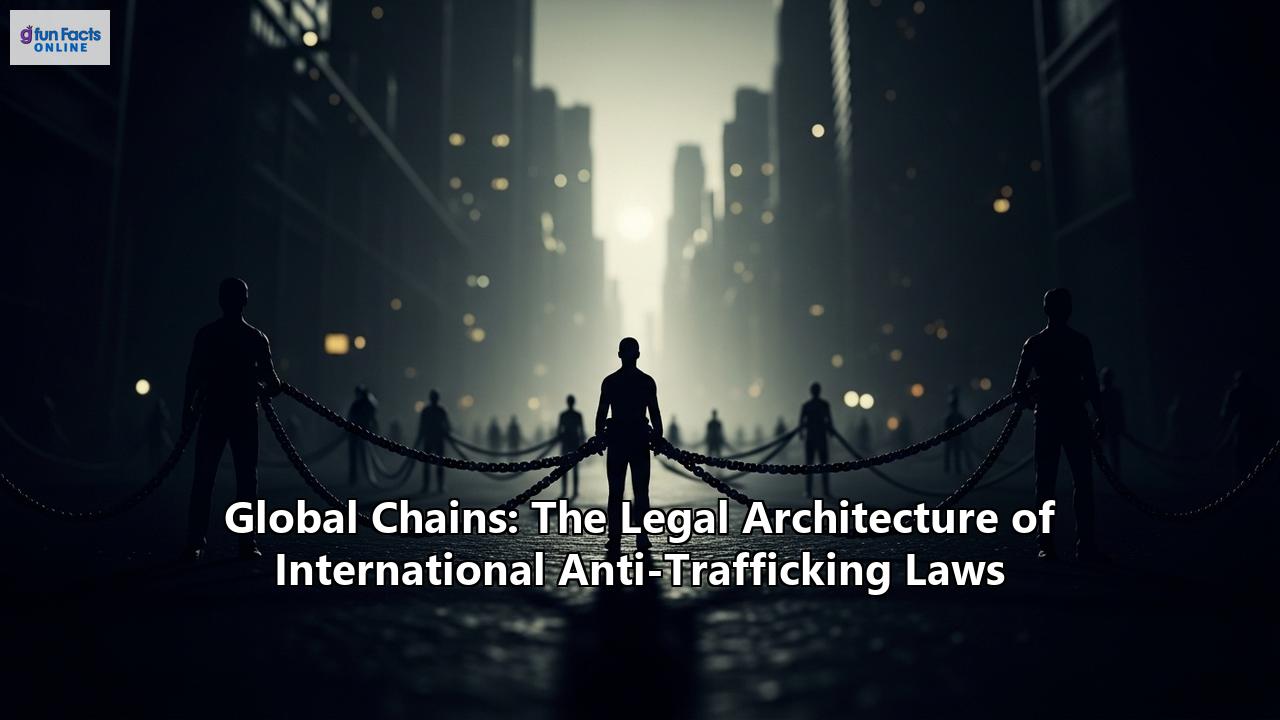
Global Chains: The Legal Architecture of International Anti-Trafficking Laws
In the shadows of our interconnected world, a sinister trade persists, exploiting the vulnerable and turning human beings into commodities. Human trafficking, a modern form of slavery, is a multi-billion dollar criminal enterprise that ensnares millions of men, women, and children. In response to this global scourge, the international community has meticulously constructed a complex legal architecture designed to dismantle these criminal networks, protect its victims, and prevent this heinous crime from flourishing. This intricate framework is a testament to a growing global consensus that human dignity is inviolable and that the chains of exploitation must be broken.
From its nascent stages in the early 20th century, focused on the so-called "white slave traffic," to the comprehensive and human-rights-centered instruments of today, the evolution of anti-trafficking law reflects a deepening understanding of this complex crime. This legal edifice is not a monolithic structure but rather a dynamic interplay of international treaties, regional conventions, and domestic legislation, each contributing to a multi-layered global response. At its heart lies the "3P" paradigm—Prevention, Prosecution, and Protection—a holistic approach that has become the cornerstone of anti-trafficking efforts worldwide.
This article will embark on a comprehensive exploration of the legal architecture of international anti-trafficking laws. It will trace the historical trajectory of these laws, dissect the pivotal international and regional instruments, and examine their implementation at the national level. Furthermore, it will illuminate the crucial roles of international organizations, non-governmental organizations (NGOs), and the private sector, while also critically assessing the challenges and ongoing debates that shape the future of this global fight for freedom.
The Genesis of a Global Conscience: A History of Anti-Trafficking Laws
The roots of the international legal framework against human trafficking can be traced back to the abolitionist movements of the 19th century. The moral condemnation of slavery and the slave trade laid the groundwork for international cooperation to combat human exploitation. However, the first targeted international efforts in the early 20th century were born out of a moral panic surrounding the "white slave traffic." This term was used to describe the abduction and transportation of European women and girls for the purpose of forced prostitution.
A series of pioneering, albeit racially and morally charged, international agreements marked the dawn of a global anti-trafficking consciousness. The International Agreement for the Suppression of the "White Slave Traffic" was signed in Paris in 1904, representing the first international framework to suppress this trade. This was followed by the International Convention for the Suppression of the White Slave Traffic in 1910, which expanded upon the 1904 agreement. These early treaties, though limited in scope, established a crucial precedent for international cooperation in combating a specific form of human exploitation.
Following the First World War, the newly formed League of Nations took up the mantle, broadening the scope of these efforts. The 1921 International Convention for the Suppression of the Traffic in Women and Children was a significant step forward, as it officially replaced the racially biased term "white slave trade" with the more inclusive "trafficking in women and children." The League also established the Advisory Committee on the Traffic of Women and Children, creating a bureaucratic apparatus to research and combat the problem.
The post-World War II era, and the establishment of the United Nations, ushered in a new chapter in the development of international law. The 1949 Convention for the Suppression of the Traffic in Persons and of the Exploitation of the Prostitution of Others was the first legally binding international agreement on human trafficking adopted by the UN. It aimed to consolidate earlier instruments and addressed the exploitation of prostitution more directly. However, it was the turn of the millennium that witnessed the most significant milestone in the codification of international anti-trafficking law.
The Palermo Protocol: The Lynchpin of the Global Framework
The adoption of the Protocol to Prevent, Suppress and Punish Trafficking in Persons, Especially Women and Children, supplementing the United Nations Convention against Transnational Organized Crime in Palermo, Italy, in 2000, was a watershed moment. The Palermo Protocol, as it is commonly known, is the first global, legally binding instrument with an agreed-upon definition of trafficking in persons. This definition is comprised of three essential elements: the act (recruitment, transportation, transfer, harbouring or receipt of persons), the means (threat or use of force, coercion, abduction, fraud, deception, etc.), and the purpose (exploitation, which includes, at a minimum, sexual exploitation, forced labor, slavery or similar practices, and the removal of organs).
The Protocol established the internationally recognized "3P" paradigm—Prevention, Prosecution, and Protection—as the comprehensive and balanced approach to combating human trafficking. This framework has become the bedrock of national and international anti-trafficking strategies. A fourth "P" for Partnership is also widely recognized as essential for the successful implementation of the other three pillars.
The Three Pillars of the Palermo Protocol:
1. Prosecution: Bringing Traffickers to JusticeThe prosecution pillar of the Palermo Protocol obligates state parties to criminalize trafficking in persons in their domestic laws and to adopt penalties that reflect the gravity of the offense. This includes not only the primary perpetrators but also those who attempt to commit, participate as an accomplice in, or organize or direct others to commit trafficking offenses.
Effective law enforcement action is an indispensable element of this pillar. Governments are expected to vigorously investigate and prosecute trafficking cases and to ensure that convicted traffickers receive stringent prison sentences, not just fines or suspended sentences. The Protocol also encourages international cooperation in criminal matters, including mutual legal assistance and extradition, to combat the transnational nature of this crime.
2. Protection: A Victim-Centered ApproachRecognizing that trafficked persons are victims of serious human rights violations, the protection pillar of the Palermo Protocol is paramount. It mandates that states provide for the physical, psychological, and social recovery of victims. This includes offering appropriate housing, counseling, medical and psychological assistance, and employment and educational opportunities.
A key aspect of the protection pillar is the principle of non-punishment, which asserts that victims of trafficking should not be prosecuted for unlawful activities they were compelled to commit as a direct result of being trafficked. The Protocol also requires states to protect the privacy and identity of victims and to provide them with information on relevant legal proceedings. Furthermore, it encourages states to consider allowing victims to remain in the country, either temporarily or permanently, in appropriate cases. This is crucial for their safety and to facilitate their cooperation in criminal proceedings against their traffickers.
3. Prevention: Addressing the Root CausesThe prevention pillar of the Palermo Protocol calls on states to establish comprehensive policies, programs, and other measures to prevent trafficking in persons. This includes undertaking research, information and mass media campaigns, and social and economic initiatives to address the root causes of trafficking.
Recognizing that vulnerability is a key driver of human trafficking, the Protocol encourages states to take or strengthen measures to alleviate factors that make people susceptible to this crime, such as poverty, underdevelopment, and lack of equal opportunity. Prevention efforts also aim to reduce the demand that fosters all forms of exploitation. This includes raising public awareness and implementing policies that discourage the use of services from trafficking victims.
The Role of International Organizations: Forging a United Front
The implementation of the international anti-trafficking legal framework is significantly bolstered by the work of key international organizations. These bodies provide technical assistance to states, conduct research, and coordinate global efforts to combat human trafficking.
- United Nations Office on Drugs and Crime (UNODC): As the guardian of the UN Convention against Transnational Organized Crime and its protocols, the UNODC plays a central role in the global fight against human trafficking. It assists states in drafting and implementing national anti-trafficking laws and strategies, provides training for criminal justice practitioners, and collects and analyzes data on trafficking trends. The UNODC's Blue Heart Campaign is a global awareness-raising initiative that encourages public involvement in the fight against human trafficking.
- International Organization for Migration (IOM): With its expertise in migration management, the IOM is at the forefront of efforts to protect vulnerable migrants from trafficking and exploitation. The organization provides direct assistance to victims of trafficking, including shelter, medical care, and voluntary return and reintegration support. The IOM also works with governments to build their capacity to identify and protect trafficking victims and to improve migration policies to prevent trafficking.
- International Labour Organization (ILO): The ILO's mandate to promote decent work and protect labor rights is intrinsically linked to the fight against forced labor and labor trafficking. The organization sets international labor standards and works with governments, employers, and workers' organizations to eradicate forced labor in all its forms. The ILO's Forced Labour Convention (No. 29) and its 2014 Protocol are key international instruments that complement the Palermo Protocol by specifically addressing forced labor and providing for the protection of its victims.
Regional Reinforcements: A Multi-Layered Defense
Complementing the global framework of the Palermo Protocol are a number of robust regional legal instruments that address the specific nuances of human trafficking in different parts of the world. These regional conventions and action plans often go beyond the minimum standards of the Protocol, particularly in the area of victim protection.
- Council of Europe Convention on Action against Trafficking in Human Beings: Adopted in 2005, this convention is widely regarded as one of the most comprehensive and human-rights-focused anti-trafficking instruments. Its main added value is its strong emphasis on victim protection, which is not conditional on a victim's cooperation with law enforcement. The convention establishes a monitoring mechanism, the Group of Experts on Action against Trafficking in Human Beings (GRETA), which evaluates the implementation of the convention by state parties through a process of questionnaires, country visits, and reports.
- ASEAN Convention Against Trafficking in Persons, Especially Women and Children (ACTIP): Adopted in 2015, ACTIP is the primary legally binding instrument for combating human trafficking in Southeast Asia. It aligns with the principles of the Palermo Protocol and aims to foster greater regional cooperation in preventing trafficking, prosecuting traffickers, and protecting victims. ACTIP is complemented by the ASEAN Plan of Action, which provides a framework for implementing the convention's provisions.
- Economic Community of West African States (ECOWAS) Plan of Action: ECOWAS has demonstrated a strong commitment to combating human trafficking through a series of regional action plans. These plans urge member states to strengthen their national laws, enhance cooperation among law enforcement agencies, and provide protection and assistance to victims. The ECOWAS Common Approach on Migration also addresses human trafficking, recognizing the link between migration and vulnerability to exploitation. In 2023, the "Freetown Roadmap" was adopted to further enhance the effectiveness of these measures.
- Organization of American States (OAS): The OAS has taken significant steps to combat human trafficking in the Americas. Through various resolutions and work plans, the OAS encourages its member states to adopt and implement comprehensive anti-trafficking policies based on the "3P" paradigm. The organization also provides training and technical assistance to strengthen the capacity of member states to prevent and prosecute trafficking and protect victims.
These regional frameworks play a vital role in translating global norms into concrete action at the regional and national levels. They provide a platform for cooperation, share best practices, and hold states accountable for their commitments.
From International Law to National Action: Domestic Implementation
The effectiveness of the international legal architecture against human trafficking ultimately hinges on its implementation at the national level. State parties to the Palermo Protocol and regional conventions are obligated to transpose these international commitments into their domestic legal systems. This has led to a wave of new anti-trafficking legislation around the world, though the scope and effectiveness of these laws vary considerably.
- United States: The Trafficking Victims Protection Act (TVPA): Enacted in 2000, the TVPA is a landmark piece of legislation that established a comprehensive framework for the U.S. government's response to human trafficking. The TVPA mirrors the "3P" paradigm, with strong provisions for prosecuting traffickers, protecting victims, and preventing the crime. Key features of the TVPA include the creation of the T-visa for foreign national victims who cooperate with law enforcement, the establishment of the President's Interagency Task Force to Monitor and Combat Trafficking in Persons, and the annual publication of the Trafficking in Persons (TIP) Report, which assesses the efforts of countries around the world to combat trafficking.
- United Kingdom: The Modern Slavery Act 2015: The UK's Modern Slavery Act was another pioneering piece of legislation, particularly for its innovative supply chain transparency provisions. Section 54 of the Act requires large businesses to publish an annual statement detailing the steps they have taken to ensure that modern slavery is not occurring in their supply chains. However, the Act has faced criticism for its lack of robust enforcement mechanisms and the inconsistent quality of corporate reporting.
- Nigeria: The NAPTIP Act: Nigeria has made significant strides in combating human trafficking through the Trafficking in Persons (Prohibition) Enforcement and Administration Act, which established the National Agency for the Prohibition of Trafficking in Persons (NAPTIP). NAPTIP is responsible for coordinating the country's anti-trafficking efforts, including investigation, prosecution, prevention, and victim protection. Despite its successes, NAPTIP faces significant challenges, including inadequate funding and the overwhelming scale of the problem.
- Brazil: A Comprehensive Legal Framework: Brazil enacted specific anti-trafficking legislation in 2016, bringing its legal framework more in line with the Palermo Protocol. The law unified various forms of exploitation under a single human trafficking offense and established provisions for victim assistance. Brazil's National Plans to Combat Human Trafficking have also played a crucial role in guiding the country's anti-trafficking efforts.
- The Philippines: The Anti-Trafficking in Persons Act: The Philippines was one of the first countries in Southeast Asia to enact a comprehensive anti-trafficking law in 2003. The law established the Inter-Agency Council Against Trafficking (IACAT) to coordinate the country's response to this crime. The Philippines has been recognized for its serious and sustained efforts to combat trafficking, although challenges remain, particularly in addressing corruption and official complicity.
These examples highlight the diverse approaches to domesticating international anti-trafficking law. While many countries have made significant progress in enacting legislation, the challenges of effective implementation, including resource constraints, corruption, and a lack of political will, persist in many parts of the world.
The Unseen Forces: The Role of Non-State Actors
The global fight against human trafficking is not solely the domain of governments and international organizations. Non-state actors, including NGOs, civil society organizations, and the private sector, play an indispensable role in every aspect of the anti-trafficking response.
The Vital Work of NGOs and Civil SocietyNGOs are often on the front lines of the fight against human trafficking, providing direct assistance to victims, advocating for policy change, and holding governments accountable. Their contributions are manifold:
- Victim Identification and Support: NGOs are often the first point of contact for trafficking victims, providing them with safe shelter, medical care, counseling, and legal assistance. They play a crucial role in the identification and referral of victims to appropriate services.
- Advocacy and Policy Development: NGOs are powerful advocates for stronger anti-trafficking laws and policies at the national and international levels. They conduct research, raise public awareness, and lobby governments to improve their responses to human trafficking.
- Monitoring and Accountability: Civil society organizations act as watchdogs, monitoring governments' implementation of their anti-trafficking commitments and exposing gaps and failures. They provide alternative reports to international monitoring bodies like GRETA, offering a critical perspective on the reality on the ground.
- Capacity Building: NGOs provide training and capacity building for law enforcement officials, prosecutors, judges, and other front-line professionals to improve their ability to identify and respond to trafficking cases in a victim-centered manner.
The private sector's involvement in the fight against human trafficking is a more recent but increasingly important development. As global supply chains have become more complex, the risk of forced labor and labor trafficking has grown. In response, there is a growing movement to hold corporations accountable for their role in preventing and addressing modern slavery.
- Supply Chain Transparency: As exemplified by the UK's Modern Slavery Act, there is a growing trend towards legislation that requires companies to report on their efforts to eradicate modern slavery from their supply chains. This transparency is intended to create market-based incentives for companies to improve their practices.
- Corporate Social Responsibility (CSR): Many companies are incorporating anti-trafficking policies into their CSR initiatives. This can include developing codes of conduct for suppliers, conducting audits of their supply chains, and providing training for employees on how to identify and report suspected cases of trafficking.
- Industry-Led Initiatives: In some sectors, industry associations are developing their own standards and best practices to combat human trafficking. These initiatives can help to create a level playing field and encourage broader adoption of responsible labor practices.
- Public-Private Partnerships: Collaboration between governments, NGOs, and the private sector is essential for a comprehensive anti-trafficking response. Public-private partnerships can leverage the unique strengths of each sector to develop innovative solutions to this complex problem.
Navigating the Labyrinth: Challenges and Critical Perspectives
Despite the comprehensive legal framework and the concerted efforts of numerous actors, the fight against human trafficking is fraught with challenges and ongoing debates.
- Implementation Gaps: The gap between law on the books and practice on the ground remains one of the most significant challenges. Many countries have enacted anti-trafficking legislation but lack the resources, political will, or capacity to effectively implement it. Corruption can also severely undermine anti-trafficking efforts, as officials may be complicit in trafficking rings.
- The Criminal Justice Focus: The Palermo Protocol and many national laws are primarily criminal justice instruments. Critics argue that this law enforcement-centric approach can sometimes come at the expense of a human rights-based approach. The focus on prosecution can lead to victims being treated as instruments of the prosecution rather than as rights-holders.
- The Conflation of Trafficking and Sex Work: The historical focus on sexual exploitation has led to a persistent and contentious debate about the relationship between trafficking and sex work. Some anti-trafficking advocates and legislation do not distinguish between forced and voluntary sex work, which can lead to the criminalization and marginalization of sex workers and undermine their rights and safety.
- The Impact on Migrants' Rights: Anti-trafficking measures can have unintended negative consequences for migrants. The focus on border control and immigration enforcement can lead to trafficking victims being treated as irregular migrants rather than as victims of a crime. This can result in their detention and deportation, further compounding their trauma and vulnerability.
- The Challenge of Proving Exploitation: The legal definition of trafficking often requires proof of exploitation, which can be difficult to establish in court. This can lead to low conviction rates and a sense of impunity for traffickers.
The Unfolding Future of Anti-Trafficking Law
The landscape of human trafficking is constantly evolving, and the legal frameworks designed to combat it must adapt to new and emerging challenges.
- Technology's Double-Edged Sword: The internet and social media have become powerful tools for traffickers to recruit, exploit, and control their victims. However, technology can also be harnessed to combat trafficking, from using data analytics to identify trafficking hotspots to developing apps that provide information and support to vulnerable individuals.
- Climate Change and Conflict: Climate change and conflict are increasingly recognized as drivers of displacement and vulnerability, which in turn can increase the risk of human trafficking. The international community will need to develop legal and policy responses that address the intersection of these global challenges.
- Evolving Forms of Exploitation: As the world changes, so do the forms of exploitation that traffickers employ. From online sexual exploitation of children to forced criminality and organ trafficking, the legal framework must be flexible enough to address these evolving threats.
- The Rise of Mandatory Human Rights Due Diligence: The trend towards supply chain transparency is evolving into a broader movement for mandatory human rights due to diligence. This would require companies to not only report on their anti-slavery efforts but also to proactively identify, prevent, and mitigate human rights risks throughout their operations and supply chains.
Conclusion: A Perpetual Work in Progress
The global legal architecture of anti-trafficking laws is a monumental achievement, a testament to the international community's resolve to eradicate modern slavery. From its origins in the early 20th century to the comprehensive framework of the Palermo Protocol and its regional and domestic progeny, the law has evolved to become more inclusive, more victim-centered, and more attuned to the complexities of this heinous crime.
Yet, this legal edifice is far from complete. The chains of exploitation have proven to be resilient, adapting to new technologies and preying on new vulnerabilities. The gap between legal promise and practical reality remains a chasm in many parts of the world. The ongoing challenges of implementation, the debates over the best approach to combating trafficking, and the ever-changing nature of the crime itself demand that the international community remain vigilant, innovative, and unwavering in its commitment to this cause.
The future of the fight against human trafficking lies in strengthening every link in the global chain of protection. This means not only reinforcing international and regional cooperation but also ensuring that domestic laws are effectively implemented and that victims' rights are at the heart of all anti-trafficking efforts. It means fostering robust partnerships between governments, civil society, and the private sector. And, most importantly, it means listening to the voices of survivors and empowering them to be leaders in the movement for their own liberation. The legal architecture is in place, but the work of building a world free from slavery is a perpetual endeavor, one that requires the sustained commitment of every nation and every individual.
Reference:
- https://ecpat.org/wp-content/uploads/2024/11/Role-of-Law-Enforcement-in-Prevention-Case-Study-Philippines.pdf
- https://repositories.lib.utexas.edu/items/a75ff9c3-f0fb-49aa-ab56-3d6db6375f7a
- https://www.justice.gov/humantrafficking/key-legislation
- https://www.biicl.org/documents/11440_final_brazil.pdf
- https://opo.iisj.net/index.php/osls/article/download/919/1074/0
- https://wearenotforsale.org/the-trafficking-victims-protection-act-tvpa/
- https://www.skadden.com/insights/publications/2024/09/uk-modern-slavery-act
- https://www.globalinvestigations.blog/compliance-program/supply-chain-transparency-updates-on-uk-and-eu-provisions-on-forced-labour-and-modern-slavery/
- https://endslaveryandtrafficking.org/summary-trafficking-victims-protection-act-tvpa-reauthorizations-fy-2017-2/
- https://www.centerffs.org/sites/default/files/TVPA%20Fact%20Sheet.pdf
- https://gowlingwlg.com/en-gb/insights-resources/articles/2025/the-modern-slavery-act-and-supply-chains
- https://www.ibanet.org/article/57fc8a75-2a33-422c-9274-e98e53056472
- https://ragas.online/wp-content/uploads/2023/04/compendium-brazil.pdf
- https://www.nyulawglobal.org/globalex/human_trafficking1.html
- https://digitalcommons.unomaha.edu/cgi/viewcontent.cgi?article=1393&context=university_honors_program
- https://www.osborneclarke.com/insights/modern-slavery-act-2015-uk-select-committee-calls-urgent-reforms
- https://ipasnigeria.org/wp-content/uploads/2024/05/An-Evaluation-of-the-Implementation-of-the-VAPP-Law-in-Nigeria-compressed.pdf
- https://rm.coe.int/coe-asean-study-thb/16808c1b91
- https://ohiostate.pressbooks.pub/humantrafficking/chapter/chapter-2-landmark-policies-in-trafficking-in-the-usa/
- https://www.icmpd.org/file/download/54097/file/Guide%2520on%2520Anti-Trafficking%2520in%2520Persons%2520-%2520Law%2520Enforcement_EN%2520summary.pdf
- https://repositories.lib.utexas.edu/server/api/core/bitstreams/a3c430b9-f4e1-4cb3-8e8f-12e7c4658797/content
- https://globalinitiative.net/wp-content/uploads/2024/10/Is-the-UNTOC-working_-An-assessment-of-the-implementation-and-impact-of-the-Palermo-Convention-GI-TOC-October-2024.v3.pdf
- https://www.numberanalytics.com/blog/comparative-analysis-smuggling-trafficking
- https://klau.nd.edu/assets/331830/ht_lgl_rems_torres.pdf
- https://www.biicl.org/documents/11415_philippines.pdf
- https://www.tandfonline.com/doi/full/10.1080/23322705.2020.1690117
- https://www.state.gov/reports/2024-trafficking-in-persons-report/philippines/
- https://scholarlypublications.universiteitleiden.nl/access/item%3A3636708/view
- https://ecpat.org/wp-content/uploads/2021/08/Ex_Summary_AF_NIGERIA_FINAL_0-1.pdf
- https://www.theseus.fi/bitstream/handle/10024/74113/Zubair_Oba_Hanafi.pdf;sequence=1
- https://beglobal-network.com/concept-and-laws-on-modern-slavery-in-brazil/
- https://www.unafei.or.jp/publications/pdf/RS_No109/No109_5_VE_Gana.pdf