
In the desolate, rust-colored expanse of the Martian surface, a paradox has haunted planetary scientists for decades. It is a riddle written in stone and sand: how could a planet, seemingly destined to be a frozen wasteland under a faint young sun, bear the unmistakable scars of flowing rivers and standing lakes? The geological record screams "wet," while climate models whisper "cold." For years, this disconnect suggested that either our understanding of ancient Mars was fundamentally flawed, or that some missing variable had yet to be unearthed.
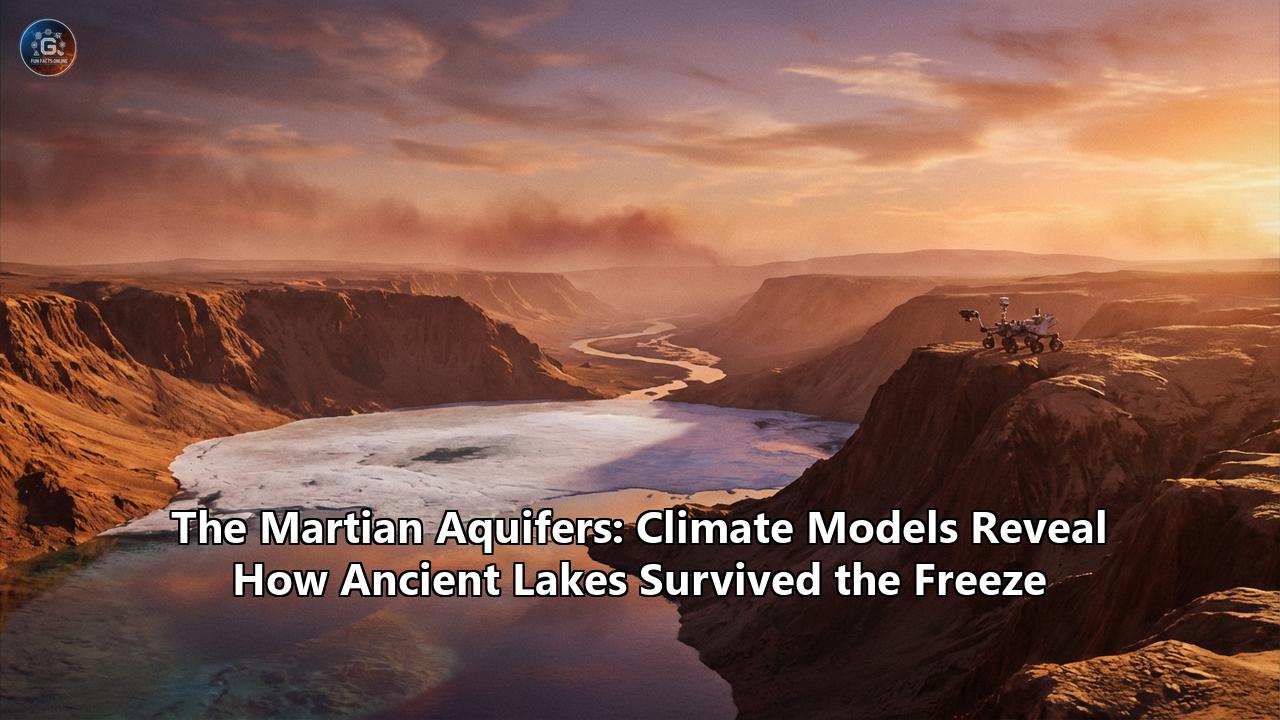
Now, a groundbreaking convergence of new climate simulations and geological analysis has offered a compelling solution. It appears that the Red Planet was indeed a frozen world, but one that harbored a secret. Beneath a protective veneer of seasonal ice, and fed by a vast, pulsating network of underground aquifers, ancient Martian lakes didn't just survive the deep freeze—they thrived.
The Paradox of the Faint Young Sun
To understand the magnitude of this discovery, one must first look at the solar system as it was 3.6 billion years ago. During the Noachian and early Hesperian periods—the eras when Mars’ most dramatic water features were formed—our sun was roughly 30% dimmer than it is today. In such a feeble light, Mars, positioned 140 million miles further out than Earth, should have been locked in a permanent ice age.
"If you run a standard climate model for early Mars, the numbers just don't add up for liquid water," explains Dr. Eleanor Moreland, a lead researcher whose team at Rice University recently published findings in AGU Advances. "The average global temperature would have been well below freezing. Yet, the Curiosity rover is rolling over mudstones in Gale Crater that could only have formed in a calm, long-standing lake."
This was the "Faint Young Sun" paradox. Previous theories tried to force the models to work by injecting massive amounts of greenhouse gases like carbon dioxide and hydrogen into the ancient atmosphere, attempting to warm the planet to Earth-like conditions. But these "warm and wet" scenarios often required atmospheric conditions that were chemically unstable or difficult to sustain for millions of years.
The new consensus, driven by sophisticated proxy system modeling, suggests we don't need to turn Mars into a tropical paradise to explain its water. We just need to understand the physics of ice.
The "Thin Ice" Solution
The breakthrough came when researchers stopped trying to melt the entire planet and started looking at how specific bodies of water behave in cold climates. The team adapted a climate model originally designed for Earth—used to reconstruct ancient climates from tree rings and ice cores—and re-engineered it for the Martian environment. They fed it data derived from the sediment layers of Gale Crater, treating the rocks themselves as a climate archive.
The simulations revealed a startlingly resilient mechanism. In a "cold and wet" Mars scenario, lakes weren't open bodies of shimmering blue water under a sunny sky. Instead, they were capped by a layer of ice, perhaps only a few meters thick.
This ice didn't crush the lake; it saved it.
"We found that a thin layer of seasonal ice acts like a thermal blanket," says Dr. Sylvia Dee, a climate modeler and co-author of the study. "It decouples the water below from the freezing atmosphere above. It prevents evaporation, which is a huge source of heat loss, while still allowing sunlight to penetrate during the summer months."
This "greenhouse effect" within the lake meant that even if the air temperature hovered at -10°C (14°F), the water beneath the ice could remain liquid, hovering just above the freezing point. The model showed that these conditions could stabilize a lake for decades, centuries, or even longer, without requiring a dense, heat-trapping atmosphere.
The Aquifer Connection: The Lifeline from Below
While the ice provided the shield, the water had to come from somewhere. This is where the story shifts from the surface to the deep subsurface—to the Martian aquifers.
The title of "aquifer" on Mars is not a misnomer; it is the central artery of the planet's hydrological system. Recent geological studies, including data from the European Space Agency’s Mars Express orbiter, have identified the fingerprints of a planet-wide groundwater system that once spanned the Martian globe.
In crater lakes like Gale and Jezero (where the Perseverance rover is currently exploring), the water wasn't just filling up from rain or snowmelt, which would have been scarce in a cold climate. It was being pushed up from below.
"Think of these lakes not as swimming pools being filled by a hose, but as windows into a massive, underground water table," notes Dr. Francesco Salese, a geologist who has mapped these ancient interconnected basins. "The pressure from the aquifers would force groundwater up into deep crater basins. This water was likely warmer than the surface, heated by the planet's internal geothermal gradient."
This creates a dynamic "sandwich" model for Martian habitability:
- Top Layer: A thin, seasonal ice cap that seals the system and traps solar heat.
- Middle Layer: Liquid water, rich in dissolved minerals.
- Bottom Layer: A connection to the warm, mineral-rich aquifers that constantly replenished the lake and provided chemical nutrients.
This interaction is crucial. If these lakes were isolated puddles, they would have eventually frozen solid or sublimated away. The connection to the aquifers meant they were part of a living, circulating planetary system. The groundwater influx helped regulate the temperature and chemistry of the lakes, preventing them from becoming too salty or too stagnant.
Evidence in the Mud
The proof of this theory lies in the rocks. The Curiosity rover has spent over a decade climbing Mount Sharp in Gale Crater, analyzing layer after layer of sedimentary rock. What it found was puzzling under the old "warm and wet" vs. "cold and dry" dichotomy.
Curiosity found mudstones—fine-grained sedimentary rocks formed by silt settling at the bottom of a calm body of water. Crucially, these layers show no evidence of the massive, chaotic ice wedges or glacial scarring that one would expect from a lake that froze solid to the bottom.
"The sediment layers in Gale are remarkably orderly," Moreland points out. "If you had a lake that was freezing solid every winter and thawing every summer, you'd see 'cryoturbation'—a churning of the soil that disrupts the layers. We don't see that. We see fine, undisturbed lamination. That tells us the water at the bottom stayed liquid and calm, protected by that ice lid."
Furthermore, the mineralogy supports the cold model. The presence of magnetite and certain clay minerals suggests formation in water that was cool but not frozen, and chemically neutral—conditions perfectly maintained by a groundwater-fed, ice-covered lake.
Beyond Gale: A Global Phenomenon?
The implications of the "thin ice" and aquifer model extend far beyond Gale Crater. It forces a re-evaluation of the entire Martian landscape.
In the southern highlands, researchers have identified vast networks of valleys that seem to start abruptly, emerging from the ground rather than collecting from wide catchment areas. These are "sapping valleys," formed when groundwater seeps out of an aquifer and erodes the earth away, causing the ground to collapse into a channel.
This aligns perfectly with the aquifer theory. During the Hesperian period, as the surface cooled and the atmosphere thinned, the water table may have remained liquid deep underground. Occasionally, this pressurized water would breach the surface, creating transient lakes and rivers that would quickly freeze over, preserving their liquid flow beneath the ice crust.
Even today, this system might not be entirely dead. Radar data from the south pole of Mars has hinted at the presence of liquid water—or briny slush—buried a mile beneath the ice caps. These could be the last remnants of the great Martian aquifers, retreating into the deep dark as the planet died.
A New Vision of Habitability
For astrobiologists, the shift from a "tropical Mars" to a "frozen aquifer Mars" is not a disappointment; it is an exciting pivot.
On Earth, some of the most stable and long-lived ecosystems are found in subglacial lakes like Lake Vostok in Antarctica, or in the deep groundwater of the crust. These environments are protected from surface radiation, stable in temperature, and rich in chemical energy—perfect for microbial life.
If ancient Martian lakes were covered by ice, that ice would have shielded potential life from the harsh ultraviolet radiation of the young sun, which Mars' thinning atmosphere could no longer block. The connection to aquifers would have provided a steady supply of dissolved ions—food for chemotrophic bacteria.
"We shouldn't be looking for Martian coral reefs," says Dr. Dee. "We should be looking for the kind of slow, hardy life that thrives in the dark, cold waters of Earth's cryosphere. The thin ice model suggests these habitats could have existed for millions of years, long enough for life to potentially gain a foothold."
The Road Ahead
As the Perseverance rover collects its samples in Jezero Crater—samples destined to return to Earth in the 2030s—scientists are now looking for specific signatures predicted by this new model. They are hunting for "dropstones" (rocks dropped into mud by melting ice rafts) and specific isotopic ratios in oxygen that would confirm the presence of an ancient ice cover.
The "Martian Aquifers" and the "Frozen Lakes" are no longer competing theories; they are two halves of the same hydrological engine. It was an engine that allowed a dying, freezing planet to hold onto its lifeblood for millions of years longer than anyone thought possible.
Mars, it seems, was not a failed Earth. It was a successful icy world, hiding its secrets beneath a glass-like shell, waiting for us to crack the code.
Reference:
- https://www.earth.com/news/ancient-lakes-on-mars-may-have-survived-beneath-thin-ice/
- https://scitechdaily.com/scientists-solve-mars-water-mystery-with-a-thin-layer-of-ice/
- https://www.discovermagazine.com/thin-ice-may-have-helped-ancient-lakes-survive-on-mars-48508
- https://www.smithsonianmag.com/smart-news/mars-may-have-had-planetary-system-underground-lakes-180971610/
- https://www.esa.int/Science_Exploration/Space_Science/Mars_Express/First_evidence_of_planet-wide_groundwater_system_on_Mars
- https://www.researchgate.net/publication/349970648_Was_Gale_Crater_Mars_Connected_to_a_Regionally_Extensive_Groundwater_System
- https://en.wikipedia.org/wiki/Water_on_Mars