
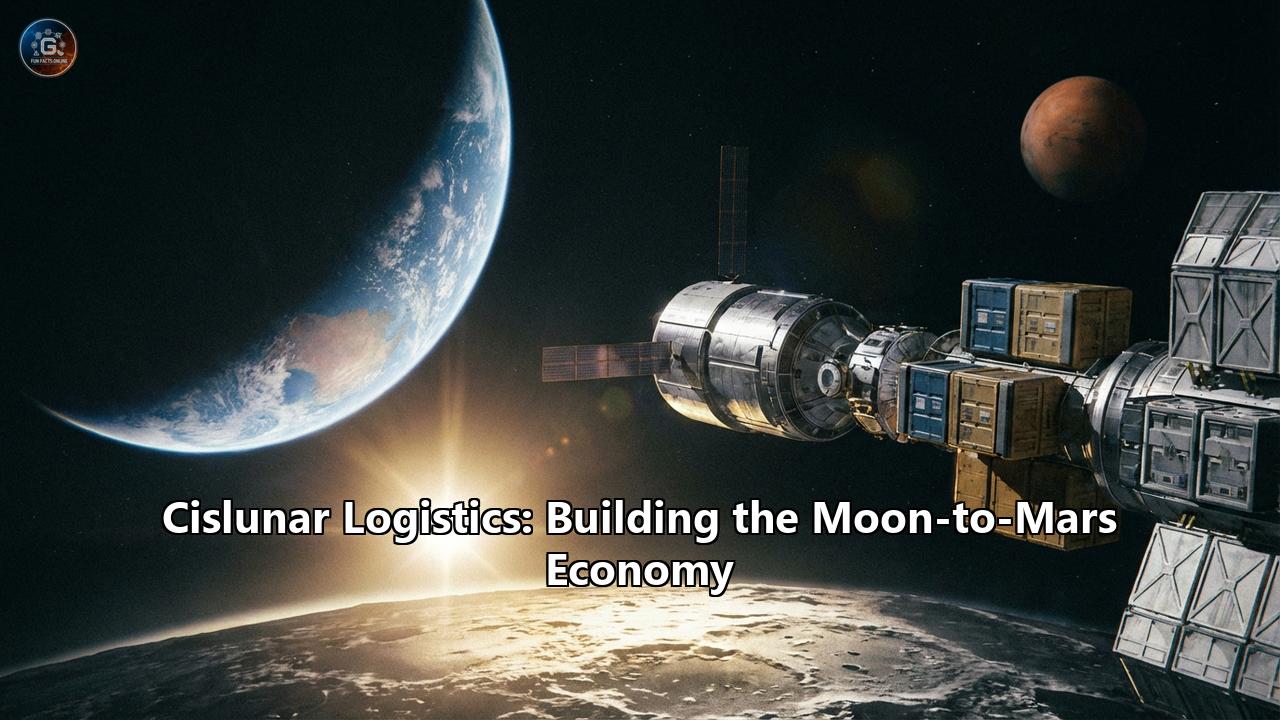
The dawn of the cislunar economy is no longer the province of science fiction writers or far-future visionaries. It is a tangible, unfolding reality, driven by a convergence of technological maturity, geopolitical competition, and a fundamental shift in how humanity approaches spaceflight. We are moving from an era of "flags and footprints"—discrete, destination-focused missions—to an era of "supply chains and sustainability." This transition is creating a new industrial geography between the Earth and the Moon, a region known as cislunar space.
This comprehensive analysis explores the emerging cislunar logistics network that will serve as the foundation for the Moon-to-Mars economy. It delves into the infrastructure being built today, the economic models driving it, the critical technologies required, and the complex geopolitical landscape that will govern this new frontier.
Part I: The New Geography of Cislunar Space
To understand the logistics of the future, one must first understand the terrain. In space, "terrain" is defined not by mountains and rivers, but by gravity wells, orbital mechanics, and energy budgets (delta-v). Cislunar space—the volume of space influenced by the gravity of the Earth and the Moon—is vast, extending roughly 1.5 million kilometers from Earth. However, it is not a uniform void; it is structured by invisible pathways and strategic high grounds.
1.1 The Superhighway Network
Just as maritime trade relies on shipping lanes and currents, cislunar logistics relies on specific trajectories that minimize fuel consumption. The most critical of these are the Lagrange Points, five locations in space where the gravitational forces of the Earth and Moon balance the centrifugal force felt by a smaller object.
- EML-1 (Earth-Moon Lagrange Point 1): Located between the Earth and the Moon, about 85% of the way to the lunar surface. EML-1 is the ideal location for a "toll booth" or a primary logistics hub. It offers a vantage point that commands the Nearside of the Moon and serves as a staging ground for descent to the surface.
- EML-2 (Earth-Moon Lagrange Point 2): Situated behind the Moon from Earth’s perspective. This is the gateway to the outer solar system and a perfect location for a propellant depot supporting Mars missions. It allows for halo orbits that provide continuous communication with the lunar Farside.
- NRHO (Near-Rectilinear Halo Orbit): The chosen orbit for NASA’s Lunar Gateway. It is a highly stable, elliptical orbit that passes close to the lunar North and South Poles, offering easy access to the surface for landers while minimizing the fuel needed to maintain the station’s position.
1.2 The Gravity Well Economics
The fundamental economic driver of cislunar logistics is the "rocket equation." Launching mass from Earth’s deep gravity well is energetically expensive. It takes roughly 9.3 km/s of delta-v just to reach Low Earth Orbit (LEO). In contrast, launching from the Moon’s shallow gravity well requires only about 2.3 km/s to reach a similar staging point.
This disparity creates the central business case for the Moon-to-Mars economy: Resource Extraction. If fuel (hydrogen and oxygen), water, and building materials can be sourced from the Moon or asteroids, they do not need to be lifted from Earth. This shatters the tyranny of the rocket equation. Early analysis suggests that sourcing propellant from the Moon for a Mars mission could reduce the mass required to be launched from Earth by over 40%, fundamentally changing the economic viability of interplanetary colonization.
Part II: The Logistics Backbone – Tugs, Depots, and Ports
A supply chain is only as good as its vehicles and nodes. The cislunar economy is rapidly moving away from "expendable" rockets toward a complex ecosystem of reusable transport vessels and permanent orbital infrastructure.
2.1 The Rise of the Space Tug
In the old paradigm, a rocket upper stage would push a payload to its destination and then become space junk. In the new paradigm, we are seeing the emergence of Orbital Transfer Vehicles (OTVs), or "space tugs." These are reusable spacecraft designed to ferry cargo between orbits.
- Impulse Space’s Helios: A high-energy kick stage designed to take payloads from LEO to Geostationary Orbit (GEO) or the Moon in under 24 hours. Unlike electric tugs which are slow, Helios uses liquid methane and oxygen to provide the high thrust needed for rapid transit, crucial for time-sensitive biological cargo or crew supplies.
- Momentus Vigoride: Using innovative water plasma propulsion, Vigoride represents a class of "last-mile delivery" vehicles. While smaller than Helios, its use of water as propellant aligns perfectly with a future where lunar ice is mined and processed into fuel, making it a potentially self-sustaining piece of the ecosystem.
- Nuclear Thermal Tugs: For heavy logistics—moving 50+ ton habitats or massive fuel tankers—chemical rockets are too inefficient. Companies like Atomos Space and government programs like DARPA’s DRACO are developing Nuclear Thermal Propulsion (NTP). NTP uses a nuclear reactor to superheat a propellant (like hydrogen), expelling it at high speeds. This technology doubles the efficiency of the best chemical rockets, effectively shrinking the solar system and allowing for rapid, heavy-lift transport between Earth, the Moon, and Mars.
2.2 Orbital Depots: The Gas Stations of Space
The "tyranny of the rocket equation" implies that long-duration missions are limited by the fuel they can carry. Orbital propellant depots solve this by decoupling launch from transit.
- LEO Depots: Massive storage tanks in Low Earth Orbit where Starships or other heavy lifters can top off before heading to the Moon. This allows a vehicle to launch with maximum cargo and minimum fuel, refuel in orbit, and then depart with a full tank.
- Cislunar Depots: Located at EML-1 or NRHO, these depots would store lunar-derived propellant. A Mars-bound ship could leave Earth empty (saving massive launch costs), fly to EML-1, fill up with lunar oxygen and hydrogen, and then burn for Mars.
- Metal Propellant Nodes: An emerging concept involves recycling space debris. Using metal-fueled thrusters (like Hall effect thrusters modified to use magnesium or zinc), "scrapyard" depots could grind down old satellite casings and turn them into fuel pellets for tugs. This creates a "circular economy" in orbit, cleaning up debris while powering logistics.
2.3 The Lunar Gateway and Commercial Ports
NASA’s Lunar Gateway is the first permanent piece of cislunar real estate. Orbiting in NRHO, it is not just a habitat but a multi-modal logistics hub. It will host visiting vehicles, aggregate cargo, and serve as a command post for surface operations.
However, commercial players are planning their own "business parks."
- Commercial LEO Destinations (CLDs): As the ISS retires around 2030, private stations from Blue Origin (Orbital Reef), Voyager Space (Starlab), and Axiom Space will take over. These will likely serve as the "Earth-side" manufacturing and consolidation hubs for goods heading outward.
- Lunar Surface Ports: Operations at the lunar South Pole (Shackleton Crater, Malapert Massif) will require landing pads, charging stations, and cryo-storage. These "Moon ports" will be the interface between the vacuum of space and the resource-rich regolith.
Part III: The Lunar Foundation – Mining and Industry
The engine of the cislunar economy is In-Situ Resource Utilization (ISRU). Without the ability to "live off the land," the Moon remains just a tourist destination. With ISRU, it becomes an industrial powerhouse.
3.1 The Water Ice Rush
Data from the Lunar Reconnaissance Orbiter (LRO) and Chandrayaan-3 confirms billions of tons of water ice trapped in the permanently shadowed regions (PSRs) of the lunar poles.
- The Process: Mining rovers (like NASA’s VIPER or commercial successors) will venture into these dark, -230°C craters. They will drill into the rock-hard regolith, sublimate the ice, capture the vapor, and transport it to a processing plant.
- The Product: Water is life. It is drinking water for crew and radiation shielding for habitats. More importantly, when split via electrolysis, it becomes Hydrogen (fuel) and Oxygen (oxidizer/breathing air).
- The Market: PwC estimates the cumulative lunar market could reach $170 billion by 2040, with resource utilization being a primary driver. Selling propellant in lunar orbit at $500,000 per ton is vastly cheaper than shipping it from Earth at $1 million+ per ton, creating an instant market for early mining operations.
3.2 Regolith and Construction
Beyond water, the lunar soil (regolith) itself is a resource.
- Oxygen Extraction: Regolith is roughly 40-45% oxygen by weight, bound in silicates and metal oxides. Processes like Molten Regolith Electrolysis can extract this oxygen, leaving behind metal alloys (iron, aluminum, silicon).
- 3D Printed Infrastructure: Companies like ICON are developing technologies to sinter regolith into landing pads, blast shields, and habitats. Launching concrete from Earth is impossible; printing it on the Moon is essential. This "dust-to-structure" capability will lower the cost of expanding lunar bases effectively to near-zero for raw materials.
3.3 Powering the Machine
Industrial mining requires megawatts of power, far more than solar panels can provide during the 14-day lunar night or in shadowed craters.
- Fission Surface Power: NASA and private partners are developing small, modular nuclear reactors (10-40 kW initially, scaling to MWs). These reactors are robust, independent of sunlight, and dense enough to be launched on standard rockets. They will be the heartbeat of the lunar industrial zone.
- Power Beaming: To get power into the dark craters where the ice is, "Tower of Power" concepts propose tall solar masts on crater rims (where sunlight is nearly continuous) beaming energy via laser or microwave down to rovers in the dark below.
Part IV: The Mars Bridge
The "Moon-to-Mars" architecture is not just a slogan; it is an engineering dependency. The Moon is the proving ground and the gas station for the Red Planet.
4.1 The "Aggregation" Concept
A human mission to Mars requires a massive amount of mass—roughly 300 to 500 metric tons departing Earth orbit. Launching this on a single rocket is impossible.
Instead, the mission is "aggregated" in cislunar space.
- The Habitat: Launched to NRHO or High Earth Orbit.
- The Propulsion Bus: Launched separately and docked.
- The Fuel: This is the game-changer. Instead of launching fully fueled tankers from Earth, the Mars ship is fueled by lunar-derived oxygen and hydrogen delivered by cislunar tugs.
This reduces the number of "Super Heavy" class launches from Earth required for a Mars mission from roughly 10-12 down to 4-6. It turns the Moon into an anchor tenant for the Mars logistics system.
4.2 Proving the Tech
Mars is 6 to 9 months away. The Moon is 3 days away.
- Life Support: If a CO2 scrubber fails on the way to Mars, the crew dies. If it fails at the Lunar Gateway, the crew can abort home. The cislunar "shakedown" cruises will push closed-loop life support systems to their breaking points in a safe-fail environment.
- Surface Operations: Dust on Mars is toxic (perchlorates) and abrasive. Lunar dust is razor-sharp and electrostatically charged. Mastering dust mitigation on the Moon—airlocks that use electrostatic cleaning, suits with dust-shedding fabrics—is a prerequisite for Mars survival.
Part V: The Economic Engine
Who pays for all of this? The transition from government funding to commercial revenue is the "valley of death" for cislunar logistics. However, the business case is strengthening.
5.1 The Trillion-Dollar Forecast
Analysts project the global space economy to reach $1.8 trillion by 2035. While much of this is satellites and Earth observation, the "cislunar" slice is growing.
- Anchor Tenancy: NASA’s Artemis program and the China-led ILRS are the initial "anchor tenants." They are signing contracts worth billions for delivery services (CLPS), landers (HLS), and spacesuits. This government spending de-risks the technology for private players.
- Commercial Revenue Streams:
Propellant Sales: Selling fuel to NASA, ESA, and other commercial satellite operators.
Waste Disposal: Disposal of dangerous orbital debris or nuclear waste into "graveyard" solar orbits via cislunar tugs.
Data & PNT: The "lunar GPS" market. A constellation of satellites around the Moon providing navigation and high-speed internet (LunaNet) is a service that every lander and rover will pay to subscribe to.
Sovereign-Commercial Nexus: Nations without their own launch capabilities (e.g., UAE, Luxembourg, South Korea) are paying US and Japanese firms to fly their payloads to the Moon.
5.2 The Startup Ecosystem
The heavy lifting is done by giants like SpaceX (Starship) and Blue Origin (New Glenn/Blue Moon), but the ecosystem is filled with agile specialists.
- Firefly Aerospace: Their "Elytra" line of vehicles offers specialized tug services and lunar landing capabilities.
- Astrobotic & Intuitive Machines: These companies are the "FedEx of the Moon," handling the complex logistics of landing payloads for paying customers.
- CisLunar Industries: Focusing on in-space metal processing, aiming to turn debris into rods for electric thrusters.
This diversity creates a resilient supply chain. If one provider fails, others can step in, preventing the single-point-of-failure risks that plagued the Shuttle era.
Part VI: The Legal and Political Framework
Space law is the "software" that allows this hardware to operate. Currently, it is a buggy beta version.
6.1 The Artemis Accords vs. ILRS
The 1967 Outer Space Treaty (OST) is the constitution of space, but it is vague on resource extraction.
- The Artemis Accords: Led by the US, these non-binding principles interpret the OST to allow for the extraction and ownership of space resources. Signatories agree to "safety zones" around their operations to prevent interference. It creates a "club" of nations operating under Western norms of transparency and interoperability.
- The ILRS (International Lunar Research Station): Led by China and Russia, this is a competing bloc. While the scientific goals are similar, the governance model is different.
This bifurcation creates a risk of "balkanization" in cislunar space, with two separate supply chains, two separate communication standards, and potential friction over prime real estate at the lunar South Pole.
6.2 Managing the Traffic
With thousands of satellites projected to enter cislunar space, "Space Traffic Management" (STM) is critical.
- The "Wild West" Problem: Currently, there is no central air traffic controller for the Moon. If a Starship and a Chinese Long March 10 are on colliding trajectories, who moves?
- Proposed Solutions: Concepts like the "Cislunar Traffic Management System" (CTMS) and the "Lunar Spectrum Management Portal" are being developed to coordinate orbits and radio frequencies. The goal is to establish "Rules of the Road" (e.g., right-of-way for crewed vessels, mandatory transponders) before a collision occurs.
6.3 The Sovereign-Commercial Nexus
A unique challenge is that private companies are often the tip of the spear. If a US company's mining rover is blinded by dust kicked up by a Chinese lander, is that an act of corporate negligence or an international incident? The US government is increasingly liable for its commercial actors under the OST, leading to a tighter integration between commercial licensing and national security strategy.
Part VII: Future Vision – The Cislunar Economy in 2040
If these trends hold, what does cislunar space look like in 2040?
Imagine a cargo shipment leaving Earth. It launches on a reusable super-heavy lifter, not to the Moon, but to a Low Earth Orbit Depot. There, the cargo container—standardized, intermodal, like a shipping container—is transferred by robotic arm to a nuclear-thermal Cycler Tug.
This tug never lands. It shuttles endlessly between LEO and the EML-1 Gateway. The journey takes days, not months. At EML-1, the cargo is offloaded. The tug refuels with liquid hydrogen shipped up from the Shackleton Industrial Zone on the lunar surface.
The cargo container is then loaded onto a Lunar Descent Shuttle for the final leg down to the surface, or perhaps transferred to a Mars Transfer Vehicle assembling at EML-2.
On the lunar surface, the "town" of Artemis Base Camp is a bustle of activity. It is not just scientists; it is mining engineers, reactor technicians, and hydroponic farmers. The lights never go out, powered by the hum of fission reactors. In the distance, a mass driver shoots canisters of processed oxygen into orbit to catch the next tug.
This is the Cislunar Logistics Network. It is the infrastructure that turns space from a place we visit into a place we live. It is the bridge that transforms humanity from a single-planet species into a multi-planetary civilization. The "Moon-to-Mars Economy" is not just about going there; it is about building the supply chain that ensures we can stay there.
Part VIII: Critical Technologies in Detail
To fully appreciate the scale of this endeavor, we must look closer at the specific technologies that make it possible. These are the nuts and bolts of the Moon-to-Mars machine.
8.1 Cryogenic Fluid Management (CFM)
Storing liquid hydrogen (-253°C) and liquid oxygen (-183°C) in space is a nightmare. Heat from the sun, the Earth, and even the spacecraft’s own electronics causes the fuel to "boil off" and vent into space.
- Zero Boil-Off (ZBO): Future depots will use active cryocoolers (essentially space-rated refrigerators) powered by large solar arrays or nuclear sources to keep the fuel liquid indefinitely.
- Propellant Transfer: Transferring liquid fuel in zero-gravity is difficult because the liquid floats in globules rather than settling at the bottom of the tank. New technologies using surface tension vanes and settling thrusters are being tested to ensure that when you pump fuel, you get liquid, not gas.
8.2 Autonomous Rendezvous and Docking (AR&D)
In the Apollo era, docking was done by pilot astronauts with nerves of steel. In the cislunar economy, thousands of docking operations will happen annually, mostly between uncrewed robotic vehicles.
- LiDAR and Computer Vision: Tugs will use advanced sensors to build real-time 3D models of their target depots, allowing for autonomous docking even in the harsh lighting conditions of cislunar space.
- Standardized Interfaces: Just as USB became the standard for electronics, the "International Docking System Standard" (IDSS) ensures that a SpaceX tug can dock with a Blue Origin depot or a European habitat.
8.3 In-Space Manufacturing (ISM)
Why ship a spare part from Earth when you can print it?
- Spare Parts on Demand: A Mars mission cannot carry a spare for every single valve and bolt. Instead, they will carry 3D printers and feedstock (metal wire, polymer powder). If a part breaks, they print a replacement.
- Recycling: ISM allows for the recycling of waste plastic and packing foam into printer filament, closing the loop on logistics waste.
Part IX: The Human Element – The Cislunar Workforce
While robots will do the heavy lifting, humans are the essential decision-makers. The cislunar economy will require a new kind of workforce.
9.1 The Orbital Blue-Collar Worker
We are moving beyond the era of the "scientist-astronaut." The future demands technicians, electricians, and mechanics.
- Hazard Pay: Working in cislunar space involves exposure to Galactic Cosmic Rays (GCRs) and Solar Particle Events (SPEs). Medical logistics—the ability to treat radiation sickness, trauma, and acute illness in microgravity—will be a major service industry.
- Training: Training centers on Earth will simulate not just the flight, but the industrial operations: repairing a jammed drill on a rover, welding a hull breach, or managing a propellant transfer.
9.2 Life in the Halo Orbit
Living at the Lunar Gateway or a commercial station in NRHO is different from the ISS.
- Isolation: The Earth appears as a marble, not a sprawling continent. The psychological strain is higher.
- Supply Lines: You cannot just "de-orbit" in an emergency to be home in 4 hours. Return from NRHO takes days. Logistics planning for food, medicine, and morale becomes a critical safety discipline.
Part X: Conclusion – The Great Logistics Challenge
Building the Moon-to-Mars economy is the greatest logistics challenge in human history. It requires coordinating assets across hundreds of thousands of kilometers, managing supply chains with zero margin for error, and inventing entire industries from scratch.
It is a challenge that involves not just aerospace engineers, but economists, lawyers, geologists, and diplomats. It is a test of our ability to cooperate as a species to manage a resource-rich frontier peacefully.
The rockets are being built. The contracts are signed. The maps are drawn. The first shipments of the cislunar era are already on the manifest. We are witnessing the construction of the road to the stars, and it is paved with logistics.
Reference:
- https://www.youtube.com/watch?v=vo-7Nddcf08
- https://manuals.plus/m/0c1b88dff937f7ec6989f698fcec2c67342542c973080054f4c5224d7777f0b1
- https://www.youtube.com/watch?app=desktop&v=iRDSbr5Fit0
- https://www.thespacereview.com/article/4898/1
- https://ntrs.nasa.gov/api/citations/20200002707/downloads/20200002707.pdf