
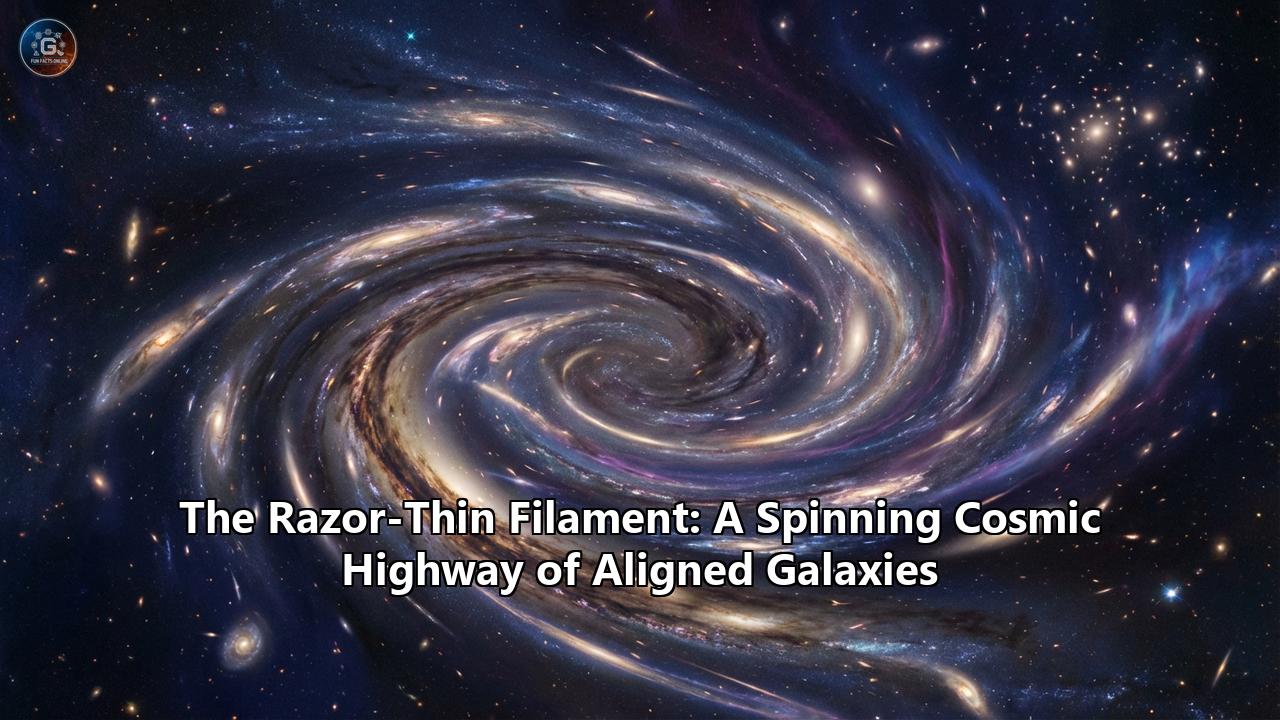
In the vast, silent theatre of the cosmos, where galaxies are often imagined as isolated islands drifting through the dark, a startling new discovery has shattered our understanding of celestial mechanics. Astronomers have unveiled a structure that defies the chaotic randomness of the void: a "razor-thin" filament of galaxies, stretching millions of light-years, spinning with the precision of a cosmic ballet. This is not merely a cluster of stars; it is a coherent, rotating highway, a mechanism of the universe that suggests the large-scale structure of reality is far more dynamic—and far more interconnected—than we ever dared to dream.
This discovery, announced just yesterday by an international team led by the University of Oxford, has sent ripples through the scientific community. It challenges our standard models of how galaxies are born, how they acquire their spin, and how the invisible scaffolding of Dark Matter shapes the visible universe.
Part I: The Architecture of the Invisible
To truly appreciate the magnitude of this discovery, we must first understand the stage upon which it is set. When we look up at the night sky, we see stars and, with telescopes, galaxies. But these visible objects are merely the fairy lights strung upon a much darker, more massive structure.
The Cosmic WebThe universe is not a uniform scattering of matter. It is a web. Computer simulations of the early universe, starting from the Big Bang, reveal that matter collapses under gravity into a distinct architecture known as the "Cosmic Web." This web consists of four primary components:
- Voids: Vast, empty bubbles of space, millions of light-years across, largely devoid of galaxies.
- Walls: Sheet-like structures that separate the voids.
- Filaments: The thick, thread-like strands where walls intersect. These are the superhighways of the universe, channeling gas and dark matter.
- Nodes: The dense intersections of filaments, where galaxy clusters—the largest gravitationally bound structures in the universe—reside.
For decades, this web was a static map. We knew matter flowed along the filaments into the nodes, feeding the growth of galaxy clusters. But we viewed these filaments largely as pipes—passive conduits for material. The new discovery changes this metaphor entirely. The pipes are not just carrying matter; they are spinning, twisting, and imparting their angular momentum to everything they contain.
Part II: The Discovery of the "Razor-Thin" Filament
The structure in question, located approximately 140 million light-years away, was identified using data from the MIGHTEE survey (MeerKAT International GHz Tiered Extragalactic Exploration). It is a sub-filament, a delicate strand embedded within a much larger cosmic structure.
The Dimensions of a GiantWhile the larger "parent" filament stretches over 50 million light-years, the newly discovered "razor-thin" strand is a marvel of cosmic proportions. It spans roughly 5.5 million light-years in length but is only 117,000 light-years wide. To put this in perspective, if the filament were a standard pencil, it would be kilometers long. This extreme aspect ratio—a thin, blade-like line of galaxies—is rare and suggests a highly organized formation process.
The "Teacup" DynamicsWhat makes this structure truly exceptional is not its shape, but its motion. Dr. Lyla Jung, co-lead author of the study, used a vivid analogy to explain the phenomenon: "You can liken it to the teacups ride at a theme park. Each galaxy is like a spinning teacup, but the whole platform—the cosmic filament—is rotating too."
Using the MeerKAT radio telescope in South Africa, combined with optical data from the Dark Energy Spectroscopic Instrument (DESI) and the Sloan Digital Sky Survey (SDSS), the team analyzed 14 specific galaxies rich in neutral hydrogen (HI). They found two synchronized motions:
- Bulk Rotation: The entire filament is rolling like a log in water. Galaxies on one side of the filament are moving away from us (redshifted relative to the filament's center), and galaxies on the other side are moving toward us (blueshifted). This indicates a rotation speed of approximately 110 kilometers per second.
- Spin Alignment: The individual galaxies inside the filament are not spinning randomly. Their axes of rotation are aligned with the rotation of the filament itself.
This "coherent alignment" is the smoking gun. In a chaotic universe, galaxy spins should be randomized. For them to be synchronized with their parent filament implies a powerful, organized transfer of angular momentum from the largest scales of the cosmos down to the individual galaxies.
Part III: The Physics of Cosmic Spin
One of the deepest unsolved problems in cosmology is the origin of spin. Why do galaxies rotate?
In the early universe, matter was almost perfectly uniform. Gravity amplifies tiny density fluctuations, pulling matter inward. But gravity pulls radially; it doesn't inherently cause rotation. If you drop a ball straight down, it doesn't start spinning on its own. So, where did the angular momentum come from?
Tidal Torque Theory (TTT)The leading explanation is Tidal Torque Theory. It suggests that as a "protogalaxy" (a cloud of gas and dark matter) forms, it is tugged on unevenly by the gravitational pull of surrounding structures. If a massive wall of matter is to the left and a void is to the right, the differential pull (torque) can twist the collapsing cloud, giving it a slight spin.
However, TTT has limits. It works well for the early stages of formation, but it struggles to explain strong alignments in the mature universe. The "Razor-Thin" filament suggests that the relationship is more direct and prolonged. The filament itself is a spinning vortex, and the galaxies born within it inherit this motion, much like eddies forming in a swirling river.
Part IV: The Instruments of Revelation
This discovery was only possible due to a convergence of cutting-edge technology.
MeerKAT: The Ear of the Southern SkyLocated in the semi-desert Karoo region of South Africa, MeerKAT is a precursor to the Square Kilometre Array (SKA). It consists of 64 interlinked satellite dishes. Its sensitivity to radio waves is unparalleled, allowing it to detect the faint signature of neutral hydrogen (HI).
Neutral hydrogen is the fuel of star formation. It is also the perfect tracer for cosmic dynamics. Unlike stars, which are dense and compact, hydrogen gas extends far beyond the visible edge of a galaxy. It is easily disturbed and influenced by the gravitational environment. By mapping the hydrogen, MeerKAT revealed the hidden velocity structure of the filament that optical telescopes would have missed.
Optical Surveys: DESI and SDSSWhile MeerKAT listened to the radio whispers of hydrogen, DESI and SDSS provided the optical context. They mapped the positions of hundreds of surrounding galaxies, allowing the team to see the "skeleton" of the larger filament in which the razor-thin strand was embedded. This multi-wavelength approach—combining radio and optical data—is the new gold standard in astrophysics.
Part V: Implications for Dark Matter and Cosmology
The rotating filament acts as a laboratory for studying Dark Matter. We cannot see dark matter, but we can see its gravitational effects. A filament of this size and rotation speed must be anchored by a massive scaffold of dark matter.
Cold Dark Matter (CDM) VerificationThe discovery supports the "Cold Dark Matter" model, which predicts that structure forms "bottom-up" (small things merge to make big things) but also allows for large-scale collapses into filaments. However, the tightness and speed of the rotation challenge our simulations. Most simulations produce messy, turbulent filaments. To get a "razor-thin," coherent, rotating cylinder suggests that our simulations might be missing some physics—perhaps related to gas dynamics or the precise nature of dark matter itself.
The "Fossil Record" of the UniverseDr. Madalina Tudorache, a co-lead author, referred to the filament as a "fossil record of cosmic flows." Because the galaxies in this filament are gas-rich and "dynamically cold" (meaning they haven't been disrupted by violent collisions), they represent a pristine look at galaxy formation. They are effectively time capsules, showing us how galaxies looked and moved as they were first being fed by the cosmic web.
Part VI: The Future of the Field
This discovery is likely the tip of the iceberg. If one such spinning filament exists 140 million light-years away—cosmically next door—the universe must be teeming with them.
The Euclid and Rubin EraUpcoming missions like the European Space Agency's Euclid telescope and the Vera C. Rubin Observatory will map billions of galaxies. The "Razor-Thin" filament provides a crucial calibration point for these missions.
One major goal of Euclid is to measure "weak gravitational lensing"—the tiny distortion of background light caused by mass. But if galaxies naturally align with their filaments (as this study shows), they can mimic the signal of lensing. Astronomers call this "intrinsic alignment." It is a nuisance for lensing studies, but a treasure trove for structure formation studies. Understanding the spinning filament allows scientists to correct for these alignments, making their maps of the dark universe more accurate.
The Square Kilometre Array (SKA)When the full SKA comes online, it will be thousands of times faster than MeerKAT. It will be able to map the spin of millions of filaments, effectively creating a dynamic weather map of the universe. We will move from a static picture of the cosmic web to a fluid dynamic model, watching the universe flow, swirl, and evolve.
Conclusion: The Spinning Universe
The universe is often described as expanding, but rarely as spinning. The discovery of the Razor-Thin Filament adds a new verb to our cosmic vocabulary. We live in a universe that twists.
From the quantum spin of an electron to the rotation of the Earth, and now to the majestic roll of filaments spanning millions of light-years, angular momentum appears to be a fundamental currency of reality. This filament, a "spinning cosmic highway," reminds us that we are not static observers on a rock. We are part of a vast, interconnected, and dynamic system, whirling through the dark in a grand, synchronized dance that began with the birth of time itself.
As we peer deeper into the web, we can only wonder: what other giants are turning in the dark, waiting for us to tune our telescopes to their silent rhythm?
Reference:
- https://www.naturalnews.com/2025-12-04-astronomers-discover-spinning-structures-universe.html
- https://www.ox.ac.uk/news/2025-12-04-astronomers-spot-one-largest-spinning-structures-ever-found-universe-0
- https://www.spacedaily.com/reports/Vast_spinning_galaxy_filament_mapped_in_nearby_Universe_999.html
- https://universemagazine.com/en/astronomers-discover-huge-filament-of-galaxies-140-million-light-years-away/
- https://www.sciencealert.com/tornado-of-galaxies-could-be-the-longest-spinning-structure-ever-seen
- https://www.iflscience.com/exceptional-55-million-light-year-long-cosmic-structure-appears-to-be-rotating-challenging-current-models-of-the-universe-81785
- https://www.space.com/astronomy/scientists-discover-one-of-our-universes-largest-spinning-structures-a-50-million-light-year-long-cosmic-thread
- https://idia.ac.za/2022/04/25/are-galaxies-spinning-in-alignment-with-the-cosmic-web/
- https://www.researchgate.net/figure/The-alignment-of-dark-matter-halo-spin-with-filaments-over-cosmic-time-Alignment-is_fig3_221660492
- https://ras.ac.uk/news-and-press/research-highlights/teacup-spinning-structure-one-largest-ever-seen-universe
- https://www.livescience.com/space/astronomy/giant-rotating-string-of-14-galaxies-is-probably-the-largest-spinning-object-in-the-known-universe