
The dark, viscous sludge began arriving on the beaches of Northeast Brazil in late August 2019. It wasn't a trickle; it was an invasion. Along 3,000 kilometers of pristine coastline—spanning nine states and affecting famous tourist destinations like Porto de Galinhas—black tar mats smothered coral reefs, mangroves, and sea turtle nesting grounds. The government was baffled. There were no reports of tanker accidents, no distress calls from oil platforms, and no obvious culprits.
In the absence of a smoking gun, the world turned to a different kind of detective: the environmental forensic scientist.
Unlike a standard crime scene investigator who looks for fingerprints on a weapon, these scientists looked for "fingerprints" inside the molecules of the oil itself. They collected samples of the sludge and ran them through gas chromatography-mass spectrometry (GC-MS). They looked past the volatile compounds that had already evaporated in the tropical sun and focused on the "biomarkers"—complex molecules like steranes and terpanes. These are the fossils of the ancient algae and plankton that formed the oil millions of years ago. Because every oil reservoir on Earth has a unique geological history, every reservoir has a unique ratio of these biomarkers. It is a chemical barcode that cannot be faked.
The results were unequivocal. The oil was not Brazilian. It didn't match the light, sweet crude produced by Petrobras. It was a heavy, sour crude. The chemical signature matched, with high precision, the heavy crude oil produced in the Orinoco belt of Venezuela.
But identifying the type of oil was only half the battle. Venezuela exports oil all over the world. Who spilled it? Scientists combined this chemical data with oceanographic modeling—simulating currents, wind speeds, and water temperature backward in time. They narrowed the window of the spill to a specific patch of ocean and a specific timeframe. Satellite data was scrubbed for ships that had passed through that exact "box" of water. The investigation zeroed in on a Greek-flagged tanker, the NM Bouboulina, which had been carrying Venezuelan crude. While the legal battles and denials continued, the science had done its job: it had turned an "act of God" into a human timeline of events, tracing a silent ecological assassin back to its source.
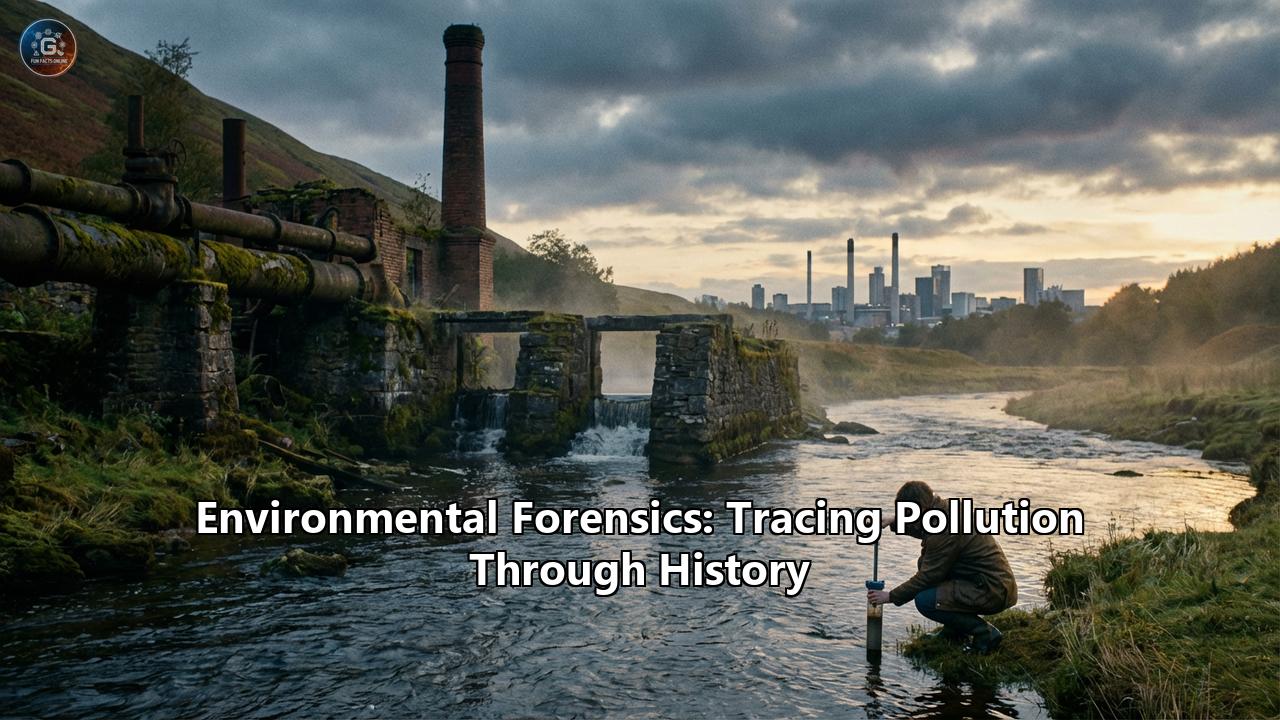
This is the world of Environmental Forensics. It is a discipline where chemistry meets law, where history is read in the rings of trees and the layers of ice, and where the Earth itself serves as the ultimate witness stand.
Part I: The Silent Witnesses
To understand how pollution is traced, one must first understand that the Earth is a meticulous record keeper. Long before humans invented writing, the planet was writing its own history in the sediment of lakes, the ice of glaciers, and the skeletons of coral.
The Ice Archives
In the frozen wastelands of the Arctic and the high Andes, snow falls year after year, compacting into distinct layers of ice. These layers are time capsules. They trap tiny bubbles of ancient air and microscopic particles of dust.
In 2015, researchers from the Paul Scherrer Institute climbed the Illimani glacier in Bolivia. They drilled a core of ice extracting a cylinder that contained thousands of years of climatic history. When they analyzed the lead isotopes in the ice, they found a startling economic history of South America.
Lead occurs naturally in four stable isotopes: Pb-204, Pb-206, Pb-207, and Pb-208. The ratio of these isotopes varies depending on where the lead was mined. By measuring these ratios in the ice layers, the scientists reconstructed the rise and fall of civilizations. They saw spikes in lead pollution corresponding to the silver mining of the Inca Empire. They saw a massive surge during the Spanish colonial era, as silver production at the famous Potosí mines released dust into the atmosphere that drifted to the glacier.
But the most distinct signal appeared after 1960. The ratio of lead isotopes shifted dramatically. It no longer matched the local mines. Instead, it matched the isotopic signature of lead additives used in gasoline in neighboring countries like Chile, Argentina, and Brazil. The glacier had recorded the exact moment the continent fell in love with the automobile. This distinction—between "mining lead" and "gasoline lead"—is a classic forensic tool. It allows regulators to look at a contaminated playground today and tell if the lead in the soil came from the old smelter down the road or from the exhaust of cars that drove past thirty years ago.
The Dendro-Detectives
Trees are perhaps the most accessible forensic archives. Dendrochronology, the study of tree rings, is famous for dating old buildings, but dendrochemistry is the study of what is trapped inside those rings.
When a tree takes up water through its roots, it also takes up dissolved chemicals. If a factory upstream dumps mercury into the river in 1985, the trees along the bank will absorb that mercury. It becomes locked in the wood of the 1985 ring.
In a famous forensic case in the United States, a man was accused of illegally logging valuable cedar trees from public land. When police searched his property, they found a woodpile, but the suspect claimed the wood came from his own private land. The stumps in the forest were the "bodies," and the logs in his yard were the "suspects."
Forensic botanists didn't just look at the species; they looked at the chemical fingerprint. Using a technique called Laser-Induced Breakdown Spectroscopy (LIBS), they zapped the wood with a high-energy laser, creating a tiny plasma spark. The light emitted by that spark revealed the elemental composition of the wood—the specific mix of magnesium, calcium, aluminum, and strontium drawn from the soil where the tree grew. The chemical profile of the logs in the suspect’s yard was a perfect match to the stumps in the protected forest, and completely different from the trees on his own land. The soil chemistry had convicted him.
The Anthropocene Coral
In the Mediterranean Sea, off the coast of Spain, a species of coral known as Cladocora caespitosa has been building reefs for centuries. Corals, like trees, grow in annual bands. A study published by University College London found that these corals have been embedding a new kind of material in their calcium carbonate skeletons: Spheroidal Carbonaceous Particles (SCPs).
SCPs are fly-ash. They are created only by the high-temperature combustion of fossil fuels (coal and oil). They do not exist in nature. By dissolving the coral layers and counting these particles, scientists created a timeline of industrialization. They found that the concentration of these pollutants in the coral skeletons mirrored, almost perfectly, the historical records of coal imports and oil consumption in Spain throughout the 20th century. The corals were not just dying from climate change; they were physically incorporating the very pollution that was warming their waters.
Part II: The Detective’s Toolbox
How do scientists extract these stories? The toolbox of the environmental forensic scientist is high-tech, expensive, and incredibly sensitive.
1. Gas Chromatography-Mass Spectrometry (GC-MS)
This is the workhorse of the field. Imagine a perfume that smells like roses, vanilla, and smoke. If you wanted to know exactly what was in it, you would need to separate those scents.
Gas Chromatography (GC) does the separation. The sample is vaporized and pushed through a very long, very thin coil of wire (the column) by a carrier gas (usually helium). Different compounds travel through this coil at different speeds. Lighter, more volatile molecules race through quickly; heavier, stickier molecules take longer. They exit the coil one by one.
Mass Spectrometry (MS) does the identification. As each compound exits the coil, it is bombarded with electrons, shattering it into fragments. These fragments are sorted by their mass. The pattern of fragments—the "mass spectrum"—is unique to each chemical. It is a fingerprint. Benzene always shatters the same way. PCBs always shatter the same way.
In environmental forensics, GC-MS is used to "fingerprint" complex mixtures. For example, if a basement is full of gasoline fumes, GC-MS can tell if the gasoline is fresh (containing lots of light, volatile compounds) or weathered (where the light stuff has evaporated). It can sometimes even identify the brand of gasoline or the year it was refined, based on the additives present.
2. Isotope Ratio Mass Spectrometry (IRMS)
While GC-MS looks at molecules, IRMS looks at atoms.
Most carbon atoms are Carbon-12 (6 protons, 6 neutrons). But a small percentage are Carbon-13 (6 protons, 7 neutrons). They are chemically identical—they react the same way—but they have different weights.
Nature discriminates between these isotopes. Plants prefer the lighter Carbon-12 because it is energetically cheaper to use during photosynthesis. Therefore, anything derived from plants (like corn syrup) will have a lower ratio of C-13 to C-12 than something derived from inorganic sources.
This is how forensic scientists catch food fraudsters. If a honey producer dilutes their product with cheap corn syrup, the chemical sugar profile (glucose/fructose) might look the same. But the isotopic profile will be wrong. The corn syrup will have a "plant" isotopic signature that looks different from the nectar collected by bees.
In pollution cases, this is vital for distinguishing between Biogenic and Petrogenic sources.
- Biogenic: Methane produced by rotting swamp vegetation (swamp gas).
- Petrogenic: Methane leaking from a natural gas pipeline.
To the naked eye (and the nose), methane is methane. But swamp gas is made by bacteria recently. Natural gas was made by heat and pressure millions of years ago. The isotopic ratios of hydrogen and carbon in the methane will be completely different. This allows gas companies to prove that the methane bubbling up in a farmer's pond is natural swamp gas, not a leak from their nearby pipeline—or vice versa.
3. Surrogate Chemicals and Additives
Sometimes, the pollutant itself is too common to trace. So, detectives look for what it travels with.
In the 1990s, the chemical MTBE (Methyl tert-butyl ether) was added to gasoline in the US to help it burn cleaner. It was a disaster for groundwater; MTBE dissolves easily in water and travels fast. However, for forensic scientists, it became a useful clock. If groundwater is contaminated with gasoline containing MTBE, the spill likely happened after 1979 (when it was introduced) and before the mid-2000s (when it was banned in many states).
Similarly, in the timeline of clothing, fabrics treated with certain flame retardants or stain repellents (like early PFAS formulations) serve as markers. If a landfill is leaching a specific type of PFAS that was only manufactured between 2000 and 2002, investigators have a huge clue about who dumped the waste.
Part III: The Legal Battlefield
The driving force behind the explosion of environmental forensics was not just scientific curiosity; it was money. specifically, liability.
In 1980, the United States Congress passed CERCLA, commonly known as the Superfund Act. It was a reaction to the Love Canal disaster, where a neighborhood in Niagara Falls was built on top of a toxic waste dump. CERCLA changed the game with a concept called "Strict, Joint and Several Liability."
- Strict Liability: You are responsible for the cleanup even if you didn't mean to pollute and even if what you did was legal at the time.
- Joint and Several: If five companies dumped waste in a site, but four of them have gone bankrupt, the government can make the one remaining solvent company pay for 100% of the cleanup.
This created a high-stakes environment. If you are Company X, and you are facing a $50 million cleanup bill for a river, you are very motivated to prove that 80% of the oil in that river actually came from the refinery next door (Company Y).
This is where the "Battle of the Experts" begins.
Case Study: The Tonawanda Coke Victory
For decades, the residents of Tonawanda, New York, suspected that the local coke plant (a facility that bakes coal to create fuel for steel mills) was making them sick. Black soot covered their cars; the air smelled of benzene. But the company, Tonawanda Coke Corporation (TCC), insisted they were in compliance.
Residents, tired of being ignored, turned to citizen science. They used simple 5-gallon buckets to trap air samples. The results showed high levels of benzene. But to win in court, they needed more than buckets.
Federal prosecutors and environmental regulators stepped in with advanced forensics. They didn't just measure the amount of soot; they analyzed the chemical structure of the soil. Coke ovens release a very specific mixture of Polycyclic Aromatic Hydrocarbons (PAHs). The fingerprint of "coke oven PAH" is different from "diesel truck PAH" or "wood burning PAH."
The forensic mapping showed a plume of these specific chemicals radiating outward from the plant, defying the wind patterns the company claimed would carry pollution away. In 2013, a federal jury found TCC guilty of violating the Clean Air Act. In a historic ruling, the judge didn't just fine them; he ordered them to fund a $12 million health and environmental study. It was a victory won not just by outrage, but by the precise, defensible identification of molecules.
Part IV: The Oil Spill Detectives
Oil spills are the most photogenic of environmental crimes, but they are also among the most complex to solve chemically.
When crude oil spills into the ocean, it immediately begins to change. This process is called weathering.
- Evaporation: The light, volatile compounds (like benzene and toluene) vaporize within hours.
- Dissolution: Some compounds dissolve into the water column.
- Photo-oxidation: The sun's UV rays blast the oil molecules, changing their structure (often creating new, more toxic compounds).
- Biodegradation: Bacteria eat the "tasty" parts of the oil (the simple straight-chain alkanes).
If a scientist scoops up a tarball from a beach three weeks after a spill, it looks chemically very different from the fresh oil that leaked from the tanker. If you try to match the tarball to the tanker using a simple "fingerprint" of the whole oil, they won't match.
Forensic scientists solve this by focusing on the Refractory Biomarkers. These are the large, bulky molecules (like hopanes and steranes) that bacteria find too hard to eat and the sun finds too hard to break. They are the "diamondoids" of the oil world—tough and persistent.
By ignoring the parts of the oil that degrade and calculating the ratios of these tough biomarkers (e.g., the ratio of C29 Sterane to C30 Hopane), scientists can see through the weathering. It’s like facial recognition software that works even if the suspect has aged 20 years and grown a beard; the underlying bone structure (the biomarkers) remains the same.
This technique was critical in the Deepwater Horizon disaster. While the source of the massive gusher was obvious, the legal question was: how far did the oil go? Did the oil found in the marshes of Florida come from the BP well, or was it from local ships, or natural seeps? BP's liability for damages depended on the answer. Forensic geochemists analyzed thousands of samples, using biomarker ratios to differentiate the Macondo well oil from the dozens of other background sources of hydrocarbons in the Gulf of Mexico.
Part V: The New Frontier – Forever Chemicals
While oil and lead are the ghosts of the 20th century, the 21st century faces a new, more difficult foe: PFAS (Per- and polyfluoroalkyl substances).
These are the "forever chemicals" used in non-stick pans (Teflon), waterproof jackets (Gore-Tex), and firefighting foams (AFFF). They are defined by the carbon-fluorine bond, one of the strongest bonds in organic chemistry. They do not degrade.
The forensic challenge with PFAS is that they are water-soluble. Unlike oil, which sits in a blob, PFAS dissolves and moves with the groundwater, creating massive plumes that can travel miles.
Tracing PFAS is becoming a cutting-edge forensic field. Different manufacturers used different processes to make these chemicals.
- Electrochemical Fluorination (ECF): A process used by 3M, which creates a mix of "linear" (straight chain) and "branched" (crooked chain) molecules.
- Telomerization: A process used by DuPont and others, which creates almost exclusively "linear" molecules.
By looking at the ratio of linear to branched isomers in a contaminated water well, forensic scientists can sometimes tell if the contamination came from a 3M product or a competitor's product.
Furthermore, the "cocktail" matters. Firefighting foam (AFFF) contains a complex mix of hundreds of different fluorinated compounds. A chrome plating factory might use just one specific PFAS compound as a mist suppressant. If a water supply is contaminated, analyzing the full spectrum of PFAS analytes—not just the two or three most common ones—can reveal the "fingerprint" of the source. Was it the local airport (firefighting foam)? Or the local factory (plating)? The chemistry holds the answer.
Part VI: The Ethics of Truth
Environmental forensics is not just a technical exercise; it is a moral one. It is the mechanism by which the "Polluter Pays" principle is enforced. Without the ability to trace contamination, regulations are toothless. If you cannot prove who dumped the waste, the taxpayer ends up footing the bill.
However, the field faces challenges. The "CSI Effect" has reached environmental courtrooms. Juries expect high-tech, absolute certainty, but environmental science is often about probability and weight of evidence. A forensic report might say, "It is 95% probable that the oil came from Tanker A." In a criminal trial, is that "beyond a reasonable doubt"? In a civil trial, is it "preponderance of the evidence"?
Moreover, as polluters become more sophisticated, so must the detectives. There are fears of "anti-forensics"—polluters chemically altering their waste to mask its fingerprint, much like a criminal filing off the serial number of a gun.
Conclusion: The Planet's Memory
We live in the Anthropocene, a geological epoch defined by human impact. We are rewriting the chemistry of the atmosphere, the ocean, and the soil. But we are also learning to read the writing we have left behind.
From the lead isotopes in Roman ice to the biomarker ratios in a Brazilian oil spill, environmental forensics teaches us that there is no such thing as "away." When we throw something away, it goes somewhere. It leaves a trace. It writes a story.
As technology advances—with Artificial Intelligence now beginning to analyze complex chemical data sets to find patterns humans miss—our ability to read these stories is becoming sharper. The hope is that this transparency will act as a deterrent. If every barrel of oil, every tank of chemicals, and every smokestack has a fingerprint that can be traced back to its owner, perhaps we will be more careful with what we release into the world.
The Earth is watching. And it has a very long memory.
Reference:
- https://www.scielo.br/j/aabc/a/YcZYWqqsKzDjJf8LRV7CyJr/?lang=en
- https://en.wikipedia.org/wiki/2019_Northeast_Brazil_oil_spill
- https://www.psi.ch/en/news/media-releases/gasoline-beats-mining
- https://therevelator.org/chemical-fingerprinting/
- https://www.youtube.com/watch?v=yPD5A5r514c
- https://en.wikipedia.org/wiki/Johnnie_Cochran