
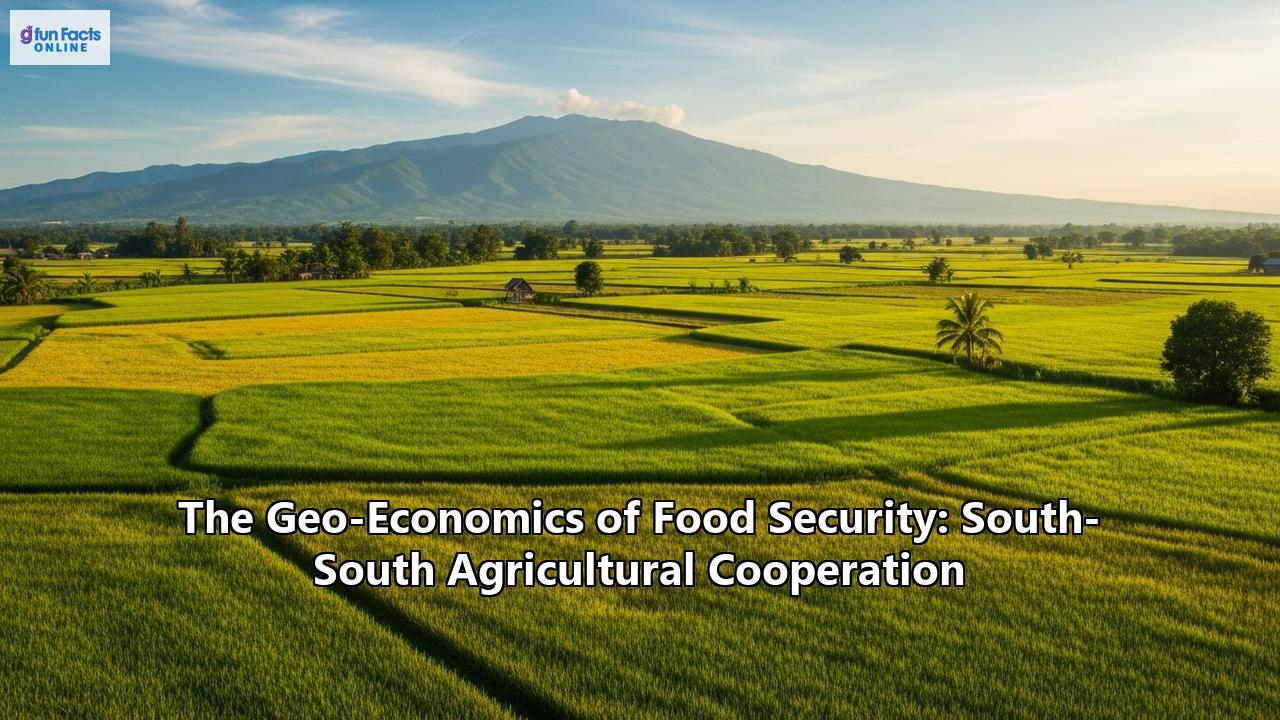
The Geo-Economics of Food Security: A New Era of South-South Agricultural Cooperation
In the intricate and often volatile landscape of global food security, a powerful transformation is underway. The traditional paradigms of development aid, long dominated by North-to-South flows, are being complemented and, in some cases, challenged by a surge in South-South cooperation. This burgeoning collaboration among developing nations, particularly in the agricultural sector, is not merely a political statement of solidarity but a calculated geo-economic strategy. It is a response to the shifting tectonics of global economic power, the urgent need for climate-resilient food systems, and a shared desire for self-reliance in an increasingly interconnected and unpredictable world.
The world has undergone a profound economic and political metamorphosis in recent decades. The rapid ascent of emerging economies in the Global South has reshaped international relations, creating new hubs of financial and technical capacity. This shift is particularly palpable in the realm of agriculture, the backbone of livelihoods for a majority of the population in the Global South. Persistent challenges, including low productivity, vulnerability to climate change, land degradation, and limited access to finance and technology, are being compounded by the growing unpredictability of traditional development assistance. In this evolving context, nations of the South are increasingly turning to one another for solutions that are not only more attuned to their shared realities but also rooted in a new geo-economic calculus of mutual benefit and strategic advantage.
This article delves into the geo-economics of food security, exploring the rise and significance of South-South agricultural cooperation. It will unpack the historical context of this collaboration, analyze the key drivers and motivations, and showcase successful case studies that illuminate the tangible impacts of these partnerships. Furthermore, it will critically examine the challenges and limitations that temper the immense potential of this new development paradigm and look toward the future trends that will shape the nexus of food security and South-South cooperation for decades to come.
A History of Solidarity and Self-Reliance
The roots of South-South cooperation run deep, intertwined with the post-colonial quest for political and economic autonomy. The landmark 1955 Bandung Conference, where Asian and African nations gathered to forge a path independent of Cold War rivalries, laid the ideological groundwork for this new form of international partnership. However, it was the 1978 United Nations Conference on Technical Cooperation among Developing Countries in Buenos Aires that formalized the framework with the adoption of the Buenos Aires Plan of Action (BAPA). This plan established a blueprint for collaboration among the developing countries of the Global South, emphasizing the principles of mutual respect for sovereignty, non-interference in internal affairs, and equality of rights.
The Food and Agriculture Organization of the United Nations (FAO) has been a pivotal actor in this journey, establishing a focal point for South-South cooperation as early as 1979. Its engagement became more formalized in 1996 with the launch of the Special Programme for Food Security, which by 2004 had deployed over 2,800 experts from developing countries to share their knowledge and skills in other nations of the South. This early work demonstrated the power of peer-to-peer learning and the transfer of contextually relevant agricultural practices.
The 21st century has witnessed an acceleration of these trends, driven by the remarkable economic transformation across the developing world. The rise of countries like Brazil, China, and India as major players in the global economy has infused South-South cooperation with new dynamism and resources. These nations, having navigated their own complex paths to development and food security, possess a wealth of experience and technological solutions that are often more readily adaptable to the socio-economic and agro-ecological conditions of other developing countries than those offered by the Global North. The 2030 Agenda for Sustainable Development has further underscored the critical role of South-South and Triangular Cooperation (SSTC) as a key means of implementation for achieving the Sustainable Development Goals (SDGs), particularly SDG 2 on Zero Hunger.
The Geo-Economic Drivers of a New Agricultural Revolution
The contemporary surge in South-South agricultural cooperation is propelled by a confluence of powerful geo-economic forces. It is a manifestation of the changing global economic landscape, where the nations of the South are not just recipients of aid but active agents in shaping their own development trajectories.
The Rise of Emerging Economies as Agricultural Powerhouses:Nations like Brazil, China, and India have transitioned from being major recipients of development aid to significant providers of technical and financial assistance. Their own experiences in boosting agricultural productivity and achieving food security have created a repository of knowledge and technology that is highly sought after by other developing countries. Brazil, for instance, transformed its vast tropical savannah, the Cerrado, into a global hub for soybean production, an experience that is of immense interest to African nations with similar agro-ecological zones. Similarly, China's journey from a net importer to a leading global producer of a wide range of agricultural commodities, driven by technological advancements and institutional reforms, offers valuable lessons for its partners in the South.
Shifting Trade and Investment Flows:The geography of global trade and investment has been fundamentally redrawn in recent decades. South-South trade has been expanding at a faster rate than global trade, and investment flows between developing countries are becoming increasingly significant. In 2021, the value of South-South trade reached an impressive US$5.3 trillion, surpassing the volume of North-South trade. This burgeoning economic exchange creates new markets for agricultural products from the South and fosters the transfer of technology and expertise.
Foreign Direct Investment (FDI) in agriculture, while still a small proportion of total FDI, is on the rise, with a notable increase in South-South investment. Investors from developing countries are increasingly active in cross-border acquisitions and greenfield projects in the agricultural sector of other Southern nations. These investments are driven by a combination of commercial interests and, increasingly, food security concerns in the home countries.
The Quest for Food Security in a Volatile World:The 2008 global food crisis, triggered by a perfect storm of rising demand, biofuel production, and commodity market speculation, served as a stark wake-up call for many developing countries. The crisis highlighted the vulnerabilities of nations dependent on food imports and underscored the need to bolster domestic agricultural production. In this context, South-South cooperation has emerged as a crucial strategy for enhancing food security. By sharing knowledge on increasing productivity, developing sustainable farming practices, and building resilience to climate change, countries of the South are collectively working to safeguard their populations from the vagaries of global food markets.
The recent fragmentation of major commodity markets due to geopolitical events has further amplified the importance of diversifying food sources and strengthening regional food systems. Low-income and other vulnerable countries are often the most severely affected by disruptions in agricultural imports, making South-South collaboration a vital buffer against food insecurity.
South-South Agricultural Cooperation in Action: Case Studies from the Field
The principles and geo-economic drivers of South-South agricultural cooperation are best understood through the lens of concrete examples. Across the Global South, a diverse array of projects and partnerships are demonstrating the transformative potential of this collaborative approach.
China's Agricultural Engagement in Africa:China's cooperation with Africa in the agricultural sector is perhaps the most prominent example of South-South collaboration. This partnership has evolved from early aid projects in the 1960s to a multifaceted engagement that includes technology transfer, infrastructure development, and private sector investment. A key pillar of this cooperation is the establishment of Agricultural Technology Demonstration Centers (ATDCs) across the continent. These centers serve as hubs for introducing and adapting Chinese agricultural technologies, training local farmers and technicians, and showcasing modern farming practices.
In Madagascar, for instance, Chinese expertise in hybrid rice technology has been a game-changer. Since 2007, collaboration with Chinese experts has led to the adoption of high-yielding rice varieties that outperform traditional strains by two to three times, with cultivation expanding to 50,000 hectares. The success of this initiative is so significant that the hybrid rice is celebrated on the country's 20,000 ariary banknote. In Nigeria, the Chinese Academy of Tropical Agricultural Sciences has shared its world-leading expertise in cassava cultivation, helping to address challenges of low productivity and underdeveloped processing capabilities.
Beyond technology demonstration, Chinese companies are also increasingly involved in agribusiness in Africa, from large-scale farming to food processing. This investment, while not without its controversies, has the potential to create jobs, develop local value chains, and contribute to the modernization of African agriculture.
Brazil's Tropical Agriculture Expertise for Africa:Brazil has leveraged its own success in developing a vibrant and competitive agricultural sector in tropical conditions to forge strong partnerships with African nations. The country's expertise in areas such as soil management, crop breeding for tropical climates, and the development of no-till farming systems is highly relevant to many parts of Africa.
One of the most notable examples of Brazil-Africa agricultural cooperation is the ProSavana program in Mozambique. While this program has faced significant criticism and challenges, it represents an ambitious attempt to replicate the Brazilian Cerrado's agricultural success in the Nacala Corridor of Mozambique. The aim was to develop large-scale commercial agriculture, but the project highlighted the complexities of transferring models without adequate consideration for local land rights and the needs of smallholder farmers.
More successful have been targeted technical cooperation projects. Brazil has shared its experience in developing the "More Food Africa" program, which aims to increase the productivity of smallholder family farms by providing them with access to credit and subsidized farm equipment. This initiative has been rolled out in several African countries, including Ghana, Zimbabwe, and Mozambique.
India's Partnership for a "Greener" Revolution in Africa:India's engagement with Africa in agriculture is rooted in a shared colonial past and a common commitment to food security for their vast populations. India's own Green Revolution, while a complex and debated chapter in its history, provides valuable lessons in agricultural research, extension services, and the development of input supply chains.
The India-Africa Forum Summit has become a key platform for deepening this partnership, with a focus on agricultural research, technology transfer, and capacity building. India has provided financial and technical support for the establishment of agricultural research centers in Africa, as well as training for farmers and extension workers. Indian expertise in areas such as soil and water management, crop production, and post-harvest management is being shared with African partners.
Furthermore, trilateral cooperation, involving India, an African nation, and a third partner such as the United States Agency for International Development (USAID), has emerged as an effective modality. These partnerships leverage the complementary strengths of different actors to address specific challenges in the agricultural sector. The private sector is also playing an increasingly important role, with Indian agribusinesses investing in Africa and contributing to the development of local value chains.
Intra-regional Cooperation and Knowledge Sharing:Beyond these bilateral partnerships, intra-regional cooperation is also gaining momentum. In Latin America and the Caribbean, for example, South-South cooperation has been a key instrument for addressing food and nutritional security. Between 2007 and 2023, over a thousand initiatives focused on this area were implemented through bilateral, triangular, and regional cooperation.
The digitalization of agriculture is another area where South-South cooperation is proving to be particularly effective. Digital platforms and mobile technologies are being used to provide farmers with access to information on weather, market prices, and best practices. South-South and Triangular Cooperation is fostering the exchange of these digital innovations, helping to bridge the digital divide in rural areas. FAO and China have collaborated on a project to support digital transformation in agriculture across 12 countries in the Community of Latin American and Caribbean States (CELAC), benefiting hundreds of farmers and having an indirect impact on thousands more.
Navigating the Challenges and Criticisms
Despite its immense potential, South-South agricultural cooperation is not a panacea. It faces a range of challenges and has drawn criticism from various quarters, highlighting the need for a nuanced and critical approach.
The Specter of "New Imperialism" and Unequal Power Dynamics:One of the most persistent criticisms leveled against South-South cooperation, particularly in the context of large emerging economies like China, is that it masks a new form of imperialism. Critics argue that the pursuit of commercial interests, including access to natural resources and new markets for technology and inputs, can overshadow the development objectives of host countries. The debate on whether these partnerships represent a genuine paradigm shift or a reinforcement of capital accumulation under a different guise is ongoing.
While South-South cooperation is often framed as a partnership of equals, the reality is that significant power imbalances can exist between participating countries. The economic and political clout of a country like China inevitably shapes its relationships with smaller, less developed nations. This can lead to concerns about the terms of agreements, the transparency of deals, and the extent to which the benefits of cooperation are shared equitably.
Land Acquisition and its Social and Environmental Impacts:The issue of large-scale land acquisitions, sometimes referred to as "land grabbing," is a particularly contentious aspect of South-South agricultural investment. Driven by food and energy security concerns in their home countries, investors from the South have acquired vast tracts of agricultural land in other developing nations. These deals, often lacking transparency and consultation with local communities, can lead to the displacement of smallholder farmers, the loss of traditional livelihoods, and increased food insecurity at the local level.
While such investments can bring in much-needed capital and technology, they also raise serious questions about land rights, environmental sustainability, and the long-term consequences for rural communities. The conversion of land from staple food production for local consumption to cash crops for export can also disrupt local food systems.
Institutional and Financial Constraints:The effectiveness of South-South cooperation is also hampered by a range of institutional and financial constraints. Many developing countries lack the institutional capacity to effectively manage and absorb the knowledge and technology being offered. There is often a lack of specialized bodies at the country level to coordinate and implement South-South cooperation projects.
Financial resources for South-South cooperation, while growing, remain limited compared to traditional North-South aid flows. This can constrain the scale and sustainability of projects. Furthermore, there is a need for more robust monitoring and evaluation frameworks to assess the impact and effectiveness of South-South initiatives. The lack of comprehensive and accessible data on South-South cooperation flows and outcomes makes it difficult to learn from past experiences and to hold partners accountable.
The Evolving Role of the Private Sector and Technology
The future of South-South agricultural cooperation will be increasingly shaped by the growing involvement of the private sector and the rapid advancements in agricultural technology.
Agribusiness and the Private Sector as Drivers of Change:The private sector, from small and medium-sized enterprises to large multinational agribusinesses, is playing an increasingly crucial role in South-South agricultural cooperation. Private companies are not only sources of investment but also repositories of expertise, technology, and innovation. Their engagement can enhance the efficiency and effectiveness of development cooperation, bringing in new business models and market-oriented solutions.
South-South investment flows, often facilitated by private sector actors, are becoming an important source of financing for agricultural development in the Global South. These investments can lead to the transfer of technology, the creation of jobs, and the development of local value chains. However, it is crucial to ensure that private sector engagement is aligned with the principles of responsible agricultural investment and that it contributes to inclusive and sustainable development. Critics raise concerns that the profit-driven motives of private companies can sometimes sideline the development objectives of poverty reduction and food security.
Technology Transfer and the Digital Revolution:Technology transfer is at the heart of South-South agricultural cooperation. Developing countries are sharing a wide range of technologies, from improved crop varieties and irrigation techniques to mechanization and post-harvest management solutions. These technologies, often developed in similar agro-ecological and socio-economic contexts, are frequently more appropriate and adaptable than those originating from the Global North.
The digital revolution is opening up new frontiers for South-South cooperation in agriculture. Digital platforms, mobile applications, and data analytics are being used to provide farmers with timely information, improve decision-making, and connect them to markets. Initiatives like the FAO's South-South and Triangular Cooperation Gateway Platform are being developed to facilitate the sharing of these digital and innovative technologies. By harnessing the power of digitalization, South-South cooperation can help to bridge the knowledge gap, empower smallholder farmers, and build more resilient and efficient food systems.
The Future of South-South Agricultural Cooperation: Trends and Opportunities
As the world grapples with the interconnected challenges of climate change, population growth, and geopolitical instability, the importance of South-South agricultural cooperation is only set to grow. Several key trends will shape its future trajectory.
A Shift Towards More Inclusive and Sustainable Models:There is a growing recognition within the South-South cooperation community of the need to move beyond a purely technical and economic focus to embrace more inclusive and sustainable models of development. This includes a greater emphasis on the needs of smallholder farmers, women, and other vulnerable groups. There is also a growing awareness of the importance of addressing the social and environmental impacts of agricultural investments, particularly in the context of land acquisitions.
The future of South-South cooperation will likely see a greater focus on promoting agroecology, climate-resilient agriculture, and sustainable food systems. This will require a shift away from a one-size-fits-all approach to one that is more context-specific and participatory, drawing on the rich indigenous knowledge of communities in the Global South.
The Rise of Triangular Cooperation:Triangular cooperation, which involves a partnership between two or more developing countries and a traditional donor from the Global North, is emerging as an increasingly important modality. This approach combines the financial resources and technical expertise of the North with the contextual knowledge and experience of the South, creating powerful synergies. Triangular cooperation can help to scale up successful South-South initiatives and to address some of the financial and institutional constraints that can limit their impact.
Strengthening Regional Integration and Trade:Regional integration is a powerful engine for agricultural development. By reducing trade barriers, harmonizing policies, and investing in cross-border infrastructure, countries can create larger markets for their agricultural products and enhance their collective food security. The African Continental Free Trade Area (AfCFTA), for example, offers immense opportunities for boosting intra-African trade in agricultural goods and for developing regional value chains. South-South cooperation will play a crucial role in supporting these regional integration efforts, facilitating the sharing of best practices and the development of common approaches to agricultural development.
Conclusion: Forging a New Path to Global Food Security
The geo-economics of food security are in flux. The rise of the Global South has ushered in a new era of international cooperation, one that is characterized by a spirit of solidarity, mutual benefit, and shared responsibility. South-South agricultural cooperation is at the forefront of this transformation, offering a powerful alternative to the traditional models of development assistance.
From the rice paddies of Madagascar, nurtured by Chinese expertise, to the agribusiness ventures in Africa, driven by Brazilian and Indian investment, the landscape of global food security is being reshaped by these dynamic partnerships. They are fostering the exchange of knowledge, the transfer of appropriate technologies, and the development of more resilient and sustainable food systems.
Yet, the path forward is not without its challenges. The pitfalls of unequal power dynamics, the controversies surrounding land acquisitions, and the persistent institutional and financial constraints must be navigated with care and a commitment to genuine partnership. The success of South-South cooperation will ultimately depend on its ability to be inclusive, sustainable, and truly responsive to the needs and priorities of the people it is intended to serve.
As the world confronts the monumental task of feeding a growing population in the face of a changing climate, the need for innovative and collaborative solutions has never been greater. South-South agricultural cooperation, with its unique blend of shared experience, contextual relevance, and geo-economic dynamism, represents a beacon of hope. It is a testament to the ingenuity and resilience of the Global South and a critical pathway toward achieving a world free from hunger. The journey is complex, but the direction is clear: the future of food security will be increasingly written in the language of South-South cooperation.
Reference:
- https://www.numberanalytics.com/blog/south-south-cooperation-in-action
- https://unctad.org/system/files/official-document/ciimem2crp3_en.pdf
- https://www.global-agriculture.com/global-agriculture/india-africa-cooperation-in-the-agricultural-sector-for-food-security/
- https://unsouthsouth.org/wp-content/uploads/2022/08/FAO-South-South-and-triangular-cooperation-in-agricultural-development-2022.pdf
- https://unsouthsouth.org/2025/05/30/fao-launches-new-south-south-and-triangular-cooperation-gateway-platform/
- https://pressroom.icrisat.org/south-south-cooperation-crucial-for-transforming-agriculture
- https://asean.org/agriculture-ministers-discuss-south-south-cooperation-for-food-systems-transformation/
- https://www.un-csam.org/news/technological-transfer-and-south-south-cooperation-key-food-security-asia-pacific
- https://www.fao.org/sstc-gateway/taxonomy/term/77
- http://vienna.china-mission.gov.cn/eng/mtjj/202410/t20241011_11505682.htm
- https://unfccc.int/ttclear/misc_/StaticFiles/gnwoerk_static/TEC_TD6/c8e2b64b9392406581c16267abcf2f93/4059b3c1ef954bf4860fece979ff4384.pdf
- https://www.econstor.eu/bitstream/10419/248184/1/sais-cari-pb05.pdf
- https://saiia.org.za/research/chinese-agribusiness-entrepreneurship-in-africa-case-studies-in-ghana-and-nigeria/
- https://kwpublications.com/papers_submitted/5540/an-analysis-of-china-africa-agricultural-cooperation-and-prospects-of-belt-and-road-initiative-a-case-of-south-africa.pdf
- https://www.fao.org/sstc-gateway/working-group/south-south-cooperation-digital-transformation-and-innovation-agriculture
- https://www.orfonline.org/research/india-africa-partnership-for-food-security-beyond-strategic-concerns
- https://indianexpress.com/article/upsc-current-affairs/upsc-essentials/india-africa-partnership-for-agricultural-development-and-food-security-10092618/
- https://www.agribusiness-facility.org/abf-and-our-work.html
- https://www.fao.org/in-action/south-south-digital-transformation-innovation/en
- https://unsouthsouth.org/2025/01/29/leveraging-south-south-and-triangular-cooperation-in-shaping-africas-inclusive-and-sustainable-digital-future/
- https://www.fao.org/americas/news/news-detail/china-celac-sur-sur/en
- https://ideas.repec.org/a/eee/wdevel/v81y2016icp13-23.html
- https://realityofaid.org/reality-check/blogs/challenges-for-the-construction-of-south-south-cooperation-by-and-for-the-people/
- https://agritrop.cirad.fr/564609/2/document_564609.pdf
- https://unctad.org/press-material/experts-discuss-south-south-triangular-cooperation-help-agricultural-development-and
- https://www.fao.org/fileadmin/user_upload/fsn/docs/HLPE/Land_grab_ghatak.pdf
- https://www.deval.org/en/evaluations/our-evaluations/cooperation-with-the-private-sector-in-agriculture
- https://unfccc.int/ttclear/misc_/StaticFiles/gnwoerk_static/brief9/0690de2775954709aaac85ced2c8fb57/2ccc6a9fa019437dac534c3c1c282652.pdf
- https://dakshin.org.in/uploads/publications/169104810618ITEC%20Report-Learning%20South-South%20Cooperation-12-23%20Nov%202018.pdf
- https://www.unsouthsouth.org/wp-content/uploads/2019/03/bapa40se_undp-tika-sesric_v2.pdf
- https://www.undp.org/policy-centre/istanbul/private-sector-engagement-through-south-south-cooperation-sustainable-development-goals
- https://www.uneca.org/sites/default/files/TCND/Presentation_South-South%20Cooperation%20for%20Harnessing%20Digitalization.pptx
- https://diplomatist.com/2025/05/24/south-south-cooperation-and-the-future-of-agri-business/
- https://diplomatist.com/2025/05/26/strengthening-india-africa-cooperation-through-food-security/
- https://africabusinesscommunities.com/agribusiness/agra-and-grow-asia-in-a-deal-to-drive-south-south-cooperation-between-africa-and-asia/