
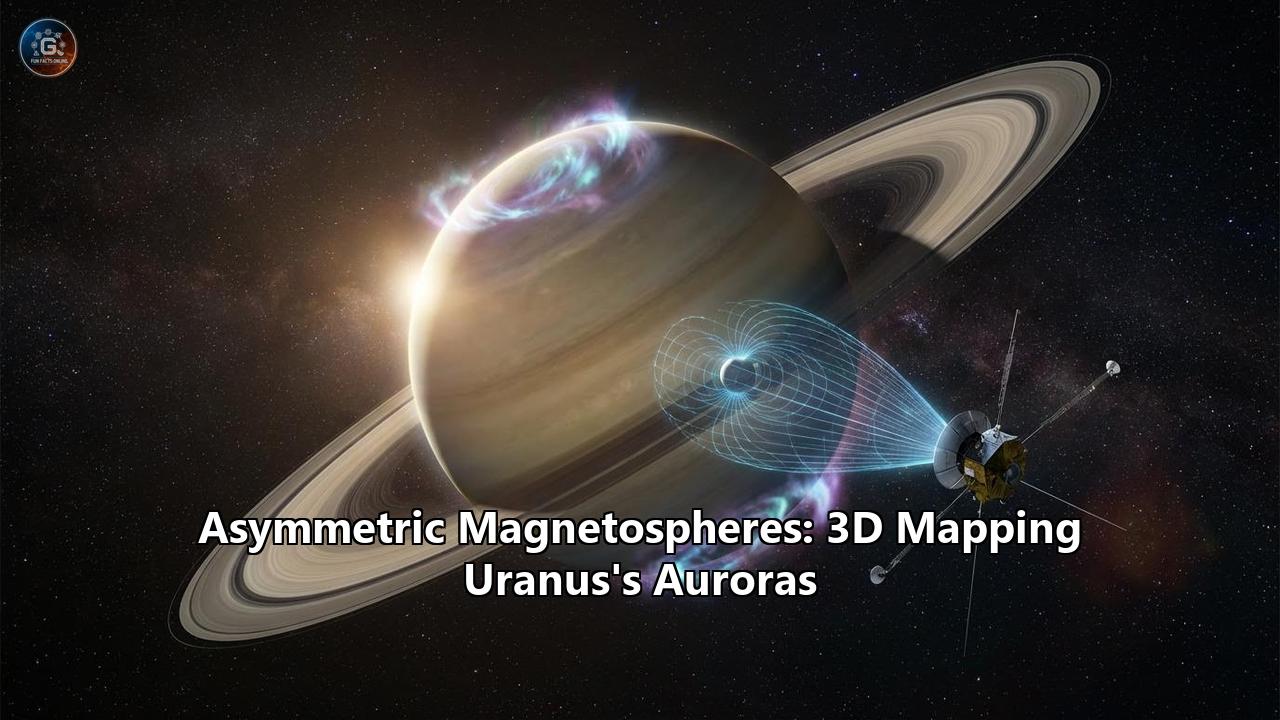
For decades, the seventh planet from the Sun has been the solar system’s most enduring enigma. Orbiting in the frigid, twilight reaches of our stellar neighborhood, Uranus is a world that defies planetary norms. It rolls on its side like a knocked-over top, features an atmosphere that has been inexplicably cooling for decades, and hosts a magnetic field so chaotic and lopsided that it has baffled space physicists since the 1980s. But thanks to a cascade of recent breakthroughs—culminating in the first-ever three-dimensional mapping of its upper atmosphere and auroras—Uranus is finally surrendering its secrets.
By utilizing the unprecedented infrared sensitivity of the James Webb Space Telescope (JWST), alongside modern re-analyses of legacy data from NASA’s Voyager 2, the scientific community is undergoing a renaissance in Uranian physics. We are discovering that the "boring" pale blue dot of the late 20th century is, in fact, a shimmering, dynamic world. Its asymmetric magnetosphere dictates the flow of energy in ways previously thought impossible, painting spectacular, invisible auroras across its skies and offering profound implications for the search for habitable worlds beyond our solar system.
To understand the sheer strangeness of Uranus's auroras, one must first understand the architectural oddity of its magnetic field. On Earth, the magnetic field is a relatively neat dipole. The magnetic north and south poles align closely with the planet's geographic axis of rotation, creating the familiar, symmetrical shield that deflects the solar wind and funnels energetic particles toward the poles to create the Northern and Southern Lights.
Uranus, however, plays by entirely different rules. Its magnetic field is tilted by a staggering 59 degrees away from its axis of rotation. Furthermore, the magnetic field does not even pass through the geometric center of the planet; it is offset, shifted away from the core by roughly one-third of the planet’s radius. As Uranus completes its 15-hour daily rotation, this wildly off-center magnetic field tumbles through space, creating a complex, corkscrew-like magnetosphere that snaps open and closed to the solar wind on a daily basis.
Because of this asymmetry, the auroras on Uranus do not form neat halos around the geographic poles as they do on Earth, Jupiter, or Saturn. Instead, they sweep across the planet's surface in complex, unpredictable ways, appearing in unexpected regions far from the geographic poles. Understanding how this lopsided field shapes the atmosphere has been one of the holy grails of planetary science, but for nearly forty years, scientists were working with a flawed baseline.
Almost everything humanity knew about the Uranian magnetosphere came from a single, fleeting encounter: NASA’s Voyager 2 flyby in January 1986. When the probe zoomed past the ice giant, it beamed back data that painted a perplexing picture. Voyager 2 detected an incredibly intense electron radiation belt—second only to Jupiter's in its ferocity—yet paradoxically found the magnetosphere to be almost entirely devoid of plasma, the ionized gas that usually populates such magnetic environments.
For nearly four decades, astronomers assumed this was simply the normal, albeit bizarre, state of Uranus. It was not until late 2024 that a brilliant piece of scientific detective work completely rewrote this narrative. Researchers at NASA's Jet Propulsion Laboratory took a fresh look at the eight months of space weather data surrounding the 1986 flyby. They discovered that Voyager 2 had been the victim of extraordinary timing.
Just days before the probe arrived, an extreme solar wind event—a high-speed flow of charged particles from the Sun—had slammed into Uranus. The immense pressure from this solar storm violently compressed the Uranian magnetosphere, squashing it down to just 20 percent of its normal volume. This dramatic compression squeezed the existing plasma out of the system while simultaneously injecting and accelerating electrons to create the intense radiation belts Voyager observed.
The researchers calculated that the conditions Voyager 2 witnessed occur only about 4 percent of the time. "If Voyager 2 had arrived just a few days earlier, it would have observed a completely different magnetosphere at Uranus," noted the lead study author from JPL. In its normal state, the Uranian magnetosphere is vastly larger, resembling the plasma-rich magnetic bubbles of Jupiter and Saturn.
This revelation is far more than a historical footnote; it drastically alters the future of Uranian exploration. Previously, Voyager's data suggested that Uranus's largest moons, Titania and Oberon, often orbited outside the planet's protective magnetic bubble. But with the realization that the magnetosphere is usually much larger, it is now understood that these icy moons reside safely inside the magnetic field most of the time. This is a massive boon for astrobiologists. If these moons harbor subsurface oceans of salty liquid water—as many planetary scientists suspect—those oceans will interact with the sweeping magnetic field of Uranus, generating their own secondary, induced magnetic fields. A future spacecraft could detect these induced fields, providing definitive proof of hidden alien oceans.
Furthermore, earlier in 2024, utilizing the Boris algorithm to model particle dynamics, scientists resolved another mystery regarding the planet's radiation belts. They found that because of the asymmetrical nature of Uranus's magnetic field, the charged particles within the belts physically change speed as they drift through areas of varying magnetic strength. This creates traffic jams of particles, resulting in density variations where the particle concentration drops by up to 20 percent in certain regions of the belt.
While the Voyager re-analysis corrected our understanding of the magnetic field's broader shape, observing the direct effects of this field on the planet's atmosphere required looking at the auroras. Because Uranus's atmosphere is dominated by hydrogen and helium, and exists at incredibly cold temperatures, its auroral light is invisible to the human eye, emitting primarily in the ultraviolet and infrared spectrums.
Ultraviolet auroras at Uranus were spotted shortly after the Voyager flyby, but confirming the presence of an infrared aurora proved to be a grueling, three-decade-long challenge. It was not until October 2023 that a team of astronomers from the University of Leicester, using the Near-Infrared Spectrograph (NIRSPEC) on the Keck II telescope in Hawaii, finally confirmed the elusive infrared auroral glow.
The researchers achieved this by analyzing specific emission lines of a positively charged molecule known as ionized triatomic hydrogen, or H3+. When energetic particles from space are funneled down the magnetic field lines and crash into the Uranian ionosphere, they ionize the hydrogen gas, generating H3+. The brightness of the infrared light emitted by H3+ acts like a planetary barcode and thermometer; it varies depending on both the density of the particles and their temperature.
By analyzing 224 images and taking meticulous measurements, the team observed localized, distinct increases in H3+ density with little corresponding change in the background temperature. This specific chemical signature was the smoking gun: it was definitive proof of ionization caused by incoming charged particles—a confirmed infrared aurora over the planet's northern magnetic pole.
This discovery was a watershed moment, bridging the gap between the planet's internal magnetic dynamo and its upper atmosphere. However, ground-based observations like those from Keck II are limited by Earth's own atmosphere and our distant vantage point. To truly unravel the mechanics of Uranus's asymmetrical magnetosphere, scientists needed a continuous, three-dimensional look at the planet. They needed the James Webb Space Telescope.
In early 2026, the scientific community celebrated a monumental achievement: the publication of the first-ever 3D map of Uranus's upper atmosphere and its auroras. Led by planetary scientists from Northumbria University, an international team utilized JWST’s highly sensitive Near-Infrared Spectrograph (NIRSpec) in its Integral Field Unit mode to execute a marathon 17-hour continuous observation of the ice giant. Because Uranus rotates once every 15 hours, this observation period allowed Webb to capture a complete planetary rotation, mapping the entirely of the globe in high resolution.
The results, published in Geophysical Research Letters, provided an unprecedented look into the planet's ionosphere—the electrically charged upper layer of the atmosphere where magnetic forces and atmospheric gases collide. By tracking the faint infrared emissions from H3+ molecules up to 5,000 kilometers (roughly 3,100 miles) above the visible cloud tops, the researchers constructed a stunning three-dimensional topography of temperature and ion density.
The 3D map vividly illuminated the sheer weirdness of the Uranian environment. Unlike the relatively uniform layers of Earth's upper atmosphere, the charged molecules around Uranus form a chaotic, lumpy blanket that rises higher in some regions and dips lower in others. This uneven distribution is the direct physical imprint of the planet's lopsided, corkscrew magnetic field dictating where and how energy diffuses into the outer layers.
The JWST data pinpointed exactly where the auroras form, revealing two distinctly bright auroral bands situated near the planet's magnetic poles. Intriguingly, these two brilliant bands are separated by a noticeable dark zone—a narrow region where both infrared emissions and ion densities dramatically drop off. Researchers linked this depleted dark zone directly to the twisted geometry of Uranus’s magnetic field lines. As the magnetic field transitions and channels the flow of charged particles from the solar wind and the local space environment, it creates "dead zones" where particles are prevented from precipitating into the atmosphere. Similar darkened auroral regions have been documented at Jupiter, confirming that magnetic geometry acts as the ultimate gatekeeper for energy flowing into a giant planet's atmosphere.
Beyond mapping the localized auroral bands, the 3D data also solved mysteries regarding the vertical structure of the atmosphere. The team found that the density of the ionized H3+ particles reaches its absolute maximum at an altitude of approximately 1,000 kilometers above the cloud tops. However, the thermal energy behaves differently. The peak temperatures in the upper atmosphere do not align with the peak ion density; instead, temperatures max out much higher up, between 3,000 and 4,000 kilometers in altitude.
At these dizzying heights, the average temperature clocks in at roughly 426 Kelvin (about 307 degrees Fahrenheit or 153 degrees Celsius). While this sounds incredibly hot for an "ice giant," the JWST data actually confirmed a baffling, long-standing trend: Uranus’s upper atmosphere is cooling down. The planet has been exhibiting a continuous temperature downturn since the 1990s, previously measured by other instruments and now definitively confirmed by Webb. This ongoing cooling indicates that Uranus is gradually bleeding off stored internal heat, fundamentally altering its atmospheric circulation and global energy balance.
The redistribution of heat mapped by JWST also helps address the "energy crisis" of the giant planets. Across the solar system, the upper atmospheres of gas and ice giants are hundreds of degrees hotter than they should be if they were warmed by the Sun alone. The 3D mapping indicates that the intense energy from Uranus’s auroral displays acts as a powerful secondary heat source. The newly modeled vertical structures show exactly how thermal energy from the magnetic collisions in the auroral zones is pumped downward and redistributed into the deeper layers of the planet's atmosphere.
The significance of these discoveries extends far beyond the orbit of Uranus. In the burgeoning field of exoplanet astronomy, the most common type of world discovered in the Milky Way galaxy falls into the "sub-Neptune" or ice giant category. These distant exoplanets are physically similar in size and likely composition to Uranus and Neptune. Therefore, they almost certainly possess the same complex, asymmetric magnetic fields and dynamic atmospheric chemistries.
By decoding the auroral mechanics of Uranus, astronomers are essentially beta-testing the physics of the broader galaxy. The interaction between a lopsided magnetic field and a planet's atmosphere directly impacts how that planet retains its atmosphere against the stripping power of stellar winds. If we want to understand the habitability potential of icy exoplanets, or predict their weather patterns and chemical compositions, Uranus serves as our premier, local laboratory. The realization that a skewed magnetic field can create localized heating and dramatic density variations in an atmosphere provides a template for interpreting the eventual atmospheric spectra we will collect from worlds light-years away.
For decades, Uranus was treated as an afterthought in planetary exploration, a silent world resting in the dark. The revelations of the mid-2020s have shattered that illusion. We now know that the single snapshot we took in 1986 was deeply skewed by a freak solar storm, hiding the true, expansive nature of a magnetosphere that likely protects ocean-bearing moons. We have successfully tuned our instruments to see its invisible, infrared auroras, using them as global thermometers to track the mysterious cooling of its skies. And now, we have mapped its upper atmosphere in breathtaking three dimensions, visualizing the chaotic dance between charged particles and a magnetic field that spins violently off-kilter.
These milestones set the ultimate stage for the next great leap in space exploration. In its 2023–2032 Decadal Survey, the National Academies of Sciences, Engineering, and Medicine designated a dedicated Uranus Orbiter and Probe (UOP) as the highest priority flagship mission for NASA. Unlike the fleeting Voyager flyby, this proposed mission will spend years orbiting the ice giant. It will map the asymmetric magnetosphere in real-time as the planet cycles through its extreme 84-year seasons, drop a probe directly into the cooling atmosphere, and fly through the induced magnetic fields of moons like Titania and Oberon to taste the evidence of hidden oceans.
Until that orbiter arrives, the James Webb Space Telescope and advanced data modeling have given us our most profound understanding yet of this lopsided giant. The 3D mapping of Uranus's auroras is more than just a cartographic achievement; it is a testament to the fact that in the outer solar system, the most bizarre and misaligned phenomena often yield the most fascinating science. The ice giant is finally coming into focus, revealing a world of magnetic corkscrews, dark auroral zones, and hidden mechanisms that bind the atmosphere to the void of space.
Reference:
- https://www.techno-science.net/en/news/first-3d-map-of-uranus-atmosphere-N28378.html
- https://www.smithsonianmag.com/smart-news/take-a-look-at-uranus-weird-lopsided-upper-atmosphere-bespeckled-with-auroras-180988305/
- https://thedebrief.org/new-clues-from-voyager-2-reveal-uranus-may-be-more-mysterious-than-originally-thought/
- https://hothardware.com/news/scientists-celebrate-as-webb-creates-first-ever-3d-map-of-auroras-on-uranus
- https://keckobservatory.org/uranus-aurora-discovery-offers-clues-to-habitable-icy-worlds/
- https://www.space-park.co.uk/2023/10/uranus-aurora-discovery/
- https://www.northumbria.ac.uk/about-us/news-events/news/uranus-aurora/
- https://www.popsci.com/science/infrared-aurora-uranus/
- https://royalsocietypublishing.org/rsta/article/378/2187/20190481/111840/Auroral-emissions-from-Uranus-and-NeptuneIce-giant
- https://orbitaltoday.com/2026/02/19/webb-telescope-just-mapped-uranuss-auroras-n-3d-for-the-first-time/
- https://www.earth.com/news/decades-after-voyager-2-flew-by-uranus-we-finally-know-what-it-saw/
- https://www.sciencenews.org/article/uranus-weird-look-voyager-2-flyby
- https://tribune.com.pk/story/2508949/uranus-243-years-later-new-discoveries-challenge-what-we-thought-we-knew
- https://www.newsweek.com/uranus-magnetic-field-radiation-belt-mystery-1920765
- https://www.techexplorist.com/presence-infrared-aurora-uranus/76463/
- https://www.spacedaily.com/reports/Webb_maps_Uranus_upper_atmosphere_in_3D_999.html
- https://www.aeronomie.be/en/news/2021/magnetospheres-solar-system
- https://science.nasa.gov/wp-content/uploads/2023/10/uranus-orbiter-and-probe.pdf