
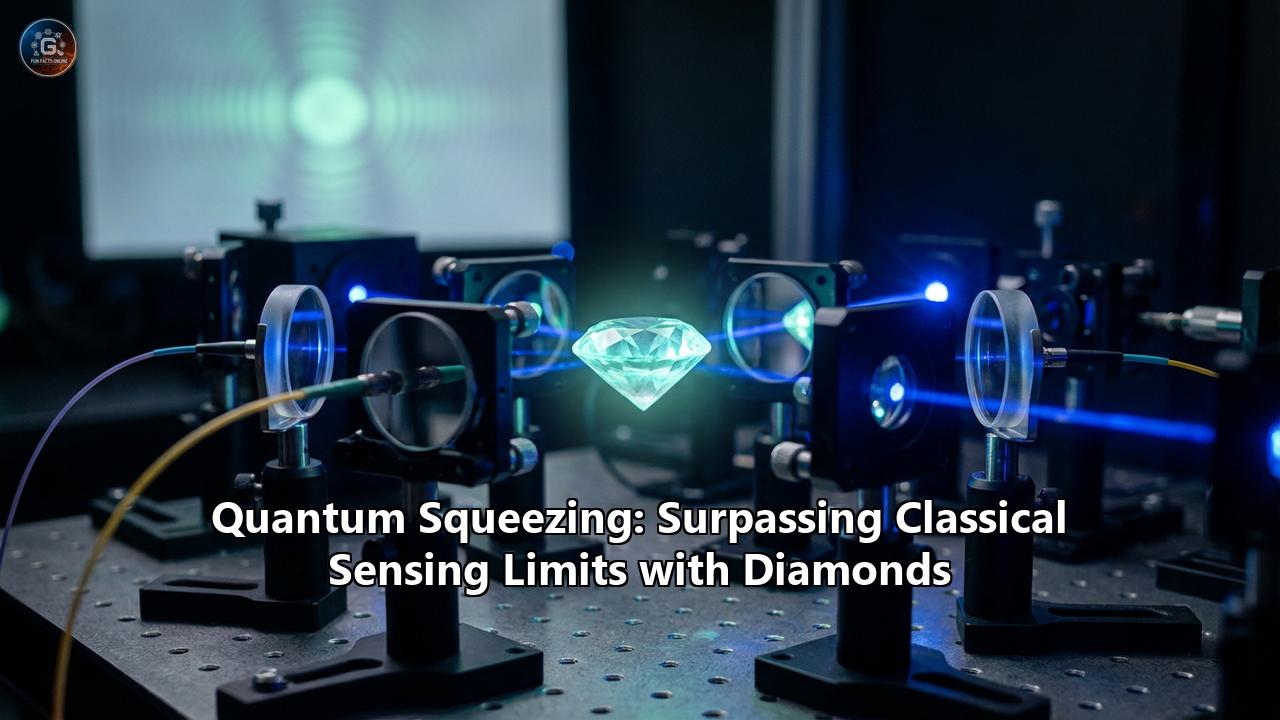
In the quiet, dust-free sanctuaries of modern physics laboratories, a revolution is brewing that promises to render the invisible visible. For decades, our ability to measure the world has been fundamentally constrained by the laws of classical physics. We have been like astronomers trying to study distant stars through a foggy lens, limited by the inherent "noise" of the universe. But in late 2025, the fog began to lift. Researchers have unlocked a new frontier in measurement technology by harnessing the strange, counter-intuitive properties of quantum mechanics within one of Earth's most tangible materials: diamond.
This is the story of Quantum Squeezing, a technique that allows scientists to "cheat" the classical limits of measurement, and how a specific defect in synthetic diamonds—the Nitrogen-Vacancy center—has become the engine for a new generation of sensors. These sensors are not merely incrementally better; they represent a paradigm shift, capable of detecting the firing of a single neuron, mapping the magnetic field of Earth's crust for unjammable navigation, and peering into the atomic structure of superconductors under pressures found at the center of the Earth.
Part I: The Limits of Perception
To understand the magnitude of this breakthrough, we must first understand the barrier that has held us back: the Standard Quantum Limit (SQL).
The Noise of the Universe
Every measurement is a conversation between the observer and the observed. When you use a ruler to measure a table, the interaction is simple. But when you try to measure the magnetic field of a single electron or the gravitational pull of a tiny mass, the act of measuring becomes messy. At the quantum scale, nothing is still. Particles jitter, energy fluctuates, and the vacuum itself hums with activity.
In classical sensors, this manifests as "shot noise." Imagine trying to determine the average position of a crowd of people by taking a snapshot. If the people are moving randomly, your snapshot will always have a degree of blur. In the quantum world, this blur is fundamental. According to Heisenberg’s Uncertainty Principle, you cannot perfectly know both the position and momentum of a particle, or in the case of sensors, the amplitude and phase of a signal, with infinite precision simultaneously.
For decades, the "Standard Quantum Limit" was the practical ceiling. It dictates that the precision of a measurement scales with the square root of the number of particles used in the sensor ($1/\sqrt{N}$). To get twice the precision, you need four times as many sensing particles. To get ten times the precision, you need a hundred times as many. This scaling law makes ultra-precise sensors massive, power-hungry, and expensive.
The Classical Competitors
Before the diamond revolution, humanity’s best attempts to touch the quantum floor relied on bulky, fragile technologies:
- SQUIDs (Superconducting Quantum Interference Devices): These are the heavyweights of magnetic sensing. Capable of detecting fields as weak as a quadrillionth of a Tesla, SQUIDs are incredibly sensitive. However, they have a fatal flaw: they require cryogenic cooling to near absolute zero. This traps them in labs, tethered to liquid helium tanks, making them useless for a portable brain scanner or a navigation chip in a drone.
- Atomic Vapor Cell Magnetometers: These use a gas of alkali atoms (like rubidium) to sense magnetic fields. While they can operate at room temperature and offer high sensitivity, they suffer from "spatial blurring." The gas atoms move around, averaging out the signal over millimeter scales. They cannot see the fine, nanometer-scale details of a biological cell or a microchip.
The world needed a sensor that combined the extreme sensitivity of a SQUID, the room-temperature operation of a vapor cell, and the microscopic resolution of an electron microscope. The answer lay in a gemstone.
Part II: The Diamond Solution
Diamond is famous for its hardness and brilliance, but to a quantum physicist, its value lies in its flaws. A pure diamond is a boring lattice of carbon atoms. But if you remove one carbon atom and replace its neighbor with a nitrogen atom, you create a Nitrogen-Vacancy (NV) center.
The NV Center: An Atom Trapped in Stone
The NV center acts like a single atom frozen in solid ice. Because the diamond lattice is so rigid, it shields this defect from the chaotic vibrations of the outside world. This allows the NV center to maintain its "quantum coherence"—its fragile quantum state—even at room temperature. This is the "holy grail" feature that separates diamond from almost every other quantum material.
The NV center has an extra electron spin that can be manipulated with microwaves and read out with a simple green laser.
- Shine green light on it: The NV center fluoresces red.
- Apply a magnetic field: The intensity of that red light changes precisely in response to the field strength.
By monitoring the brightness of this red glow, scientists can measure magnetic fields, electric fields, temperature, and strain with incredible precision. But until recently, even NV centers were hit by the Standard Quantum Limit. A single NV center is too noisy. A group (ensemble) of NV centers is better, but they act like a crowd of individuals shouting over each other—uncorrelated and chaotic.
The 2025 Breakthrough: Solid-State Entanglement
In late 2025, a team of physicists at UC Santa Barbara, led by the group of Ania Jayich, shattered this barrier. For the first time, they successfully engineered a 2D layer of NV centers that were not just shouting individually, but singing in harmony.
They achieved this through Quantum Squeezing.
Part III: The Mechanics of the Squeeze
"Squeezing" is a metaphorical term for redistributing quantum uncertainty. Imagine a balloon filled with air. The air represents the "noise" or uncertainty in your measurement. You cannot get rid of the air (Heisenberg says the noise must exist), but you can squeeze the balloon. If you squeeze it flat from the top, it bulges out the sides.
- The Height of the Balloon: Represents the uncertainty in the property you want to measure (e.g., the phase of a magnetic signal).
- The Width of the Balloon: Represents the uncertainty in the property you don't care about (e.g., the amplitude).
By "squeezing" the quantum state, researchers reduce the noise in the measurement direction (flattening the balloon) while dumping that excess noise into the other direction where it doesn't hurt the measurement.
The "Asymmetric Many-Body Echo"
Achieving this in a solid block of diamond is incredibly difficult because the spins of the NV centers naturally want to decohere (lose their connection) due to the messy environment of the diamond lattice. The UCSB team developed a novel control pulse sequence called the Asymmetric Many-Body Echo.
To understand this, imagine a room full of pendulums (the spins) all swinging at slightly different rates due to friction and wind (noise).
- Standard Echo (Classical approach): You pause time, flip all the pendulums upside down, and let them swing back. This cancels out the "wind" and brings them back to sync. This is how MRI machines work.
- Asymmetric Many-Body Echo (The Breakthrough): The researchers didn't just flip the pendulums. They applied a complex, uneven rhythm of pulses that did two things:
1. It canceled the environmental noise (the wind).
2. It forced the pendulums to interact with each other.
This interaction created Entanglement. The spins stopped acting as individuals and started acting as a single, massive quantum object. When one spin felt a magnetic field, they all felt it. This collective behavior amplified the signal while the noise, which was random for each spin, canceled itself out.
The result? A sensor that surpasses the Standard Quantum Limit, scaling its sensitivity not by the square root of the number of particles, but closer to the number of particles itself (the Heisenberg Limit).
Part IV: A New Era of Applications
The transition from "classical" diamond sensors to "squeezed" diamond sensors is the difference between a magnifying glass and a microscope. This leap in sensitivity, combined with the robustness of diamond, unlocks applications that were previously science fiction.
1. Medical Imaging: The Unseen Electrical Storms
The human body is an electrical machine. Every heartbeat, every muscle twitch, and every thought is driven by ionic currents that generate tiny magnetic fields.
- Magnetocardiography (MCG): Currently, detecting the magnetic field of the heart requires a SQUID room shielded with thick steel walls to block out Earth's magnetic field. Squeezed diamond sensors can potentially do this in a portable device the size of a smartphone. This allows for the detection of heart anomalies (like ischemia) that regular EKGs miss because they are purely electrical and affected by body tissue conductivity.
- Magnetoencephalography (MEG): Mapping the brain's firing patterns usually involves a helmet that looks like a giant hair dryer, filled with liquid helium. Diamond sensors could lead to a lightweight "cap" that allows patients to move naturally while doctors image their brain activity with neuron-level resolution. This could revolutionize the diagnosis of epilepsy, Alzheimer's, and concussions.
- Single-Neuron Action Potentials: Researchers have already grown neurons directly on diamond chips. With squeezed states, they can detect the firing of a single neuron without sticking an electrode inside it, enabling non-invasive, high-speed interfaces between brains and computers.
2. Navigation: The GPS-Free World
We are dangerously reliant on GPS. A satellite outage or jamming signal could cripple global logistics. But the Earth itself provides a map. The crust of our planet has a unique magnetic "fingerprint"—local anomalies caused by iron ore deposits and geological structures.
- Mag-Nav: A diamond quantum sensor is sensitive enough to read this magnetic map as a plane or ship moves over it. By matching the real-time magnetic reading to a known database, a vehicle can determine its location with meter-level accuracy without seeing the sky.
- Advantages: Unlike GPS, the magnetic crust cannot be jammed or turned off. Diamond sensors, being small and solid-state, can be integrated into aircraft autopilots and potentially even autonomous cars as a backup navigation system.
3. The Microscopic World: Bioreactors and Droplets
In 2025, parallel research at Berkeley Lab utilized "nanodiamonds" (diamond dust) inside microfluidic droplets. Imagine a tiny water droplet acting as a test tube. By putting squeezed nanodiamonds inside, the droplet itself becomes a sensor.
- Chemical Sensing: These droplets can detect trace amounts of specific ions or molecules. In a bioreactor growing lab-grown meat or pharmaceutical drugs, these sensors could monitor pH and metabolic rates in real-time, adjusting the nutrients automatically to optimize growth.
4. Extreme Science: 240 Gigapascals
One of the most "heavy metal" applications of these sensors is in high-pressure physics. Scientists squeeze materials between two diamond anvils to simulate the core of Jupiter or create room-temperature superconductors.
- The Sensor is the Anvil: Because the sensor is a diamond, it can survive the crushing pressure. In late 2025, researchers used NV centers to measure the magnetic properties of titanium and hydrides at pressures exceeding 240 GPa (2.4 million times atmospheric pressure). They observed the Meissner Effect—the expulsion of magnetic fields that proves superconductivity—at pressures where no other sensor could survive. This is a critical tool in the race to find a superconductor that works at room temperature and pressure.
Part V: The Industrial Landscape & Roadmap
The shift from academic papers to commercial products is already underway. The "Quantum 2030" strategies of nations like Canada and the UK have identified diamond sensing as a critical technology for national security and economic growth.
Key Players
- Bosch Quantum Sensing: The German engineering giant has partnered with Element Six (the synthetic diamond arm of De Beers) to mass-produce diamond quantum sensors. Their goal is a chip-scale magnetometer for the automotive and consumer electronics markets. They envision a future where your phone has a quantum sensor to improve indoor navigation or control interfaces.
- Qnami: A Swiss pioneer, Qnami produces "scanning NV microscopes." These are essentially record players where the needle is a diamond tip with a single quantum sensor. They are already used by the semiconductor industry to inspect the magnetic memory (MRAM) of next-generation hard drives and chips.
- Quantum Diamond Technologies Inc (QDTI): Focused on the biomedical space, leveraging the high-throughput screening capabilities of diamond sensors.
The Road to 2030
The roadmap for this technology is aggressive:
- 2026-2027: First commercial prototypes of "squeezed" sensors for niche scientific markets (e.g., advanced material characterization).
- 2028: Integration of diamond sensors into industrial monitoring (e.g., checking for micro-cracks in steel pipelines or monitoring electric vehicle battery health by sensing current flows non-invasively).
- 2030: The "Holy Grail" target. Deployment of medical-grade imaging devices in clinics and magnetic navigation systems in defense and aerospace sectors.
Part VI: The Future is Crystal Clear
The breakthrough of quantum squeezing in diamonds is more than just a technical improvement; it is a democratization of quantum power. We are moving away from the era where quantum physics was confined to dilution refrigerators in the basements of universities. We are entering an era where quantum effects are harnessed in a chip at room temperature.
As we look forward, the convergence of AI and Quantum Sensing looms large. Squeezed sensors produce massive amounts of complex data. Artificial Intelligence will be the key to interpreting this noise-reduced signal, identifying the subtle magnetic signature of a developing tumor or the faint geological anomaly that signals a hidden mineral deposit.
The standard quantum limit has been breached. The diamond, once a symbol of static, unyielding endurance, has become the most dynamic and sensitive eye we have ever opened onto the universe. We are no longer just looking at the world; through the squeezed states of a diamond lattice, we are finally seeing it clearly.
Reference:
- https://bioengineer.org/amplifying-signals-in-solid-state-sensors-via-asymmetric-echo/
- https://www.tandfonline.com/doi/full/10.1080/26941112.2021.1964926
- https://www.youtube.com/watch?v=g8nyR9ogkzQ
- https://pdf.marketpublishers.com/future_markets/global-quantum-sensors-market-2025-2035.pdf
- https://www.ruiyuanelec.com/news_detail/6.html
- https://qnami.ch/quantilever-revolution/
- https://thequantuminsider.com/2022/03/31/5-quantum-computing-companies-working-with-nv-centre-in-diamond-technology/