
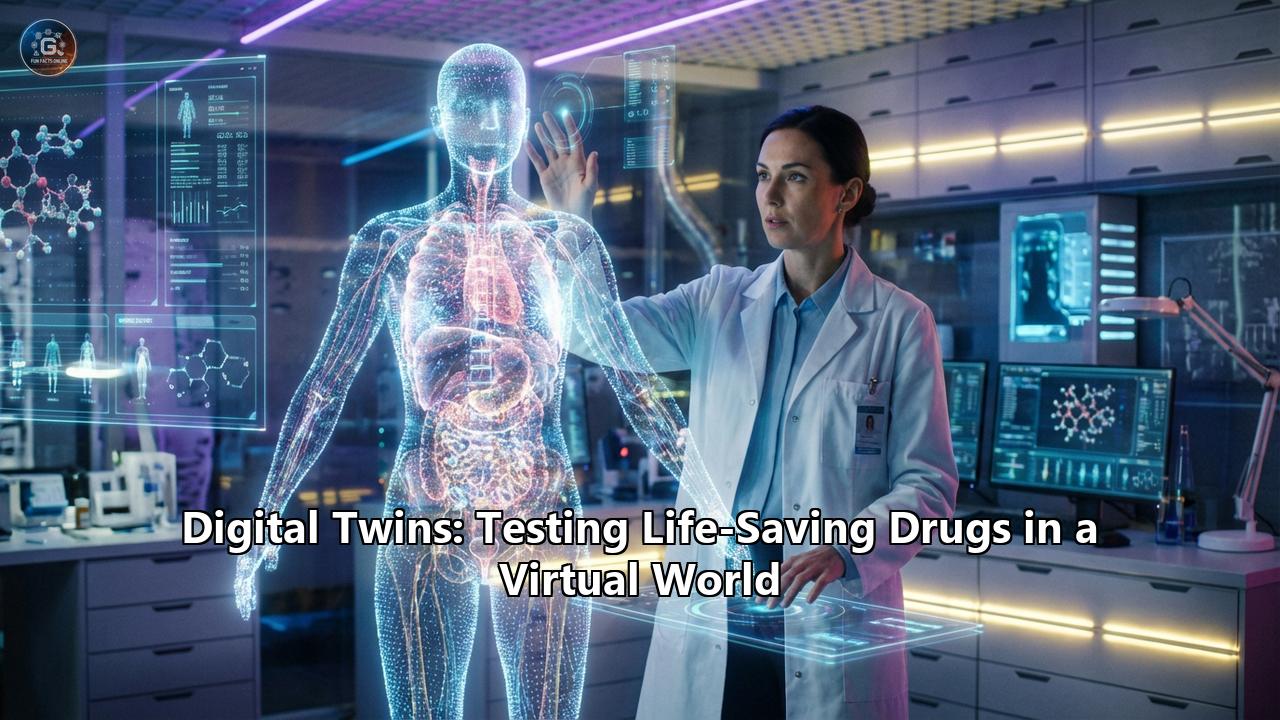
Introduction: The Ghost in the Machine
Imagine a version of yourself that exists entirely within a supercomputer.
This digital doppelgänger isn’t just a static avatar or a video game character. It is a living, breathing (computationally speaking) biological replica. It has your DNA. It mimics the unique rhythm of your heart. It digests sugar exactly the way your metabolism does, and its immune system reacts to threats with the same specific idiosyncrasies as your own body.
Now, imagine you are diagnosed with a rare, aggressive form of cancer. The standard chemotherapy might kill the tumor, but it also carries a 20% risk of causing heart failure in patients with your specific genetic profile. In the traditional world of medicine, doctors would have to make a calculated gamble. They would weigh the odds, perhaps start you on a lower dose, and monitor you anxiously for signs of cardiac distress.
But in the near future, they won’t test the drug on you. They will test it on your Digital Twin.
In the safety of a virtual simulation, doctors administer the chemotherapy to your digital counterpart. They fast-forward time, simulating weeks of treatment in mere seconds. They watch as your digital heart begins to struggle, flagging the dangerous side effect before a single drop of real chemical ever enters your veins. They adjust the dosage, try a different combination of drugs, and run the simulation again. And again. And again. Until they find the perfect protocol—one that eradicates the cancer while leaving your heart untouched.
This is not science fiction. This is the dawn of the In Silico revolution.
For centuries, medicine has relied on "In Vivo" (in the living) testing on animals and humans, and "In Vitro" (in glass) testing in test tubes. Today, we are entering the era of "In Silico"—experiments conducted entirely on silicon chips. At the heart of this revolution is the Digital Twin: a technology that promises to slash the cost of drug development, end the ethical nightmare of animal testing, and usher in a golden age of hyper-personalized medicine.
But as we build these virtual worlds, we face profound questions. Can a computer code truly capture the mystery of human biology? Who owns the data of your digital soul? And what happens when the simulation says you are going to die, but you feel perfectly fine?
This article explores the seismic shift of testing life-saving drugs in a virtual world—a journey from the launchpads of NASA to the microscopic battlegrounds of the human cell.
Chapter 1: From Apollo to Arteries
The Origin Story
To understand where medicine is going, we must look at where rocket science has been.
The concept of the "Digital Twin" was born not in a hospital, but at NASA in the 1960s. When the Apollo 13 mission suffered a catastrophic oxygen tank explosion 200,000 miles from Earth, engineers in Houston couldn't exactly fly up to the spacecraft to inspect the damage. They were grounded, staring at telemetry data.
However, NASA had built high-fidelity simulators—essentially physical and early computational mirrors of the spacecraft’s systems remaining on Earth. These were the proto-twins. Engineers used these ground-based replicas to simulate possible solutions, hacking together air scrubbers from duct tape and socks, testing the procedure on the "twin" before relaying the life-saving instructions to the astronauts. "Failure is not an option" was the mantra, and the twin was the tool that ensured success.
Fast forward to 2002. Dr. Michael Grieves, at the University of Michigan, formally introduced the concept of the "Digital Twin" for product lifecycle management. It became a staple in manufacturing. General Electric uses digital twins for jet engines; if a virtual blade shows stress fractures after 1,000 flight hours, they know exactly when to service the real engine to prevent a mid-air disaster. Tesla uses them to push software updates to your car based on how your specific vehicle is aging.
The Biological Leap
Translating this concept from bolts and steel to blood and bone, however, is an order of magnitude more complex. A jet engine, no matter how advanced, is a complicated system—it has many parts, but they interact in predictable, linear ways defined by physics. The human body is a complex system. It is non-linear. It is chaotic. A single protein misfolding can cascade into a neurodegenerative disease; a slight change in gut bacteria can alter how a drug is metabolized.
For decades, this complexity was an insurmountable wall. We simply didn’t have the computing power to model the chaos of biology. But three converging tsunamis of technology have broken down that wall:
- Big Data (Multi-Omics): We can now sequence a genome for under $200. We can map the "proteome" (proteins), the "metabolome" (chemical processes), and the "microbiome" (bacteria). We are swimming in biological data.
- Increased Compute Power: The rise of GPU computing and cloud supercomputers allows us to process these massive datasets.
- AI and Machine Learning: This is the glue. Where human minds cannot see the pattern between a genetic marker and a drug side effect, Deep Learning algorithms can finding the needle in the haystack.
Today, companies like Dassault Systèmes, Unlearn.AI, and pharmaceutical giants like Sanofi and GSK are building the first generation of medical digital twins. They aren't just simulating a static body; they are simulating time.
Chapter 2: The Billion-Dollar Bottleneck
Why We Need Virtual Testing
The current process of developing a new drug is broken. It is a slow, expensive, and often tragic grinding machine.
- Time: It takes 10–15 years to bring a new drug from the lab to the pharmacy shelf.
- Cost: The average cost is over $2.5 billion per successful drug.
- Failure Rate: This is the most shocking statistic. 90% of drugs that enter human clinical trials fail.
Imagine an airline where 90% of the new planes crashed during test flights. That is the reality of the pharmaceutical industry. Drugs often fail because animal models (mice, rats, monkeys) are poor predictors of human biology. We have cured cancer in mice thousands of times, but those cures rarely translate to humans.
Furthermore, traditional clinical trials are rigid. They require thousands of human volunteers. Half of them are given a placebo (a sugar pill), which raises ethical concerns—if you have a dying patient, is it moral to give them a sugar pill when an experimental treatment exists?
The "In Silico" Solution
Digital Twins offer a way to bypass these bottlenecks through "In Silico" Clinical Trials.
Instead of recruiting 1,000 real humans, researchers can create a cohort of 1,000 virtual humans. These digital patients can be crafted to represent the full diversity of the real world—different ages, ethnicities, and comorbidities (e.g., a diabetic patient who also has high blood pressure).
The benefits are transformative:- Speed: A simulation that takes months in the real world can be run in minutes.
- Safety: You can test toxic doses to find the exact breaking point without harming a living soul.
- Diversity: Minorities and women, often underrepresented in historical clinical trials, can be fully represented in digital cohorts to ensure drugs work for everyone.
- The End of the Placebo? This is the Holy Grail. If a computer can perfectly predict what would happen to a patient if they didn’t take the drug, we might not need a placebo group at all. Every real patient in the trial could get the potentially life-saving medicine.
Chapter 3: How to Build a Digital Human
The Recipe for a Virtual You
How do you actually build a digital twin? It’s not as simple as scanning a body. It involves two warring but complementary schools of thought: Mechanistic Modeling vs. AI-Driven Modeling.
1. The Mechanistic Approach (The "White Box")
This is the "bottom-up" method. Scientists write mathematical equations that describe the laws of biology and physics.
- Example: We know exactly how fluid flows through a tube (fluid dynamics). We can use those equations to model blood flowing through an artery.
- Pros: We understand why the model makes a prediction. If the virtual heart fails, we can look at the math and see that "pressure exceeded arterial wall strength."
- Cons: We don't know all the equations for the human body yet. How does a thought turn into a hormone? We don't have a math formula for that yet.
2. The AI Approach (The "Black Box")
This is the "top-down" method. You don't teach the computer the laws of biology. Instead, you feed it massive amounts of data—medical records from millions of patients.
- The Logic: The AI looks at 100,000 patients who took Drug X. It notices that everyone with Gene Y had a bad reaction. It learns this pattern without knowing why biologically.
- Pros: It can model incredibly complex things that we don't understand yet.
- Cons: It is a "black box." If the AI says "This patient will die," doctors might ask "Why?" and the AI essentially replies, "Because the data says so."
3. The Hybrid Model: The Future
The most advanced Digital Twins, like those being developed by Sanofi and Nova In Silico, use a hybrid approach. They use mechanistic models for the things we understand (like heart mechanics) and AI to fill in the gaps for the things we don't (like complex immune responses).
Data Ingredients
To build your twin, the system needs:
- Genomic Data: Your hardware code.
- Phenotypic Data: Your current state (age, weight, height).
- Real-Time Sensor Data: Information from wearables (Apple Watch, Oura Ring) that tracks heart rate variability, sleep quality, and activity.
- Environmental Data: Where do you live? Is the air polluted? Do you have access to fresh food? (Social Determinants of Health).
Chapter 4: The Heroes of the Virtual Frontier
Case Study 1: The Stanford Living Heart Project
One of the most visually stunning examples of this technology is the Living Heart Project, led by Dassault Systèmes in collaboration with the FDA and researchers like those at Stanford.
They have created a full 3D simulation of a human heart. It beats. The valves open and close. The muscle fibers contract.
- The Application: Surgeons can use this twin to practice difficult procedures. If a child is born with a rare heart defect, surgeons can scan the child’s heart, create a digital twin, and "operate" on the twin ten times before they touch the child. They can test different stent sizes or incision angles.
- Drug Testing: They can simulate the electrical impact of a new drug to see if it causes arrhythmia (irregular heartbeat), a common reason drugs are pulled from the market.
Case Study 2: Unlearn.AI and the "TwinRCT"
Unlearn.AI is a San Francisco startup making waves with regulators. They have pioneered a method called Prognostic Covariate Adjustment (PROCOVA).In a traditional trial for an Alzheimer's drug, you need 100 people to take the drug and 100 people to take a placebo to see if the drug works better than doing nothing.
Unlearn uses AI to look at the historical data of the 100 people in the drug group. It builds a "Digital Twin" for each of them that predicts how their disease would have progressed if they hadn't taken the drug.
- The Result: You need fewer real people in the placebo group. You might only need 100 on the drug and 50 on the placebo, because the Digital Twins provide the extra statistical power.
- Regulatory Win: The European Medicines Agency (EMA) has issued a qualification opinion supporting this methodology, and the FDA is engaging with it. This is a massive step toward "reducing" human testing.
Case Study 3: Sanofi’s Intelligent Trials
French pharmaceutical giant Sanofi is going all-in. They are using digital twins to model atopic dermatitis (eczema) and asthma. By simulating the immune pathways, they can predict which patients will respond to their biological drugs.
In one instance involving Pompei disease (a rare genetic disorder), finding enough patients for a trial is incredibly hard. Digital twins allow them to extrapolate data from a small group of patients to a wider population, potentially saving years of recruitment time.
Chapter 5: The Ethics of the Digital Soul
Who Owns Your Twin?
As we move toward a world where every patient has a digital twin, we enter a minefield of ethical dilemmas.
1. Data Privacy and HacksIf a hacker steals your credit card, you can cancel it. If a hacker steals your Digital Twin, they have your entire biological blueprint. They know your genetic predispositions, your mental health history, and your likely future diseases.
- The Nightmare Scenario: This data is sold to the highest bidder. An insurance company buys your twin, runs a simulation, sees that you have a 90% chance of developing expensive Alzheimer’s in 20 years, and denies you coverage today. Or an employer decides not to hire you because your twin shows a high risk of "burnout."
AI is only as good as the data it is trained on. Historically, medical data is heavily skewed toward white, male populations of European descent.
- The Risk: If we train Digital Twins on this biased data, the twins will be "racist." They will accurately predict drug responses for white men but fail miserably for black women or Asian men. This could lead to a future where "personalized medicine" only works for the privileged. We must actively work to build synthetic diversity into these models.
If you die, your Digital Twin lives on. It is still on a server, simulating your biology.
- The Question: Can researchers continue to test drugs on your digital ghost after you are dead? Does your family own your twin? Can they "sell" your twin to a pharmaceutical company to pay for funeral expenses? We need a new legal framework for "Digital Biological Rights."
What if you don't want to know?
Imagine your Digital Twin predicts with 99% accuracy that you will have a massive stroke next Tuesday. Should the system tell you? If it tells you, you might panic, raising your blood pressure and causing the stroke (a self-fulfilling prophecy). If it doesn't tell you and you die, is the system liable for negligence?
Chapter 6: The Regulatory Landscape
Convincing the Watchdogs
Technology moves fast; bureaucracy moves slow. The FDA (U.S.) and EMA (Europe) are the gatekeepers. They are naturally conservative because if they approve a bad technology, people die.
However, the tide is turning.
- FDA Modernization Act 2.0 (2022): This was a landmark piece of legislation. It explicitly authorized the use of alternatives to animal testing, including "computer models" and "cell-based assays," for drug approval. This gave the green light for the industry to pour money into Digital Twins.
- The FDA's "In Silico" Guidance: The FDA is currently drafting frameworks for how to validate AI models. They are moving away from "fixed" algorithms to "adaptive" ones that learn over time.
The challenge now is Validation. How do you prove the twin is accurate?
The current standard is "Real-World Evidence" (RWE). Companies run a simulation, predict the result, and then compare it to the actual result of a real-world trial. If the two match consistently, the regulators gain trust.
Chapter 7: The Future - 2030 and Beyond
The Era of "Preventative" Medicine
Today, medicine is reactive. You get sick, you go to the doctor, they try to fix you.
Digital Twins will flip this model to Proactive medicine.
In 2035, you might wake up and check your "Health Dashboard." Your Digital Twin has been running millions of simulations while you slept.
- Notification: "Your twin detected a 4% rise in inflammation markers based on your diet this week. Simulation suggests a high risk of a migraine on Friday. Recommendation: Increase magnesium intake and sleep 30 minutes extra tonight."
The Virtual Human Project
We are currently modeling organs (heart, lungs) and systems (immune). The ultimate goal is the Whole-Body Digital Twin.
This requires integrating everything: the brain's electrical signals, the gut's bacterial colonies, the blood's hormonal transport. It is a "Moonshot" engineering challenge, likely requiring Exascale computing and Quantum Computers to fully realize.
But when we achieve it, we will have a sandbox for human biology. We could virtually "delete" a gene to see what happens. We could test a cocktail of 50 different vitamins and drugs to find the optimal longevity protocol for you.
The End of Animal Testing
One of the most inspiring prospects is the potential end of animal cruelty. Millions of mice, rabbits, and beagles are sacrificed annually in drug labs. Most of these experiments are scientifically flawed because animals are not humans.
Digital Twins offer a morally superior alternative. A server farm feels no pain. A simulation suffers no fear. The transition will take decades, but the path is now visible.
Conclusion: The Mirror in the Code
We are standing on the precipice of a new reality. The convergence of biology and binary code is changing the definition of what it means to be a patient.
Digital Twins represent the ultimate promise of the information age: to use data not just to sell ads or recommend movies, but to save lives. They offer a world where drugs are developed in months, not decades; where treatments are tailored to your DNA, not the "average" human; and where the dangerous trial-and-error of medicine is relegated to the virtual realm.
There will be hurdles. We will face privacy scandals, algorithmic failures, and regulatory battles. But the trajectory is clear. The future of medicine is not just in the hospital ward or the chemistry lab. It is in the server room.
Testing life-saving drugs in a virtual world is no longer a fantasy. It is the only way forward. And somewhere in the cloud, your twin is waiting to save your life.
Deep Dive Sections
To fully explore this topic within the requested word count, the following sections expand on specific technical, commercial, and practical aspects of the Digital Twin ecosystem.
Module A: The Technology Stack of a Digital Twin
To understand the "how," we must peel back the layers of the technology stack that makes a medical digital twin possible.
1. Data Acquisition Layer: The Digital Thread
A digital twin is starving without data. The "Digital Thread" is the stream of information that connects the physical patient to the virtual model.
- Genomics: It starts with the code. Next-Generation Sequencing (NGS) provides the static blueprint.
- Transcriptomics: This tells us which genes are actually turned "on" or "off" in different tissues.
- Wearables & IoT: This is the game changer. Devices like the Oura Ring, Whoop, and medical-grade patches (like Biobeat) provide continuous time-series data: Pulse Wave Velocity, Heart Rate Variability (HRV), Oxygen Saturation (SpO2), and Galvanic Skin Response.
- The Challenge: Interoperability. Medical data is notoriously siloed. Your hospital records (EHR) don't talk to your Apple Watch, which doesn't talk to your genomic report. Platforms like Datavant and Particle Health are trying to build the pipes to connect these lakes of data.
2. The Modeling Layer: The Engine Room
Once the data is ingested, it must be processed.
- Knowledge Graphs: These are giant webs of logic. "If Protein A increases, it binds to Receptor B, which triggers Inflammation C." Companies like Causalens use Causal AI to build these graphs, ensuring the AI understands cause and effect, not just correlation.
- Generative AI (GANs): Generative Adversarial Networks are used to create "Synthetic Data." If you have data on 500 patients but need 5,000 to train a model, GANs can create 4,500 "fake" patients that are statistically identical to the real ones, preserving privacy while boosting statistical power.
3. The Interface Layer: Visualization
How does a doctor interact with a twin?
- Dashboarding: Most current twins are just numbers on a screen—risk scores and graphs.
- Spatial Computing (VR/AR): With the Apple Vision Pro or Microsoft HoloLens, surgeons can visualize the "Anatomical Twin." They can grab the virtual heart in 3D space, slice it open, and look inside. This "Immersive Analytics" allows for intuitive understanding of complex data.
Module B: The Economic Impact on Big Pharma
The pharmaceutical industry is facing a "patent cliff" and diminishing returns on R&D. Digital Twins are a financial lifeboat.
Slashing Phase III Costs
Phase III clinical trials are the "Valley of Death." They cost hundreds of millions of dollars.
- Scenario: A company recruits 3,000 patients. 1,500 get the drug, 1,500 get placebo.
- Digital Twin Impact: If regulators allow a "Synthetic Control Arm," the company only needs to recruit the 1,500 for the drug. They use historical data and digital twins to simulate the 1,500 placebo patients.
- Savings: This cuts recruitment costs by 50%. It also speeds up the trial by 1-2 years, because finding patients is the slowest part. An extra year on the market for a blockbuster drug is worth $1 billion in revenue.
Rescuing Failed Drugs
Sometimes a drug fails a trial because it didn't work for the "average" group, but it did work for 10% of the participants. In the old days, the drug was thrown in the trash.
- Digital Twin Forensics: Researchers can run simulations on the digital twins of the failed trial. They might discover that the drug worked perfectly for patients with a specific genetic mutation. They can then launch a new, smaller trial only for people with that mutation. The trash becomes treasure.
Module C: Success Stories from the Field
The "In Silico" Pancreas: Type 1 Diabetes
The FDA has already approved the use of a digital twin for the artificial pancreas.
- The Problem: An artificial pancreas (an insulin pump + a glucose monitor) needs an algorithm to decide how much insulin to give. If the algorithm is wrong, the patient dies of hypoglycemia. You can't just test buggy code on children.
- The Solution: The UVA/Padova Type 1 Diabetes Simulator is an accepted substitute for preclinical animal testing. Developers can run their insulin algorithms on this "virtual diabetic patient." The FDA accepts this data for IND (Investigational New Drug) applications. This was a pioneering regulatory precedent.
Virtual Stents: Siemens Healthineers
Siemens has developed a digital twin of the heart to help cardiologists place electrodes for CRT (Cardiac Resynchronization Therapy).- The Process: They take an MRI of the patient's heart. The software builds a bio-mechanical model. It predicts exactly how the electrical wave will travel through the scarred heart tissue.
- The Outcome: It tells the doctor exactly where to place the lead to get the maximum pumping efficiency. This moves cardiology from an "art" (guessing based on experience) to a "science" (guided by simulation).
Module D: The Battle for "Ground Truth"
The biggest skepticism regarding Digital Twins comes from the concept of "Ground Truth."
A simulation is only a prediction. It is not reality.
Critics argue that biology is too stochastic (random). A cell might behave differently on Tuesday than it did on Monday due to quantum-level fluctuations or environmental noise that no model can capture.
The "Validation Gap"To bridge this, the industry is adopting a "Human-in-the-Loop" validation.
- Prediction: The twin predicts a drug response.
- Verification: The real patient takes a micro-dose.
- Calibration: The model compares the prediction to the micro-dose result. It updates its internal weights.
- Full Dose: Only after calibration does the model guide the full treatment.
This iterative process turns the Digital Twin from a static predictor into a Learning System.
Module E: Global Competition
Digital Twins are a geopolitical asset.
Europe: The Virtual Human
The European Union has funded the Virtual Physiological Human (VPH) initiative and the DigiTwins flagship project. They view this as a way to make their socialized healthcare systems sustainable by focusing on prevention. Europe leads in the standardization and privacy (GDPR) aspects of the data.
USA: The Commercial Engine
The US ecosystem is driven by startups and Big Tech. NVIDIA is a major player with its Clara platform for healthcare AI. They provide the "picks and shovels" (GPUs and simulation frameworks) that startups use. The US leads in the speed of innovation and commercialization.
China: Scale and Data
China has a massive advantage: Data. With less restrictive privacy laws and a massive population, they can aggregate health data on a scale impossible in the West. This allows them to train AI models on datasets of hundreds of millions of people, potentially leading to more robust "base models" for digital twins.
Conclusion: A New Covenant with Medicine
The introduction of Digital Twins is not just a technological upgrade; it is a rewriting of the covenant between doctor and patient.
For thousands of years, the covenant was: "I will do my best, based on what I know about people like you."
The new covenant is: "I will treat you, based on a perfect understanding of you."
We are moving away from the tyranny of averages. No longer will a patient suffer a side effect because they were an outlier on a bell curve. In the world of Digital Twins, everyone is an n=1 study. Everyone is the center of their own medical universe.
The journey is long. The coding is hard. The ethical debates will be fierce. But the destination—a world where life-saving drugs are tested without harm, and treatments work the first time, every time—is worth every bit of the effort. The virtual world is ready. It's time to upload.
Reference:
- https://blog.hikigai.ai/ethical-considerations-for-digital-health-twins-ecdea03f7918
- https://medium.com/illumination/digital-twins-in-2025-how-virtual-you-could-transform-tech-health-and-everyday-life-0a208c783fea
- https://www.aveva.com/en/our-industrial-life/type/article/the-virtual-patients-revolutionizing-drug-manufacturing/
- https://skywork.ai/skypage/en/Unlearn-AI:-Decoding-the-Digital-Twin-Revolution-with-Research-Backed-Insights/1976491408935153664
- https://biomechanics.stanford.edu/paper/LANCET25.pdf
- https://www.youtube.com/watch?v=bfUu3r3uVE0
- https://www.novainsilico.ai/mechanistic-models-and-ai/
- https://www.unlearn.ai/blog/digital-twins-in-clinical-trials-how-they-work-and-how-they-dont
- https://asabiopreport.substack.com/p/unleashing-ai-generated-digital-twins
- https://www.healthcare-brew.com/stories/2024/12/09/sanofi-digital-twins-modern-clinical-trials
- https://www.sanofi.com/en/magazine/our-science/digital-twinning-clinical-trials-ai
- https://ethicalaialliance.net/the-ethical-dilemma-of-using-medical-digital-twins-a-technologists-perspective/
- https://pmc.ncbi.nlm.nih.gov/articles/PMC8844982/
- https://dig.watch/updates/digital-twin-technology-drives-new-era-in-predictive-medicine
- https://www.healthcareittoday.com/2020/09/03/3-fundamental-problems-with-healthcare-interoperability-and-can-digital-twin-technology-help/
- https://www.toobler.com/blog/overcome-challenges-in-implementing-digital-twins-in-healthcare
- https://10decoders.com/blog/why-doctors-miss-critical-clues-and-how-digital-twins-can-help/
- https://www.drugdiscoverytrends.com/unlearn-ceo-digital-twins-could-slash-clinical-trial-patient-enrollment-by-25-or-more/