
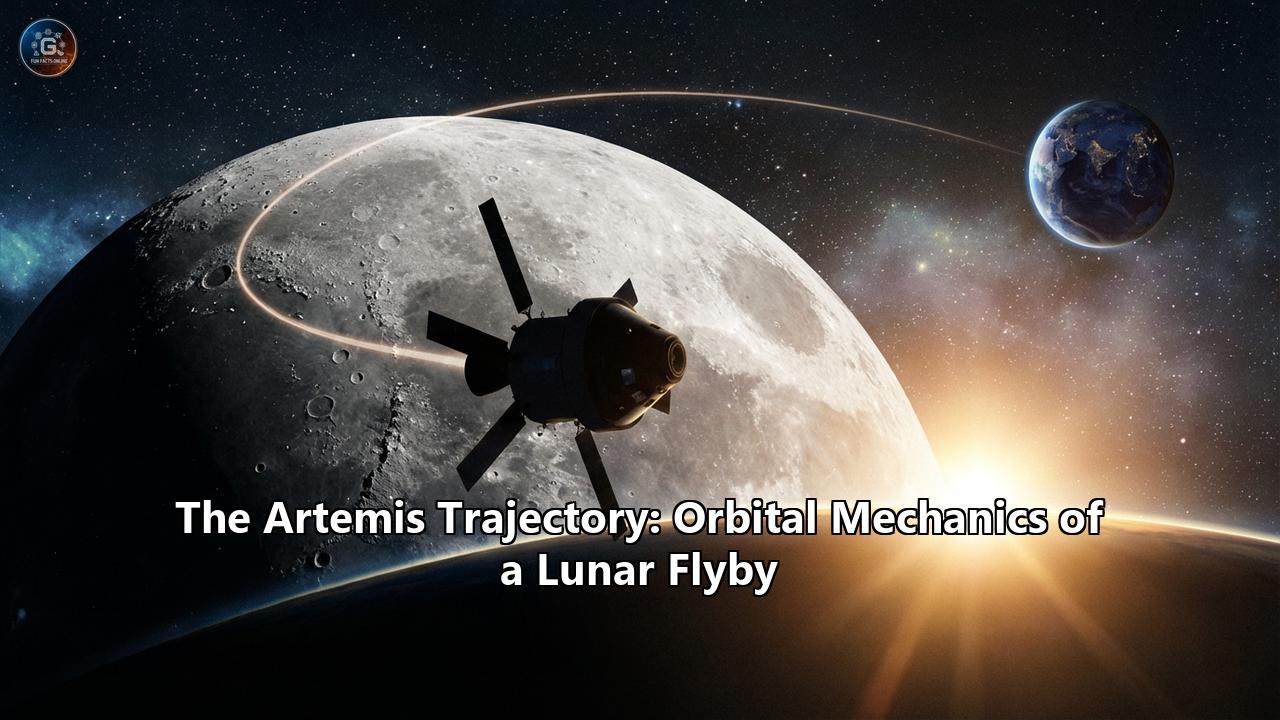
The return of humanity to the Moon is not merely a matter of building a larger rocket and aiming it at the night sky. It is a masterclass in celestial choreography, a dance governed by the unforgiving laws of Newton and Kepler. The Artemis program, NASA's ambitious successor to Apollo, utilizes a set of trajectories far more complex and elegant than the direct shots of the 1960s. From the "hybrid free-return" of Artemis II to the exotic "Near-Rectilinear Halo Orbit" (NRHO) of Artemis III, these flight paths represent the cutting edge of orbital mechanics.
This article explores the physics, the mathematics, and the sheer audacity of the trajectories that will carry the next generation of astronauts to the lunar surface.
Phase I: Escaping the Well—The Multi-Trans-Lunar Injection
Every lunar mission begins with a struggle against Earth’s gravity well. For Artemis, this battle is fought by the Space Launch System (SLS), a leviathan of thrust. However, the path from the launchpad to the Moon is not a straight line; it is a carefully sequenced series of energy transfers.
The Parking Orbit and the Oberth Effect
Unlike a satellite destined for Low Earth Orbit (LEO), an Artemis spacecraft has a "high energy" destination. The launch vehicle places the Orion spacecraft and its upper stage (the Interim Cryogenic Propulsion Stage, or ICPS) into an initial parking orbit. This is a standard circular orbit, roughly 100 nautical miles (185 km) above Earth.
In this parking orbit, the spacecraft is moving at approximately 7.8 km/s (17,500 mph). To reach the Moon, it must increase this speed to roughly 11.2 km/s (25,000 mph)—escape velocity. This burn is called the Trans-Lunar Injection (TLI).
Performing this burn at the lowest point of the orbit (perigee) takes advantage of the Oberth Effect. Simply put, a rocket engine is more efficient when the spacecraft is moving fast. The kinetic energy of the propellant is proportional to the square of the velocity ($E_k = \frac{1}{2}mv^2$). By burning fuel when velocity ($v$) is already high (at perigee), the spacecraft gains more total mechanical energy than if it burned the same amount of fuel at a higher altitude where it was moving slower.
The Artemis II Twist: Multi-Trans-Lunar Injection (MTLI)
For the crewed Artemis II mission, NASA has introduced a variation known as the Multi-Trans-Lunar Injection (MTLI). Unlike Apollo, which shot for the Moon almost immediately after checking systems in Earth orbit, Artemis II adds a dramatic intermediate step.
- Burn 1: Apogee Raise. The ICPS fires to push the spacecraft into a highly elliptical High Earth Orbit (HEO) with a period of roughly 24 hours (initially planned as 42 hours in earlier concepts, but refined to ~24 hours). This orbit takes the crew tens of thousands of kilometers away from Earth—higher than GPS satellites, higher than geostationary communication satellites—before falling back toward the planet.
Purpose: This "checkout orbit" allows the crew to test life support and manual control systems in deep space but largely within the safety of Earth's magnetosphere. If a critical failure occurs here, they naturally fall back to Earth in one day without needing a massive engine burn.
- Burn 2: The Final Kick. Once the checkout is complete and the spacecraft swings back down to its closest point to Earth (perigee), the final TLI burn is executed. Interestingly, for Artemis II, the Orion Service Module’s main engine (the OMS-E) performs this final push, not just the upper stage. This validates the spacecraft’s propulsion system for deep space operations.
Phase II: The Coast and The Figure-Eight
Once TLI is complete, the spacecraft is on a ballistic trajectory. It is effectively "falling" toward the Moon. This phase is dominated by Three-Body Dynamics—the complex gravitational tug-of-war between the Earth, the Moon, and the spacecraft.
The Hybrid Free-Return Trajectory
Safety is the primary driver for early Artemis missions. The trajectory chosen for Artemis II is a Hybrid Free-Return.
In a "classic" free-return trajectory (used on Apollo 8, 10, and 11), the spacecraft is aimed such that if the engine fails to fire at the Moon, the Moon’s gravity will naturally sling the spacecraft around and send it directly back to Earth's atmosphere at a safe re-entry angle. It requires zero fuel to return home if things go wrong.
However, a classic free-return imposes strict limits on where you can land or fly. It restricts the "access" to the Moon. The "Hybrid" version used by Artemis II tweaks this. The initial launch puts Orion on a path that would result in a high-altitude miss or a slow return. A small maneuver, powered by the Service Module during the coast phase, "fixes" the geometry to ensure a free return. This allows mission planners to access different lighting conditions and geometries while maintaining the safety net: if the engine dies after that first correction, gravity still brings the crew home.
The Geometry of the Flyby
As Orion approaches the Moon, it enters the Lunar Sphere of Influence (SOI). This is a mathematical boundary (radius ~66,000 km) where the Moon’s gravity becomes the dominant force acting on the ship, overpowering Earth’s pull.
Inside the SOI, the trajectory is hyperbolic relative to the Moon. Orion is not being captured into orbit; it is falling past the Moon.
- Perilune (Closest Approach): Orion will pass roughly 4,600 miles (7,400 km) beyond the lunar far side.
- The Slingshot: As it swings behind the Moon, the spacecraft steals a tiny fraction of the Moon's orbital momentum. This "gravity assist" accelerates Orion relative to the Earth, bending its path into a figure-eight that targets the Pacific Ocean recovery zone.
During this flyby, the crew will be further from Earth than any human in history, breaking the altitude record set by the Apollo 13 crew in 1970.
Phase III: The Deep Dive—Near-Rectilinear Halo Orbit (NRHO)
For Artemis III and the future Gateway space station, a simple flyby or a low lunar orbit (like Apollo) is insufficient. NASA needs a staging ground that is stable, accessible, and provides constant communication. The solution is one of the most counter-intuitive orbits in mechanics: the Near-Rectilinear Halo Orbit (NRHO).
Why "Halo"? Why "Rectilinear"?
To understand NRHO, we must abandon the simple idea of a satellite circling a planet. Instead, we look at Lagrange Points.
In the Earth-Moon system, there are five points where the gravitational forces of the two bodies balance the centrifugal force of motion. $L_1$ is the balance point between Earth and Moon; $L_2$ is on the far side of the Moon. These points are unstable equilibrium hills—like balancing a ball on the peak of a mountain. If you drift slightly, you roll away.
However, around these unstable points exist families of periodic orbits called "Halo Orbits." A spacecraft in a halo orbit moves in a loop around the invisible Lagrange point.
The Near-Rectilinear part describes the shape. A "normal" halo orbit looks like a wide circle or ellipse. As you tweak the energy of the orbit, bringing it closer to the Moon, the ellipse stretches out. It becomes highly elongated, almost a straight line (rectilinear) perpendicular to the Earth-Moon plane.
- The Shape: Imagine a giant, stretched vertical necklace hanging off the Moon's neck.
- The Dimensions: At its closest (perilune), the NRHO passes just 1,500–3,000 km over the lunar North Pole. At its furthest (apolune), it swings out to 70,000 km over the South Pole.
The Physics of Stability
The magic of the NRHO is its stability index. Most orbits around Lagrange points are highly unstable; you need to fire thrusters constantly to stay there. The NRHO is marginally stable.
In dynamical systems theory, this means the "Lyapunov exponents" (which measure how fast errors grow) are very small. A spacecraft can stay in NRHO for years with a Delta-V (change in velocity) budget of less than 10 m/s per year. It effectively "rides the ridge" of gravity with minimal effort.
The 9:2 Resonance
The specific NRHO chosen for Artemis III and Gateway is in a 9:2 Synodic Resonance.
- The spacecraft completes 9 revolutions around the Moon.
- In the same time, the Moon completes 2 phases (synodic periods) around the Earth.
This resonance prevents the spacecraft from ever being eclipsed by the Moon. It is always in direct line-of-sight of Earth, ensuring 24/7 communication—a critical requirement that Low Lunar Orbit (which is blocked 50% of the time) cannot meet.
Phase IV: Interaction—Docking and Landing
The trajectory mechanics get even more complex during the landing phase of Artemis III. This mission involves a rendezvous between two vehicles with vastly different flight characteristics: the Orion capsule and the SpaceX Starship HLS (Human Landing System).
The Loitering Dance
Orion enters NRHO using a powered burn at the perilune (closest approach). It then "loiters" in this 6.5-day orbit.
Meanwhile, the Starship HLS launches from Earth, refuels in Low Earth Orbit, and travels to the Moon, inserting itself into the same NRHO.
Because the NRHO is so slow at its highest point (apolune)—moving at only a few hundred miles per hour—docking is much easier and safer than in a high-speed Low Lunar Orbit. The "launch window" to drop down from NRHO to the lunar surface is open every 6.5 days.
The Descent
To land, Starship performs a separation burn. It leaves the stability of the NRHO and drops into a transfer ellipse that takes it down to a Low Lunar Orbit, and finally to the surface at the South Pole.
The return requires the lander to launch precisely when the NRHO plane passes overhead, catching the Orion spacecraft as it swings by on its low pass (perilune). This requires timing accuracy down to the second.
Phase V: The Return—Skip Entry
The journey home from the Moon involves a high-speed re-entry. Artemis introduces a new maneuver here as well: the Skip Entry.
Upon reaching Earth, Orion hits the atmosphere at Mach 32 (roughly 24,500 mph or 11 km/s). Instead of plunging directly in, Orion will perform a "skip."
- First Dip: The capsule dips into the upper atmosphere, using aerodynamic lift to shed significant speed and heat.
- The Bounce: Like a stone skipping on a pond, the capsule generates lift to fly back out* of the atmosphere temporarily. This cools the heat shield and allows the guidance computer to extend the range and refine the landing point.
- Second Dip: The capsule re-enters for the final descent and parachute deployment.
This skip maneuver reduces the G-forces on the crew (maxing out at 4G instead of the Apollo-era 6-7G) and allows for a precision landing off the coast of San Diego, regardless of where the Moon is in the sky at the moment of return.
Conclusion
The trajectory of an Artemis mission is a testament to how far orbital mechanics has come since the 1960s. We have moved from the "brute force" distinct ellipses of Apollo to the nuanced, resonant, manifold-riding trajectories of the 21st century.
By utilizing the Multi-Trans-Lunar Injection, the Hybrid Free-Return, and the Near-Rectilinear Halo Orbit, Artemis balances the opposing requirements of safety, fuel efficiency, and access. It treats the Earth and Moon not as separate gravity wells to be conquered, but as a unified dynamical system to be surfed. When the next astronauts look out their window at the lunar surface, they will be riding the invisible, mathematical waves of gravity itself.
Reference:
- https://www.universetoday.com/articles/the-lunar-gateway-will-be-in-a-near-rectilinear-halo-orbit
- https://www.nasa.gov/reference/artemis-ii/
- https://en.wikipedia.org/wiki/Artemis_II
- https://www.space.com/artemis-2-humans-moon-orbit
- https://www.popsci.com/science/artemis-2-lunar-mission-goals/
- https://engineering.purdue.edu/people/kathleen.howell.1/Publications/Conferences/2019_IAA_BouHowDav.pdf
- https://grokipedia.com/page/Near-rectilinear_halo_orbit
- https://en.wikipedia.org/wiki/Near-rectilinear_halo_orbit
- http://advspace.publicshare.s3.amazonaws.com/NRHO+OD+with+Simulated+DSN.pdf
- https://ntrs.nasa.gov/api/citations/20200011550/downloads/20200011550.pdf