
The ticking of a clock has always been humanity’s attempt to impose order on the chaos of the universe. From the rhythmic dripping of water clocks in ancient Egypt to the swinging pendulums of the Renaissance, our history is a chronicle of slicing time into ever-thinner, more precise slivers. For the last half-century, the atomic clock has been the undisputed monarch of this domain, counting the oscillations of electrons to define the international second. It is the heartbeat of our modern world, synchronizing GPS satellites, financial markets, and the internet itself.
But in the quiet, temperature-controlled laboratories of Vienna and Boulder, Colorado, a new monarch has been crowned. The atomic age of timekeeping is ending; the nuclear age has begun.
We are witnessing the birth of the Thorium Chronometer—a device so precise that if it had started ticking at the Big Bang, it would not have lost or gained a second by today. This is not merely an incremental improvement; it is a paradigm shift. While atomic clocks measure the frenetic dance of electrons around an atom, the Thorium clock ignores the shell and peers directly into the heart of the matter: the atomic nucleus. By counting the "breaths" of a single nucleus of Thorium-229, we are unlocking a new dimension of metrology that promises to rewrite the laws of physics, map the invisible dark matter filling our galaxy, and guide humanity to the stars with pin-point accuracy.
This is the story of the Thorium Chronometer—how it works, why it changes everything, and the monumental scientific odyssey that made it possible.
Part I: The Limits of the Atom
To understand why we need a nuclear clock, we must first appreciate the marvel—and the limitations—of the atomic clock.
Since 1967, the International System of Units (SI) has defined the second not by the rotation of the Earth, which is wobbly and unreliable, but by the properties of the Cesium-133 atom. Specifically, a second is defined as the duration of 9,192,631,770 periods of the radiation corresponding to the transition between the two hyperfine levels of the ground state of the cesium-133 atom. In simpler terms, we bathe cesium atoms in microwaves, and when they absorb the energy and change their electron state (a "transition"), we count the frequency of that microwave radiation. That frequency is our pendulum.
Over the decades, we have moved from microwaves to optical light, using atoms like Strontium and Ytterbium in "optical lattice clocks." These devices use lasers instead of microwaves. Since light waves oscillate much faster than microwaves—hundreds of trillions of times per second—they divide time into much finer slices, offering greater precision. The best optical atomic clocks today are accurate to about one part in $10^{18}$. This is akin to measuring the distance from Earth to the Sun to within the width of a single bacterium.
However, atomic clocks have an Achilles' heel: the electron.
Electrons are flighty, lightweight particles that exist in the outer shells of an atom. Because they are on the outside, they are exposed to the world. They are easily pushed and pulled by stray electric fields, magnetic disturbances, and even the blackbody radiation (heat) emitted by the laboratory walls. To build the world's best atomic clock, scientists must go to heroic lengths to shield these atoms. They trap them in vacuum chambers, cool them to near absolute zero with lasers to stop them from jittering, and surround them with magnetic shielding.
But no matter how good the shielding, the electron remains vulnerable. It is a leaf blowing in the wind of the electromagnetic environment. To go deeper—to reach precisions of $10^{19}$ or $10^{20}$—we need a pendulum that is heavier, stiffer, and protected from the noise of the world.
We need the nucleus.
Part II: The Nuclear Fortress
The atomic nucleus is a fortress. Tightly packed with protons and neutrons, it is roughly 100,000 times smaller than the atom itself. It is held together by the Strong Nuclear Force, the most powerful force in nature. Because it is so small and bound so tightly, the nucleus is virtually immune to the external disturbances that plague electrons. Magnetic fields, electric noise, and thermal radiation bounce off the nucleus like pebbles off a tank.
If we could use a nuclear transition as our clock pendulum, we would gain an immediate, massive advantage in stability. A nuclear clock would be naturally robust, potentially allowing us to take ultra-precise timekeeping out of the lab and into the real world—onto ships, spacecraft, and perhaps even smartphones.
But there is a catch. A massive one.
Because the Strong Force is so strong, "ringing" the nucleus usually requires enormous amounts of energy. In standard atoms, exciting a nucleus from its ground state to a higher energy state requires X-rays or gamma rays—high-energy radiation that destroys molecules and is incredibly difficult to generate and control with the precision needed for a clock. We have no "gamma-ray lasers" that can gently tickle a nucleus into a rhythmic oscillation. We only have sledgehammers.
This seemed to be an insurmountable law of nature: Electrons are easy to control but fragile; nuclei are robust but impossible to control.
But nature, in a rare moment of generosity, gave us a loophole. A single, solitary exception in the entire periodic table of elements.
Part III: The Miracle of Thorium-229
Deep in the actinide series of the periodic table lies Thorium-229, a radioactive isotope with a half-life of nearly 8,000 years. For decades, nuclear physicists suspected that Thorium-229 had a secret.
Theoretical models in the 1970s suggested that this particular nucleus possessed an excited state—an "isomer"—that was bizarrely close in energy to its ground state. While most nuclear excitations require mega-electron-volts (MeV) or kilo-electron-volts (keV) of energy, calculations hinted that the Thorium-229 nucleus could be excited with just a few electron-volts (eV).
This energy scale—a few electron-volts—is not the realm of X-rays or gamma rays. It is the realm of ultraviolet light. It is the same energy scale that electrons use. This meant that, theoretically, one could use a standard tabletop laser to manipulate a nuclear state. It was the "Goldilocks" nucleus: the robustness of a nuclear core with the accessibility of an electronic shell.
The hunt for this "isomer transition" became the Holy Grail of nuclear physics. For forty years, scientists searched for it, narrowing down the energy range but failing to pinpoint the exact frequency. It was like trying to tune into a radio station when you don't know the frequency, the station is broadcasting for only a fraction of a second, and the dial spans the entire electromagnetic spectrum.
The breakthrough finally began to crystallize in the mid-2020s. First, teams at CERN and LMU Munich managed to detect the tell-tale glow of the isomer decaying, confirming its existence. Then, in a cascade of rapid-fire discoveries in 2024 and 2025, the teams at JILA (a joint institute of NIST and the University of Colorado Boulder) and TU Wien (Vienna University of Technology) achieved the impossible.
They didn't just find the transition; they locked a laser to it.
Using a "frequency comb"—a ruler made of light—they measured the transition energy to be exactly 8.355733... eV. They had found the keyhole in the nuclear fortress.
Part IV: Anatomy of the Thorium Chronometer
So, how does one build a clock out of a rock? Unlike the gas chambers of traditional atomic clocks, the Thorium Chronometer looks surprisingly different.
The Crystal Heart
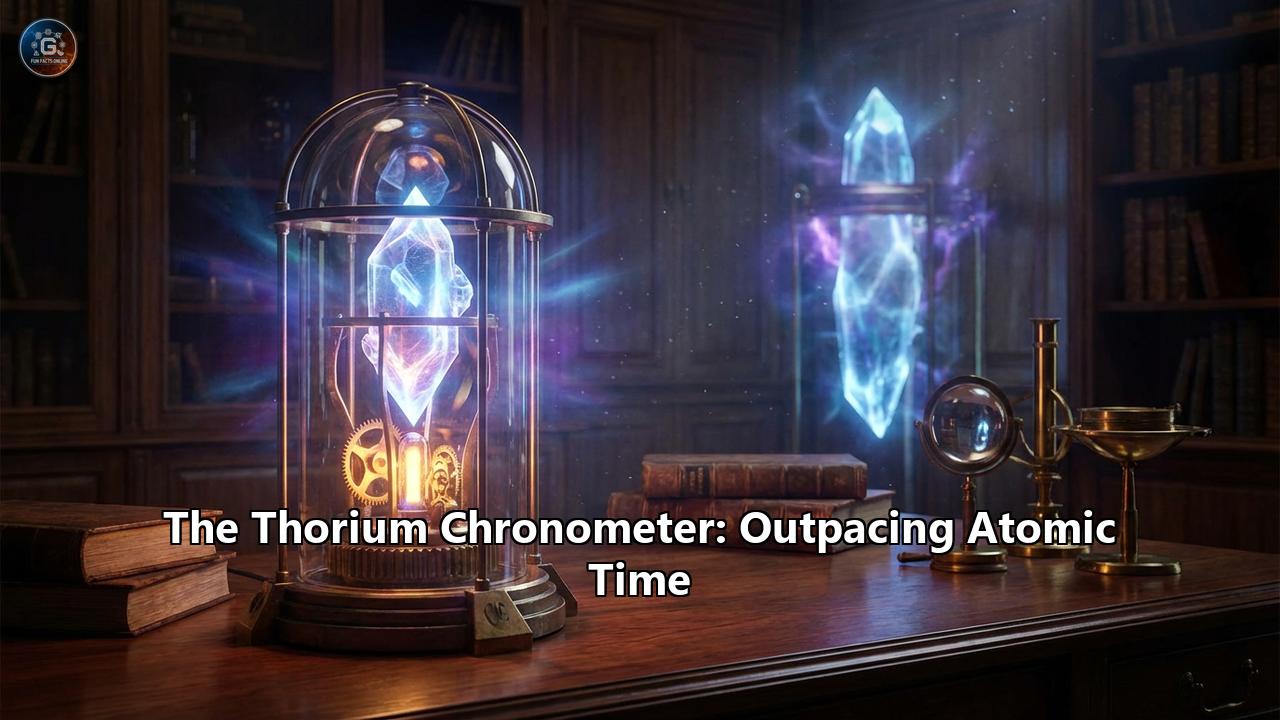
The most promising design, and the one that has garnered the most headlines in 2026, is the solid-state nuclear clock. Instead of trapping individual atoms in a vacuum using complex magnetic fields, scientists take billions of Thorium-229 nuclei and embed them directly into a crystal lattice of Calcium Fluoride (CaF2).
Calcium Fluoride is transparent to ultraviolet light, meaning it acts like a glass window. When Thorium nuclei are doped into this crystal, they are held rigidly in place by the crystal structure. This gives the Thorium clock a massive advantage: density. A standard atomic clock might interrogate a few thousand atoms at a time. A small crystal of Thorium-doped Calcium Fluoride, no larger than a grain of rice, contains nearly $10^{15}$ (one quadrillion) Thorium nuclei.
This sheer number of "pendulums" swinging in unison provides an incredibly strong signal, allowing the clock to reach its maximum precision much faster than its atomic cousins.
The VUV Laser
The "pendulum" needs a push. This comes from a custom-built Vacuum Ultraviolet (VUV) laser. VUV light is finicky; it is absorbed by oxygen in the air, so the entire apparatus must be kept in a vacuum. The laser is tuned to exactly 148.38 nanometers—the wavelength corresponding to the 8.35 eV transition.
When the laser light hits the crystal, it penetrates the calcium fluoride and strikes the thorium nuclei. If the laser is tuned to the exact right frequency, the nuclei absorb the photons and jump to their excited "isomer" state.
The Frequency Comb
How do we count the ticks? The laser light oscillates at about 2 petahertz ($2 \times 10^{15}$ times per second). No electronic counter can track a signal that fast. This is where the optical frequency comb comes in.
Invented by Nobel laureates Ted Hänsch and John Hall, the frequency comb acts as a reduction gear. It takes the uncountably fast oscillations of the VUV laser and divides them down, step by step, until they turn into a radio frequency that a standard computer can count. The comb links the nuclear heartbeat to the human second.
Part V: The Struggle for Precision
If the story ended here, we would have a nice clock. But we want the perfect clock. And perfection is not easily won.
While the nucleus is shielded from the outside world, it is not completely isolated. In the solid-state approach, the Thorium nuclei are sitting inside a crystal lattice. They are surrounded by calcium and fluorine ions, which exert electric fields on the nucleus.
This leads to the primary challenge of the Thorium clock: Crystal Lattice Effects.
The electric fields inside the crystal can warp the shape of the nucleus slightly, shifting the frequency of the "tick." Worse, these fields change with temperature. As the crystal warms up, it expands. The atoms move further apart, the electric fields weaken, and the frequency of the nuclear transition drifts.
For a long time, critics argued that this "temperature shift" would kill the solid-state nuclear clock. They claimed you would need to control the temperature of the crystal to an impossible degree—better than a millionth of a degree.
But in late 2024, the JILA/TU Wien collaboration discovered a "magic" solution.
They found that the Thorium-229 nucleus has multiple sub-states (quantum variations of the transition). They discovered that one specific transition—the jump between the ground state ($m = \pm 5/2$) and the excited state ($m = \pm 3/2$)—is incredibly insensitive to temperature. It’s a physical quirk, a cancellation of errors where the shift caused by the changing electric field is almost exactly opposed by the shift caused by the changing electron density.
This "magic transition" shifts by only 62 kilohertz over a temperature range of 140 degrees! By cooling the crystal and locking onto this specific transition, the temperature problem becomes manageable. Scientists now believe that with standard cryogenic cooling, they can suppress these shifts enough to reach the $10^{19}$ accuracy goal.
Part VI: Trapped Ions vs. Solid State
While the solid-state crystal approach is currently winning the race due to its strong signal and simplicity, there is a rival architecture: the Trapped Ion Nuclear Clock.
In this design, pioneered by teams in Germany (PTB) and the US, scientists don't use a crystal. Instead, they trap a single Thorium ion in an electromagnetic trap, hovering in a vacuum.
The Pros:A single ion in a vacuum is the ultimate pristine environment. There is no crystal lattice to distort the frequency. There are no neighbors to bump into. The "systematic uncertainties" are vanishingly small. If you want the absolute most accurate measurement of the nuclear frequency, this is the way to do it.
The Cons:It’s slow. With only one ion, you have to repeat the experiment millions of times to build up a statistic. It’s like trying to determine the average height of a population by measuring one person a day. The "dead time" (the time spent cooling and preparing the ion) is high.
Currently, the field is split. The solid-state "crystal clock" is viewed as the path to robust, portable applications. Imagine a rack-mounted nuclear clock on a Navy ship or a deep-space satellite. The trapped-ion clock is viewed as the path to ultimate laboratory precision, the device that will stay in a bunker and define the SI second for the next century.
Both approaches are vital. They will likely coexist, checking each other’s work.
Part VII: Why Do We Need This?
Why spend billions of dollars and decades of careers to split a second into a quintillion parts? Does it matter if we know the time to 18 decimal places versus 19?
The answer is a resounding yes. Better clocks are not just about punctuality; they are the telescopes of time. They allow us to see things that are otherwise invisible.
1. Searching for Dark Matter
We know Dark Matter exists; it makes up 85% of the matter in the universe. But we have never seen a particle of it. Some theories suggest that Dark Matter is not a heavy particle, but an ultralight field that oscillates through the cosmos.
If this field exists, it would interact with normal matter in subtle ways. It might cause the fundamental constants of nature—like the Fine Structure Constant ($\alpha$), which determines the strength of electromagnetic interactions—to wobble slightly.
An atomic clock relies on electromagnetic forces (electrons). A nuclear clock relies on the Strong Force (nuclei). If Dark Matter sweeps through the Earth, it might affect these two forces differently. By comparing a Thorium nuclear clock with a Strontium atomic clock, scientists could see the ratio of their ticks oscillate. That oscillation would be the smoking gun of Dark Matter. The Thorium clock is essentially a Dark Matter detector disguised as a timepiece.
2. Testing the Constancy of Constants
Are the laws of physics constant? We assume the speed of light and the strength of gravity are the same today as they were yesterday. But some theories of "New Physics" (like String Theory) suggest these constants might drift over billions of years.
Because the Thorium transition energy results from a delicate cancellation between the Strong Force and the Coulomb Force, it is incredibly sensitive to any change in the Fine Structure Constant. In fact, it is estimated to be 10,000 to 100,000 times more sensitive than any atomic system. A nuclear clock running for a year could set constraints on the stability of the universe's laws that are orders of magnitude tighter than anything we have today.
3. Relativistic Geodesy
Einstein’s Theory of General Relativity tells us that time moves slower closer to a massive object. A clock on the floor ticks slower than a clock on a table.
Current atomic clocks are already sensitive enough to detect the time dilation caused by a height difference of one centimeter. A nuclear clock, with its potential $10^{19}$ precision, could detect height differences of less than a millimeter.
This turns the clock into a gravimeter. You could map the interior of the Earth by measuring how time warps on the surface. We could detect magma chambers filling up under volcanoes before they erupt, simply by watching the clock slow down as the mass beneath it increases. We could monitor the melting of polar ice sheets or the movement of tectonic plates in real-time, just by checking the time.
4. Deep Space Navigation
GPS works because the satellites carry atomic clocks. But GPS signals are weak and easily jammed. Furthermore, for deep space exploration—sending probes to the moons of Jupiter or the Kuiper Belt—we currently rely on Earth-based tracking. We have to send a signal from Earth, have the probe bounce it back, and measure the delay. This is slow and imprecise over billions of miles.
A robust, solid-state Thorium clock is small enough to be put on the spacecraft itself. A probe with its own ultra-precise master clock could navigate autonomously. It could triangulate its position using the signals from pulsars or distant stars without needing a constant lifeline to Earth. It would enable a "GPS for the Galaxy."
Part VIII: The Road Ahead (2026-2030)
As we stand in early 2026, the "Thorium Rush" is in full swing.
The initial prototypes demonstrated in late 2024 were "proof of principle." They proved that the laser could drive the nucleus and that the frequency comb could count it. But they were not yet more stable than the best Strontium clocks.
The goal for the remainder of this decade is stability and accuracy.
Teams at TU Wien, JILA, PTB, and emerging groups in China and Japan are racing to refine the crystal growth process. They need cleaner crystals with fewer defects to reduce the line broadening. They are developing better VUV lasers with narrower linewidths.
By 2028, experts predict we will see the first Thorium clock that beats the best atomic clock in stability.
By 2030, we may see the first commercial prototypes—rack-mounted units designed for testing in field environments.
There is also the exciting possibility of "entangled clocks." Using quantum entanglement, scientists could link billions of Thorium nuclei in a crystal so that they act as a single "super-atom," reducing the noise even further. This is the frontier of "Heisenberg-limited" timekeeping.
Conclusion: The Master of Time
The invention of the mechanical clock in the Middle Ages changed how we organized society. The invention of the atomic clock in the 20th century gave us the Information Age. The invention of the Thorium Chronometer in the 21st century promises to unveil the hidden fabric of reality itself.
We are moving from a civilization that measures time by the motion of the visible (pendulums, quartz, electrons) to one that measures time by the stillness of the invisible (the nucleus).
The Thorium Chronometer is more than just a better watch. It is a testament to human persistence. It took fifty years to find a needle in a haystack—a single energy level in a single isotope hidden among the infinite possibilities of quantum mechanics. But now that we have found it, we hold the key to a new kingdom.
In this new era, we will not just measure time; we will use time as a tool to pry open the universe's deepest secrets. The atomic clock tick-tocked its way through the 20th century. The nuclear clock does not just tick; it hums with the fundamental frequency of the forces that bind the cosmos together. And for the first time, we are listening.
Reference:
- https://idstch.com/technology/electronics/revolutionizing-precision-a-1000x-leap-forward-in-next-generation-atomic-clock-technology/
- https://physicsworld.com/a/excitation-of-thorium-229-brings-a-working-nuclear-clock-closer/
- https://physicsworld.com/a/solid-state-nuclear-clocks-brought-closer-by-physical-vapour-deposition/
- https://arxiv.org/html/2409.11590v2
- https://www.alphaxiv.org/overview/2409.11590v1
- https://m-malinowski.github.io/2022/05/21/ti-best-and-worst.html
- https://www.archivemarketresearch.com/reports/thorium-229-660383