
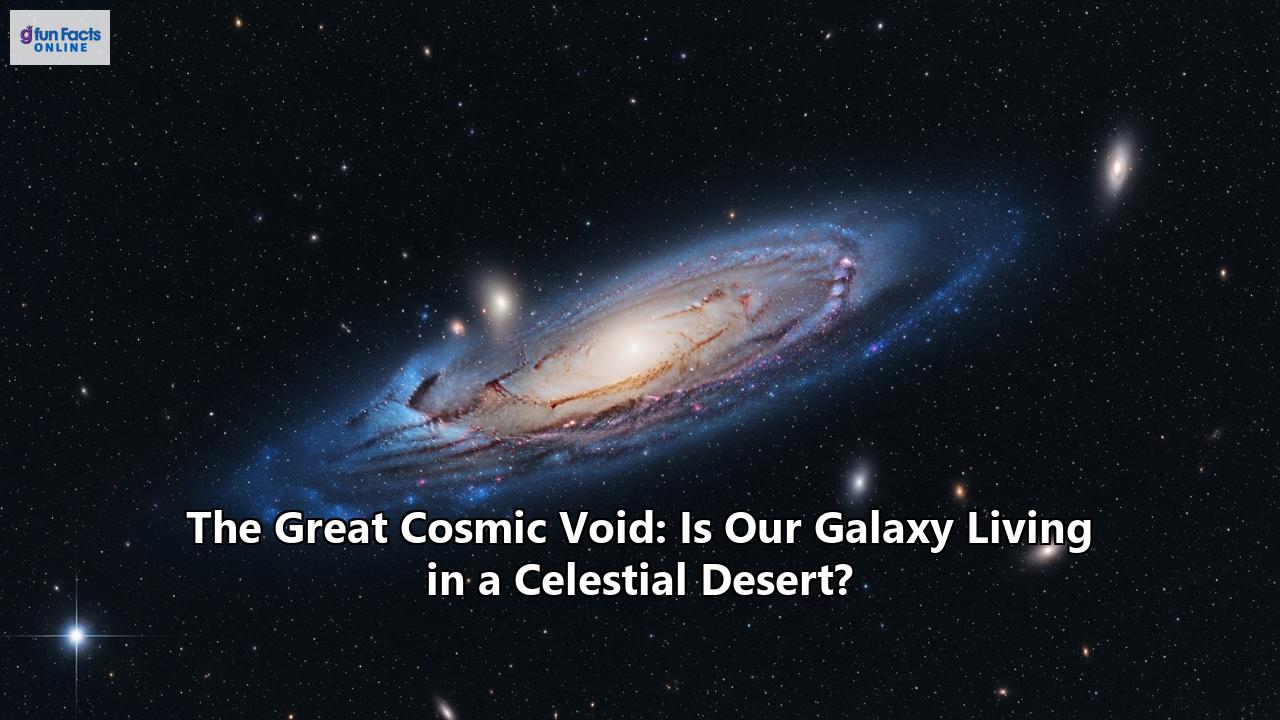
Imagine gazing up at the night sky, a velvet canvas sprinkled with the diamond dust of distant stars and galaxies. For centuries, we've charted these celestial bodies, mapping our cosmic neighborhood and beyond. But what if this bustling metropolis of galaxies is just a vibrant oasis in a vast, cosmic desert? What if our own Milky Way galaxy, our home in the universe, resides in an immense, under-dense region of space—a "Great Cosmic Void"? This intriguing and somewhat unsettling idea is at the forefront of a major cosmological debate, potentially holding the key to solving one of the most significant puzzles in modern astronomy: the Hubble tension.
The Cosmic Web: A Universe of Filaments and Voids
To understand the concept of a cosmic void, we must first zoom out and look at the large-scale structure of the universe. On the grandest of scales, matter is not distributed uniformly. Instead, it is organized into a colossal, web-like structure. This "cosmic web" consists of dense filaments of galaxies and galaxy clusters, stretching for hundreds of millions of light-years, surrounding vast, relatively empty regions known as cosmic voids.
These voids are not entirely empty; they contain some galaxies and a thin gruel of hydrogen gas, but their density is typically less than 10% of the cosmic average. They can range in size from tens to hundreds of millions of light-years in diameter. The formation of this cosmic web is thought to be a result of tiny quantum fluctuations in the primordial plasma of the early universe, shortly after the Big Bang. These minute density variations were amplified over billions of years by the force of gravity, causing denser regions to collapse and form the galaxy filaments we see today, while the less dense regions expanded to become the cosmic voids.
The study of cosmic voids began in earnest in the mid-1970s with the advent of redshift surveys, which allowed astronomers to create the first three-dimensional maps of the universe. In 1981, a particularly large void was discovered in the constellation Boötes, spanning an incredible 330 million light-years. If our Milky Way were at the center of the Boötes Void, we would not have known about the existence of other galaxies until the 1960s. This discovery and others that followed confirmed that voids are a fundamental component of the universe's structure, making up a significant portion of its volume.
The KBC Void: Our Home in the Celestial Suburbs?
For years, the prevailing assumption in cosmology has been the "cosmological principle," which states that on large enough scales, the universe is homogeneous and isotropic, meaning it looks the same in all directions and from all locations. However, a growing body of evidence suggests that our own galactic neighborhood might not be so average after all.
In 2013, a team of astronomers—Ryan Keenan, Amy Barger, and Lennox Cowie—published a study that suggested the Milky Way galaxy is located within a vast cosmic void. This immense underdense region, now known as the Keenan, Barger, and Cowie (KBC) void, is estimated to be roughly 2 billion light-years in diameter, making it the largest cosmic void ever observed. Subsequent studies have confirmed these initial findings, suggesting that our galaxy resides in a region of space with a matter density about 20% lower than the cosmic average.
It is important to note that being in a void does not mean we are in a completely empty expanse. The KBC void contains our own Local Group of galaxies, which includes Andromeda, and even the larger Laniakea Supercluster. A helpful analogy is to think of the cosmic web as a network of bustling cities (galaxy clusters) connected by highways (filaments). In this analogy, the KBC void is like a vast, sparsely populated rural area or a suburb, far from the dense urban centers. So, while our immediate surroundings are populated, the larger region we inhabit is significantly less dense than average.
The Hubble Tension: A Cosmic Conundrum
The discovery of our residence within the KBC void has profound implications, particularly for one of the most pressing problems in cosmology today: the Hubble tension. This "tension" arises from a discrepancy in the measured value of the Hubble constant, which is the rate at which the universe is expanding.
There are two primary methods for measuring the Hubble constant. One method looks at the "local" universe, observing relatively nearby objects like Cepheid variable stars and Type Ia supernovae. These "standard candles" have known intrinsic brightness, allowing astronomers to calculate their distance and, by measuring their redshift, how fast they are receding from us. This method consistently yields a higher value for the Hubble constant, around 73 kilometers per second per megaparsec.
The other method looks at the "early" universe, by observing the Cosmic Microwave Background (CMB), the faint afterglow of the Big Bang. By analyzing the tiny temperature fluctuations in the CMB, cosmologists can predict what the expansion rate of the universe should be today, based on the standard model of cosmology, known as the Lambda-CDM model. This method gives a lower value for the Hubble constant, around 67 kilometers per second per megaparsec.
This persistent disagreement, a roughly 10% difference between the two measurements, is the Hubble tension. It suggests that either there is a flaw in our measurements, or the standard model of cosmology is incomplete.
A Void as the Solution?
The existence of the KBC void offers a tantalizingly simple and elegant solution to the Hubble tension. If we are living in a large, underdense region, the gravitational pull from the denser matter outside the void would have a significant effect on our local measurements.
Imagine being on a large trampoline. If you are in the center of a less dense area of the trampoline's fabric, the pull from the more stretched, denser areas around you will be stronger. Similarly, galaxies within the KBC void experience a stronger gravitational tug from the denser regions of the cosmic web that lie beyond the void's edge. This outward pull would cause galaxies within the void to move away from us at a higher speed than the global expansion rate of the universe.
This additional velocity, a "local" acceleration, would make the universe appear to be expanding faster from our vantage point inside the void. This would explain why our local measurements of the Hubble constant, which are based on observations of galaxies within the KBC void, give a higher value. The measurements from the CMB, on the other hand, reflect the average expansion rate of the entire universe and would not be affected by this local anomaly.
Recent studies have lent significant weight to this hypothesis. An analysis of Baryon Acoustic Oscillations (BAOs)—fossilized sound waves from the early universe that are imprinted on the distribution of galaxies—suggests that a model of the universe with a local void is about 100 million times more likely to fit the observational data than a model without one.
Challenges and Alternative Explanations
While the KBC void provides a compelling explanation for the Hubble tension, it is not without its challenges and is not universally accepted within the cosmological community.
One of the main issues is the sheer size of the KBC void. According to the standard Lambda-CDM model, a void as large and as underdense as the KBC void is statistically very unlikely to form. Such a massive structure would require a very large initial density fluctuation in the early universe, an event that is considered highly improbable. Some studies have even suggested that the existence of the KBC void, combined with the Hubble tension, rules out the Lambda-CDM model with a high degree of confidence.
This has led some researchers to propose alternative theories that could explain both the existence of large voids and the Hubble tension. One such theory is Modified Newtonian Dynamics (MOND). MOND suggests that gravity behaves differently at very low accelerations, which are common in the vast expanses of cosmic voids. Proponents of MOND argue that this modified gravity would allow for the formation of larger and deeper voids than predicted by the standard model, and that these voids would naturally resolve the Hubble tension.
Another alternative explanation for the Hubble tension is the existence of "early dark energy." This theory proposes that there was a brief period of accelerated expansion in the early universe, driven by a new form of dark energy. This early burst of expansion could have altered the universe's expansion history in a way that reconciles the measurements from the local and early universe. However, this idea also faces its own set of challenges and is yet to be confirmed by observational evidence.
The Future of the Cosmic Desert
The question of whether our galaxy truly resides in a celestial desert remains a hot topic of debate and an active area of research. The answer has profound implications for our understanding of the universe's structure, its evolution, and the fundamental laws that govern it.
Future observational campaigns, with next-generation telescopes and large-scale galaxy surveys, will provide more precise data on the distribution of galaxies in our local universe. These observations will help to either confirm the existence and properties of the KBC void or reveal a more uniform distribution of matter, which would point towards other solutions for the Hubble tension.
Whether the Milky Way is an island in a cosmic void or just another speck in a homogeneous universe, the quest to understand our place in the cosmos continues to drive scientific discovery. The "Great Cosmic Void" may seem like a desolate concept, but it has opened up a universe of new questions and possibilities, reminding us that even the emptiest of spaces can be filled with profound insights.
Reference:
- https://physics.stackexchange.com/questions/519816/voids-and-hubble-constant
- https://darkmattercrisis.wordpress.com/2020/11/20/52-beyond-the-standard-model-of-cosmology-mond-as-a-way-out-of-the-current-cosmological-crisis/
- https://academic.oup.com/mnras/article/499/2/2845/5939857
- https://www.livescience.com/space/cosmology/echoes-from-the-big-bang-suggest-earth-is-trapped-inside-a-giant-cosmic-void-scientists-claim
- https://www.space.com/the-universe/hubble-trouble-or-superbubble-astronomers-need-to-escape-the-supervoid-to-solve-cosmology-crisis
- https://www.youtube.com/watch?v=wQH7Z8mW-xI&pp=0gcJCf8Ao7VqN5tD
- https://www.youtube.com/watch?v=Y59rsi4p5Ko
- https://www.researchgate.net/publication/344382008_The_KBC_void_and_Hubble_tension_contradict_LCDM_on_a_Gpc_scale_-_Milgromian_dynamics_as_a_possible_solution
- https://www.thebrighterside.news/post/the-milky-way-may-reside-at-the-center-of-a-2-billion-light-year-wide-cosmic-void/
- https://aasnova.org/2019/03/05/can-we-a-void-the-hubble-tension-with-local-voids/
- https://physicsworld.com/a/a-cosmic-void-may-help-resolve-the-hubble-tension/
- https://www.independent.co.uk/space/cosmic-void-early-universe-earth-b2798055.html