
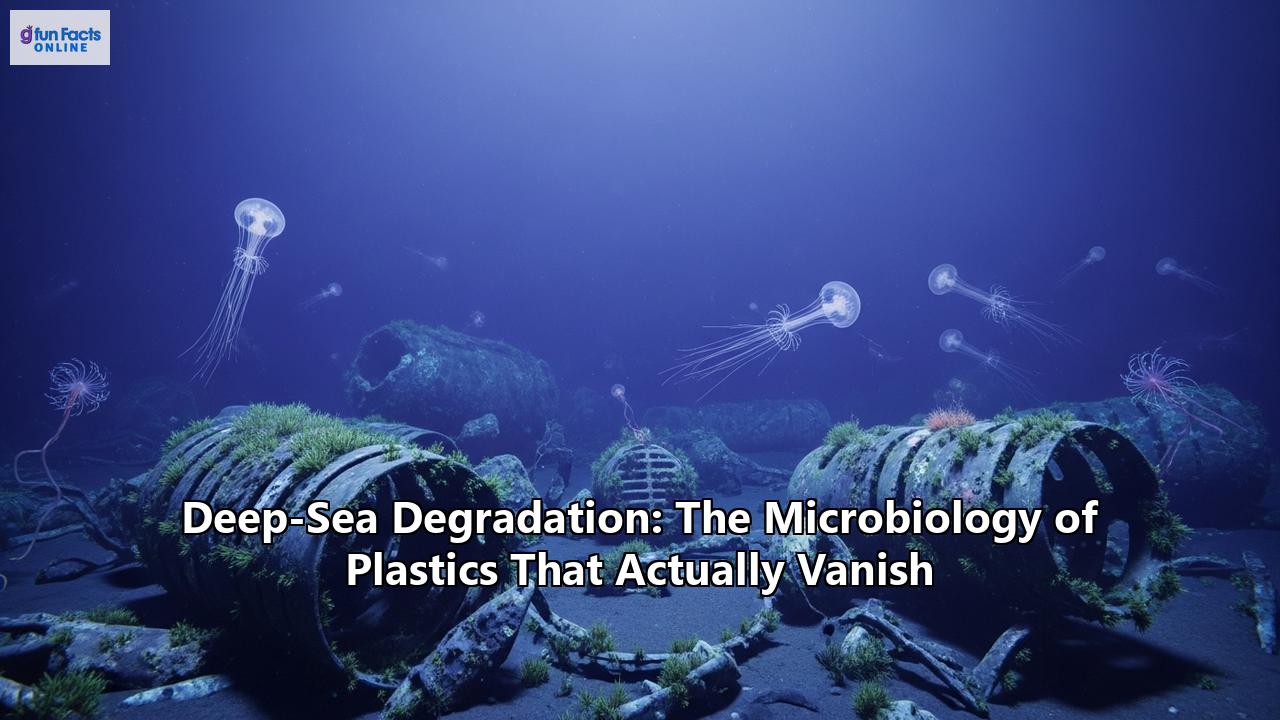
The Abyss of Plastic: A New Era of Microbial Vanishing Acts
The deep sea, a realm of crushing pressure, perpetual darkness, and frigid temperatures, has long been considered the final resting place for a significant portion of the world's plastic waste. An estimated 1.7 million metric tons of plastic flowed directly into aquatic ecosystems in 2019 alone, with much of it destined for the ocean's depths, where it was thought to persist for centuries, if not millennia. This silent, slow-motion environmental disaster has been unfolding for decades, creating a legacy of pollution in the most remote and mysterious habitats on Earth. But recent scientific breakthroughs are challenging this grim narrative, revealing a hidden world of microbial allies with a surprising appetite for certain types of plastic. This is not a story of a magical solution to our plastic problem, but a fascinating exploration of the intricate dance between human innovation and the adaptive power of life in the deep ocean.
The Deep-Sea Plastic Problem: A Cold and Dark Reality
For years, the fate of plastic in the deep sea was a largely unanswered question. The very conditions that make the deep sea so inhospitable to most life forms also make it a formidable environment for breaking down synthetic polymers. The lack of sunlight prevents the UV radiation-induced degradation that occurs on the surface. The near-freezing temperatures slow down chemical reactions, including the metabolic processes of microorganisms. And the immense pressure further complicates biological activity.
Conventional plastics, like polyethylene (PE), polypropylene (PP), and polyethylene terephthalate (PET), are notoriously resilient in this environment. Studies have shown that these materials can persist for hundreds of years, fragmenting into smaller and smaller pieces known as microplastics, but never truly disappearing. These microplastics can be ingested by a wide range of marine organisms, from tiny zooplankton to large filter feeders, introducing toxic chemicals into the food web and potentially causing physical harm.
The discovery of plastic debris in the deepest parts of the ocean, including the Mariana Trench, has underscored the pervasive nature of this pollution. A plastic bag was found at a staggering depth of 10,898 meters, a stark reminder that our daily habits have a direct impact on the most remote environments on our planet. This has led to a growing sense of urgency to find solutions that can address the plastic that has already reached the deep sea and prevent further accumulation.
The Rise of Biodegradable Plastics: A Promising but Complicated Solution
In response to the growing plastic crisis, scientists and engineers have been developing biodegradable plastics as a potential alternative to their conventional counterparts. These materials are designed to be broken down by microorganisms into natural substances like water, carbon dioxide, and biomass. Common examples of biodegradable plastics include polylactic acid (PLA), polyhydroxyalkanoates (PHAs), and starch blends.
However, the term "biodegradable" can be misleading. Many of these plastics only break down under specific industrial composting conditions, which involve high temperatures and specific microbial consortia. When these plastics end up in the marine environment, particularly the cold, nutrient-poor deep sea, their degradation can be significantly slower, or in some cases, non-existent. Studies have shown that PLA, one of the most common biodegradable plastics, does not degrade at all in deep-sea conditions.
This has led to concerns that biodegradable plastics could be just as harmful as conventional plastics if they are not properly managed. They can still fragment into microplastics, release harmful additives, and be ingested by marine life. This has highlighted the need for a new generation of biodegradable plastics that are specifically designed to break down in the challenging conditions of the deep sea.
A New Hope from the Deep: The Discovery of LAHB
In a groundbreaking study, researchers have identified a new type of biodegradable plastic that shows remarkable promise for deep-sea degradation. This material, a lactate-based polyester called poly(D-lactate-co-3-hydroxybutyrate) or LAHB, is biosynthesized using engineered Escherichia coli. What makes LAHB so special is its ability to be broken down by microbial communities found in the deep sea.
To test its real-world performance, researchers submerged films of LAHB, along with a conventional PLA film, at a depth of 855 meters off the coast of Japan. The conditions at this depth were harsh: a temperature of 3.6°C, high salinity, and low dissolved oxygen levels. After just 13 months, the LAHB films had lost over 80% of their mass. In stark contrast, the PLA film showed no signs of degradation.
This remarkable vanishing act was the work of a diverse community of deep-sea microorganisms that had colonized the surface of the LAHB films, forming a biofilm. This "plastisphere," as it's known, is a miniature ecosystem teeming with life, and in this case, it was a team of plastic-degrading specialists.
The Microbial Demolition Crew: A Symphony of Enzymes
The key to LAHB's degradation lies in the specific enzymes produced by the microbes in the plastisphere. The researchers identified several dominant groups of bacteria, including Colwellia, Pseudoteredinibacter, and Agarilytica, which belong to the class Gammaproteobacteria. These bacteria produce extracellular enzymes called poly[3-hydroxybutyrate (3HB)] depolymerases. These enzymes act like molecular scissors, breaking down the long polymer chains of LAHB into smaller, more manageable fragments.
This is a multi-step process. The initial breakdown by the Gammaproteobacteria creates shorter polymer chains, dimers, and trimers. These smaller molecules are then further metabolized by other members of the microbial community, including Alphaproteobacteria and Desulfobacterota. Ultimately, the LAHB is completely mineralized, meaning it is converted into carbon dioxide, water, and other environmentally benign compounds.
The discovery of these plastic-degrading microbial communities and their enzymatic machinery is a major breakthrough. It demonstrates that the deep sea, once thought to be a plastic graveyard, is actually home to a hidden world of recyclers. The fact that these microorganisms are found in seabed sediments worldwide suggests that LAHB could be a viable solution for reducing plastic pollution in deep-sea environments across the globe.
The Broader Picture: Other Microbial Players in Plastic Degradation
The discovery of LAHB-degrading microbes is just one piece of a much larger puzzle. Scientists are discovering a growing number of microorganisms with the ability to break down a variety of plastics, not just in the deep sea but in a range of environments.
One notable example is the fungus Parengyodontium album, which has been found to break down polyethylene (PE), the most common type of plastic pollution in the ocean. However, there's a catch: the fungus can only degrade PE that has been exposed to UV radiation from sunlight. This suggests that a two-step process may be necessary for the degradation of some plastics, with initial breakdown by sunlight at the surface followed by microbial degradation in the water column or on the seafloor.
Researchers are also exploring the gut microbiomes of various organisms, such as waxworms and mealworms, which have been found to contain bacteria capable of degrading plastics like PE and polystyrene (PS). While these discoveries have been made in terrestrial environments, they offer valuable insights into the types of enzymes and metabolic pathways that could be harnessed for plastic degradation in other settings, including the deep sea.
Challenges and Future Directions: A Long Road Ahead
Despite these exciting discoveries, there are still many challenges to overcome before biodegradable plastics can become a widespread solution to the deep-sea plastic problem. The degradation rate of even the most promising materials, like LAHB, is still relatively slow. While an 80% reduction in mass over 13 months is a significant achievement, it's important to remember the sheer volume of plastic that is already in the deep sea.
Furthermore, the potential ecological impacts of widespread use of biodegradable plastics need to be carefully considered. Even if these materials do eventually break down, they could still release microplastics and chemical additives into the environment during the degradation process. The long-term effects of these byproducts on deep-sea ecosystems are still largely unknown.
There are also concerns that a focus on biodegradable plastics could distract from the more pressing need to reduce our overall consumption of plastic in the first place. While these materials may offer a way to mitigate the harm caused by plastic that inevitably ends up in the environment, they should not be seen as a license to continue our current patterns of production and consumption.
Future research will need to focus on several key areas. First, we need to continue to explore the vast microbial diversity of the deep sea to discover new plastic-degrading enzymes and metabolic pathways. This could lead to the development of even more effective biodegradable plastics and potentially even bioremediation strategies for cleaning up existing plastic pollution.
Second, we need to conduct long-term studies to assess the full life cycle of biodegradable plastics in the deep sea, from their initial colonization by microbes to their final degradation products. This will help us to better understand the potential risks and benefits of these materials.
Third, we need to develop a more nuanced and accurate system for labeling and certifying biodegradable plastics. This will help consumers and policymakers to make informed decisions about which materials are truly environmentally friendly.
A Glimmer of Hope in the Deep
The discovery of microorganisms that can degrade plastics in the deep sea is a testament to the remarkable adaptability of life on Earth. It offers a glimmer of hope in the fight against plastic pollution, a problem that once seemed insurmountable. However, it is not a silver bullet. The ultimate solution to the plastic crisis will require a multi-pronged approach that includes reducing our reliance on single-use plastics, improving waste management systems, and developing a new generation of materials that are truly circular, designed to be safely and completely reintegrated into the natural world. The journey to a plastic-free ocean is a long one, but the tiny microbes of the deep sea have shown us that nature itself may hold some of the keys to a cleaner future.
Reference:
- https://www.sciencedaily.com/releases/2025/07/250724232418.htm
- https://www.technologynetworks.com/applied-sciences/news/biodegradable-bioplastic-designed-to-tackle-deep-sea-plastic-pollution-402599
- https://europe.oceana.org/wp-content/uploads/sites/26/d_files/oceana-plastic_in_the_deep_an_invisible_problem.pdf
- https://www.unep-wcmc.org/en/news/single-use-plastic-has-reached-the-worlds-deepest-ocean-trench
- https://www.sciencedaily.com/releases/2024/06/240603114314.htm
- https://pubmed.ncbi.nlm.nih.gov/38278791/
- https://oceanblueproject.org/how-concerned-should-you-be-about-pollution-in-the-depths-of-the-ocean/
- https://www.oaepublish.com/articles/wecn.2022.11
- https://featured.japan-forward.com/japan2earth/2024/02/6099/
- https://www.researchgate.net/publication/363698299_Biodegradable_plastics_in_the_marine_environment_a_potential_source_of_risk
- https://chemtrust.org/news/biodegradable-plastics-marine-impacts/
- https://ecomagazine.com/news/research/deep-sea-experiments-test-new-bioplastic-solution/
- https://pmc.ncbi.nlm.nih.gov/articles/PMC9981674/