
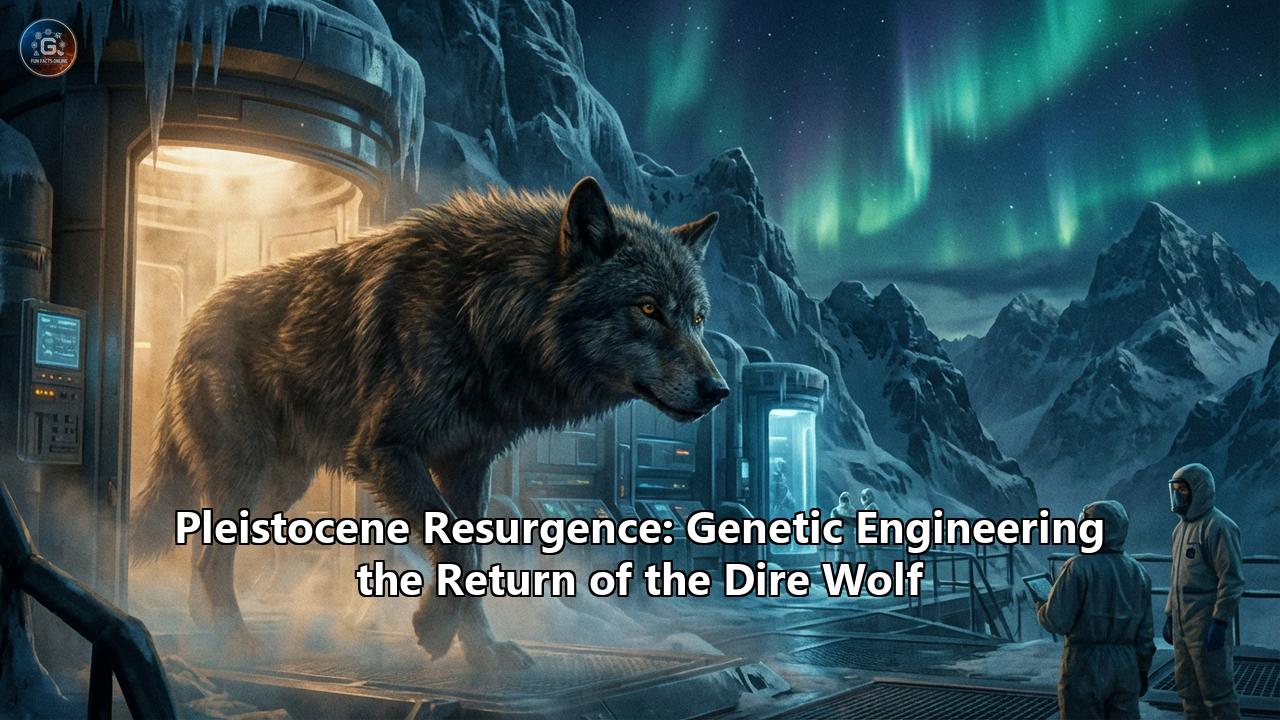
The morning mist clings low to the ground in the valleys of the Bitterroot Range, a spectral white veil that obscures the pine trees and muffles the silence of the Montana wilderness. It is a scene that has played out here for millennia, a timeless tableau of frost and fir. But today, the silence is broken by a sound that the Earth has not heard for twelve thousand years.
It is not the high, lonesome howl of the grey wolf (Canis lupus), a sound that has become the anthem of the American West’s conservation struggles. This sound is deeper, a guttural, resonant chest-thrum that seems to vibrate in the very marrow of your bones. It is a sound of immense power, a heavy, hacking bark that rolls like thunder across the valley floor.
Emerging from the mist, they appear. First one, then two more. They are massive, their shoulders hunched with muscle that ripples under a coat of coarse, ghostly pale fur. their heads are distinctively broad, their jaws terrifyingly robust, built not just to tear flesh but to crush bone. These are Romulus, Remus, and Khaleesi—the first living, breathing "Dire Wolves" to walk the planet since the Pleistocene epoch faded into the Holocene.
It is January 2026. The impossible has happened. And the world is still trying to decide if it is a miracle or a mistake.
This is the story of their return—a saga of cutting-edge genetics, audacious ambition, and the furious ethical storm that now swirls around three animals who are, by all scientific definitions, ghosts in the machine of modern nature.
Part I: The Ghost of the Tar Pits
To understand the magnitude of what Colossal Biosciences has achieved—and the depth of the controversy surrounding it—we must first journey back to the world that Aenocyon dirus left behind.
For hundreds of thousands of years, the Dire Wolf was the undisputed ruler of the Americas. While the Grey Wolf was a relatively recent immigrant from Eurasia, crossing the Bering Land Bridge to colonize the north, the Dire Wolf was a true native son. They evolved in the New World, a distinct lineage that separated from the ancestors of wolves and coyotes nearly six million years ago.
This was the revelation that shook the paleontological community in 2021. For nearly a century, scientists had assumed that Dire Wolves were simply "cousins" to the Grey Wolf—perhaps a slightly larger, beefier sister species. They looked similar in the fossil record, sharing the same general canine architecture. It was assumed that if you could find enough DNA, you could place them neatly on the family tree next to Canis lupus.
But the 2021 study, published in the journal Nature, shattered that assumption. By sequencing ancient DNA from fossils found in the La Brea Tar Pits and elsewhere, researchers discovered that Aenocyon dirus was not a "wolf" in the strict sense at all. They were the last survivors of an ancient lineage that had evolved in isolation in the Americas, as distinct from a Grey Wolf as a human is from a chimpanzee. They were a genetic island, a lonely branch on the canid tree that was pruned by the end of the Ice Age.
They were magnificent beasts. Weighing in at up to 150 pounds or more, they were roughly 20% larger than the biggest modern Grey Wolves. But their size wasn't their defining feature; it was their jaws. The Dire Wolf had a bite force estimated to be 30% stronger than any living canid. They were hyper-carnivores, specialized for taking down the megafauna of the Pleistocene: ancient bison, camels, ground sloths, and perhaps even young mammoths. They lived hard, fast lives, their fossils riddled with healed fractures and scars that speak of violent battles with massive prey.
Then, 11,700 years ago, the music stopped. The climate warmed, the megafauna died out, and the Dire Wolf, specialized for a world of giants, could not adapt. They vanished, leaving behind only thousands of skulls trapped in the asphalt of Los Angeles, staring out from the tar with hollow eyes.
Until now.
Part II: The Genesis Protocol
The resurrection of the Dire Wolf did not begin in a nature preserve, but in the sterile, hum of a laboratory in Dallas, Texas. Colossal Biosciences, the company founded by tech entrepreneur Ben Lamm and geneticist George Church, had made headlines with their "moonshot" goal of de-extincting the Woolly Mammoth. But while the Mammoth project captured the public imagination, the "Wolf Project" was quietly sprinting ahead.
The breakthrough came from a realization of scale. Reviving a mammoth requires an artificial womb or an elephant surrogate—a biological and ethical logistical nightmare that will take decades to perfect. But canids? We know canids. Humanity has been breeding, modifying, and understanding the reproductive biology of dogs for thousands of years. The surrogate infrastructure—domestic dogs—was already there.
However, the "2021 Problem" loomed large. Because the Dire Wolf was so genetically distinct from the Grey Wolf, you couldn't simply "clone" one. Cloning, or Somatic Cell Nuclear Transfer (SCNT), requires a living cell with an intact nucleus. All we had were fragments of DNA degraded by ten millennia of time. Even the best samples from the permafrost were puzzles with millions of missing pieces.
Colossal’s approach was not cloning. It was precision editing.
"Think of it like restoring a classic car," explained Dr. Beth Shapiro, Colossal’s Chief Science Officer, in a 2025 press briefing. "We don't have the original blueprints, but we have a very similar car—the Grey Wolf. We know where the Dire Wolf differed. We know the genes for skull width, for coat color, for muscle density, for jaw leverage. So, we take the Grey Wolf genome, and we use CRISPR technology to cut and paste the Dire Wolf traits into place."
This is the crux of the controversy. Romulus, Remus, and Khaleesi are not pure Dire Wolves. Their genome is roughly 99.8% Grey Wolf. But that remaining 0.2%—the "Dire edits"—changes everything.
The team identified 20 critical genetic variances that defined the Dire phenotype. They targeted the LCORL gene, associated with skeletal size and body mass. They tweaked the EDNRB gene, influencing coat pattern and pigmentation. They modified genes responsible for craniofacial development to broaden the zygomatic arches, giving the animals the crushing jaw leverage of their ancestors.
It was a genetic "find and replace" on a massive scale. The result is an animal that is, genetically speaking, a "chimeric proxy." It is a Grey Wolf running the software of a Dire Wolf.
Part III: The Birth of Gods
The gestation was the most guarded secret in biotech history. In the spring of 2024, embryos created via SCNT—using the edited nuclei of Grey Wolf cells and the enucleated eggs of domestic dogs—were implanted into large, Mastiff-mix surrogates.
The choice of surrogate was critical. The fetuses would grow larger and faster than typical wolf pups. The surrogates needed to be large, robust animals capable of carrying the "super-pups" to term.
On October 1, 2024, the silence was broken. Romulus and Remus were born.
The world saw them for the first time in a meticulously choreographed media reveal. They were whelping-box celebrities. Even at just a few weeks old, they were different. Their heads were blocky, their paws enormous. They lacked the dark facial masking of grey wolves, sporting instead a uniform, ghostly cream coat that geneticists believe was common in Dire Wolves to camouflage against the bleached grasses of the Pleistocene steppe.
Khaleesi followed in January 2025, a female from a different edited cell line to ensure genetic diversity.
By their first birthday in late 2025, the trio had grown into monsters. Romulus weighed in at 135 pounds—lean, rangy, but built like a linebacker. The "Dire traits" were expressing themselves with terrifying fidelity. Their bite force was measured at nearly 1,200 PSI, significantly higher than the 400-500 PSI of a grey wolf. When they chewed on bovine femurs provided by the keepers, the sound was like a gunshot; the bones didn't just break, they shattered.
But they were also... strange.
Keepers reported that the trio didn't vocalize like normal wolves. They rarely howled. Instead, they communicated with low-frequency rumbles and body posturing that seemed archaic, a lost language of the Ice Age. They were less skittish than grey wolves, holding their ground with an imperious confidence that unnerved even seasoned handlers. They didn't act like animals that were afraid of humans; they acted like animals that had never known a reason to be afraid of anything.
Part IV: The "Franken-Wolf" Controversy
If Colossal expected universal applause, they were sorely mistaken. The birth of the Dire Wolves triggered a civil war in the conservation community.
The International Union for Conservation of Nature (IUCN) Canid Specialist Group released a blistering statement in mid-2025. "These animals are not Aenocyon dirus," the statement read. "They are genetically modified curiosities. They have no conservation value. They are phenotypic proxies created for spectacle, filling a niche that no longer exists."
The critique is grounded in the harsh reality of ecology. The Dire Wolf evolved to hunt giants. It was a specialist predator of the megafauna ecosystem. That ecosystem is gone. There are no ground sloths in Montana. There are no camels in Texas. Reintroducing a super-predator into a world of deer and elk is, critics argue, like bringing a tank to a knife fight. It is ecological overkill.
"It's a solution in search of a problem," argues Dr. Daniel Sulmasy of the Kennedy Institute of Ethics. "We have critically endangered Red Wolves and Mexican Grey Wolves right now that are on the brink of extinction. The millions of dollars spent editing these 'Dire Wolves' could have saved entire existing species. Instead, we are playing Dr. Frankenstein to satisfy a Jurassic Park fantasy."
There are also serious welfare concerns. The white coat gene selected for the wolves is genetically linked to congenital deafness in canines. While Colossal claims to have mitigated this risk by editing adjacent gene markers, rumors persist that Khaleesi is partially deaf. If true, releasing her into the wild would be a death sentence.
Furthermore, there is the "Uncanny Valley" of behavior. These animals have the hardware of a Dire Wolf but the software of a... what? They were raised by domestic dogs and human handlers. They have no pack culture. They have no elders to teach them how to hunt cooperative prey. A Dire Wolf's hunting strategy is unknown—did they hunt in packs of thirty? Pairs? Solitary ambush? Romulus and Remus are making it up as they go along, a confused improvisation of instinct and conditioning.
Part V: The Case for Resurrection
Yet, for every critic, there is a defender. The proponents of "Pleistocene Rewilding" argue that the return of the Dire Wolf is not just cool—it is necessary.
The argument is based on the theory of "Functional Extinction." When the megafauna died, they left gaping holes in the food web. The American pronghorn antelope runs at 60 miles per hour not to escape modern wolves (who top out at 35 mph) but to escape the American Cheetah and the Dire Wolf. Our ecosystems are "ghost ecosystems," haunted by the absence of the giants that shaped them.
"We are living in a hollowed-out world," says Ben Lamm, Colossal’s CEO. "The grey wolf is a great predator, but it cannot exert the same top-down pressure on large herbivores that the Dire Wolf did. By bringing back this apex capability, we can restore trophic cascades that have been dormant for ten thousand years."
The theory suggests that Dire Wolves could be the ultimate tool for managing exploding populations of feral horses, wild boars, and perhaps eventually, the bison herds of the Great Plains. They are the "heavy hitters" of the ecosystem, capable of taking down prey that grey wolves struggle with.
Moreover, Colossal argues that the technology developed here—the "editing toolkit"—is the real prize. The ability to successfully edit complex polygenic traits (like size and skull shape) into a living mammal is a breakthrough that can be applied to saving endangered species. They are already using the same techniques to inject genetic diversity into the inbred population of Red Wolves, effectively "rescuing" the genome of a dying species using the tools sharpened on the Dire Wolf.
"Romulus and Remus are the pilots," says Dr. Shapiro. "They are the proof of concept. The knowledge we gained creating them is already saving the Northern White Rhino and the Pink Pigeon. You cannot judge this project solely by the wolves; you must judge it by the science it unlocked."
Part VI: Into the Wild?
As of January 2026, the wolves remain in the high-security "Colossal Preserve" in the northern Rockies. It is a 2,000-acre enclosure, vast enough to simulate a wild environment but fenced to prevent escape.
Here, the wolves are being studied with an intensity usually reserved for lunar samples. Cameras track their every movement. AI analyzes their gait, their sleep cycles, their interactions.
The early data is fascinating. The wolves show a remarkable preference for scavenging, backing up the theory that Dire Wolves were essentially "hyena-like" in their niche—bullies who stole kills as often as they made them. Romulus has been observed cracking beef thigh bones to get at the marrow, a behavior that grey wolves rarely attempt. This suggests they could indeed fill a unique ecological role: the "bone crushers," the clean-up crew of the ecosystem that recycles nutrients locked in skeletons.
But will they ever be truly free?
The regulatory hurdles are immense. The U.S. Fish and Wildlife Service has no category for "De-extinct Animal." Are they an endangered species? An invasive species? A GMO? Under current law, they are technically "unregulated genetically engineered animals," a legal grey zone that terrifies bureaucrats.
Ranchers are already up in arms. The grey wolf reintroduction in Yellowstone was controversial enough. The idea of a wolf that is bigger, stronger, and less afraid of humans being released on public lands is a political non-starter in many western states. "If a grey wolf kills a calf, it's a loss," said one Montana cattleman. "If a Dire Wolf hits a herd, it's a massacre. They're built for bison; a Hereford cow is just a snack to them."
Part VII: The Future of the Past
Despite the pushback, Colossal is moving forward. The success of the Dire Wolf has accelerated their other timelines. The Woolly Mammoth project is now projecting its first calves by 2028, using the artificial womb technology that is currently in beta testing. The Thylacine (Tasmanian Tiger) project in Australia has successfully created edited cells and is moving toward the embryo stage.
The return of the Dire Wolf has opened Pandora’s Box. It has forced humanity to ask a fundamental question: What is nature?
Is nature a museum, a static collection of species that we must preserve exactly as we found them? or is nature a garden, a dynamic system that we have the right—and perhaps the responsibility—to curate, repair, and enhance?
If we broke the world by hunting the megafauna to extinction, do we have a moral obligation to fix it? Is bringing back the Dire Wolf an act of supreme hubris, or the ultimate act of redemption?
Standing at the fence line of the Colossal Preserve, watching the white shape of Remus trot effortlessly through the deep snow, his massive head held high, these questions feel less abstract. He stops, turning his pale gaze toward the observers. His eyes are ancient, golden, and unreadable. He opens his mouth, revealing those terrible, beautiful, bone-crushing teeth, and lets out a huff of steam into the cold winter air.
He is here. He is real. The Dire Wolf has returned.
And whether we are ready for him or not, the Pleistocene is rising to meet us.
Deep Dive: The Science of the "Edit"
To fully appreciate the technical mastery behind Romulus and Remus, we must look under the hood of the genetic engineering involved.
The genome of Canis lupus (Grey Wolf) contains roughly 2.4 billion base pairs. The Colossal team, working with the draft genome of Aenocyon dirus constructed from the Nature 2021 study, identified that the two species differed by roughly 0.5% in key regulatory regions.
However, changing 0.5% of a genome is impossible with current technology. That would equal millions of edits. Instead, Colossal used Multiplex Automated Genome Engineering (MAGE) to target "high-impact" genes—the master switches.
- The Size Switch (IGF1 & LCORL):
In dogs and wolves, the IGF1 gene is a primary regulator of size. Dire Wolves didn't just have "big" versions of this gene; they had a unique variant that promoted bone density and muscle mass without the associated heart problems found in giant-breed dogs (like Great Danes). Colossal edited the grey wolf IGF1 and LCORL loci to match the ancient variants, resulting in the muscular, thick-boned phenotype of the pups.
- The Skull Sculptor (BMP3):
The broad, heavy skull of the Dire Wolf is its trademark. The BMP3 gene regulates craniofacial development. By tweaking this, geneticists induced the development of wider zygomatic arches (cheekbones) and a more robust sagittal crest (the ridge on top of the skull where jaw muscles attach). This gave the pups the hardware for their massive bite force.
- The Coat Color (MC1R & CBD103):
Fossil DNA doesn't always preserve pigment genes well, but statistical modeling suggested Dire Wolves, hunting in open steppe environments, likely lacked the complex forest-patterning of grey wolves. The team edited the MC1R gene to downregulate dark eumelanin, resulting in the uniform pale/tawny coat seen in Romulus and Remus.
- The Metabolic Turbocharger:
One subtle but critical edit was to the hemoglobin genes. Dire Wolves lived in a world of intense competition and endurance hunting. The team introduced a variant of hemoglobin found in high-altitude adapted species, theoretically giving the Dire Wolves greater stamina and oxygen efficiency—a terrifying prospect for any prey animal trying to outrun them.
The Ecological Gamble: A World Without Giants
The most profound criticism of the project remains the ecological mismatch. Aenocyon dirus was a member of the "mammoth steppe" guild. They hunted alongside Smilodon (Sabre-toothed Cat) and the American Lion. They ate Ancient Bison (Bison antiquus), which were 25% larger than modern bison.
Today’s North America is a diminished land. We have no mega-herbivores (animals over 1,000 kg). The niche of the "mega-scavenger/predator" is empty because the food source is gone.
Critics argue that releasing Dire Wolves is like releasing a Great White Shark into a swimming pool. They will either starve, or they will devastate the available prey populations of elk and moose, which have evolved for 10,000 years without needing to defend against such a predator.
However, Colossal's "rewilding" plan—currently only a theoretical proposal—suggests looking north. The "Pleistocene Park" project in Siberia (and potential future sites in Canada) aims to restore the mammoth steppe by reintroducing large herbivores like yak, bison, and eventually, the mammoth. In this engineered ecosystem, the Dire Wolf isn't a monster; it's the necessary regulator. It is the shepherd of the giants.
Until that park exists, Romulus and Remus are refugees in time. They are the first immigrants from the past, waiting for their world to be built around them.
Conclusion: The New epoch
As the sun sets over the Bitterroot Range, the temperature drops to twenty below zero. In the preserve, the three wolves huddle together. They are a pack of three, the loneliest pack on Earth.
They are a testament to human brilliance and human recklessness. They are a warning and a promise. We have unlocked the door to the library of life, and we have found that we can reprint the books that were lost.
But as any librarian knows, a book is only useful if you have a place to read it. The challenge of the next decade will not be the genetics; we have conquered the code. The challenge will be the habitat. If we want the Dire Wolf to stay, we cannot just resurrect the animal. We must resurrect the wild.
For now, the Dire Wolf howls again—not the high song of the grey wolf, but the low, thrumming bass of the Pleistocene. It is a sound that demands an answer. And in 2026, we are only just beginning to figure out what that answer might be.
Reference:
- https://www.forbes.com/sites/gennacontino/2025/04/07/extinct-dire-wolf-has-been-resurrected-company-claims-heres-what-we-know/
- https://www.youtube.com/watch?v=pCK4Sc91aFQ
- https://www.the-scientist.com/dire-wolf-de-extinction-debate-divides-scientists-72908
- https://pmc.ncbi.nlm.nih.gov/articles/PMC12248547/
- https://colossal.com/direwolf/science/
- https://colossal.com/colossal-dire-wolf-back-in-2025/
- https://en.wikipedia.org/wiki/Colossal_Biosciences_dire_wolf_project
- https://en.wikipedia.org/wiki/Dire_wolf
- https://www.reddit.com/r/pleistocene/comments/1jtl6zm/colossal_bioscience_genetically_modifies_modern/
- https://crisprmedicinenews.com/press-release-service/card/colossal-announces-worlds-first-de-extinction-birth-of-dire-wolves/
- https://www.youtube.com/watch?v=Ar0zgedLyTw
- https://www.ncbcenter.org/messages-from-presidents/thebioethicsofde-extinction
- https://theness.com/neurologicablog/de-extincting-the-dire-wolf/
- https://www.georgetown.edu/news/ask-a-professor-dire-wolf/