
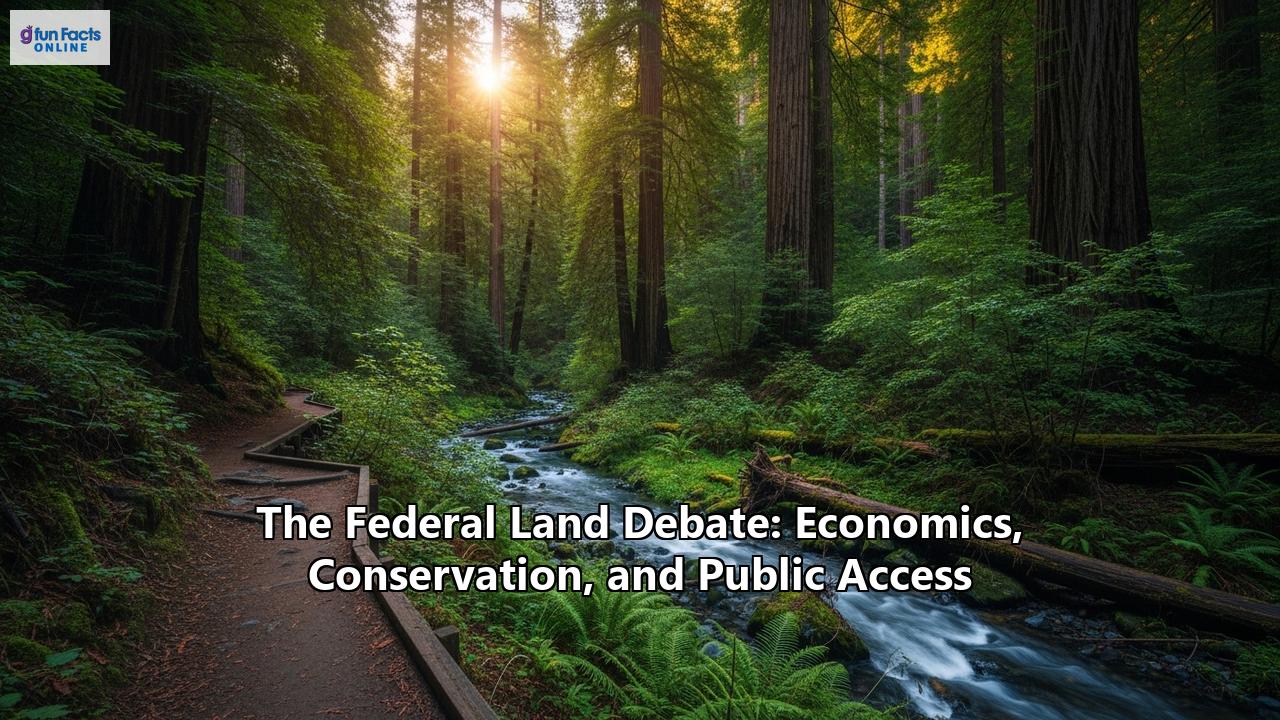
An expanse of earth, stretching from the dense forests of the Appalachian Mountains to the sun-scorched deserts of the Great Basin and the icy tundra of Alaska, is held in common by every American. Roughly 640 million acres, or about 28% of the United States, are public lands managed by the federal government. This vast estate, a tapestry of national parks, forests, wildlife refuges, and open rangelands, is more than just territory; it is a repository of natural resources, a sanctuary for biodiversity, a hub for recreation, and a deep well of national identity. Yet, the very existence and management of these lands are at the heart of one of America's most enduring and contentious debates.
The federal land debate is a complex, multi-faceted conflict, pitting powerful economic interests against the imperatives of conservation, and the public’s right to access against the push for private control. It is a story that traces back to the very formation of the republic, evolving from a policy of rapid disposal to fuel westward expansion to one of retention and multiple-use management. Today, this debate continues to rage in the halls of Congress, in rural western communities, and across the sweeping landscapes that define the nation.
At its core, the controversy revolves around a fundamental question: Who should control these lands and for what purpose? Should they be managed primarily for economic development—powering industries like energy, mining, timber, and grazing? Should their highest purpose be the preservation of wild nature, the protection of endangered species, and a buffer against climate change? Or should they be optimized for public enjoyment, providing unfettered access for hiking, hunting, fishing, and a myriad of other recreational pursuits? This article delves into the intricate layers of the federal land debate, exploring its historical roots, the clashing economic and conservation arguments, and the passionate politics of public access that shape the future of this shared American birthright.
A Legacy of Land: From Disposal to Retention
The story of federal land begins with the birth of the United States. Following the American Revolution, the original colonies ceded their "western" lands—the territory between the Appalachians and the Mississippi River—to the new central government. This act was foundational, creating a vast public domain that would shape the nation's development. For most of the 19th century, the federal government's primary land policy was one of disposal. Through a series of landmark laws, the government actively encouraged the transfer of public lands into state and private hands to pay off war debts, encourage settlement, and spur economic growth.
The Homestead Act of 1862, for instance, allowed citizens to claim 160 acres of public land, ultimately transferring 270 million acres to private individuals. Other laws like the Desert Land Act of 1877 and the Timber and Stone Act of 1878 further accelerated this privatization. In total, the federal government has divested itself of an estimated 1.29 billion acres, with the vast majority of these transfers occurring before 1940.
However, a countervailing philosophy began to emerge in the late 19th and early 20th centuries. Visionaries like John Muir and Theodore Roosevelt championed the idea that some lands were too valuable—for their scenic beauty, scientific importance, or wild character—to be given away. This burgeoning conservation movement led to the creation of the world's first national park, Yellowstone, in 1872, and the establishment of the Forest Reserve Act in 1891, which allowed the president to set aside forest lands from the public domain.
This marked a pivotal shift from a policy of disposal to one of retention. The 20th century saw the creation of the primary agencies tasked with managing this retained estate: the U.S. Forest Service (USFS) in 1905, the National Park Service (NPS) in 1916, and eventually the Bureau of Land Management (BLM) in 1946, which was formed by merging the General Land Office and the U.S. Grazing Service. This shift culminated in the passage of the Federal Land Policy and Management Act of 1976 (FLPMA), which formally declared that the remaining public domain lands would generally be retained in federal ownership. FLPMA established a "multiple-use, sustained-yield" mandate for the BLM and the Forest Service, a framework that attempts to balance the often-competing demands of resource extraction, recreation, and conservation.
This historical arc from disposal to retention sets the stage for the modern debate. The concentration of these retained federal lands, primarily in the 11 Western states and Alaska, has created a deep-seated tension. In many western counties, the federal government is the largest landowner, a reality that fuels arguments over local control, economic opportunity, and the very legitimacy of federal authority.
The Economic Arena: A Tug-of-War Over Resources and Revenue
The economic dimension of the federal land debate is a fierce battleground where competing visions for prosperity clash. The arguments are broadly split between those who see public lands as a vast storehouse of raw materials to be extracted for economic gain and those who argue their greatest economic value lies in conservation and recreation.
The Case for Resource Extraction
For generations, federal lands have been instrumental to the American economy, providing essential resources for industry and communities. This perspective champions the "multiple-use" mandate, emphasizing the development of timber, minerals, energy, and forage for livestock.
- Energy and Minerals: The lands managed by the federal government hold significant deposits of oil, natural gas, coal, and hardrock minerals like gold, copper, and uranium. In fiscal year 2022, oil and gas produced from the federal mineral estate accounted for about 11% of all oil and 9% of all natural gas produced in the United States. Proponents of expanded development argue that opening more federal lands to leasing could generate substantial economic activity, create jobs, and increase government revenue. One study by the Institute for Energy Research projected that opening currently closed federal lands could increase GDP by $127 billion annually in the short term and create over 550,000 jobs. The mining industry points to the nation's $6.2 trillion worth of mineral resources and the sector's significant contribution to GDP as a reason to maintain access to public lands. Revenue from federal mineral development is second only to the IRS in contributions to the U.S. Treasury, and these revenues are split with the states where the extraction occurs, providing critical funding for local services.
- Timber Harvesting: The nation's 154 national forests, managed by the U.S. Forest Service, were originally established to provide a sustainable timber supply. While harvest levels have declined significantly since their peak in the 1980s, proponents argue that responsible timber harvesting is essential for maintaining forest health, reducing wildfire risk, and supporting rural economies. The Forest Service and BLM offered a combined total of over 300 million board feet of timber in 2022, generating revenue and supporting jobs in forest-adjacent communities.
- Livestock Grazing: Ranching is deeply woven into the cultural and economic fabric of the American West. The Taylor Grazing Act of 1934 created a system of permits and fees to manage livestock grazing on public rangelands, bringing order to what had been a chaotic and destructive era of open-range grazing. Today, the BLM and Forest Service administer thousands of grazing permits across millions of acres. Proponents argue that this access is vital for the survival of many family ranches and rural communities. One study estimated that public lands forage contributes to over $1 billion in livestock sales value annually. The removal of federal grazing, studies suggest, could lead to significant job losses and a reduction of hundreds of millions of dollars in economic activity in states like Wyoming, Idaho, and Oregon.
The Economics of Conservation and Recreation
A powerful counter-narrative argues that the greatest economic engine of federal lands is not extraction, but preservation and recreation. This viewpoint has gained significant traction, backed by a growing body of research demonstrating the economic power of protected landscapes.
- The Outdoor Recreation Economy: The outdoor recreation sector has become an economic juggernaut. In 2021, it accounted for $454 billion, or 1.9% of U.S. GDP. By 2023, that figure had grown to $639.5 billion, supporting around 5 million jobs. Much of this activity—from hiking and camping to hunting and fishing—takes place on federal public lands. National Parks alone contributed over $50.3 billion to the economy in 2022. A study focused on BLM lands found that hunting, fishing, and wildlife viewing generated over $3 billion in economic output in 2016.
- Protected Lands as Economic Engines: Research by groups like Headwaters Economics has shown that western counties with more protected federal land, such as national parks and wilderness areas, have, on average, experienced faster growth in population, employment, and personal income compared to their peers with no protected lands. These protected landscapes act as magnets for new residents, entrepreneurs, and tourists, diversifying local economies beyond the boom-and-bust cycles often associated with resource extraction. The improved quality of life associated with access to the outdoors is a powerful economic asset.
The Privatization and Transfer Debate
The tension between these economic visions fuels the fiery debate over transferring federal lands to state or private ownership. Proponents, often echoing the sentiments of the 1970s "Sagebrush Rebellion," argue that states could manage the lands more efficiently and generate more revenue. They contend that federal bureaucracy and environmental regulations stifle economic activity and that local control would better serve the needs of western communities.
Opponents, however, paint a starkly different picture. They argue that states lack the financial resources to manage these vast landscapes, particularly the enormous costs of wildfire suppression, which can exceed $3 billion per year for the federal government. An analysis of a potential land transfer in Montana estimated it could cost the state nearly $8 billion over 20 years, factoring in wildfire costs, deferred maintenance, and lost federal payments. To cover these costs, states would likely be forced to either raise taxes or sell the newly acquired lands to the highest bidder, effectively leading to privatization and the loss of public access. Furthermore, state trust lands, often held up as a model by transfer advocates, are legally mandated to maximize revenue, primarily for funding public schools. This would necessitate prioritizing logging, mining, and grazing over recreation, conservation, and public access.
The idea of outright privatization is also a recurring theme, with proponents arguing that private ownership leads to better stewardship and financial solvency. They point to the operating deficits of federal land agencies as evidence of mismanagement. However, opponents counter that privatization would lead to widespread ecological damage and eliminate the public benefits of these shared landscapes, from clean water to recreational access.
The Conservation Imperative: A Haven for Biodiversity and a Bulwark Against Climate Change
Beyond the economic calculus, federal lands serve a vital role as the nation's primary reservoir of biodiversity and a critical tool in the fight against climate change. This conservation imperative forms the second major pillar of the debate, often standing in direct opposition to intensive economic development.
Sanctuaries for Wildlife and Endangered Species
The vast, unfragmented habitats provided by federal lands are essential for the survival of countless plant and animal species. These lands are home to more than 3,000 "special status species," including those listed as threatened or endangered under the Endangered Species Act (ESA) of 1973. For hundreds of listed species, from the Florida panther to the California condor, federal lands represent their last best hope for survival.
The importance of federal lands is magnified because the ESA's protections are strongest there. For example, while the law prohibits actions that "take" (harm or kill) a listed animal on any land, its protections for listed plants are significantly weaker on private property. On federal lands, however, listed plants receive full protection, making these areas indispensable for the nation's flora. Research has shown that lands managed by the Department of Defense and the U.S. Forest Service are particularly crucial, harboring high densities of endangered and imperiled species.
The Value of Ecosystem Services
Federal lands provide benefits to society that extend far beyond scenic views and recreational opportunities. These "ecosystem services" are the natural processes that sustain human life and well-being, and they carry immense, though often unpriced, economic value.
- Water Resources: National forests are the single largest source of fresh water in the United States. They provide water for about 60 million Americans, a service valued at an estimated $3.7 billion per year.
- Carbon Sequestration: The forests, grasslands, and soils of public lands act as a massive carbon sink, absorbing and storing vast amounts of carbon dioxide from the atmosphere. U.S. forests alone remove enough CO2 to reduce the nation's net annual emissions by 11%. This makes the conservation and restoration of these ecosystems a key strategy for mitigating climate change.
- Other Services: A comprehensive analysis estimated that ecosystem services from lands used for beef cattle grazing, including on federal rangelands, provide $24.5 billion in value through wildlife recreation, forage production, and biodiversity conservation. Another study estimated that U.S. National Parks provide a staggering $98 billion per year in ecosystem service value.
Designating Protection: National Monuments and Wilderness Areas
The most intense conservation battles are often fought over specific land designations that prioritize preservation over other uses.
- National Monuments: The Antiquities Act of 1906 gives the President the authority to unilaterally designate national monuments on federal lands to protect "objects of historic or scientific interest." This powerful tool has been used by 19 presidents of both parties to protect iconic landscapes like the Grand Canyon and Grand Staircase-Escalante. However, these designations are often highly controversial. Opponents, particularly in local communities, argue that monument designations are an overreach of federal power that can stifle economic activities like mining, drilling, and grazing. The debate over the size and scope of monuments like Bears Ears in Utah, which was established after a petition from a coalition of Native American tribes and later drastically reduced by a subsequent administration before being restored, highlights the deep political and cultural divisions surrounding this issue.
- Wilderness Areas: The Wilderness Act of 1964 created the highest level of protection for federal lands. Designated Wilderness Areas are defined as places "where the earth and its community of life are untrammeled by man, where man himself is a visitor who does not remain." In these areas, motorized and mechanized transport, logging, and road building are prohibited to preserve their primitive character and provide opportunities for solitude. Proponents argue that wilderness is essential for scientific research, protecting biodiversity, preserving watersheds, and offering a profound connection to the natural world. Critics, however, often see wilderness designations as locking up valuable resources and restricting access for many forms of recreation.
The differing missions of the primary land management agencies also shape the conservation landscape. The National Park Service has a dual mission of preserving resources and providing for public enjoyment, but preservation is paramount. The U.S. Fish and Wildlife Service's primary mission is the conservation of fish, wildlife, and their habitats. In contrast, the Bureau of Land Management and the U.S. Forest Service operate under a multiple-use mandate, requiring them to balance conservation with a wider range of activities, including resource extraction. This often places them at the center of the most heated conflicts over land use.
The Right to Roam: The Passionate Politics of Public Access
The third critical pillar of the federal land debate is public access. For millions of Americans, these lands represent a birthright—a place to hunt, fish, hike, camp, and connect with nature. The principle of public access is a cornerstone of the American outdoor tradition, but it is fraught with its own set of challenges and conflicts.
The Challenge of Landlocked Lands
One of the most significant barriers to access is the issue of "landlocked" public lands. Decades of land disposal policies, particularly the granting of 640-acre square sections to railroad companies to encourage western settlement, created a "checkerboard" pattern of ownership across the West. The result is that millions of acres of federal land are entirely surrounded by private property, with no legal public access. A 2004 report found that over 35 million acres of BLM and Forest Service land have inadequate public access. This issue is a major concern for hunters and anglers, as lack of access is cited as a primary reason why people stop participating in these sports.
The Land and Water Conservation Fund (LWCF)
A key tool for addressing this problem is the Land and Water Conservation Fund (LWCF). Established in 1964, the LWCF uses royalties from federal offshore oil and gas leases—not taxpayer dollars—to fund projects that protect land and water resources and increase recreational access. The program provides matching grants to states and local governments to acquire land for parks and open spaces and funds federal acquisitions of critical inholdings within national parks, forests, and refuges to improve public access. With the passage of the Great American Outdoors Act in 2020, the LWCF is now permanently and fully funded at $900 million annually, a major victory for conservation and access advocates.
User Conflicts on the Trail
Once on public lands, the diversity of recreational pursuits can lead to conflict. The clash between motorized and non-motorized recreation is a persistent challenge for land managers. Off-highway vehicle (OHV) users, snowmobilers, and motorboaters seek opportunities for their sports, which contribute significantly to local economies. However, their activities can conflict with those of hikers, equestrians, and others seeking quiet and solitude. The noise and environmental impact of motorized vehicles are often at the heart of these disputes. Federal agencies like the Forest Service and BLM manage these conflicts through travel management planning, which designates specific roads, trails, and areas for different types of use, but balancing these competing interests remains a difficult and often contentious process.
The Cultural and Social Importance of Access
Public access is more than just a matter of recreation; it is deeply tied to cultural identity and social well-being.
- Hunting and Fishing Heritage: For many communities, particularly in the West, hunting and fishing on public lands are cherished traditions passed down through generations. These activities are not only economically significant but are also central to a way of life.
- Tribal and Indigenous Rights: For America's Tribal Nations, federal lands are often their ancestral homelands. Many treaties, ratified by the U.S. government, reserved tribal rights to hunt, fish, gather, and hold ceremonies on these lands, even after they were ceded. Today, there is a growing movement to ensure these treaty rights are honored and to increase tribal co-management of federal lands, integrating traditional ecological knowledge into modern stewardship. Proposals to transfer or sell federal lands are often seen as a direct threat to these hard-won rights.
- Health and Community: Access to public lands provides profound benefits for physical and mental health and strengthens community bonds. From urban parks funded by the LWCF to remote wilderness areas, these spaces offer opportunities for individuals and families to connect with nature and each other.
The Legal and Historical Bedrock
Underpinning the entire federal land debate is a framework of laws and constitutional principles that have evolved over more than two centuries. Understanding this legal and historical context is essential to grasping the arguments of all sides.
The Foundation: The Constitution and Key Laws
- The Property Clause: The ultimate authority for federal ownership and management of public lands stems from the Property Clause of the U.S. Constitution (Article IV, Section 3, Clause 2), which gives Congress the power to "dispose of and make all needful Rules and Regulations respecting the Territory or other Property belonging to the United States." The Supreme Court has consistently interpreted this power as being "without limitations."
- The General Mining Law of 1872: This law, a relic of the 19th-century push for western development, allows individuals and companies to "claim" hardrock mineral deposits on public lands. Claimants can explore for and extract minerals without paying a federal royalty, and until a 1994 moratorium, they could "patent" or purchase the land for as little as $2.50 an acre. Critics argue the law is a massive giveaway of public resources that lacks modern environmental protections, while the mining industry defends it as essential for competing in a global market.
- The Taylor Grazing Act of 1934: This act marked a major shift in rangeland policy. It ended the era of unregulated open-range grazing that had led to widespread ecological damage and created the permit-based system that still governs livestock use on BLM and Forest Service lands today. While it brought stability to the livestock industry, critics argue it institutionalized grazing at levels detrimental to the health of western ecosystems.
- The Wilderness Act of 1964: This landmark law established the National Wilderness Preservation System, creating a legislative process for Congress to permanently protect the wildest corners of the federal estate from development.
- The Federal Land Policy and Management Act (FLPMA) of 1976: Often called the "organic act" for the BLM, FLPMA was a watershed moment. It formally ended the era of large-scale land disposal, declaring a policy of federal retention. It established the multiple-use, sustained-yield mandate for the BLM, requiring the agency to balance competing uses like recreation, conservation, and resource development through a public land-use planning process.
The Sagebrush Rebellion and the Modern Transfer Movement
The passage of FLPMA, along with other environmental laws of the 1960s and 70s like the Endangered Species Act, sparked a backlash in the West known as the Sagebrush Rebellion. Led by western politicians like Nevada legislator Dean Rhoads and Utah Senator Orrin Hatch, and supported by ranchers, miners, and other resource-dependent industries, the rebellion sought to transfer federal lands to state control. Rebels argued that federal "absentee landlords" were locking up resources and infringing on local and state sovereignty.
While the original rebellion faded with the election of the more sympathetic Ronald Reagan administration in the 1980s, its ideology never disappeared. It has been resurrected in the 21st century as the modern land transfer movement. Groups like the American Lands Council, with proponents like former Montana state legislator Jennifer Fielder, have pushed bills in numerous western states demanding the handover of federal lands. These efforts have been consistently defeated by broad coalitions of hunters, anglers, conservationists, and business owners who fear that a transfer would lead to the loss of public access and the eventual sale of these lands. The debate, however, remains a central and defining issue in western politics, a modern echo of a long-simmering conflict over land and power.
Conclusion: A Contested Commons
The federal lands of the United States are a contested commons, a stage upon which the nation's competing values and priorities are played out. The debate is not a simple binary of good versus evil, but a complex tapestry of deeply held beliefs, powerful economic forces, and competing visions for the future. It is a reflection of the enduring American tension between individualism and collective responsibility, between resource exploitation and environmental stewardship, and between local control and national interest.
The economic arguments highlight a fundamental divergence: are these lands more valuable for the commodities they contain beneath the surface or for the sustainable economic engine of recreation and quality of life they provide on the surface? The conservation arguments force a reckoning with the long-term consequences of our actions, framing the lands as invaluable reservoirs of biodiversity and a crucial defense against a changing climate. The public access arguments underscore the democratic ideal of a shared natural heritage, a place open to all citizens regardless of wealth or status.
As the nation grapples with the challenges of the 21st century—from climate change and biodiversity loss to economic inequality and housing crises—the debate over these 640 million acres will only intensify. The future of America's public lands will depend on the ability of its citizens and leaders to navigate these complex and often conflicting demands, to find a balance that honors the land's immense economic, ecological, and cultural value, and to ensure that this uniquely American birthright endures for generations to come.
Reference:
- https://en.wikipedia.org/wiki/Federal_lands
- https://www.ebsco.com/research-starters/history/sagebrush-rebellion-begins
- https://www.explorebigsky.com/dispatches-from-the-wild-the-land-transfer-movement-resurrected/66676
- https://my.lwv.org/sites/default/files/leagues/grand-county/tplmeducationalstudyreviewed6821_0.pdf
- https://www.naco.org/resource/americas-public-lands-founding-framework
- https://en.wikipedia.org/wiki/General_Mining_Act_of_1872
- https://www.ebsco.com/research-starters/science/federal-land-policy-and-management-act-flpma
- https://www.wyohistory.org/encyclopedia/leasing-public-range-taylor-grazing-act-and-blm
- http://web.stanford.edu/group/spatialhistory/FollowTheMoney//pages/BLM_Grz_3.html
- https://www.hcn.org/articles/a-look-back-at-the-first-sagebrush-rebellion/
- https://www.perc.org/1997/12/01/the-mining-law-of-1872-digging-a-little-deeper/
- https://www.ebsco.com/research-starters/law/general-mining-law-1872
- https://www.hcn.org/articles/grabbing-public-land-in-the-name-of-housing/
- https://www.westernwatersheds.org/the-history-of-public-lands-grazing/
- https://digitalrepository.unm.edu/nrj/vol63/iss2/3/
- https://publicland.org/wp-content/uploads/2016/08/150359_Public_Lands_Document_web.pdf
- https://www.e-education.psu.edu/mng230/node/8
- https://www.ebsco.com/research-starters/law/taylor-grazing-act
- http://exhibits.usu.edu/exhibits/show/sagebrushrebellion/intro
- https://en.wikipedia.org/wiki/Sagebrush_Rebellion
- https://www.beyondintractability.org/bksum/graf-wilderness
- https://federalism.org/encyclopedia/no-topic/public-lands/
- https://www.blm.gov/programs/natural-resources/rangelands-and-grazing/livestock-grazing/about
- https://www.pew.org/~/media/assets/2009/01/24/mining-law-time-for-reform.pdf
- https://wildmontanaaction.org/news/6-real-public-lands-champions-oppose-selling-off-and-transferring-public-land/