
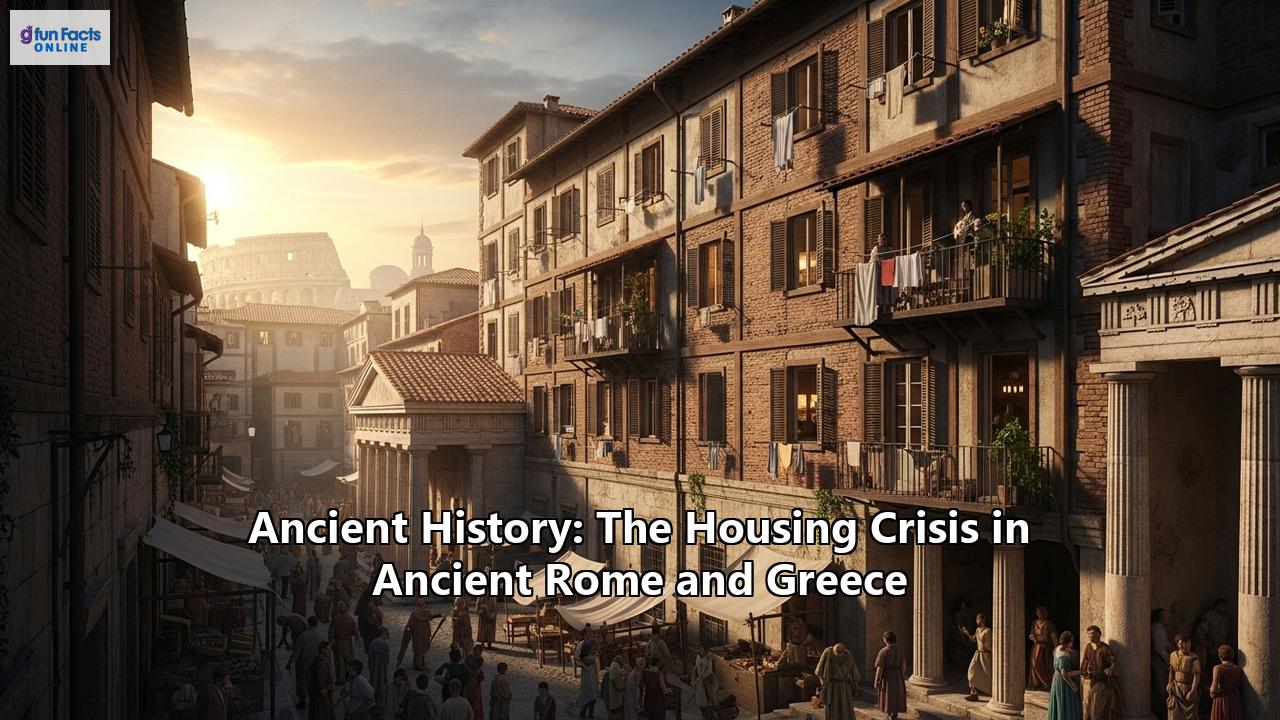
Ancient Metropolis, Modern Problem: The Housing Crises of Greece and Rome
The sprawling cities of ancient Greece and Rome stand in the modern imagination as beacons of civilization, monumental hubs of philosophy, law, art, and power. Athens, the cradle of democracy, and Rome, the heart of a world-spanning empire, attracted people by the tens of thousands, promising opportunity, security, and a role in the grand theatre of history. Yet, beneath the gleaming marble of the temples and the triumphal arches lay a starkly different reality for the vast majority of their inhabitants. A reality of cramped quarters, precarious structures, and exorbitant costs—a timeless urban struggle that we would today call a housing crisis.
The story of housing in these ancient supercities is not one of magnificent villas and serene, columned courtyards alone. It is overwhelmingly a story of survival in the face of systemic challenges that resonate with striking familiarity in the 21st century. Overpopulation, speculative real estate markets, dangerously subpar construction, and a chasm between the living conditions of the rich and the poor were as much a part of the urban fabric of Rome and Athens as the Forum or the Acropolis. This article delves into the depths of this ancient struggle, exploring how these two foundational cultures of the Western world grappled with the fundamental human need for a place to call home.
The Athenian Model: Crowding in the Cradle of Democracy
In the 5th century BCE, during its Golden Age, Athens was the vibrant center of the Hellenic world. It was a city of intellectual ferment and artistic brilliance, but its magnetic pull came at a cost. The growth of its democratic and imperial power fueled a demographic boom, drawing migrants from across Attica and beyond, all seeking the economic and social opportunities concentrated within its walls.
This influx reached a critical point during the Peloponnesian War (431-404 BCE). The brilliant statesman Pericles, in a strategic move to counter Sparta's formidable land army, ordered the entire rural population of Attica to abandon their farms and take refuge within the "Long Walls"—the fortified corridor connecting Athens to its vital port, Piraeus. The historian Thucydides, an eyewitness to the events, chronicled the immense strain this policy placed on the city. He described how the displaced people, without homes or friends to take them in, crowded into any available space, including temples and the "stifling cabins" they erected within the city's fortifications. This sudden, massive increase in population density under wartime conditions created a perfect storm for a public health catastrophe: the devastating Plague of Athens, which killed an estimated 25% of the population, including Pericles himself. Thucydides directly linked the plague's severity to the extreme overcrowding caused by Pericles' defensive strategy.
*The Anatomy of the Athenian Oikos---
Before this crisis, the typical Athenian dwelling, the oikos, was a relatively modest affair, reflecting a society where, for a time, civic life and public spaces were prioritized over private luxury. The standard house was constructed from simple, locally sourced materials: foundations of stone rubble, walls of sun-dried mud-brick, and roofs of overlapping terracotta tiles supported by wooden beams.
These homes were typically inward-facing, organized around a central courtyard that provided essential light and air. This courtyard was the hub of household activity, from cooking to weaving. Rooms were arranged around it, and while some homes of the wealthy might feature an andron—a formal dining room for the male head of the household to entertain guests at symposia—many houses had multifunctional spaces without specialized purposes. Evidence for dedicated bathrooms is sparse; while some homes at sites like Olynthus had built-in tubs or terracotta toilets that drained outside, many households likely relied on chamber pots and public fountains. Sanitation was a persistent problem; while Athens had channels for stormwater, there was no comprehensive sewage system, and household waste was often thrown into the streets or collected in cesspits for later use as fertilizer.
A key feature of Athenian housing, particularly in the Classical period, was a surprising degree of architectural egalitarianism. Unlike in Rome, where the gulf between the homes of the rich and poor was vast and obvious, the houses of wealthy Athenians were often not significantly larger than those of their less affluent neighbors. Status was instead displayed through interior decoration—fine painted plaster, intricate mosaics depicting mythological scenes, and more valuable possessions within the home.
A City of RentersNot everyone owned their own oikos. Renting was a common feature of the Athenian housing market. The city's population included a large number of metics (foreign residents), freed slaves, and citizens who lacked the means to purchase property. To accommodate them, property owners would rent out entire houses or subdivide larger homes into smaller units. These multi-family rental buildings were known as synoikiai. The term literally means "houses together," and while it could also refer to a specific political festival, its use to describe tenement-style housing points to a recognized category of rental property. The Old Oligarch, a contemporary writer, noted that when foreigners were in Athens, those with lodgings to rent were eager to do so.
Despite the prevalence of renting, there is little surviving evidence of a formal legal framework protecting tenants' rights, a stark contrast to the highly detailed contracts that would later emerge in Rome. The relationship between landlord and tenant was likely governed by informal, private agreements, leaving renters in a precarious position.
Urban Planning: The Exception, Not the RuleThe core of Athens grew organically over centuries, resulting in a tangle of narrow, winding streets. The concept of systematic urban planning did emerge in the Greek world, famously associated with Hippodamus of Miletus. He is credited with developing the "Hippodamian plan," a grid system of straight, right-angled streets that promoted order and rational division of space into public, private, and sacred zones.
However, this revolutionary approach was applied not to the ancient heart of Athens, but to new constructions. The most prominent local example was the port of Piraeus, which Pericles had Hippodamus lay out in a regular grid. This created a striking contrast between the orderly, modern port and the chaotic, ancient city it served. For most Athenians, life was lived not on wide, planned avenues, but in a dense and often confusing urban landscape that had evolved without a guiding hand.
The Roman Megalopolis: A Crisis of Unprecedented Scale
If Athens experienced a housing crisis driven by wartime emergency, Rome endured one born of its own staggering success. By the height of the Empire in the 1st and 2nd centuries CE, the city of Rome had become the first metropolis in human history to reach a population of approximately one million people. It was a magnet for the entire Mediterranean world, drawing a relentless tide of merchants, soldiers, administrators, slaves, and fortune-seekers. This unprecedented population density, packed into a city still defined by its ancient geography, created a housing crisis on a scale the world had never seen.
The engine of this growth was multifaceted. The Cura Annonae, or grain dole, provided a subsidized food supply for hundreds of thousands of citizens, making urban life sustainable for the poor in a way that was previously unimaginable. The city was the epicenter of imperial power, commerce, and culture, offering opportunities for work and advancement that were unrivaled. The result was a voracious, unending demand for housing that property owners were all too happy to exploit.
*A Tale of Two Cities: Domus vs. Insula---
The Roman housing market was starkly divided, creating two distinct cities within one. For the super-rich—the senators, equestrians, and enormously wealthy landowners—there was the ---domus---. This was the lavish single-family urban mansion, a symbol of status and power. A typical domus was built of stone and brick, with an inward-facing design centered on an atrium and a peristyle garden. Its floors were covered in intricate mosaics, its walls adorned with vibrant frescoes, and many boasted amenities like private baths and even running water supplied by the city's magnificent aqueducts. The domus was a private sanctuary of luxury and ease, a world away from the chaos of the streets. But it was a world accessible to only a tiny fraction of the population.
For the overwhelming majority of Romans—the shopkeepers, artisans, laborers, and the poor—home was the ---insula--- (literally "island"). These were multi-story apartment blocks, often rising to five, six, or even seven stories, that housed the bulk of the urban population. The ground floor of an insula was typically occupied by shops and workshops (tabernae) that opened onto the street, with apartments (cenacula) located on the floors above. These buildings were not segregated into slums but were intermingled with the domus of the wealthy, a jumble of rich and poor that characterized the Roman streetscape.
Life in the Insulae: A Litany of DangersLife for the Roman apartment-dweller was defined by insecurity and discomfort. The Roman satirist Juvenal, writing in the late 1st and early 2nd centuries CE, provides the most scathing and vivid accounts of the horrors of life in the insulae. His writings, though likely exaggerated for comedic and rhetorical effect, paint a picture of daily life fraught with peril.
- The Threat of Collapse: The primary driver of the insula market was profit. Landlords, who included some of Rome's wealthiest men like the famous Marcus Licinius Crassus, often used cheap materials and shoddy construction methods to maximize their returns. Walls were made of timber-framed rubble-work (opus craticium), and buildings were pushed to heights their foundations could scarcely support. Juvenal laments living in a city "propped up for a great part on matchsticks," where landlords would paper over gaping cracks and assure tenants they could "sleep easy" even as the building was poised to collapse. The Roman architect Vitruvius also criticized these flimsy, profit-driven construction practices.
- The Menace of Fire: Fire was the single most constant and terrifying threat. The combination of flammable building materials, crowded conditions, and the widespread use of open flames for cooking, heating, and light made the insulae tinderboxes. The narrow, winding streets acted like wind tunnels, allowing fires to spread with terrifying speed. While the Great Fire of 64 CE is the most famous conflagration, devastating fires were a common feature of Roman life. For those living on the upper floors, escape was nearly impossible. Juvenal noted grimly that if a fire broke out on the lower levels, the last to burn would be the poor tenant in the attic, with only the roofing tiles between him and the rain, "where the gentle doves lay their eggs."
- Exorbitant Rents and Predatory Landlords: The demand for housing was so high that landlords could charge exorbitant rents for even the most squalid of rooms. Juvenal quipped that for the price of a year's rent on a "shabby, ill-lit attic" in Rome, one could buy a fine freehold house in a quiet country town. Tenants had few, if any, rights. Eviction for non-payment could be swift and summary. The relationship was transactional and often exploitative. The statesman Cicero, himself a landlord, wrote letters to his friend Atticus complaining about his tenants and dilapidated properties, revealing the purely financial perspective of the elite owner class. It's estimated a simple room could cost 120 sesterces a year, which might represent a full month's wages for a common laborer.
- Sanitation and Squalor: While Rome's system of aqueducts and sewers like the Cloaca Maxima were engineering marvels, their benefits rarely extended to the urban masses. Running water was a luxury generally available only to the ground floors of some insulae and the homes of the rich. For everyone else, water had to be hauled up endless flights of stairs from public fountains. There were no private toilets; residents had to use foul public latrines or, more commonly, simply dump their waste from chamber pots into the street below. Juvenal warns of the danger of walking the streets at night, where one might be struck by the contents of a falling pot. The resulting filth and contamination of water sources made the crowded neighborhoods breeding grounds for disease.
The dangers posed by the housing crisis were so severe that they could not be entirely ignored by the state. The threat of fire and civil unrest prompted a series of imperial interventions, marking a significant difference from the more hands-off approach seen in Athens.
- Augustus's Reforms: Emperor Augustus (27 BCE - 14 CE) instituted the first major safety regulations. He established the ---Vigiles Urbani---, a permanent corps of 7,000 freedmen who acted as a combination fire brigade and night watch. Organized into seven cohorts, each responsible for two of Rome's fourteen administrative regions, the Vigiles patrolled the streets armed with buckets, pumps, axes, and hooks to tear down buildings and create firebreaks. While their effectiveness could be limited by the scale of the city, their creation marked the first state-sponsored, institutional response to the urban danger. Augustus also set a height limit for new buildings, restricting them to 70 Roman feet (about 21 meters).
- Nero's Building Code: The Great Fire of 64 CE was a turning point. It destroyed or damaged ten of Rome's fourteen districts and laid bare the catastrophic vulnerability of the old city. In its aftermath, Emperor Nero enacted the most sweeping urban reforms Rome had ever seen. He mandated that streets be widened, that buildings be constructed with a certain amount of fire-retardant stone, and crucially, that insulae could no longer share a common wall but had to be separated by open space. He also ordered the construction of porticoes at the front of apartment blocks to provide shelter and aid in firefighting efforts. While these reforms were sensible and forward-thinking, they were met with cynicism by a population that blamed Nero for the fire, suspecting he simply wanted to clear land for his extravagant new palace, the Domus Aurea (Golden House).
Subsequent emperors, like Trajan, would further lower the height limits on buildings. However, enforcement of these codes remained a constant challenge. Speculative builders frequently ignored the rules, and the sheer density and complexity of the city made comprehensive oversight nearly impossible.
A Tale of Two Crises: A Comparative View
While both Athens and Rome faced severe housing challenges, the nature and scale of their crises differed significantly, reflecting their distinct social, political, and technological landscapes.
| Feature | Ancient Athens | Ancient Rome |
| :--- | :--- | :--- |
| Scale & Density | Population peaked around 250,000, with a major crisis spurred by the Peloponnesian War. Housing was mostly low-rise (oikos). | Unprecedented population of up to 1 million. Housing was dominated by high-rise insulae of 5-7 stories. |
| Primary Housing Type | The oikos, a single-family courtyard house. Rental stock (synoikiai) often involved subdividing existing houses. | The insula, a purpose-built, multi-story apartment block for the masses, contrasted with the elite domus. |
| Key Dangers | Overcrowding leading to disease (e.g., the Plague of Athens). Poor sanitation. | Constant threat of fire and structural collapse due to shoddy, profit-driven construction. Overcrowding and disease were also rampant. |
| Technology | Simple construction (mud-brick, timber). Limited sanitation infrastructure. | Advanced concrete construction allowed for greater height but was often misused. Sophisticated aqueducts and sewers, but benefits were unequally distributed. |
| State Intervention | Very limited. Urban planning (Hippodamian plan) was applied to new areas like Piraeus, but not the city core. | Significant imperial intervention. Creation of the Vigiles (fire brigade) by Augustus. Comprehensive building codes enacted by Nero after the Great Fire of 64 CE. |
| Social Expression | Wealth was shown more through interior decoration than house size, reflecting a degree of architectural egalitarianism. | Extreme inequality was visibly manifest in architecture: the vast gulf between the luxurious domus and the squalid, dangerous insula. |
Conclusion: Echoes of the Ancient City
The housing crises of ancient Athens and Rome were more than just historical footnotes; they were fundamental forces that shaped the daily experience, health, and social structure of these foundational civilizations. In Athens, the crisis revealed the fragility of a city unprepared for the consequences of war and sudden demographic shock. In Rome, it exposed the dark side of empire: a system where colossal wealth and unprecedented urban growth were built upon the precarious and often miserable existence of the masses.
The voices of ancient writers like Thucydides and Juvenal, combined with the silent testimony of archaeology at sites like Ostia and the Athenian Agora, allow us to reconstruct a world where the search for a safe and affordable home was a central and often losing battle. The Roman state's attempts to legislate safety through building codes and public services represent the first large-scale efforts in Western history to manage the inherent dangers of high-density urban living.
These ancient struggles echo with profound relevance today. The modern megacity, with its soaring skyscrapers and sprawling suburbs, still grapples with the same fundamental issues: the high cost of rent, the dangers of speculative development, the public health challenges of density, and the deep, visible inequality between the housing of the rich and the poor. The challenges of urban life are, it seems, a timeless human condition. The quest for shelter, security, and a place of one's own is a story that connects the anonymous resident of a Roman insula to the city-dweller of the 21st century, reminding us that the foundations of our modern urban world were laid in the crowded, chaotic, and endlessly fascinating cities of ancient Greece and Rome.
Reference:
- https://brill.com/display/book/9789004702974/BP000012.xml
- https://www.historyskills.com/classroom/ancient-history/plague-of-athens/
- https://www.youtube.com/watch?v=LosCK5l2s4Y
- https://en.wikipedia.org/wiki/Plague_of_Athens
- https://www.researchgate.net/publication/51115758_The_great_plague_of_Athens_430_BC
- https://www.youtube.com/watch?v=mcbS12t7BIM
- https://www.econstor.eu/bitstream/10419/300813/1/1897494777.pdf
- https://www.cambridge.org/core/books/abs/cambridge-companion-to-ancient-athens/housing-and-the-household/27EAFCD00017EE093319AD3138FC6C9B
- https://en.wikipedia.org/wiki/Satires_(Juvenal))
- https://oxfordre.com/classics/display/10.1093/acrefore/9780199381135.001.0001/acrefore-9780199381135-e-5699?d=%2F10.1093%2Facrefore%2F9780199381135.001.0001%2Facrefore-9780199381135-e-5699&p=emailAKGThZUqANIdg
- https://ecampusontario.pressbooks.pub/housesandhouseholdsancientgreece/chapter/water-supply-and-waste-management/
- https://www.researchgate.net/publication/272501188_Drainage_and_Sewerage_Systems_at_Ancient_Athens_Greece
- https://www.quora.com/How-did-ancient-cities-like-Athens-and-Rome-manage-sanitation
- https://rafaelrguthmann.substack.com/p/ancient-inequality
- https://www.koslawoffice.gr/practice-areas/property-law/kos-law-firm/46-tenants
- https://www.youtube.com/watch?v=hzBU8HKA6WE
- https://en.wikipedia.org/wiki/Hippodamus_of_Miletus
- https://whydoesitlooklikethishere.com/f/ancient-urban-plans-hippodamus-of-miletus-grid-shaped-cities
- https://dspace.library.uvic.ca/items/5b638142-907c-4b0f-b239-ffadd3246f95
- https://www.cambridge.org/core/books/abs/cambridge-companion-to-ancient-athens/piraeus-harbors-navy-and-shipping/E10F7344DE2BF8398DF234C3F23B3FD5
- https://www.livius.org/articles/concept/hippodamian-plan/
- https://www.unrv.com/articles/vigiles.php
- https://www.getty.edu/news/the-seven-plagues-of-the-ancient-roman-city-dweller/
- https://novelsofcolinhough.wordpress.com/2021/03/27/the-vigiles-urbani-romes-misunderstood-city-watch/
- https://www.romancoinbank.com/post/the-cost-of-living-rent-in-ancient-rome-introduction
- https://www.khanacademy.org/humanities/ancient-art-civilizations/roman/x7e914f5b:beginner-guides-to-roman-architecture/a/roman-domestic-architecture-insula
- https://europe.factsanddetails.com/article/entry-425.html
- https://www2.nzqa.govt.nz/assets/NCEA/Subject-pages/Latin/Exams-and-exemplars/Level-3/AS-91509/91509-exemplar-High-Merit.pdf
- https://www.understandingitaly.com/great-fire-of-rome.html
- https://historybibliotheca.com/firefighters-intelligence-police-in-rome/
- https://www.cambridge.org/core/journals/journal-of-roman-studies/article/abs/rental-market-in-early-imperial-rome/81ACAE358446ADBEB194FC2EC6C3A20F
- https://www.uwa.edu.au/news/article/2025/august/ancient-greeks-and-romans-grappled-with-housing-crises-too
- http://etheses.dur.ac.uk/7455/
- https://ancient-history-blog.mq.edu.au/cityOfRome/Vigiles
- https://www.armstrongeconomics.com/research/monetary-history-of-the-world/roman-empire/chronology_-by_-emperor/imperial-rome-julio-claudian-age/nero-54-68-ad/
- https://en.wikipedia.org/wiki/Great_Fire_of_Rome