
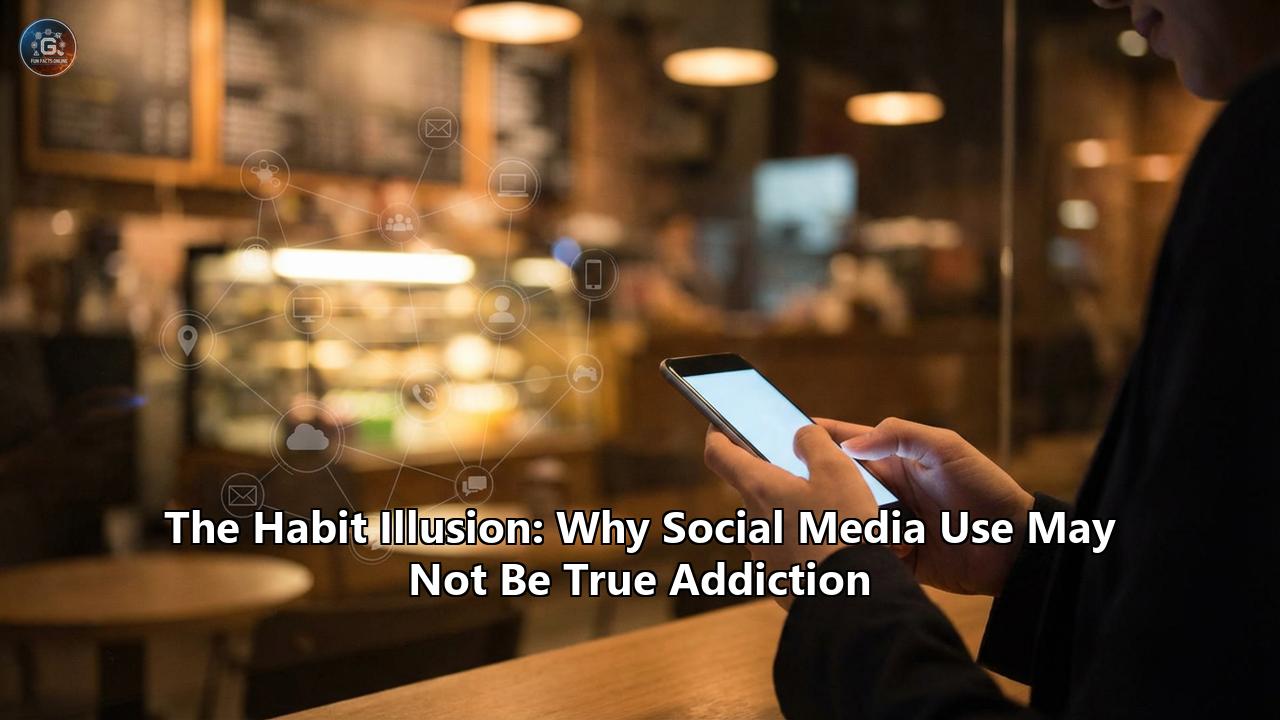
In the quiet glow of a smartphone screen at 2:00 AM, a familiar scene plays out in millions of bedrooms across the world. A thumb flicks upward, eyes scan a rapidly moving feed, and a brain, weary but wired, seeks one last hit of novelty. The user knows they should sleep. They want to sleep. Yet, they cannot stop. When they finally put the phone down, guilt washes over them—a sensation that feels perilously close to the shame of a relapse. "I am addicted," they whisper to the darkness.
But are they?
For over a decade, the narrative surrounding social media has been dominated by the language of clinical pathology. We speak of "users," "dopamine hits," "withdrawals," and "detoxes." We view Mark Zuckerberg and the architects of Silicon Valley as digital cartel lords, pushing a product as chemically coercive as nicotine or cocaine. While this comparison is potent—and partially true—it obscures a more nuanced, and perhaps more liberating, reality.
Emerging research from 2024 and 2025 suggests that for the vast majority of users, what we are experiencing is not a clinical addiction (a physiological dependency that hijacks the brain’s survival mechanisms) but a habit illusion: a powerful, engineered behavioral loop that mimics the feeling of addiction without necessarily carrying the same biological intractability.
This distinction is not merely semantic. If we believe we are "addicts," we surrender our agency to a disease model, waiting for a cure or a total abstinence that is impossible in a digital world. If we understand we are trapped in a "habit loop"—a cognitive trick played by profit-driven design—we can reverse-engineer the trap and walk out of it.
This article explores the neuroscience, sociology, and psychology of the Habit Illusion, dissecting why the scroll feels so inescapable, the cognitive price we pay for it, and how we can reclaim our autonomy without throwing our smartphones into the sea.
Part I: The Architecture of the Illusion
The Neuroscience of "Just One More"
To understand why we feel addicted, we must first understand the currency of the brain: dopamine. Popular culture has branded dopamine as the "pleasure molecule," the chemical equivalent of a gold star or a cookie. This is a misconception. As neuroscientist Dr. Andrew Huberman and others have clarified, dopamine is not about pleasure; it is about craving and motivation. It is the chemical of "more."
When you see a notification badge, your brain doesn't release dopamine because you are happy; it releases dopamine to propel you to take action—to click, to check, to see. The pleasure of seeing a "like" is fleeting, often lasting only seconds. The dopamine surge that precedes it, however, is a powerful engine of behavior.
The Ludic Loop and Variable Rewards
The reason social media feels like a slot machine is that it is a slot machine. In the mid-20th century, psychologist B.F. Skinner discovered that he could get pigeons to peck a lever endlessly not by rewarding them every time, but by rewarding them randomly. This is the Variable Ratio Schedule of Reinforcement, the most addictive behavioral pattern known to science.
Social media platforms are masters of this "Ludic Loop."
- The Pull-to-Refresh: This interaction was explicitly designed to mimic the mechanical action of a slot machine arm. You pull down, the wheel spins (the loading icon), and you wait in anticipation. Will it be a new email? A viral video? A message from a crush? Or nothing? The uncertainty is the drug.
- Algorithmic Withholding: Some studies and whistleblower reports suggest that algorithms may "batch" notifications. Instead of delivering one "like" every ten minutes, the app holds them back and delivers ten at once, creating a larger, more euphoric spike in dopamine—a "jackpot" moment that reinforces the behavior more strongly than a steady trickle.
The Habit Loop vs. The Addiction Cycle
While the neurochemistry is similar to substance abuse, the mechanism differs. Clinical addiction involves a progressive narrowing of pleasure—the addict eventually enjoys nothing else, and the substance is needed just to feel normal (homeostasis).
Social media use, for most, fits better into the Habit Loop model described by researchers like Charles Duhigg and James Clear, but hyper-charged by AI:
- Cue: Internal (boredom, anxiety, loneliness) or External (a "ding," a red dot).
- Routine: The unconscious action of unlocking the phone and opening an app.
- Reward: A temporary relief from the internal itch (distraction) or a hit of social validation.
The "illusion" is that because the urge is strong, we assume the dependency is deep. But unlike heroin withdrawal, which causes violent physical illness, the "withdrawal" from social media is often a psychological phantom—a mix of boredom and anxiety that dissipates surprisingly quickly once the loop is broken.
Part II: The Design of Dependency
Dark Patterns and the Attention Economy
If the user is the pigeon pecking the lever, who built the box? The answer lies in the "Attention Economy," a business model where human attention is the finite resource being mined for profit. To maximize "Time on Device," designers employ Dark Patterns—user interface choices that coerce users into doing things they didn't intend to do.
1. The Infinite Scroll
Before 2006, the internet had "pages." You reached the bottom of an article or a forum thread, and you had to make a conscious decision to click "Next." That split-second pause was a moment of agency—a chance to ask, "Am I done?"
The infinite scroll, invented by Aza Raskin (who has since expressed regret), removed that stopping cue. The content flows like a liquid, removing the natural friction that signals our brain to switch tasks. It exploits the Zeigarnik Effect, a psychological phenomenon where our brains obsess over incomplete tasks. Because the feed never ends, the task of "checking" is never complete.
2. Autoplay and the Passive Consumer
Netflix and YouTube’s autoplay features shift the default choice from "continue" to "stop." To not watch the next episode requires an active intervention. In a state of cognitive fatigue (which screens induce), the path of least resistance—doing nothing—wins every time.
3. False Urgency and "Confirmshaming"
"Your story expires in 1 hour!" "You have a 3-day streak!" These alerts create artificial scarcity. The app implies that if you don't engage now, you lose something valuable. This exploits Loss Aversion, the economic principle that the pain of losing is psychologically twice as powerful as the pleasure of gaining.
Part III: The Cognitive Cost
Why We Feel "Brain Dead"
The primary casualty of the Habit Illusion is not just time; it is the quality of our cognition. Even if we aren't "addicted" in a clinical sense, our brains are suffering from chronic fragmentation.
Attention Residue
Business professor Sophie Leroy coined the term "Attention Residue." Her research shows that when you switch from Task A (writing a report) to Task B (checking an email) and back to Task A, your attention doesn't immediately follow. A "residue" of your attention remains stuck on the email.
In a world of constant notifications, we are never fully present in any task. We are operating with a fraction of our cognitive capacity, leading to a state of "semidistractedness" that kills deep work and creativity. We aren't multitasking; we are rapid-toggling, and every toggle incurs a metabolic cost on the brain.
Continuous Partial Attention
Former Apple executive Linda Stone describes our state as "Continuous Partial Attention." Unlike multitasking, which is about efficiency, this state is motivated by a desire not to miss anything. It keeps the brain in a permanent state of high alert, flooding the system with cortisol (the stress hormone). This explains why a day of scrolling feels physically exhausting—your brain has been "on guard" for threats and opportunities for 12 hours straight.
Part IV: The Sociological Trap
Surveillance Capitalism and the Performance of Self
The Habit Illusion is not just a battle between a user and a screen; it is a battle between a citizen and a surveillance system. Harvard professor Shoshana Zuboff defines "Surveillance Capitalism" as a new economic order that claims human experience as free raw material for translation into behavioral data.
We are not the "customers" of social media; we are the carcasses from which data is harvested. The "addiction" is the mechanism by which the extraction happens.
The Goffmanesque Nightmare
Sociologist Erving Goffman, in his seminal work The Presentation of Self in Everyday Life, described social interaction as a theatrical performance. We have a "front stage" (where we perform for others) and a "back stage" (where we relax).
Social media collapses these walls. We are now "on stage" 24/7. Instagram is a curated art gallery of the self; TikTok is a performative variety show. The pressure to maintain this digital avatar creates a "Sunk Cost Fallacy." We feel we cannot leave because we have invested thousands of hours building this digital identity. To delete the account feels like a form of suicide—the death of the "digital self."
The Loneliness Paradox
Perhaps the cruelest irony of the Habit Illusion is the Loneliness Epidemic. As 2024/2025 studies from Baylor University and others have shown, heavy social media use correlates with increased loneliness.
We trade "strong ties" (deep, messy, real-world relationships) for "weak ties" (digital, performative, low-stakes connections). We consume the highlights of others' lives, leading to "comparative suffering," while our own capacity for empathy atrophies because digital communication strips away the micro-expressions and tone of voice required for true emotional resonance.
Part V: Breaking the Illusion (Practical Steps)
If it’s a habit and not a disease, it can be broken. The solution is not willpower; it is system design. We must redesign our digital environments to reduce friction for good habits and increase friction for bad ones.
1. The Digital Minimalism Protocol (The Newport Method)
Cal Newport, author of Digital Minimalism, proposes a 30-day "digital declutter." This is not a detox (which implies you go back to normal afterwards) but a reset.
- Step 1: The 30-Day Break. Remove all "optional" technologies. If your job doesn't depend on Twitter, delete it. If you don't need Instagram to pay rent, remove it.
- Step 2: Rediscover Analog Joy. You cannot just remove the habit; you must replace the void. Fill the time with high-quality leisure: reading, woodworking, hiking, cooking. You must reteach your brain that slow activities are rewarding.
- Step 3: The Conscious Reintroduction. After 30 days, do not just reinstall everything. Ask of each app: Does this serve a deep value of mine? If yes, how will I use it? (e.g., "I will check Instagram only on my computer on Sundays for 20 minutes.")
2. The Dopamine Detox (The Huberman Protocol)
Neuroscientist Andrew Huberman suggests resetting the brain’s dopamine baseline.
- The Rule: Abstain from highly stimulating/dopaminergic activities (social media, video games, junk food) for a set period (e.g., 24-48 hours) to resensitize dopamine receptors.
- The Outcome: Boredom becomes tolerable again. The "itch" to check subsides because the brain realizes it won't die without the stimulus.
3. Friction Engineering
If you don't want to go "cold turkey," simply make the phone annoying to use.
- Grayscale Mode: Turning your phone to black and white removes the "candy" appeal of colorful icons. It turns the slot machine into a utilitarian tool.
- The "Dumb Phone" Movement: In 2025, devices like the Light Phone 3 and Mudita Kompakt are gaining traction. These are phones that only do the essentials (calls, texts, maps, podcasts) but lack an infinite scroll. They are "tools," not "traps."
- App Blockers: Use tools like Opal or Freedom to create "hard blocks." For example, block all social media from 9 AM to 5 PM.
Conclusion: Reclaiming the "Good Life"
The Habit Illusion is a powerful cage, but the door is unlocked. The anxiety we feel about disconnecting—the Fear Of Missing Out (FOMO)—is a marketing fabrication. The reality is JOMO (the Joy Of Missing Out).
When we step out of the loop, we don't "miss" life; we regain it. We regain the ability to sit in silence, to hold a conversation without glancing at a wrist, to watch a movie without a second screen, and to think a thought through to its conclusion without it being fractured by a notification.
We are not broken. We are not addicts. We are simply humans living in an environment designed to distract us. And we have the power to redesign it.
Reference:
- https://www.youtube.com/watch?v=oOI7TX-tDcc
- https://www.hubermanlab.com/newsletter/tools-to-manage-dopamine-and-improve-motivation-and-drive
- https://medium.com/predict/your-ultimate-2025-resolution-a-neuroscientists-guide-to-digital-detox-for-a-clearer-mind-and-6a94c7fde271
- https://stephanjoppich.com/digital-minimalism-cal-newport/
- https://www.ohsoorganized.com/blog/2017/6/19/are-you-suffering-from-continuous-partial-attention.html
- https://able.ac/blog/switch-cost-effect/
- https://www.youtube.com/watch?v=5rYqNaKsDnM
- https://strongerhabits.com/attention-residue/
- https://www.thecut.com/2016/01/attention-residue-is-ruining-your-concentration.html
- https://keyphone.tech/latest-news/dumbphones-the-complete-guide-for-2025/
- https://lindastone.net/faq/
- https://news.wfu.edu/2024/04/16/the-switch-cost-of-multitasking/
- https://businesswomen.com/blog/how-to-do-a-digital-declutter/
- https://www.reddit.com/r/digitalminimalism/wiki/declutter-guide/
- https://www.ninasemczuk.com/blog/5-practices-to-put-in-place-from-digital-minimalism-by-calnbspnewport
- https://www.refinery29.com/en-gb/digital-decluttering-how-to