
The sun beats down on the scrub-covered mound of Hisarlik, a dusty hill in northwestern Turkey that has, for centuries, guarded the secrets of the ancient world. Here, where the Scamander plain stretches out toward the shimmering Aegean, the boundary between myth and history is thinner than anywhere else on Earth. For generations, scholars and dreamers have walked this ground, searching for the shadow of Hector, the footprints of Achilles, and the charred remnants of a city that supposedly fell to a trick with a wooden horse.
But the most compelling evidence for the "shattering of the Trojan battle lines" — as Homer once sang — has not come from a golden mask or a royal scepter. It has emerged from the dirt in the form of thousands of humble, rounded stones.
These are the "Trojan Ballistics."
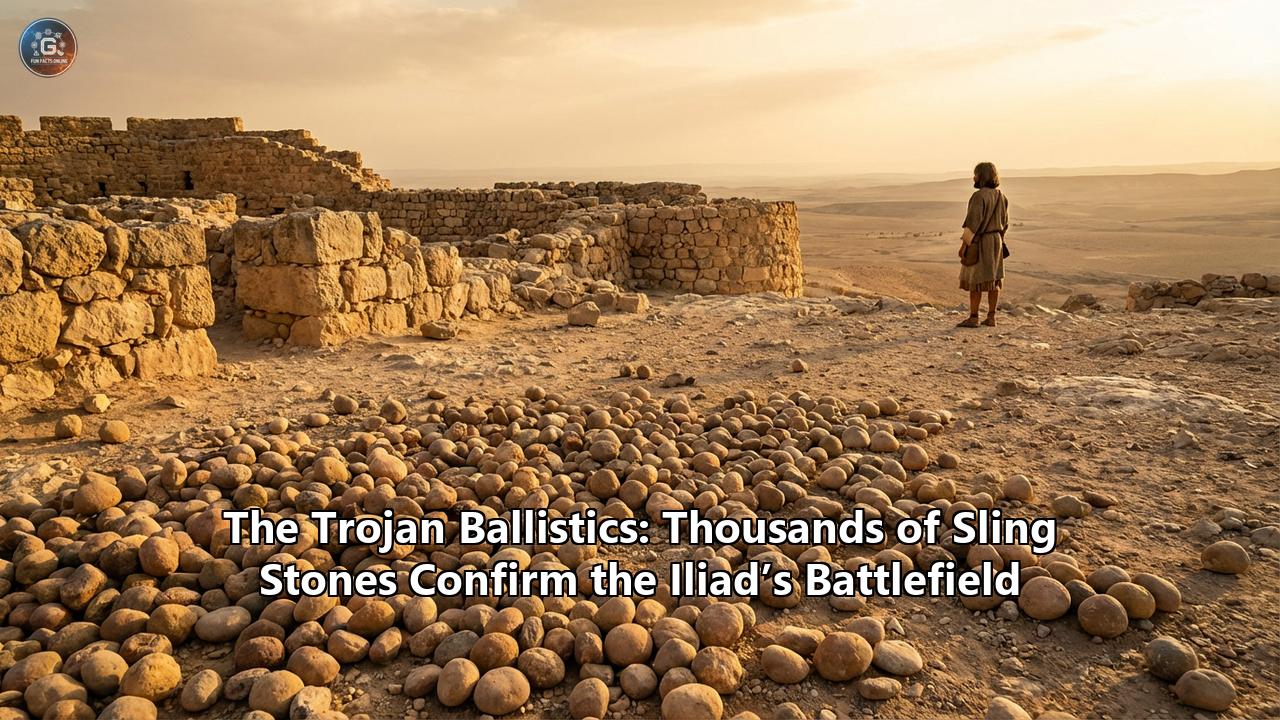
In a discovery that has electrified the archaeological community and sent ripples through Homeric scholarship, Professor Rüstem Aslan and his team have unearthed a massive cache of sling stones in the destruction layers of Late Bronze Age Troy. These are not mere river pebbles kicked aside by passing shepherds. They are munitions: standardized, stockpiled, and unleashed in a volume that speaks of a desperate, cataclysmic struggle. They confirm that the legendary battlefield of the Iliad was not just a stage for the duels of demigods, but a kill zone saturated by the ancient world’s equivalent of machine-gun fire.
This is the story of those stones, the men who threw them, and how a pile of clay and rock is rewriting the history of the greatest war ever told.
Part I: The Arsenal of the Earth
To understand the magnitude of this discovery, one must first strip away the Hollywood veneer of the Trojan War. In popular imagination, the conflict is a series of polite, choreographed sword fights between golden-armored heroes. But the reality of Bronze Age warfare was far grimmer, louder, and more chaotic. It was a storm of projectiles.
When Professor Aslan’s team began excavating the area near the southern gate of the citadel—the layer known as Troy VI/VIIa, which most scholars align with the timeline of the Homeric war—they were looking for the "destruction layer." This is the stratum of ash, charred wood, and debris that marks the violent end of a city. What they found embedded in this layer was a concentration of sling stones so dense it suggested a "frozen moment" of intense combat.
"The fact that so many sling stones were uncovered in such a small area in front of the palace points to an activity related to defense or assault," Aslan reported.
These stones tell a specific tactical story. In the Late Bronze Age, the sling was not a toy or a hunter's backup weapon; it was the primary long-range artillery of the infantry. A skilled slinger could hurl a projectile at speeds exceeding 100 miles per hour. The stones found at Troy are a mix of smoothed river rocks and, more crucially, crafted clay bullets.
The presence of clay ammunition is significant. River stones are found in nature, but clay bullets must be manufactured. They require digging the earth, shaping the projectile (often into a biconical or "lemon" shape to improve aerodynamics), drying it in the sun, and stockpiling it. The discovery of a cache of these manufactured rounds implies premeditation. The defenders of Troy knew they were coming under siege. They had prepared an arsenal to rain death upon anyone who approached the Scaean Gates.
The sheer number of stones found suggests that the air on that fateful day would have been black with missiles. For the Achaean soldier trying to breach the walls, there was no glory in this part of the fight. There was only the terrifying, high-pitched hum of a stone cutting the air, followed by the sickening crunch of impact. A sling stone does not pierce like an arrow; it crushes. It shatters shields, caves in bronze helmets, and breaks bones with the force of a sledgehammer. The archaeological record at Troy, with its hasty burials and battered skeletons, bears silent witness to this blunt-force trauma.
Part II: The Physics of the "Humming Death"
To appreciate why these stones confirm the intensity of the Trojan battlefield, we have to look at the ballistics. In modern terms, we often underestimate the sling. We think of David and Goliath—a lucky shot from a shepherd boy. But in the hands of a professional soldier of the Bronze Age, the sling was a weapon of terror.
A typical sling stone from the Troy excavation weighs between 40 and 100 grams. When launched from a leather sling by a trained arm, the centrifugal force generates immense kinetic energy. Tests with modern recreations of ancient slings show that these projectiles can outrange the composite bows of the era. While an archer might be effective at 100 yards, a slinger could harass enemy formations from 150 to 200 yards away, raining fire from a safe distance.
The clay stones found at Troy add another layer of sophistication. Unlike natural rocks, which vary in density and shape, clay bullets could be standardized. A slinger gets used to the weight of his standard ammunition, allowing for greater accuracy. Furthermore, some ancient sources and experimental archaeology suggest that clay bullets could be heated before battle. If they hit a thatched roof or dry timber, they could act as incendiary devices. If they hit a man, they might shatter on impact, leaving a jagged shrapnel wound that was impossible to treat.
But the true power of the sling was its "suppressing fire." In the Iliad, we often read of heroes cowering behind their shields or the lines of battle rippling and breaking. A volley of sling stones explains this visceral reaction. You cannot parry a sling stone. You cannot dodge a hundred of them falling at once. The only defense is to turtle under a shield and stop moving. This pin-down tactic allowed the opposing infantry—the spearmen and swordsmen—to close the gap and finish the job.
The discovery at Hisarlik suggests that the final assault on Troy was not just a sneak attack with a horse. It was a massive, combined-arms operation where "softening up" the target with ballistics played a crucial role. The density of the find near the palace walls paints a picture of a last stand: the defenders on the ramparts, hurling their stockpiles down into the throng of Greeks, desperate to keep the enemy at bay.
Part III: Homer’s "Locrians" and the Missing Link
For centuries, literary critics have argued over the accuracy of Homer’s descriptions. The Iliad was composed roughly 400 years after the city of Troy fell. By Homer’s time (the Iron Age), warfare had changed. Some scholars argued that Homer was "archaizing"—inventing a heroic past that didn't reflect reality. They pointed to the fact that the Iliad focuses heavily on aristocratic champions fighting one-on-one, while the masses of common soldiers are often treated as nameless background extras.
However, the "Trojan Ballistics" discovery forces us to re-read the epic with fresh eyes. It turns out, Homer did tell us about the slingers; we just weren't paying attention.
In Book 13 of the Iliad, as the battle rages near the Greek ships, Homer shifts his gaze from the heavy infantry to a specific contingent of troops: the Locrians, led by Ajax the Lesser.
"But the Locrians followed not with the great-hearted son of Oïleus... seeing they had no brazen helms with thick plumes of horse-hair, neither round shields, nor spears of ash, but trusting in bows and well-twisted slings of sheep's wool had they followed with him to Ilios; with these thereafter they shot thick and fast, and sought to break the battalions of the Trojans."
Homer describes their effect on the battlefield with chilling precision:
"The Trojans... could no longer stand their ground, for the arrows and the sling-stones threw them into confusion."
For years, this passage was treated as a minor detail. But the archaeology vindicates it completely. The thousands of stones found at Troy match the description of a battlefield dominated by "thick and fast" missiles. The "Trojan Ballistics" are the physical residue of the Locrians' volley.
This validates the Iliad not just as a poem, but as a repository of military memory. The oral tradition successfully preserved the specific tactical reality of the Late Bronze Age: that while the kings might have claimed the glory, the tide of battle was often turned by the light infantry, the men with "slings of well-twisted wool," who could shatter a formation from a distance.
Furthermore, the ubiquity of these stones explains a peculiar quirk of the Iliad: the heroes who throw rocks.
Throughout the poem, warriors like Hector and Ajax are constantly picking up massive boulders to hurl at each other. Critics have often dismissed this as "mythic powerlifting"—a way for Homer to show that these men were superhuman. But in the context of a battlefield littered with thousands of sling stones and stockpiles of ammunition, "throwing stones" becomes a much more grounded reality. Perhaps the "boulders" of the heroes are poetic exaggerations of the very real, very deadly rain of stone that defined the siege. The landscape of Troy was literally weaponized.
Part IV: The Soldier’s View
Imagine standing on the walls of Troy VI. It is the height of summer. The heat is shimmering off the plains. Below you, the Achaean army is not a golden line of heroes, but a dusty, terrifying mass of humanity.
You are a defender. At your feet lies a pile of sun-dried clay bullets, shaped by the hands of your wife or daughter weeks ago, when the siege began to tighten. You fit one into the leather cradle of your sling. You whirl it once, twice, the sound a low thrum like a hornet, and then release.
Down below, a Greek soldier from Pylos or Argos hears the sound, but it is too late. The clay bullet strikes his bronze cuirass with the force of a sledgehammer. The bronze dents; the ribs underneath snap. He falls, gasping for air. But you don't watch him fall. You are already loading the next stone.
This was the reality of the Trojan War. It was gritty, industrial, and brutal. The discovery of the sling stone cache humanizes the conflict. It moves the narrative away from the gods on Olympus and places it squarely in the hands of the frightened, desperate men who fought and died in the mud.
The sheer volume of stones found at the Scaean Gate suggests that the ammunition was not just used; it was exhausted. The defenders threw everything they had. The fact that the city still fell, despite this wall of projectile fire, speaks to the overwhelming numbers or the tactical ingenuity of the attackers. It makes the fall of Troy even more tragic. They had the weapons; they had the high ground; they had the walls. And they still lost.
Part V: Conclusion - The Echo in the Earth
The "Trojan Ballistics" are more than just artifacts; they are a bridge. They span the gap of three millennia, connecting the verses of Homer to the soil of Turkey. They tell us that behind the myth of the Golden Apple and the face that launched a thousand ships, there was a real war fought by real men using the most effective technology of their time.
Professor Aslan’s discovery does not prove that Achilles had a vulnerable heel, or that the gods descended to fight in the dust. But it does prove that the scale of the violence described in the Iliad was real. The air over Troy really did hum with death. The battle lines were indeed broken by "volleys thick and fast."
In the thousands of silent stones resting in the museum cases of Çanakkale, we finally hear the true sound of the Trojan War. It is not the clang of swords, but the whistle of the sling—the weapon of the common soldier, the weapon that defended the walls until the very end, confirming that the greatest epic in history was forged in the fire of a very real, and very deadly, battlefield.
Reference:
- https://www.turkiyetoday.com/culture/archaeologists-dig-deeper-into-possible-traces-of-trojan-war-in-turkiyes-legendary-ci-3203948
- https://indiandefencereview.com/new-clues-trojan-war-excavations-troy/
- https://www.jpost.com/archaeology/article-861322
- https://www.quora.com/Was-an-ancient-lead-sling-shot-really-as-deadly-as-a-45
- https://en.wikipedia.org/wiki/Sling_(weapon))
- https://www.theoi.com/Text/HomerIliad13.html
- https://classics.mit.edu/Homer/iliad.13.xiii.html
- https://www.poetryintranslation.com/PITBR/Greek/Iliad13.php