
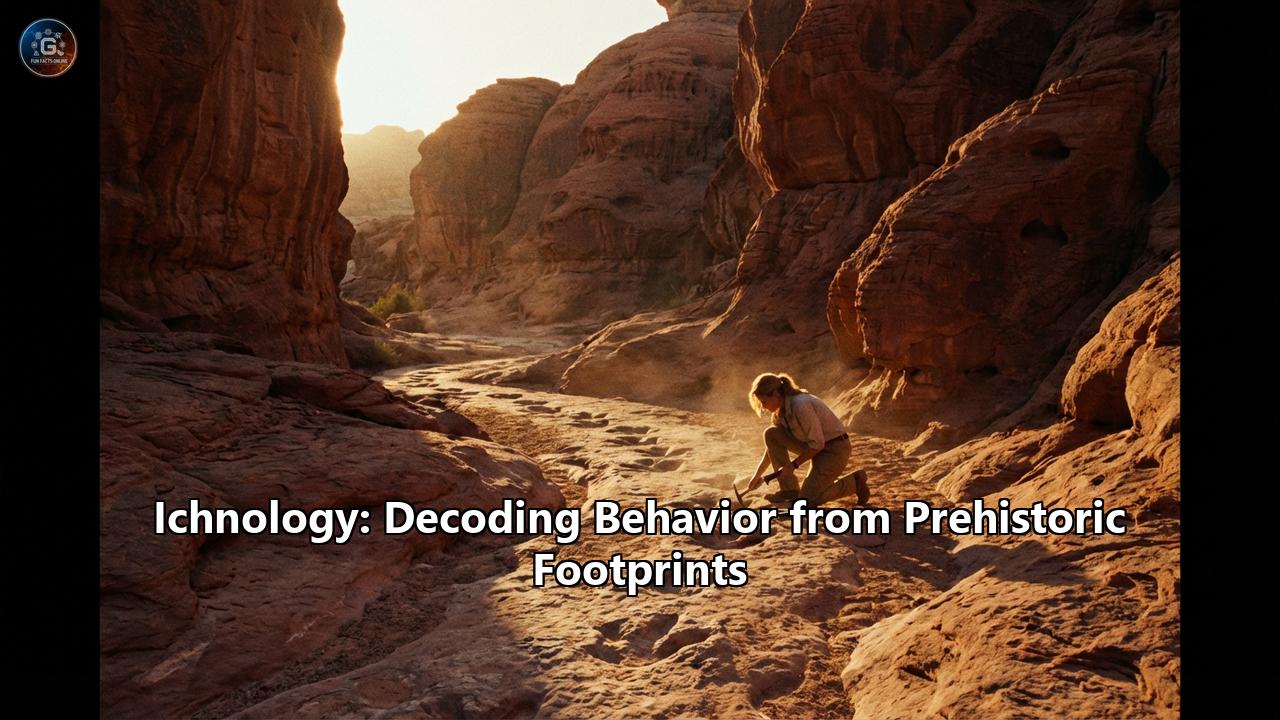
The fossil record is often imagined as a dusty museum hall filled with silent skeletons—bleached bones mounted in static poses, staring blankly into eternity. We look at a Tyrannosaurus rex skeleton and see a monster frozen in death. But death is only a single moment. What of the millions of moments that came before it? What of the life lived?
To find the living, breathing animal—the creature that ran, hunted, cared for its young, and struggled through the mud—we must turn away from the bones and look to the ground. We must look for the shadows they cast in the stone.
This is the domain of ichnology, the study of trace fossils. Unlike body fossils (bones, teeth, shells), which preserve the organism itself, trace fossils preserve the activity of the organism. They are the petrified records of behavior, fleeting seconds of prehistoric time locked in rock for millions of years. A footprint is not just an impression in sediment; it is a biomechanical data point, a narrative clue, and a ghost of a movement that happened eons ago.
From the ash plains of Tanzania to the dried lakebeds of New Mexico, and from the muddy shores of Jurassic England to the vast trackways of Bolivia, ichnologists are decoding these ancient scripts. They are calculating the speed of sprinting theropods, reconstructing the social hierarchy of sauropod herds, and witnessing the terrified final moments of a giant sloth stalked by human hunters.
This is the story of how we read the behavior of the dead.
Part I: The Science of Shadows
The Goldilocks of Geology
The existence of a fossil footprint is a statistical miracle. For a bone to fossilize, an animal must die and be buried. For a footprint to fossilize, the conditions must be exactly right while the animal is still alive.
The substrate (the ground surface) cannot be too wet, or the walls of the print will collapse into a shapeless blob. It cannot be too dry, or the foot will make no impression at all. It must be the "Goldilocks" consistency—firm enough to hold detail, yet plastic enough to mold under pressure. A sticky mudflat, a damp volcanic ash fall, or the microbial mat of a tidal zone are perfect canvases.
But making the print is only step one. To survive deep time, this fragile impression must be buried rapidly and gently. A sudden influx of gentle silt from a river flood or a layer of windblown sand must cover it without scouring it away. Over millions of years, the sediment turns to stone (lithification). The original mud becomes shale or mudstone; the infill becomes sandstone. Eventually, erosion peels back the layers, revealing the moment again.
The Taxonomy of Traces
While footprints are the "celebrities" of ichnology, the field covers a vast array of biologic signatures, collectively known as ichnofossils:
- Repichnia (Locomotion traces): Footprints, trackways, and trails. These tell us about movement, speed, and gait.
- Cubichnia (Resting traces): Impressions left when an animal stopped moving. A starfish resting in the sand, or a dinosaur sitting down (leaving an impression of its belly and "hands").
- Fodichnia (Feeding traces): Burrows or networks made by animals mining sediment for food, like earthworms or ancient marine invertebrates.
- Domichnia (Dwelling traces): Permanent homes, such as the burrows of ghost shrimp or the sophisticated nests of ancient termites.
- Coprolites: Fossilized feces. These are arguably the most intimate records of diet and metabolism, sometimes containing scales, bone fragments, or pollen.
In this article, we will focus primarily on the most dynamic of these: the locomotion traces that allow us to reconstruct the scenes of the past.
Part II: The Mathematics of Movement
How do you look at a hole in the rock and know how fast a dinosaur was running? It seems like magic, but it is pure physics and biomechanics.
Anatomy of a Trackway
To an ichnologist, a single print is an ichnite. A series of prints is a trackway.
- Stride: The distance between two successive placements of the same foot (e.g., right heel to right heel).
- Pace: The distance between the left foot and the right foot.
- Track Gauge: The width of the trackway, telling us how wide the animal's stance was.
Alexander’s Formula
In 1976, British zoologist R. McNeill Alexander revolutionized the field by providing a mathematical way to calculate speed from these measurements. He realized that animals of similar shapes move in dynamically similar ways.
The formula generally used is:
$$Speed \approx 0.25 \times g^{0.5} \times SL^{1.67} \times h^{-1.17}$$
Where:
- g is the acceleration due to gravity (9.8 m/s²).
- SL is the Stride Length.
- h is the Hip Height (often estimated as 4x the footprint length for large theropods).
Using this math, we can determine if a dinosaur was strolling, trotting, or running for its life.
- If the Relative Stride Length (Stride Length / Hip Height) is less than 2.0, the animal is walking.
- If it is greater than 2.9, it is running.
This math has shattered the old Victorian image of dinosaurs as sluggish, tail-dragging lizards. We now know that large theropods could move with terrifying grace, and that some smaller dinosaurs were agile sprinters.
The "Slip" Factor
Modern ichnology goes beyond simple measurements. We look for displacement rims—the mud squeezed out around the toes.
- If the mud is pushed heavily to the outside of the track, the animal was turning.
- If the toe impressions are deep and the heel is shallow or missing, the animal was accelerating or running on its toes (digitigrade).
- Slide marks behind the print indicate slippery substrates, telling us about the ancient weather.
Part III: Case Study — The Human Story
Nothing resonates quite like the footprint of our own ancestors. They are startlingly familiar, a mirror across time.
Laetoli: The First Family?
In 1976, in Tanzania, paleoanthropologist Mary Leakey’s team discovered something extraordinary in a layer of cemented volcanic ash dated to 3.66 million years ago. Stretching for 27 meters were tracks of Australopithecus afarensis—the same species as the famous "Lucy."
The Laetoli footprints settled a fierce debate: did our ancestors get big brains first, or did they walk upright first? These prints, with their deep heel strikes, distinct arches, and non-divergent big toes (meaning the toe was in line with the foot, not grabbing like an ape's), proved that hominins were fully bipedal millions of years before they developed large brains or stone tools.
The Behavior: The tracks show two individuals walking side-by-side, with a third, smaller individual trailing behind, stepping carefully into the footprints of the leader. For decades, this was romanticized as the "First Family"—a male, female, and child.However, recent re-evaluations suggest a more complex social structure. The size difference between the two "adult" tracks is significant, pointing to high sexual dimorphism (males much larger than females). In modern primates like gorillas, high dimorphism often correlates with polygynous groups (one male, multiple females) rather than monogamous nuclear families. The "family walk" might actually be a dominant male and a female from his harem, with a juvenile tagging along.
White Sands: The Ghost Tracks
In the last few years (2018–2025), White Sands National Park in New Mexico has become the epicenter of human ichnology. The "Ghost Tracks" here are invisible when the ground is dry but emerge in a darker color when wet, stretching for miles across the alkali flats.
The Dating Revolution: In 2021, seeds found embedded in the footprints were radiocarbon dated to between 21,000 and 23,000 years ago. This was explosive. It placed humans in North America during the Last Glacial Maximum, thousands of years earlier than the "Clovis First" theory allowed. Critics argued the seeds might be unreliable (sucking up "old carbon" from groundwater).But in October 2023, a study published in Science confirmed the dates using radiocarbon dating of conifer pollen and Optically Stimulated Luminescence (OSL) of quartz grains. The dates held. This rewriting of history was driven entirely by footprints.
The Sloth Hunt: The most dramatic find at White Sands is a trackway recording a life-and-death interaction.- The Scene: A Giant Ground Sloth (likely Paramylodon) was walking across the mud.
- The Action: Human footprints appear inside the sloth’s tracks. The humans were not just following; they were stalking.
- The Climax: The sloth tracks suddenly change. The animal rears up on its hind legs and spins, creating "flailing circles." It was reacting to a threat. Simultaneously, human tracks approach from a different angle—on tiptoe.
Part IV: Case Study — The Age of Dinosaurs
Glen Rose: The Chase that Wasn't?
The Paluxy River in Glen Rose, Texas, is perhaps the most famous dinosaur track site in the world. In 1940, Roland T. Bird excavated a massive slab here (now in the American Museum of Natural History).
The Scene: The trackway shows a herd of sauropods (long-necked dinosaurs) moving in one direction. Directly on top of their tracks are the three-toed prints of a large theropod (likely Acrocanthosaurus). The Traditional Story: A predatory dinosaur was stalking a herd of sauropods, waiting for a straggler. It was the classic "chase scene." The "Man Track" Controversy: In the mid-20th century, local creationists claimed some eroded, elongated theropod tracks were "human footprints" proving humans and dinosaurs coexisted. Ichnologists debunked this by showing the "human" prints were actually metatarsal impressions—dinosaurs walking on their heels (plantigrade) due to crouching or mud consistency. The faint claw marks, visible when properly cleaned, sealed the case. Recent Discoveries (2022-2024): Droughts in Texas have revealed previously submerged tracks in the Paluxy riverbed. These new exposures, including the "Lone Ranger" trackway, have allowed for high-tech drone mapping. The new analysis suggests that while the theropod was indeed following the sauropods, the time gap is hard to prove. Was it hunting, or just using the same convenient mudflat highway hours later? The "chase" might be a coincidence of geography, but the alignment of the predator's steps with the prey's path remains tantalizingly suspicious.The "Dinosaur Highway" of Oxfordshire (2024/2025)
Just recently, excavations at Dewars Farm Quarry in England have uncovered a Middle Jurassic treasure trove.
- The Find: In 2024 and 2025, researchers uncovered Europe's longest sauropod trackway, spanning over 200 meters.
- The Insight: These tracks belong to Cetiosaurus. The sheer length allows scientists to see changes in gait over a long distance—something rare in the fragmented fossil record. It also captures the interaction between different species, with Megalosaurus (the first dinosaur ever named) tracks crossing the sauropod highway.
The Bolivia Megasite
Between 2019 and 2024, an international team mapped the Carreras Pampa site in Bolivia.
- The Scale: Over 16,000 footprints in a single area.
- The Behavior: This site is a chaotic dance floor. It reveals not just walking, but swimming.
Swim Tracks: Some prints show only the tips of the claws scraping the bottom, with no heel impression. This indicates the dinosaur was buoyant, paddling in deep water and just grazing the bottom with its toes. It proves that theropods were capable swimmers, likely crossing rivers or lakes to find food or mates.
Herding Behavior
How do we know dinosaurs lived in herds? We can't see them. But footprints don't lie.
- Parallel Trackways: Sites like the Red Gulch in Wyoming or Lark Quarry in Australia show dozens of animals of the same species moving in the same direction at the same speed.
- Spacing: The tracks often show equal spacing between individuals, implying they were maintaining formation.
- The Nursery Structure: In some sauropod trackways, the footprints of juveniles are found exclusively in the center of the trackway, flanked by the massive prints of adults on the outside. This is direct evidence of protective herding behavior, similar to modern elephants protecting their calves from lions.
Part V: The First Walkers (Arthropods & Tetrapods)
Ichnology isn't just about dinosaurs and humans. Some of the most significant tracks come from the dawn of terrestrial life.
Valentia Island: The First Steps
On a slate shoreline in County Kerry, Ireland, lies a trackway dated to 385 million years ago (Devonian Period). It looks like a series of divots, but it marks a monumental event in Earth's history.
The Story: A tetrapod (a four-limbed vertebrate ancestor) dragged itself out of the water. The tracks show a wide gait and a distinct tail drag. Decoding: The animal was not walking efficiently; it was lumbering, using its belly and tail for support. This captures the literal evolutionary moment of transition from aquatic life to land-dwelling.The Giants of Scotland: Arthropleura
In the Carboniferous period, oxygen levels were higher, allowing arthropods to grow to nightmare proportions.
- The Beast: Arthropleura, a millipede-like creature up to 2.5 meters (8 feet) long.
- The Tracks: Found on the Isle of Arran and in Fife, Scotland. These tracks are two parallel rows of many small legs.
- The Insight: Recent analysis of these tracks (including new finds discussed in 2023/2024) shows they are often found in open areas, not just swampy forests. The tracks are remarkably straight, indicating these giants had few predators to fear. They bulldozed through the undergrowth, the undisputed tanks of the Carboniferous.
Part VI: Beyond Footprints
Coprolites: The Truth in the Dung
Coprolites (fossilized feces) are the "unsung heroes" of ichnology. You can lie about what you ate, but your poop cannot.
- Tyrannosaur Diet: A famous T. rex coprolite contained pulverized bone fragments. This proved that T. rex was an osteophage (bone eater), with jaw pressure strong enough to crush skeletal material—a trait seen today in hyenas but rare in reptiles.
- Parasites: Coprolites from early humans often contain eggs of tapeworms and nematodes, allowing us to map the history of human disease and sanitation.
Insect Architecture
In the Chinle Formation of Arizona (Triassic), paleontologists have found massive sandstone pillars that were once thought to be geological oddities.
Decoding: They are actually fossilized termite nests. Their complexity rivals modern termite mounds in Africa. This proves that social insect behavior (eusociality) is incredibly ancient, dating back over 200 million years. These insects were building air-conditioned cities while the first dinosaurs were just starting to evolve.The Burrowers
In Montana, a dinosaur named Oryctodromeus was found inside its own burrow.
The Trace: A lithified tunnel filled with sand. The Behavior: This was the first definitive proof of fossorial (digging) dinosaurs. It upended the idea that dinosaurs were purely surface dwellers. They dug dens to escape the heat or protect their young, adding a new layer of complexity to their daily lives.Part VII: The Future of Ichnology
The future of studying the past is digital. The "Golden Age" of Ichnology is happening right now, fueled by technology.
Photogrammetry and 3D Laser Scanning
In the past, tracks were studied by making plaster casts—a destructive and heavy process. Today, ichnologists use photogrammetry. By taking hundreds of overlapping photos from different angles (often using drones), software can build a sub-millimeter accurate 3D model of a tracksite.
- False Color Analysis: Once a track is digital, scientists can apply "false color" maps to highlight depth. A track that looks like a vague depression to the naked eye suddenly pops with detail—revealing claw marks, skin texture, or the subtle "slip" of a heel—when visualized as a topographical heat map.
- Preservation: Erosion is the enemy. The tracks at White Sands are made of gypsum; they are crumbling as they are exposed to the air. Digital archiving preserves them forever before the wind blows them away.
Artificial Intelligence
AI is beginning to play a role. Machine learning algorithms can scan thousands of square meters of drone footage to identify potential footprints that the human eye might miss, distinguishing a weathered dinosaur track from a random pothole with increasing accuracy.
Conclusion: The Echo of Life
Ichnology is the closest we can get to time travel. A bone is a static object, but a footprint is an action. It is a specific second in a specific day that happened 100 million years ago.
When we place our hand over the three-toed print of a Dilophosaurus* or stand next to the "Ghost Tracks" of a human hunting a sloth, we are connecting with a living intent. We are seeing the hesitation in a step, the burst of speed in a chase, the protective flank of a mother.
These traces remind us that the prehistoric world was not a movie monster set; it was a real ecosystem filled with animals that slipped in the mud, dragged their tails, walked together, and struggled to survive. The ground beneath our feet is a palimpsest, written over and over again by the creatures that came before. We just have to learn how to read the story.
Reference:
- https://noticiasambientales.com/science/bolivia-reveals-a-dinosaur-footprint-archive-that-redefines-the-behavior-of-these-prehistoric-animals/
- https://www.youtube.com/watch?v=TV5YnAGlh6M
- http://projectmarest.weebly.com/uploads/5/4/0/8/54083625/2_walk_like_a_dinosaur.pdf
- https://data.igws.indiana.edu/pages/download.php?direct=1&noattach=true&ref=41888&ext=pdf
- https://www.fossilageminerals.com/blogs/news/fossilized-footprints-decoding-prehistoric-movement-patterns
- https://www.quora.com/How-can-dinosaur-tracks-be-preserved-as-fossils
- https://www.nhm.ac.uk/discover/dinosaur-footprints.html
- https://www.amnh.org/content/download/49379/751532/file/relative-speed-of-dinosaurs.pdf
- https://www.ox.ac.uk/news/2025-01-02-major-new-footprint-discoveries-britain-s-dinosaur-highway
- https://en.wikipedia.org/wiki/2024_in_paleontology
- https://www.archaeologyexpert.co.uk/coproliteanalysts.html
- https://cdn.serc.carleton.edu/files/NAGTWorkshops/paleo/activities/laboratory_ndash_estimating_di.pdf
- https://archaeologymag.com/2025/06/new-study-on-ancient-human-footprints-in-new-mexico/
- https://www.sci.news/paleontology/dewars-farm-quarry-dinosaur-footprints-14282.html
- https://www.birmingham.ac.uk/news/2025/researchers-return-to-britains-jurassic-highway-to-uncover-new-dinosaur-footprints