
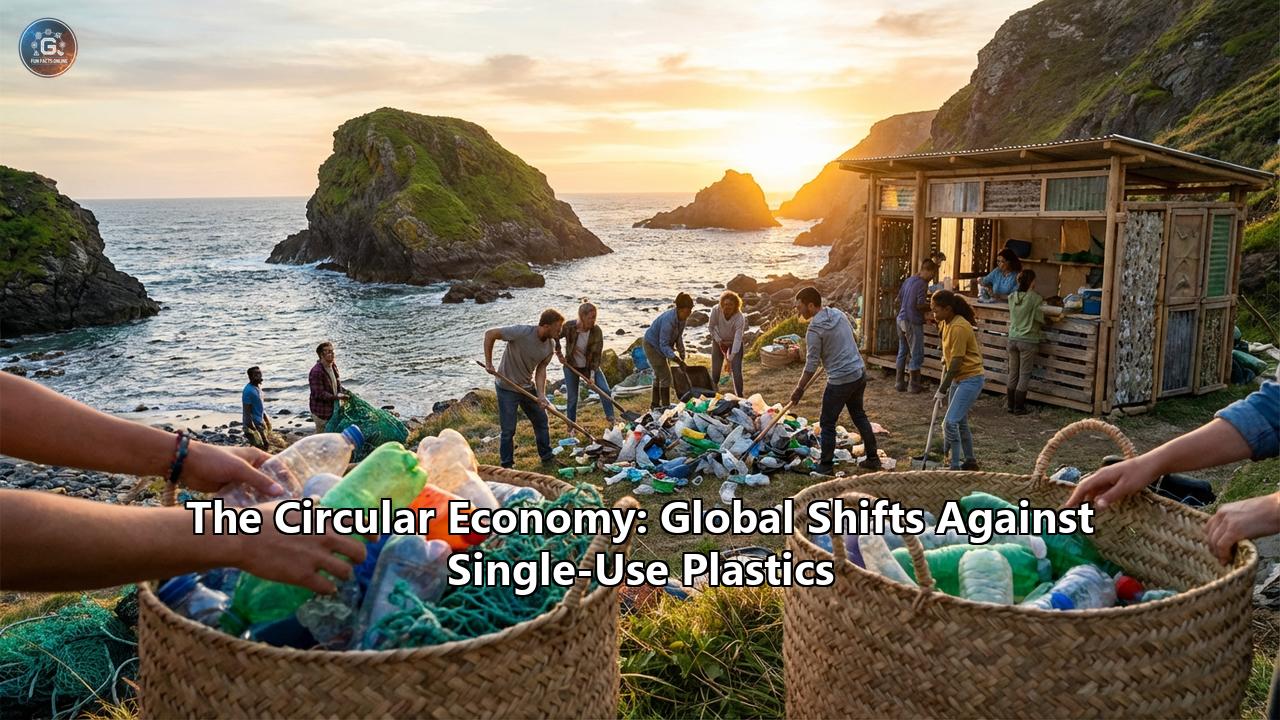
The year is 2026. Walk into a supermarket in Paris, Nairobi, or Vancouver, and the aisles look different than they did just five years ago. The glistening walls of single-use plastic—shrink-wrapped cucumbers, polyethylene bags, and disposable clam-shells—are vanishing. In their place? Refill stations, compostable mushroom-based packaging, and “naked” produce.
This isn’t just a trend; it is the visible face of a profound economic metamorphosis. We are witnessing the death throes of the "Linear Economy"—the take-make-waste model that dominated the 20th century—and the messy, urgent birth of the Circular Economy.
As we stand in the mid-2020s, the global war against single-use plastics has shifted from polite suggestion to legislative mandate and corporate survival strategy. But the transition is far from smooth. From the stalemates of United Nations treaty negotiations to the innovative laboratories of small startups, the battle for a plastic-free future is being fought on every front.
This article dives deep into the state of the circular economy in 2026, exploring the geopolitical power plays, the technological breakthroughs, the grassroots rebellions, and the economic realities driving the world’s most critical shift.
Part 1: The Geopolitical Battlefield
The Global Plastics Treaty: A Historic Stalemate
The headline story of late 2025 was undoubtedly the dramatic conclusion—or lack thereof—of the UN Global Plastics Treaty negotiations. Following the intense sessions of INC-5.2 in Geneva, the world watched as diplomats sparred over the soul of the treaty.
The divide was stark. On one side, the High Ambition Coalition (including the EU, Canada, Rwanda, and Peru) pushed for a hard cap on global plastic production. Their argument was simple: we cannot recycle our way out of a crisis where production is set to triple by 2060. They demanded a “turn off the tap” approach, limiting the extraction of virgin fossil fuels for polymer creation.
Opposing them were the Petrochemical States, a bloc of major oil and gas producers who argued that the treaty should focus solely on waste management—cleanup and recycling—rather than production limits.
The result was a tense deadlock that has pushed negotiations well into 2026. However, this diplomatic "failure" paradoxically accelerated action at the national level. Frustrated by global gridlock, individual nations decided to go it alone.
The Rise of the "Ban Nations"
While diplomats argued in Geneva, national governments were busy legislating.
- Canada: By December 2025, Canada had fully implemented its comprehensive ban on the manufacture and import of six categories of single-use plastics, including checkout bags, cutlery, and stir sticks. The once-controversial policy has now become the new normal for Canadian consumers.
- The European Union: The EU continues to be the regulatory heavy-hitter. With the Circular Economy Act looming for 2026, the bloc is preparing to introduce "Digital Product Passports" (DPPs). These digital twins will track a plastic product's journey from creation to disposal, making "greenwashing" nearly impossible. If a company claims a bottle is recycled, the blockchain will prove it—or expose the lie.
- The African Vanguard: Often overlooked in Western media, African nations remain the pioneers of strict plastic control. Kenya and Rwanda have maintained and tightened their bans, with Kenya’s "plastic police" serving as a model for enforcement. In 2025, Nairobi has emerged not just as a policy leader, but as a hub for circular innovation, with local "recycling hubs" turning waste collection into a profitable, community-owned enterprise.
- Asia’s Awakening: China, once the world's dumping ground for plastic waste, has aggressively pivoted. Its "National Sword" policy has evolved into a domestic phase-out plan, with major cities banning non-biodegradable bags and straws. Meanwhile, Thailand has enacted a total ban on plastic waste imports as of 2025, forcing Western nations to deal with their own trash for the first time in decades.
Part 2: The Corporate Pivot
Adapt or Die
For the corporate world, the circular economy is no longer a CSR (Corporate Social Responsibility) slide in a pitch deck; it is a matter of survival. The cost of raw materials, combined with Extended Producer Responsibility (EPR) taxes—where companies pay for the disposal of their packaging—has flipped the economic script.
The Giants Move:- Google achieved a milestone in 2025, reaching its goal of plastic-free packaging for its hardware products. The "unboxing" experience of a Pixel phone is now a masterclass in molded fiber and paper engineering.
- Amazon responded to massive consumer pressure by eliminating plastic air pillows in North America, replacing billions of plastic bladders with recycled paper filler. It’s a low-tech swap with a high-impact result, removing nearly 15 billion plastic units from the waste stream annually.
- IKEA continues to redefine retail with its "Buy Back & Resell" service, effectively becoming a second-hand furniture dealer for its own products. By keeping Billy bookcases and Poäng chairs in circulation, they are decoupling profit from resource extraction.
The SME Revolution: Small Players, Big Shifts
While the giants grab headlines, Small and Medium Enterprises (SMEs) are the true laboratories of the circular economy. They are agile enough to rebuild their business models from scratch.
- Case Study: Huskee (Australia): This company didn't just make a reusable cup; they solved a waste problem for the coffee industry. Their cups are made from coffee husks, a waste by-product of coffee processing. By turning trash into a durable commodity, they exemplify the "closed-loop" ideal.
- Case Study: The New Factory: In the fashion world, textile waste is a massive pollutant. Startups like The New Factory are using new mechanical recycling tech to turn old denim and cotton directly into new yarn, bypassing the need for virgin cotton farming, which is water-intensive and pesticide-heavy.
- Case Study: Insutex: Construction is a notorious waste generator. Insutex has developed a method to compress textile waste—unwearable fast fashion—into high-grade thermal insulation panels for homes. Your old t-shirt is now keeping a house warm.
Transitioning isn't free. Research from 2025 indicates that SMEs face significant upfront barriers: the cost of new machinery, the logistics of "take-back" schemes, and a lack of access to "green finance." However, the payoff is real. Data suggests that businesses fully adopting circular models are seeing profit margin increases of 23% within three years, driven by lower material costs and fierce customer loyalty.
Part 3: The Innovation Engine
Technology Saving Us from Ourselves
We cannot ban our way to a perfect world; we need to invent our way there. The technology of 2026 is finally catching up to our ambitions.
1. Chemical Recycling 2.0:Mechanical recycling (grinding plastic into flakes) has limits; eventually, the plastic degrades. Enter advanced chemical recycling (depolymerization). Companies are now scaling reactors that break plastic down to its molecular level—monomers—allowing it to be rebuilt into "virgin-quality" plastic infinitely. While energy-intensive, new catalysts developed in 2025 have significantly lowered the carbon footprint of this process.
2. AI-Powered Sorting:The "Wish-cycling" era—where we toss everything in the blue bin and hope for the best—is ending. New Materials Recovery Facilities (MRFs) are deploying AI-powered optical sorters. These robots can distinguish between a food-grade PET bottle and a non-food HDPE container in milliseconds, blasting them into separate bins with jets of air. This purity is crucial for creating a market for recycled materials.
3. The Bioplastic Renaissance:Forget the "corn plastic" of the 2010s that melted in the sun. The new wave of bioplastics is derived from algae, fungi (mycelium), and seaweed.
- Notpla, a UK-based innovator, has normalized edible, seaweed-based packaging for sauces and beverages.
- Mycelium packaging is replacing Styrofoam. Grown in molds, mushroom roots digest agricultural waste to form sturdy, shock-absorbing shapes that compost in your garden in 45 days.
Imagine scanning a QR code on a jacket and seeing its entire life history: the farm where the cotton grew, the factory where it was sewn, and the instructions for how to repair or recycle it. DPPs are turning products into data points, creating transparency that forces accountability.
Part 4: The Human Element
Grassroots Power and Consumer Psychology
The shift to a circular economy is not just happening in boardrooms; it’s happening in living rooms.
The "Eco-Anxiety" Pivot:For Gen Z and Millennials, the climate crisis is personal. "Eco-anxiety" has morphed into "Eco-action." Consumer psychology reports from 2025 show a tipping point: a majority of shoppers under 40 are now willing to pay a premium for verified sustainable products—and, crucially, are boycotting brands that fail the transparency test.
Community-Led Models:- Plastic Free July: What started as a small initiative has exploded. In 2025, participation hit 174 million people globally. It’s no longer just about refusing a straw; it’s a month-long training camp for a low-waste lifestyle that permanently alters consumer habits.
- Sharjah Sustainable City (UAE): This development is proving that circular living can be built into the urban fabric. With community biodomes for food, waste-to-energy plants, and strict single-use bans within the community, it’s a living laboratory for the post-plastic city.
- Philly Unwrapped (USA): A grassroots coalition in Philadelphia is helping local businesses transition away from disposables. By bulk-buying compostable wares and setting up city-wide reusable container networks, they are proving that "zero waste" is possible even in a grimy, busy American metropolis.
Part 5: The Economic Case
The $4.5 Trillion Opportunity
For years, economists argued that saving the planet was "too expensive." The data now proves the opposite. The "Linear Economy" is leaking money. Every time a plastic bottle is buried in a landfill, its economic value is destroyed.
The circular economy recovers that value. Estimates now peg the potential economic benefit of the circular transition at $4.5 trillion by 2030.
Where is the money coming from?- Material Savings: Companies spending less on virgin raw materials.
- New Markets: The rental, repair, and resale markets are booming.
- Job Creation: You cannot automate the repair of a vintage jacket or the refurbishment of an iPhone as easily as you can automate a manufacturing line. The circular economy is labor-intensive in a good way, creating skilled "green jobs" in local communities—from "refurbishment managers" to "urban miners" who extract rare earth metals from e-waste.
Conversely, the cost of doing nothing is skyrocketing. With carbon taxes increasing and insurance premiums rising due to climate instability, staying linear is becoming a financial liability. The "pollution premium" is real, and businesses that ignore it are seeing their stock prices punished.
Conclusion: The Inevitable Turn
As we look toward 2030, the trajectory is clear. The era of single-use plastic is not ending because we suddenly became altruistic; it is ending because it is no longer chemically, politically, or economically viable.
The Circular Economy is no longer a utopian dream. It is a messy, difficult, necessary reality being built day by day. It is built by the Kenyan entrepreneur turning trash into bricks, the Parisian shopper bringing their own jars, the Canadian legislator banning bags, and the AI robot sorting waste in a factory in Ohio.
We are leaving the age of "Disposable." We are entering the age of "Valuable." The shift is global, it is accelerating, and there is no turning back.
Reference:
- https://www.earthday.org/campaign/end-plastics/
- https://vietnamnews.vn/environment/1720235/community-works-together-to-reduce-plastic-waste-for-a-greener-future.html
- https://circulareconomysummit.com.au/content/article-waste-profit-your-guide-successfully-transitioning-circular-business-model
- https://empact.nu/en/insights/the-business-case-for-circular-economy-from-cost-to-profit-model/
- https://www.aiu.edu/blog/helping-the-community-with-plastic-waste-a-path-to-a-cleaner-future/
- https://climatepromise.undp.org/news-and-stories/transitioning-circular-economy-future-we-cannot-afford-delay
- https://afors.org/2025/01/22/sustainability-tip-go-plastic-free-in-2025-simple-swaps/
- https://www.greenpolicyplatform.org/sites/default/files/downloads/resource/GreenEconet_CEPS_SMEs_Circular_Economy.pdf
- https://plasticfreefoundation.net/our-impact/2025-report/
- https://www.sharjahsustainablecity.ae/news/why-community-led-solutions-are-our-best-bet-against-plastic-pollution/
- https://ecoskills.academy/circular-economy-in-business-cases-strategies/