
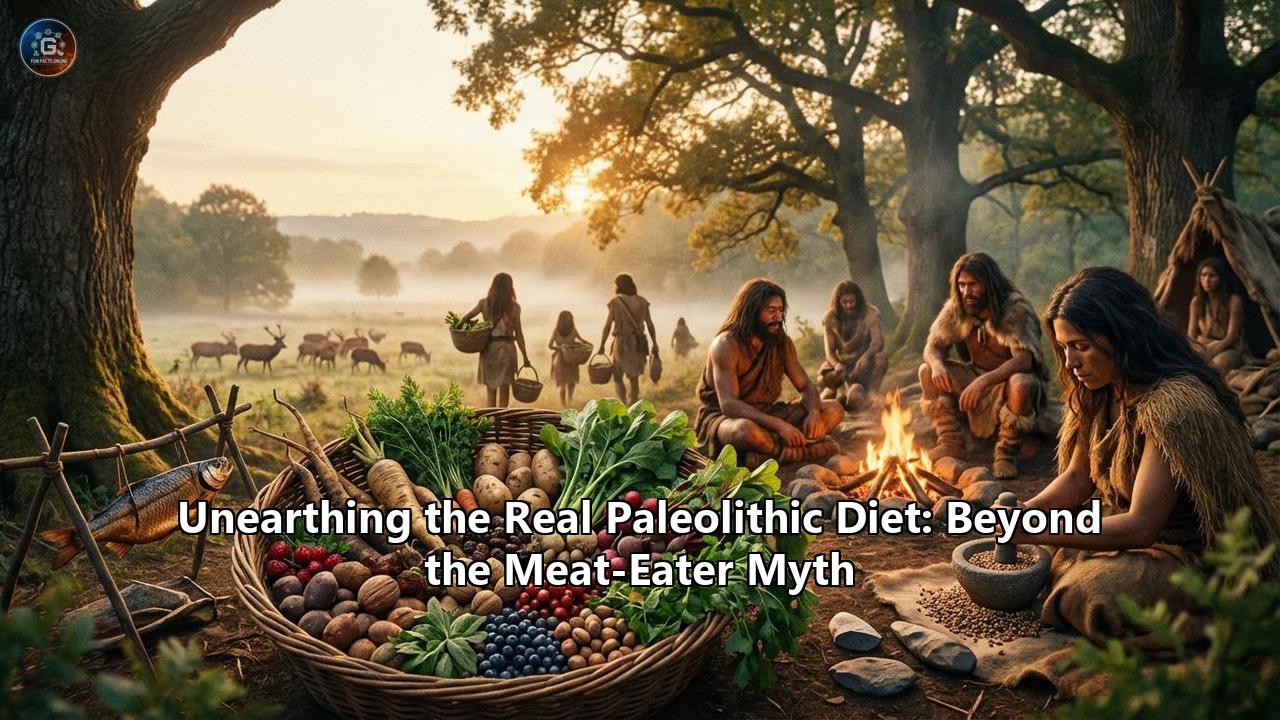
Picture a Paleolithic human. If the prevailing winds of modern diet culture and pop-history are to be believed, you likely envisioned a rugged, spear-wielding man standing triumphantly over the freshly hunted carcass of a woolly mammoth. In this modern mythology, the prehistoric human was an apex predator, thriving on a strict, low-carbohydrate, high-protein diet of lean meats, entirely free from the "toxic" influences of grains, starches, legumes, and modern agriculture. This alluring image has spawned a massive dietary industry—valued at approximately $500 million in recent years—convincing millions that to achieve optimal health, we must return to the meat-heavy, carbohydrate-phobic eating habits of our Stone Age ancestors.
But what if the very foundation of this narrative is an illusion? What if the "caveman" was less of an obligate carnivore and more of an opportunistic botanist?
In recent decades, a paradigm shift in archaeology, anthropology, and paleogenetics has begun to completely rewrite the story of early human nutrition. Far from the meat-obsessed CrossFit warriors of modern marketing, our ancient ancestors were highly adaptable, flexible omnivores who relied just as heavily—if not more so—on gathered plants, roasted tubers, wild grains, and even early forms of bread. The real Paleolithic diet was not a monolith, nor was it a strict regimen. It was a vibrant, localized, and incredibly diverse tapestry of survival that challenges everything we thought we knew about human evolution.
The Tap Roots of the "Man the Hunter" Myth
To understand how we got the Paleolithic diet so wrong, we must look back to how early anthropology was conducted. For over a century, the story of human evolution was dominated by the "Man the Hunter" hypothesis. Formalized during a legendary 1966 symposium at the University of Chicago convened by anthropologists Richard Lee and Irven DeVore, this theory posited that hunting large game was the primary driver of human physical and cognitive evolution. Meat-eating, the theory went, provided the dense calories needed to fuel our expanding brains, while the complex coordination required for the hunt birthed language, society, and tool use.
This narrative, however, suffered from two massive blind spots: taphonomic bias and cultural projection.
Taphonomy is the study of how organisms decay and become fossilized. When archaeologists dig up a Pleistocene campsite, what do they find? They find stones and bones. Animal bones, especially those bearing the distinct cut marks of human stone tools, can survive in the earth for millions of years. Plant matter, on the other hand, is highly perishable. Tubers, leaves, berries, and wooden gathering tools disintegrate rapidly, leaving almost no visible trace in the fossil record. For generations, scientists looked at piles of butchered animal bones and concluded that meat made up the entirety of the prehistoric menu, simply because the vegetables had rotted away.
Furthermore, the "Man the Hunter" myth was heavily colored by the gender norms of the 19th and 20th centuries. The prevailing assumption was that men bravely hunted big game to provide for the community, while women passively gathered a few berries on the side. Recent archaeological and ethnographic evidence has thoroughly dismantled this. Modern studies of ancient burial sites across the Americas have revealed that 30% to 50% of big-game hunters were female, proving that hunting was a community-wide endeavor. More importantly, nutritional analyses of contemporary hunter-gatherer societies—which serve as our best living analogs to Paleolithic life—demonstrate that gathered plant foods often provide the vast majority of caloric intake. For instance, the Hadza people of Tanzania obtain up to 70% of their food from plant sources, including baobab fruit, berries, and tubers.
There is also a strict biological ceiling on the "meat-eater" myth: human physiology simply cannot handle a purely carnivorous terrestrial diet. If a human consumes more than 35% to 40% of their total daily calories from lean protein, they run into a metabolic limit. The liver cannot synthesize urea fast enough to clear the toxic byproducts of protein metabolism, leading to a dangerous condition known as protein toxicity, or "rabbit starvation". To survive, early humans had to pair meat with abundant sources of fat or, crucially, carbohydrates.
Dental Plaque: The Ultimate Time Capsule
If taphonomic bias erased the vegetables from the archaeological record, how do we know what our ancestors actually ate? The answer lies in one of the most unlikely places: ancient tooth grime.
Prehistoric humans did not have toothbrushes. Over a lifetime of eating, a sticky film of bacteria and food debris formed on their teeth. Eventually, this plaque hardened into dental calculus (tartar), a calcium phosphate mineral crust. As this mineral matrix formed, it trapped and entombed microscopic food particles, plant starches, pollen, and DNA. Today, scientists can extract this ancient calculus, dissolve it, and peer through a microscope to see exactly what a Paleolithic human was chewing on right before they died.
The discoveries pulled from fossilized dental plaque have been nothing short of revolutionary, particularly regarding Neanderthals. Long stereotyped as primitive, club-toting hyper-carnivores of the Ice Age, Neanderthals were actually sophisticated foragers with highly varied diets.
In 2017, researchers published a landmark study analyzing the dental plaque of Neanderthals from two drastically different environments: Spy Cave in Belgium and El Sidrón Cave in Spain. The Belgian Neanderthals, living in a frigid, steppe-like environment, indeed had a meat-heavy diet; their plaque contained the DNA of woolly rhinoceros and wild mouflon sheep, alongside evidence of mushroom consumption.
However, the Neanderthals from the El Sidrón cave in Spain told a completely different story. Their dental calculus contained almost no evidence of meat consumption. Instead, they were eating a highly vegetarian, forest-forager diet. Scientists found genetic traces of pine nuts, moss, mushrooms, and tree bark. Further research into Neanderthal teeth from Shanidar Cave in Iraq and other sites has revealed the consumption of date palms, water lily tubers, and wild legumes.
Perhaps most astonishingly, the dental plaque revealed that ancient humans understood the medicinal properties of plants. One Neanderthal from El Sidrón, who suffered from a visible dental abscess and a severe gastrointestinal parasite (Microsporidia), was found to have been self-medicating. His plaque contained traces of poplar bark—a natural source of salicylic acid, the active ingredient in modern aspirin—as well as Penicillium mold, the natural source of the antibiotic penicillin. Far from being mindless meat-eaters, our evolutionary cousins were deeply in tune with the botanical ecology of their environments, using plants for both sustenance and medicine.
The Starch Revolution and the Making of the Human Brain
One of the central tenets of the modern Paleo diet fad is the vilification of carbohydrates, specifically starches and grains. Proponents argue that our bodies are genetically mismatched to digest complex carbohydrates because humans supposedly did not consume them until the advent of farming 10,000 years ago. The archaeological and genetic evidence, however, tells a remarkably different story. Our ancestors were eating carbs, and our genes evolved to process them, hundreds of thousands of years before the first farm was ever sown.
The human brain is an incredibly energy-hungry organ, consuming up to 20% of the body's total energy budget, functioning almost exclusively on glucose. While fat and protein can be converted into glucose through a slow metabolic process, thriving in harsh Ice Age environments and fueling massive brain expansion required a more direct, dense source of carbohydrates. Enter: the humble tuber and the wild seed.
Our ability to unlock the energy in starchy plants comes down to a specific enzyme in our saliva called amylase, which begins breaking down complex carbohydrates into simple sugars the moment food enters our mouths. This enzyme is encoded by the AMY1 gene. Recent groundbreaking studies published in Science and Nature utilizing long-read DNA sequencing on ancient genomes have reconstructed the evolutionary history of the AMY1 locus. Researchers discovered that the amylase gene began duplicating itself in the hominin lineage over 700,000 to 800,000 years ago—long before anatomically modern humans even split from Neanderthals.
This gene duplication is a classic signature of adaptive evolution. Pre-agricultural hunter-gatherers analyzed from 45,000-year-old remains in Siberia already carried an average of four to eight copies of the AMY1 gene per cell, indicating that their bodies were heavily primed for a carbohydrate-rich diet. The genetic architecture to digest starches evolved precisely because early humans were actively seeking out and consuming starchy roots, tubers, and grains as a fundamental part of their survival strategy.
The archaeological record robustly backs up this genetic data. At the Middle Pleistocene site of Gesher Benot Ya'aqov in Israel, which dates back 780,000 years, researchers analyzed stone tools and found starch granules indicating that early hominins were actively processing and roasting acorns, water chestnuts, yellow water lily rhizomes, grass grains, and legume seeds.
Furthermore, the modern Paleo diet's strict ban on grains completely ignores the fact that ancient humans were essentially the first bakers. Researchers examining 30,000-year-old grinding stones from Paleolithic sites in Italy, Russia, and the Czech Republic discovered the earliest evidence of flour. Long before the agricultural revolution, hunter-gatherers were harvesting wild oats, barley grasses, and the highly starchy roots of cattail plants. They dried these roots, ground them into a fine flour using stone mortars, and cooked them into primitive, sweet-tasting flatbreads. The presence of chemical alterations in starch granules from Neanderthal teeth also proves that they were cooking these starches to make them more digestible and palatable. Carbohydrates were not an agricultural accident; they were a prehistoric staple.
The Myth of a Singular Diet: Opportunism and Adaptation
If there is one definitive truth about the "Paleolithic diet," it is that there is no single Paleolithic diet. The defining characteristic of the genus Homo is not a highly specialized digestive tract, but rather our unparalleled behavioral and dietary flexibility. We are the ultimate opportunistic omnivores.
What a Paleolithic human ate depended entirely on where they lived, the season, the climate, and what they could manage to forage, scavenge, or hunt without burning more calories than they consumed.
In the freezing, resource-scarce tundra of the Arctic, ancient diets heavily resembled those of the modern Inuit, relying almost exclusively on the fat and protein of marine mammals and caribou, simply because edible plant life was non-existent for most of the year. Conversely, human populations living near the equator in lush, tropical environments subsisted on diets heavily skewed toward vegetation. Indigenous groups in the Amazon and the Hadza of Tanzania utilize a vast pharmacopeia of wild fruits, nuts, seeds, and insects.
Interestingly, one of the most critical energy sources for ancient humans is completely shunned by modern Paleo enthusiasts: sugar, in the form of honey. Ethnographic studies reveal that honey is highly prized by nearly all modern hunter-gatherer societies. For the Hadza, honey can account for up to 20% of their annual caloric intake, and for the Jarawa people of the Andaman Islands, honey provides over 50% of their carbohydrates during certain seasons. Early humans went to extraordinary, often dangerous lengths to harvest wild honey, using smoke to pacify bees and climbing massive trees to secure this dense, energy-rich food.
Ancient humans also relied heavily on aquatic environments. Long before big-game hunting became a dominant cultural narrative, hominins were wading into shallow waters to collect mollusks, crabs, and kelp, or scavenging the remains of beached marine mammals. Neanderthals living near the coast of Gibraltar baked mollusks and regularly consumed seals. This coastal foraging provided essential Omega-3 fatty acids (like DHA), which are absolutely critical for brain development and maintenance.
The romanticized notion that early humans were casually picking out optimal macronutrient ratios is a modern fiction. Prehistoric people did not stress over whether their meal was "low-carb" or "grain-free." They ate whatever kept them from starving. If they managed to take down a mammoth, they gorged on meat and fat. If the hunt failed—which it frequently did—they relied on the reliable, carbohydrate-dense tubers, legumes, and grains gathered by the women and elders of the tribe.
Deconstructing the Modern Paleo Fad
The contemporary Paleolithic diet, popularized in the 21st century by best-selling books and wellness influencers, rests on the premise that our genetics have remained static since the Stone Age, and that the agricultural revolution introduced "foreign" foods (like dairy, beans, and grains) that our bodies are unequipped to handle. Science has thoroughly debunked this premise.
First, human evolution did not freeze in place 10,000 years ago. The sequencing of the human genome has proven that our DNA has continued to evolve rapidly in response to dietary shifts. The most famous example is lactase persistence. Prior to the domestication of cattle, almost all humans lost the ability to digest lactose (milk sugar) after weaning. However, as dairy farming took hold in Europe, parts of Africa, and the Middle East, genetic mutations that allowed adults to produce the lactase enzyme swept through these populations in an evolutionary blink of an eye. Similarly, the previously mentioned AMY1 amylase gene copy numbers skyrocketed as agricultural societies began relying even more heavily on starches. We are not genetically trapped in the Pleistocene.
Second, it is virtually impossible to eat a true "Paleolithic" diet in the modern world because the plants and animals available in your local supermarket did not exist in the Stone Age. Every piece of produce we consume today is the product of thousands of years of intensive agricultural selective breeding. Wild paleolithic tubers were woody, fibrous, and bitter, bearing little resemblance to the plump, starchy modern potato or sweet potato. The wild ancestors of modern fruits were small, packed with seeds, and much lower in sugar. Broccoli, kale, cabbage, and Brussels sprouts did not exist in the Paleolithic era—they are all human-engineered cultivars of a single species of wild mustard weed (Brassica oleracea).
The meats recommended by modern Paleo diets also fall short of prehistoric reality. A pasture-raised cow or a factory-farmed chicken has a completely different fat profile, muscle density, and Omega-3 to Omega-6 ratio compared to a wild Pleistocene reindeer or an ancient wild boar. Even the most diligently sourced grass-fed beef is still an agriculturally domesticated product.
Finally, the modern Paleo movement often packages its dietary advice with the idealized notion of a prehistoric health utopia—the idea that ancient humans lived disease-free lives in perfect harmony with nature, only to have our health ruined by modern agriculture. The truth of the Paleolithic era is much grittier. While they were largely free of modern sedentary diseases like Type 2 diabetes, early humans endured massive infant mortality rates, frequent periods of starvation, and relentless burdens of infectious diseases and parasites. Surviving past the age of 40 was an achievement, and those who did often lived with worn-down teeth from chewing dirt-covered roots and breathing smoke from indoor cooking fires.
Lessons from our True Ancestral Diet
If the modern Paleo diet is based on a myth, does that mean we should discard the concept of looking to our ancestors for nutritional guidance? Not entirely. While the rigid rules against legumes, whole grains, and starches are scientifically baseless, the broader strokes of how early humans ate still offer profound lessons for navigating today’s hyper-processed food landscape.
The true dietary legacy of our Paleolithic ancestors can be distilled into a few core principles:
1. Whole Foods and Minimal Processing: Whether it was a piece of mammoth meat, a roasted water lily tuber, or a handful of wild almonds, prehistoric food was eaten in its whole matrix. The fiber, water, and micronutrients were all intact. The real danger of the modern Western diet is not the presence of carbohydrates, but the presence of ultra-processed, acellular carbohydrates—refined flours and added sugars stripped of their natural fiber and nutrients. 2. Incredible Dietary Diversity: Ancient hunter-gatherers consumed hundreds of different plant species over the course of a year. This immense botanical diversity fed a rich and robust gut microbiome. Modern humans, by contrast, rely on a terrifyingly narrow band of staple crops (primarily corn, wheat, soy, and rice). Expanding the variety of plants, mushrooms, nuts, and seeds we eat is one of the most authentically "Paleolithic" things we can do for our digestive health. 3. High Fiber Consumption: Because wild plants are much tougher and more fibrous than domesticated crops, prehistoric humans consumed staggering amounts of dietary fiber—often upwards of 100 grams per day, compared to the paltry 15 grams averaged by modern adults. This fiber slowed digestion, regulated blood sugar, and sustained the symbiotic bacteria in the gut. 4. Seasonality and Opportunism: Our ancestors ate what was in season. They experienced periods of caloric abundance (such as a late-summer fruit harvest or a successful large-game hunt) and periods of caloric scarcity (late winter). This natural fluctuation may have provided metabolic benefits, aligning with modern research into the potential benefits of intermittent fasting and seasonal eating.Ultimately, the most defining trait of the real Paleolithic diet is the very trait that made humans the most successful species on the planet: adaptability. We survived the Ice Ages, expanded across arid deserts, and navigated dense jungles not because we evolved to eat one specific menu of meat and vegetables, but because we evolved to eat almost anything.
The "Man the Hunter" is a compelling story, but it is merely a shadow of a much richer history. The true story of our ancestors involves women digging for tubers, communities cooperating to gather wild grain, the slow roasting of root vegetables over an open fire, and the ingenious use of medicinal barks. To truly eat like a Paleolithic human is not to enforce a rigid, meat-heavy dogma, but to embrace a diverse, omnivorous, and endlessly adaptable relationship with the natural world.
Reference:
- https://www.ncbi.nlm.nih.gov/books/NBK482457/
- https://www.mayoclinic.org/healthy-lifestyle/nutrition-and-healthy-eating/in-depth/paleo-diet/art-20111182
- https://en.wikipedia.org/wiki/Paleolithic_diet
- https://www.thewholehealthpractice.com/post/rethinking-the-paleo-diet-what-science-really-tells-us
- https://projects.research-and-innovation.ec.europa.eu/en/horizon-magazine/how-stone-age-humans-unlocked-glucose-plants
- https://medium.com/@schagi/the-myth-of-the-paleo-diet-what-our-ancestors-really-ate-49ba75064268
- https://www.reddit.com/r/Archaeology/comments/1hwi41n/archaeological_study_challenges_palaeo_diet/
- https://afan.ottenheimer.com/articles/myth_of_persistent_hunting
- https://newrepublic.com/article/161593/prehistoric-myth-work-james-suzman
- https://curious.science.org.au/people-medicine/what-did-neanderthals-eat
- https://www.smithsonianmag.com/science-nature/delving-neanderthal-dental-plaque-understand-how-they-lived-and-ate-180962449/
- https://insider.si.edu/2011/01/starch-grains-found-on-neandertal-teeth-helps-debunk-theory-their-extinction-was-caused-by-dietary-deficiencies/
- https://www.businessinsider.com/ancient-neanderthal-teeth-plaque-diet-2017-3
- https://bigthink.com/surprising-science/neanderthal-dental-plaque-reveals-a-lot-about-their-diet-medical-practices-and-love-life/
- https://pubmed.ncbi.nlm.nih.gov/38077078/
- https://gokcumenlab.org/publication/ancient-amy1-gene-duplications-primed-the-amylase-locus-for-adaptive-evolution-upon-the-onset-of-agriculture/
- https://www.discovermagazine.com/the-amy1-gene-variation-from-our-ancient-ancestors-may-explain-our-46708
- https://humantechnopole.it/en/news/the-evolutionary-history-of-amylase-genes-for-starch-digestion/
- https://www.researchgate.net/publication/376011209_Ancient_AMY1_gene_duplications_primed_the_amylase_locus_for_adaptive_evolution_upon_the_onset_of_agriculture