
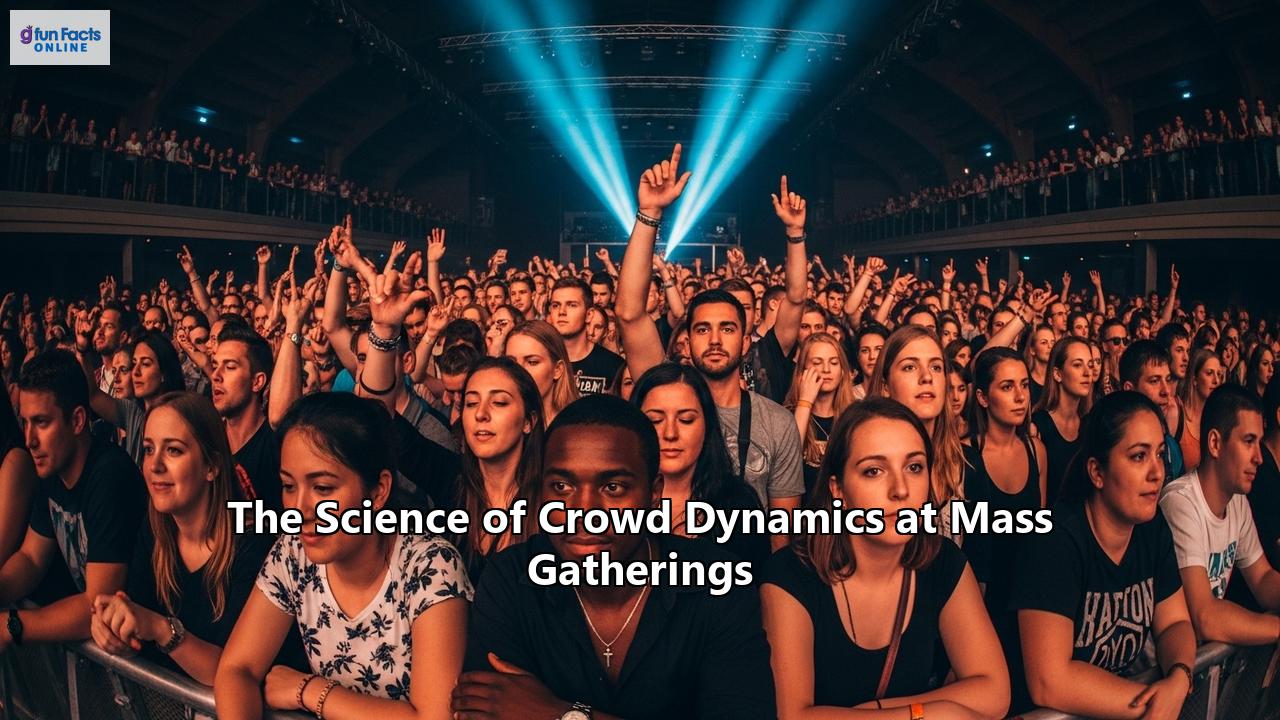
An invisible force flows through our cities, stadiums, and festival grounds. It’s a force that can be festive and unifying, but one that can also turn deadly in an instant. This force is the crowd, and the science of understanding its movements and behaviors is known as crowd dynamics. From the joyous celebrations of a World Cup victory to the tragic depths of a crowd crush, the principles of crowd dynamics are at play, governing the ebb and flow of humanity in mass gatherings.
The study of crowd dynamics is a multidisciplinary field, drawing on insights from physics, computer science, mathematics, psychology, and sociology to unravel the complex tapestry of collective human behavior. It’s a science that has been shaped by tragedy and honed by decades of research, with the ultimate goal of ensuring that when people gather, they can do so safely. This article will delve into the fascinating and often-misunderstood world of crowd dynamics, exploring its historical roots, the psychological drivers of crowd behavior, the mathematical models used to predict its movements, and the real-world applications that are making mass gatherings safer for everyone.
The Evolution of a Science: From Mob Psychology to Modern Models
The formal study of crowds began in the late 19th and early 20th centuries, a period of significant social and political upheaval in Europe. Early thinkers were often motivated by a fear of the "mob" and its perceived irrationality.
The Early Pathologists of the Crowd
One of the most influential early figures in crowd psychology was the French physician and anthropologist Gustave Le Bon. In his seminal 1895 work, The Crowd: A Study of the Popular Mind, Le Bon argued that when individuals become part of a crowd, they lose their sense of self and are subsumed into a "collective mind." This, he believed, led to a state of heightened suggestibility and emotionality, where rational thought is abandoned in favor of instinctual and often destructive behaviors. Le Bon's theory was heavily influenced by his witnessing of the Paris Commune of 1871, a revolutionary socialist government that briefly ruled Paris and was marked by significant civil unrest.
Le Bon proposed three key mechanisms through which the psychological crowd emerges:
- Submergence: The individual loses their sense of personal responsibility due to the anonymity of the crowd.
- Contagion: Emotions and ideas spread rapidly through the crowd, much like a virus.
- Suggestion: The crowd becomes highly susceptible to the influence of a charismatic leader or a powerful idea, acting with an almost hypnotic impulsivity.
Other early theorists, such as the Italian criminologist Scipio Sighele and the French sociologist Gabriel Tarde, also explored the darker side of crowd behavior, focusing on its criminal potential. Their work was part of a broader debate about how to assign criminal responsibility within a crowd and who should be held accountable for its actions.
These early theories, while influential, were largely based on observation and anecdote rather than empirical research. They painted a picture of the crowd as a primitive, irrational, and dangerous entity, a view that would persist for many years.
Shifting Perspectives: Towards a More Nuanced Understanding
It wasn't until the mid-20th century that a more nuanced understanding of crowd behavior began to emerge. Researchers started to question the idea that crowds were inherently pathological, recognizing that they could also be a force for positive social change.
One of the key shifts in thinking came with the development of deindividuation theory. First proposed by Leon Festinger, Albert Pepitone, and Theodore Newcomb in 1952, this theory suggests that being in a crowd can lead to a loss of self-awareness and a reduced concern for social evaluation. This can lower inhibitions and make individuals more likely to engage in behaviors they wouldn't normally consider, both positive and negative. While deindividuation can contribute to antisocial behavior, it can also foster a sense of unity and shared purpose.
Another important development was emergent norm theory, which posits that crowds are not initially unified in their thinking or behavior. Instead, norms of behavior emerge through a process of social interaction, with key individuals suggesting appropriate actions and others falling in line. This theory helps to explain how a crowd can develop a shared understanding of what is and isn't acceptable behavior in a given situation.
The Social Identity Revolution
The most significant leap forward in understanding the psychology of crowds came with the development of the social identity approach. Pioneered by Henri Tajfel and John Turner, social identity theory proposes that our sense of self is derived in part from our membership in social groups. We have a personal identity, but we also have multiple social identities that become more or less salient depending on the context.
When we are in a crowd, our shared social identity can become particularly prominent. This has several important consequences:
- Shared Beliefs and Values: We begin to see the world through the lens of our shared group identity, adopting its values and beliefs.
- Coordinated Action: Our shared identity allows us to coordinate our actions with other members of the group, even without explicit communication.
- Empowerment: Acting as a collective, we feel empowered to achieve our shared goals.
The social identity approach moves away from the idea that crowds are irrational and instead sees their behavior as a meaningful expression of their shared identity. For example, a protest crowd's actions are not random acts of violence but are often directed at specific targets that are seen as being in opposition to the group's values.
This perspective has been further developed in the elaborated social identity model (ESIM), which examines the intergroup dynamics of crowd events, particularly the interactions between crowds and police. The ESIM helps to explain how conflict can escalate or de-escalate depending on how each group perceives the other's actions and intentions.
The Physics of the Crowd: Mathematical and Computational Models
While psychology provides crucial insights into the "why" of crowd behavior, mathematics and computer science offer the tools to understand and predict the "how." By treating crowds as complex systems, researchers can model their movements and identify potential danger points before they occur.
From Fluid Dynamics to Social Forces
One of the earliest and most intuitive ways to model a crowd is to treat it as a fluid. Just as water flows through a pipe, a crowd can be seen as a continuous medium, with its own density, pressure, and flow rate. This fluid dynamics approach is particularly useful for understanding large-scale crowd movements and identifying potential bottlenecks where congestion is likely to occur. However, it has its limitations, as it doesn't account for the individual decisions and interactions that shape crowd behavior.
A more sophisticated approach is the social force model, developed by physicist Dirk Helbing. This model treats each individual in the crowd as an agent who is subject to a variety of "forces." These are not physical forces in the traditional sense, but rather representations of the individual's motivations and social interactions.
The key forces in the social force model include:
- A driving force: This propels the individual towards their desired destination at a certain speed.
- Repulsive forces: These prevent individuals from colliding with each other and with obstacles in their environment.
- Attractive forces: These can model the tendency of people to form groups or be drawn to points of interest.
By simulating the interplay of these forces for every individual in a crowd, the social force model can reproduce a wide range of emergent crowd behaviors, such as the formation of lanes in opposing flows of pedestrian traffic and the "faster-is-slower" effect, where pushing and shoving in a panic situation can actually slow down the overall evacuation time.
Agent-Based Models and Cellular Automata
Building on the principles of the social force model, agent-based models (ABMs) have become a powerful tool for simulating crowd behavior. In an ABM, each individual is represented as an autonomous "agent" with their own set of rules and characteristics. These agents can be programmed with different levels of knowledge about their environment, different goals, and different behavioral tendencies. This allows for the simulation of heterogeneous crowds, where people have different ages, mobilities, and levels of familiarity with their surroundings.
Cellular automata (CA) are another computational approach used in crowd simulation. In a CA model, the environment is divided into a grid of cells, and each cell can be either occupied or empty. Simple rules govern how individuals move from one cell to another, taking into account factors like the presence of obstacles and other people. While simpler than ABMs, CA models can be computationally efficient and are particularly useful for simulating evacuations and other scenarios where the primary goal is to understand how a large number of people can move through a space.The Technology of Crowd Simulation
The development of these mathematical models has been paralleled by the creation of sophisticated software tools for crowd simulation. These tools allow architects, event planners, and safety officials to create virtual models of public spaces and test how they will perform under a variety of conditions.
Some of the leading crowd simulation software includes:
- Legion: This software is widely used for modeling pedestrian flows in complex environments like railway stations, airports, and stadiums. It uses an agent-based model that has been validated against real-world data to ensure its accuracy.
- Viswalk: This is another powerful pedestrian simulation tool that can model the interactions between pedestrians and vehicles. It uses the social force model to create realistic simulations of crowd behavior in a variety of settings.
- AnyLogic: This is a versatile simulation software that includes a dedicated Pedestrian Library for modeling crowd flows. It can be used to analyze everything from the efficiency of service points in a shopping mall to the effectiveness of evacuation plans in a public building.
- FDS+Evac: This is a specialized tool that combines a fire dynamics simulator (FDS) with an evacuation model. This allows for the simulation of how a fire will spread through a building and how people will react to the smoke and heat, providing a comprehensive tool for fire safety engineering.
These tools are not just for predicting how crowds will behave; they are also invaluable for understanding why they behave the way they do. By running simulations and visualizing the results, planners can gain insights into the complex dynamics of crowd movement and design safer and more efficient public spaces.
Lessons from Tragedy: Case Studies in Crowd Dynamics
The science of crowd dynamics has been tragically shaped by a series of disasters that have highlighted the devastating consequences of poor planning and a lack of understanding of crowd behavior. By studying these events, we can learn valuable lessons that can help to prevent similar tragedies in the future.
The Hillsborough Disaster: A Turning Point for Stadium Safety
On April 15, 1989, a devastating crowd crush occurred at Hillsborough Stadium in Sheffield, England, during an FA Cup semi-final match between Liverpool and Nottingham Forest. The disaster resulted in the deaths of 96 Liverpool fans and injured hundreds more.
The crush was caused by a combination of factors, including poor crowd management, a lack of communication between police and stadium officials, and a stadium design that was ill-equipped to handle the large number of fans who had gathered for the match. A key contributing factor was the decision to open an exit gate to relieve congestion outside the stadium, which led to a flood of fans into already overcrowded pens.
The Hillsborough disaster was a watershed moment for stadium safety in the United Kingdom and around the world. The subsequent Taylor Report led to sweeping changes in stadium design and crowd management, including the introduction of all-seater stadiums for top-tier football matches and a greater emphasis on the safety and well-being of spectators.
The Love Parade Disaster: A Failure of Planning
The Love Parade was a popular electronic dance music festival that was held annually in Germany. In 2010, the event was held in the city of Duisburg, and it ended in tragedy when a crowd crush on a ramp leading to the festival area resulted in the deaths of 21 people and injured over 650.
A subsequent analysis of the disaster revealed that the single entrance and exit ramp was a critical design flaw, creating a bottleneck that was unable to cope with the massive number of people who were trying to enter and leave the festival grounds. The situation was exacerbated by a lack of effective crowd management and communication, which led to a build-up of pressure on the ramp that eventually became fatal.
The Love Parade disaster serves as a stark reminder of the importance of proper planning and risk assessment for mass gatherings. It also highlights the phenomenon of "crowd turbulence" or "crowd quake," where the intense pressure in a dense crowd can lead to a domino effect of people falling and being crushed under the weight of those around them.
The Astroworld Festival Tragedy: A Modern-Day Catastrophe
In November 2021, a crowd surge at the Astroworld Festival in Houston, Texas, resulted in the deaths of 10 people and injured hundreds more. The incident occurred during a performance by the rapper Travis Scott, when a densely packed crowd surged towards the stage, causing a crush that left many people unable to breathe.
Investigations into the tragedy have revealed a number of contributing factors, including inadequate security, a lack of communication between event staff and emergency services, and a failure to stop the concert even after it was clear that people were in distress. The event's operational plan was also found to be lacking, with no specific protocols for dealing with a crowd surge.
The Astroworld tragedy has brought renewed attention to the dangers of crowd crushes at music festivals and other large-scale events. It has also highlighted the need for artists and event organizers to take a more proactive approach to crowd safety, including being prepared to stop a show if there are signs of distress in the crowd.
The Science of Success: Managing the World's Largest Crowds
While crowd disasters serve as a powerful reminder of the risks associated with mass gatherings, there are also many examples of successful crowd management at some of the world's largest and most challenging events.
The Hajj: A Masterclass in Crowd Management
The Hajj, the annual Islamic pilgrimage to Mecca in Saudi Arabia, is one of the largest mass gatherings in the world, with millions of people from over 190 countries participating each year. Managing a crowd of this size and diversity presents a unique set of challenges, but the Saudi authorities have developed a sophisticated system of crowd management that is widely regarded as a model of best practice.
Key elements of the Hajj crowd management strategy include:
- Advanced Technology: The use of surveillance cameras, drones, and mobile apps to monitor crowd movements in real-time and provide pilgrims with information and guidance.
- Infrastructure: The construction of massive infrastructure projects, such as the multi-level Jamarat Bridge for the stoning of the devil ritual, to increase capacity and improve crowd flow.
- Data-Driven Planning: The use of data analysis and simulation to predict crowd behavior and plan for a variety of contingencies.
- International Cooperation: Collaboration with countries around the world to ensure that pilgrims are well-prepared for the Hajj and are aware of the safety procedures.
The success of the Hajj crowd management strategy is a testament to the power of a comprehensive and data-driven approach to crowd safety. It demonstrates that with careful planning and the use of modern technology, it is possible to manage even the largest and most complex crowds safely and effectively.
The Olympic Games: A Global Showcase for Crowd Science
The Olympic Games are another example of a mega-event that requires a massive and sophisticated crowd management operation. The organizers of each Olympic Games work closely with crowd scientists and safety experts to develop a comprehensive plan for managing the millions of spectators, athletes, and officials who will be in attendance.
Crowd simulation software is used extensively in the planning of the Olympic Games to model the flow of people through venues, transport hubs, and public spaces. This allows planners to identify potential bottlenecks and test different crowd management strategies before the Games even begin.
During the Games, a combination of technology and trained personnel is used to monitor crowd movements and respond to any issues that may arise. This can include everything from using signs and public address systems to guide people to their seats to deploying security personnel to manage queues and prevent overcrowding.
The Future of Crowd Science: Towards a Safer and More Predictable World
The science of crowd dynamics is constantly evolving, with new technologies and research methods providing ever-more sophisticated tools for understanding and managing crowds.
One of the key areas of development is the use of real-time data to inform crowd management decisions. With the proliferation of smartphones and other mobile devices, it is now possible to collect vast amounts of data on how people are moving through a space. This data can be fed into simulation models to create a "digital twin" of a crowd, allowing for real-time predictions of how the crowd will behave and how it will respond to different interventions.
Virtual reality (VR) is also emerging as a powerful tool for crowd science. By immersing people in virtual crowds, researchers can study how they react to different situations, such as an emergency evacuation, in a safe and controlled environment. This can provide valuable insights into human behavior that can be used to improve the design of public spaces and the effectiveness of emergency procedures.
As our world becomes increasingly urbanized and interconnected, the need to understand and manage crowds will only become more important. By continuing to develop the science of crowd dynamics, we can create a future where mass gatherings are not just a source of joy and celebration, but are also safe and secure for everyone who participates. The invisible force of the crowd is a powerful one, but with the tools of science, we can learn to understand it, to respect it, and to ensure that it is always a force for good.
Reference:
- https://www.thorntontomasetti.com/capability/crowd-dynamics
- https://www.google.com/search?q=time+in+Sheffield,+GB
- https://atlas.co/gis-use-cases/crowd-simulation/
- https://en.wikipedia.org/wiki/Love_Parade_disaster
- https://royalsocietypublishing.org/doi/10.1098/rsif.2020.0116
- https://www.ajsp.net/research/Effectiveness%20of%20Crowd%20Forecasting%20and%20Crisis%20Management%20Techniques%20in%20Health%20Emergencies%20During%20Hajj_12.pdf
- https://ideas.repec.org/p/stz/wpaper/eth-rc-12-010.html
- https://www.unlikelyexplanation.com/post/astroworld-and-the-continuing-threat-of-crushes
- https://unb.com.bd/category/World/smart-hajj-how-saudi-arabia-is-innovating-crowd-management-for-pilgrims/161276
- https://www.emerald.com/insight/content/doi/10.1108/jpmd-10-2019-0090/full/html
- https://people.howstuffworks.com/astroworld-tragedy.htm
- https://publica-rest.fraunhofer.de/server/api/core/bitstreams/bdf67396-3884-428b-9f62-c6c31f6e9dbd/content
- https://www.gkstill.com/Support/WhyModel/dimice.html
- https://www.emro.who.int/media/news/beyond-the-spiritual-saudi-arabia-and-whos-partnership-to-ensure-safe-hajj-gatherings.html
- https://projects.research-and-innovation.ec.europa.eu/en/projects/success-stories/all/smart-crowd-evacuation-emergencies
- https://swoogo.events/blog/crowd-management-events/
- https://heinonline.org/hol-cgi-bin/get_pdf.cgi?handle=hein.journals/ucflaegs5§ion=12
- https://www.pbs.org/newshour/show/what-went-wrong-at-the-astroworld-festival-and-how-panic-played-a-role-in-the-crowd-surge
- https://www.gkstill.com/CV/PhD/Chapter2.html
- https://www.gkstill.com/CV/PhD/Chapter1.html
- https://e-space.mmu.ac.uk/625559/7/10-1108_JPMD-10-2019-0090.pdf
- https://evc.sa/en/crowd-management-in-hajj/
- https://www.ajsp.net/research/Evaluation%20of%20the%20Emergency%20Response%20System%20in%20Cases%20of%20Massive%20Crowds_13.pdf
- https://www.researchgate.net/publication/361127943_Crowd_Simulation_for_Urban_Planning
- https://www.crowdrisks.com/uploads/1/4/6/1/146195766/2000_still.pdf
- https://www.researchgate.net/figure/The-DIM-ICE-risk-model-the-Murrayfield-Stadium-project_fig1_340713731
- https://www.wiresfence.com/service/news/crowd%20control%20pane%20Case%20Studies.html
- https://condorsecurity.com/the-art-of-crowd-control-crowd-management-las-vegas/
- https://www.yalescientific.org/2013/05/mind-of-the-mob-the-geosimulation-of-crowd-control/
- https://www.athleticbusiness.com/operations/safety-security/article/15742643/how-a-better-understanding-of-crowd-dynamics-has-helped-keep-stadiums-safer
- https://arxiv.org/abs/1206.5856
- https://en.wikipedia.org/wiki/Astroworld_Festival_crowd_crush
- https://www.mdpi.com/2071-1050/12/17/7003
- https://www.u-tokyo.ac.jp/focus/en/features/z1304_00108.html
- https://dtcc.chalmers.se/crowd-movement-2/