
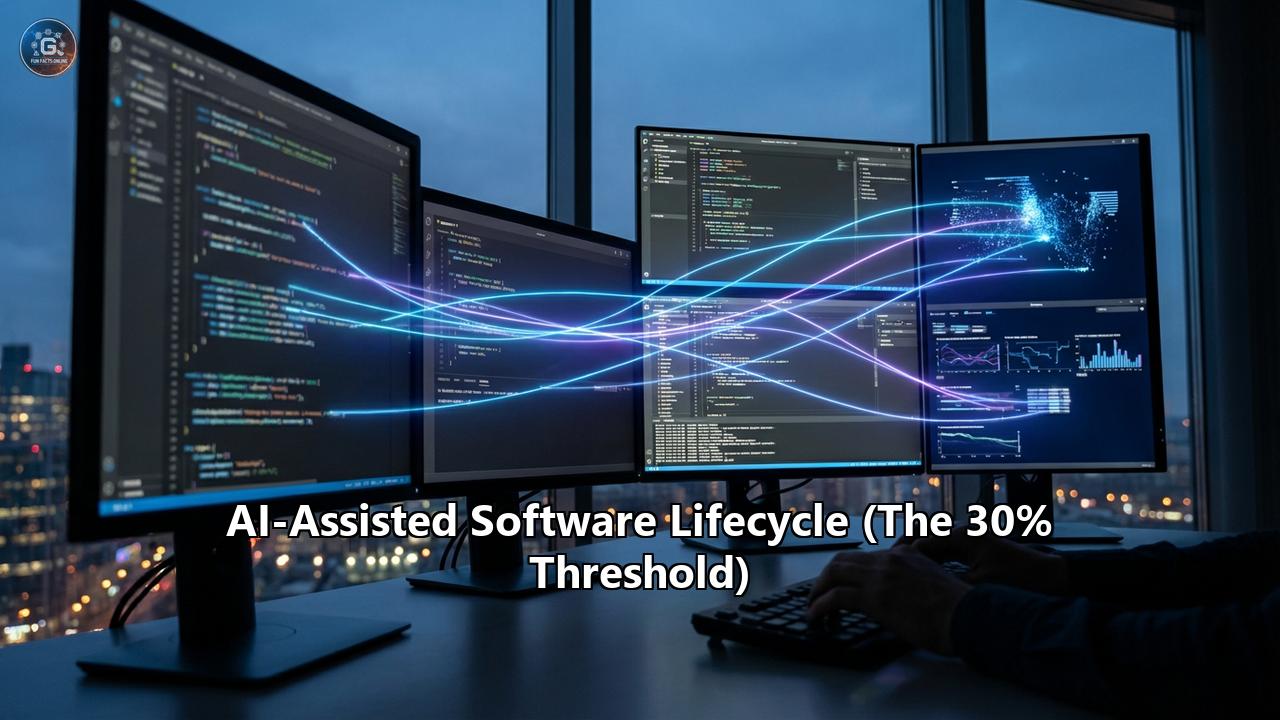
The software engineering landscape is currently navigating a tectonic shift, one that is not merely incremental but existential. We have arrived at a critical juncture that industry analysts and forward-thinking CTOs are increasingly referring to as "The 30% Threshold."
This threshold is not a single line in the sand; it is a multi-dimensional tipping point. It represents the moment where AI-generated code surpasses 30% of a repository’s volume, where productivity gains from AI tooling must exceed 30% to maintain market parity, and where the human developer's role shifts by at least 30% from syntax generation to semantic orchestration. Crossing this threshold fundamentally breaks the traditional Software Development Life Cycle (SDLC) and necessitates the birth of a new paradigm: the AI-Assisted Software Lifecycle (AI-SDLC).
This article explores the depths of this transformation, dissecting how every phase of software creation—from the first spark of an idea to the eternal loops of maintenance—is being rewritten. It is a guide for the architect, the engineer, and the leader standing on the precipice of this change, deciding whether to leap or be pushed.
Part I: The Anatomy of the 30% Threshold
To understand the gravity of the current moment, we must first quantify what the "30% Threshold" actually means in practice. It is the dividing line between experimentation and industrialization.
1. The Volume Metric: The Flood of SyntaxFor decades, the limiting factor in software production was the speed at which a human could think and type valid syntax. A proficient senior engineer might produce 50 to 100 lines of high-quality, debugged code per day. With Large Language Models (LLMs) integrated into IDEs (Integrated Development Environments) like VS Code via GitHub Copilot, Cursor, or proprietary enterprise assistants, that output has skyrocketed.
The threshold here is literal: when 30% of your codebase is written by AI, the "Reviewer’s Dilemma" kicks in. It is a well-known psychological phenomenon that it is harder to spot a subtle bug in code you read than in code you wrote. When AI writes the bulk of the boilerplate, the human developer transitions from a writer to an editor. If the editor is not hyper-vigilant, the codebase bloats with "looks-good-to-me" (LGTM) code—syntactically correct but structurally brittle.
2. The Efficiency Metric: The Competitive FloorEarly adopters of AI coding tools reported modest gains of 10-15%. However, as tools have matured from simple autocomplete to context-aware agents, the baseline has moved. The "30% Threshold" now refers to the minimum efficiency gain required to remain competitive. If your engineering team is not delivering features 30% faster (or delivering 30% more value) than they were three years ago, you are effectively operating at a loss relative to the market. This is not about firing developers; it is about the "Jevons Paradox" of software: as coding becomes cheaper, the demand for code increases. Companies that cross the 30% efficiency threshold don't reduce headcount; they tackle the backlog of features that were previously too expensive to build.
3. The Adoption Metric: The Cultural Tipping PointSociological studies on technology adoption suggest that when 30% of a population adopts a new norm, it creates a critical mass that forces the remaining majority to conform. In software teams, once 30% of engineers are proficient with AI workflows—using RAG (Retrieval-Augmented Generation) for documentation, prompting agents for refactoring, and auto-generating unit tests—the "old way" becomes visibly obsolete. The friction between AI-native developers and traditionalists becomes untenable, forcing a universal upskilling event.
Part II: The New Phase 1 — Planning & Requirements (The End of Ambiguity)
In the traditional Waterfall or even Agile models, the Requirements phase was a game of "telephone." Business stakeholders described a need, product managers wrote user stories, and engineers interpreted them. Misalignments were common and costly.
The AI IntermediaryIn the AI-SDLC, the 30% Threshold manifests here as a reduction in ambiguity. Generative AI acts as a "RequirementRefiner."
Imagine a Product Manager (PM) inputs a raw, messy paragraph about a new payment feature. An AI agent, trained on the company’s existing architecture and business rules, immediately parses this request. It doesn't just format it into a Jira ticket; it interrogates the PM.
- Agent: "You mentioned 'secure payments,' but our current gateway supports Stripe and PayPal. Do you intend to add a new provider, or stick to existing integrations?"
- Agent: "This feature conflicts with the logic defined in User Story #402 regarding subscription renewals. How should this conflict be resolved?"
Previously, a "feasibility spike" took a senior engineer three days of research. Now, an engineer can feed the requirements into an LLM with access to the codebase (via vector embeddings). The AI can perform a "Gap Analysis," identifying exactly which services need to change, which APIs need new endpoints, and where the potential "dragons" lie in the legacy code. The result is a 30-50% reduction in the "Planning Poker" estimation variance. We aren't guessing anymore; we are predicting based on deep structural analysis.
Part III: The New Phase 2 — Design & Architecture (From Blank Slate to Multi-Variant Prototyping)
The "Blank Page Syndrome" is the architect's enemy. Starting a system design from scratch is mentally taxing and prone to "availability bias"—architects stick to patterns they know, even if they aren't the best fit.
Generative ArchitectureIn the AI-Assisted lifecycle, the architect becomes a curator. Instead of drawing one system diagram, the architect prompts the AI: "Design a scalable microservices architecture for a real-time inventory system handling 50k transactions per second. Propose three variants: one optimizing for lowest latency, one for lowest cost on AWS, and one for maximum maintainability."
Within seconds, the AI generates three distinct PlantUML or Mermaid diagrams, complete with infrastructure-as-code (IaC) skeletons. The architect’s job shifts from drawing boxes to analyzing trade-offs. They might mix the latency optimization of Option A with the cost controls of Option B. The "30% Threshold" here is the volume of exploration. Architects can explore 30% more design space in the same amount of time, leading to more robust, future-proof systems.
The UI/UX AccelerationFor frontend development, the leap is even more visceral. Tools like V0 or Screenshot-to-Code allow designers to draw a napkin sketch, photograph it, and receive a working React/Tailwind component in return. The friction between Figma designs and working DOM elements is dissolving. The threshold is crossed when the "handover" involves the designer checking the AI's code rather than the developer interpreting the designer's pixels.
Part IV: The New Phase 3 — Coding (The Core Transformation)
This is where the battle for the soul of software engineering is being fought. The act of coding is changing from "manual transmission" to "self-driving with hands on the wheel."
The Hierarchy of AI AssistanceTo understand the AI coding workflow, we must distinguish between the levels of assistance:
- The Autocomplete (Tab-Complete): Predicting the next 3 words. Useful, but not transformative.
- The Copilot (Context-Aware): Predicting the next 10 lines based on the open file and imports. This is where most developers are today.
- The Agent (Task-Autonomous): The new frontier. "Refactor this entire class to use the Factory pattern and update all references in the project."
The biggest bottleneck for AI coding was context. If the AI didn't know about the UserAuth module in the other folder, it would hallucinate a new one. With the advent of massive context windows (1M+ tokens) and RAG techniques applied to codebases, the AI now "holds" the entire project in its working memory.
When a developer asks, "Where is the bug causing the checkout lag?", the AI doesn't just look at the open file. It traces the execution path through the frontend, the API layer, the middleware, and the database queries, identifying that a missing index in a SQL query is the culprit. This reduces "Time to Remediation" by far more than 30%.
The Problem of "Lazy Code"However, the 30% Threshold brings a dark side: "Lazy Code." Because generating code is so easy, developers are tempted to generate too much of it. Instead of creating a clever, reusable abstraction (which requires deep thought), it’s easier to let the AI copy-paste-modify a block 10 times.
This leads to a paradox: The Code Volume Inflation. A system that should be 10,000 lines might balloon to 15,000 lines because the AI favors verbosity over elegance. This inflation increases the surface area for bugs. Senior engineers must now police the density of the code. The new metric for code quality is not "Cyclomatic Complexity" but "Semantic Density"—how much value does each line of AI-generated code actually deliver?
Part V: The New Phase 4 — Testing & QA (The Safety Net)
If we are generating code at superhuman speeds, we must test it at superhuman speeds. The traditional "write code -> write test -> run test" loop is too slow for the AI-SDLC.
AI Writing Tests for AIOne of the most robust use cases for LLMs is unit test generation. LLMs excel at covering edge cases that humans forget. A human might test the "Happy Path" and one error state. The AI will test null inputs, massive integers, special characters, and race conditions.
The "30% Threshold" in QA is when the AI generates more test code than the humans generate production code. This sounds alarming, but it is necessary. We are moving toward Self-Healing Tests. When a UI element changes (e.g., a button ID shifts from #submit to #submit-btn), traditional Selenium/Cypress scripts fail. AI-driven testing agents detect the failure, analyze the DOM, realize the intent is the same, self-correct the selector, and pass the test.
Visual Regression and Synthetic DataAI is also revolutionizing the data used for testing. Instead of using scrubbed production data (which is a privacy risk), developers can ask an AI: "Generate a SQL script to populate the database with 10,000 users, distributed across 5 regions, with a 3% churn rate and 50 users having malformed addresses." The AI creates a statistically perfect synthetic dataset in seconds.
Part VI: The New Phase 5 — Deployment & Ops (AIOps)
The wall between Development and Operations (DevOps) has been crumbling for years; AI is vaporizing the rubble.
The Intelligent PipelineIn a traditional CI/CD pipeline, if a build fails, a developer reads the log, guesses the error, and pushes a fix. In the AI-SDLC, the pipeline is active.
- Scenario: The build fails on the CI server.
- AI Action: The CI agent parses the error log, identifies that a dependency version mismatch occurred in package.json, checks the breaking changes in the library's changelog, and automatically generates a Pull Request (PR) to fix the version number.
- Human Action: The developer receives a notification: "Build failed, but I fixed it. Please review PR #405."
The "30% Threshold" in Ops refers to resource optimization. Traditional autoscaling reacts to spikes in CPU or RAM. AIOps predicts them. By analyzing historical traffic patterns, marketing calendars, and even weather reports (for retail apps), the AI pre-scales the infrastructure 30 minutes before the traffic hits. This eliminates the "cold start" latency and prevents downtime.
Part VII: Maintenance & Legacy Modernization (The Billion-Dollar Opportunity)
The unsexy truth of software engineering is that we spend 70% of our time reading and maintaining old code. This is where AI delivers its highest ROI.
The COBOL to Cloud TranslationBanks and insurance companies are sitting on mainframes running COBOL code written in the 1980s. The engineers who wrote it are retired. AI is the "Rosetta Stone." It can ingest million-line legacy monoliths, explain the business logic in plain English, and propose a strangulation pattern to migrate it to Java or Go microservices.
The threshold here is Trust. We are approaching the point where the AI-translated code is reliable enough (with human verification) to replace critical infrastructure. We aren't fully there yet, but once the accuracy crosses the 99.9% mark, the Great Migration of legacy tech will begin in earnest.
Documentation that LivesDocumentation is usually the first thing to rot. In the AI-SDLC, documentation is not a static file; it is a dynamic query result. No one writes wikis anymore. The AI indexes the code and commit history. When a new hire asks, "How does the authentication flow work?", the AI generates a fresh, up-to-the-minute explanation based on the current code, not the wiki from 2021.
Part VIII: The Human Element — The Developer of 2030
So, where does this leave the human? If AI Plans, Designs, Codes, Tests, and Deploys, is the human obsolete?
Absolutely not. But the human role is unrecognizable.
From Syntax to SemanticsThe "30% Threshold" demands that developers shed the "typist" identity. The value of a developer is no longer their ability to recall the syntax for a useEffect hook in React. Their value is in their ability to reason about Systems, Security, and Semantics.
- Systems Thinking: Understanding how the AI-generated microservice interacts with the message bus and the data lake.
- Security Posture: Recognizing that the code the AI grabbed from a public repository might have a supply chain vulnerability.
- Semantic Intent: Ensuring the AI built what the user needs, not just what the prompt asked for.
We are seeing the emergence of a new role: the AI Orchestrator. This person manages a team of AI agents. They assign the "Frontend Agent" to build the UI, the "Backend Agent" to write the API, and the "QA Agent" to test it. They sit in the middle, reviewing the outputs, resolving conflicts between agents, and providing the "human taste" that ensures the product feels cohesive.
The Skill Gap CrisisThere is a massive risk of a "Junior Gap." If AI writes all the simple code, how do junior developers learn? We learn by struggling with syntax and simple bugs. If that struggle is removed, we risk raising a generation of "Senior" engineers who can prompt but cannot debug a system when the AI gets stuck. Companies must invent new ways to train juniors—perhaps by artificially disabling AI tools during "training hours" or focusing heavily on code review skills.
Part IX: The Risks — The "Lazy 30%" and Security Hallucinations
We cannot paint this picture without the shadows. The transition to the AI-SDLC is fraught with peril.
1. The Hallucination Supply ChainIf an AI hallucinates a package name (e.g., fast-json-parser-v2) and a developer runs npm install, they might be installing a malware package that a hacker created because they knew the AI would hallucinate it. This is "Package Hallucination Squatting." Security teams must now scan not just for known vulnerabilities, but for non-existent dependencies.
2. Intellectual Property (IP) LeaksWhen you paste your proprietary algorithm into a public LLM, who owns it? The "30% Threshold" of adoption cannot be crossed until legal teams are satisfied with the data privacy of the tools. This is driving the massive adoption of "Local LLMs" and "Private Cloud Instances" where the model is brought to the data, not the other way around.
3. The Homogenization of SoftwareIf everyone uses the same model to generate their UI, every app starts to look the same. The "Google Material Design" era made apps uniform; the "GPT Design" era could make them identical. Brands will need to fight harder to inject unique personality into their digital products.
Part X: Future Outlook — Beyond the Threshold
We are currently standing at the 30% mark. What happens when we hit 50% or 80%?
The Era of Agentic SoftwareWe are moving from "Chatbots" to "Agentic Workflows." A Chatbot answers a question. An Agent pursues a goal.
In the near future (1-3 years), a developer will say: "Fix all accessibility issues in the dashboard module."
The Agent will:
- Scan the code.
- Run an accessibility auditor (like Axe).
- Identify contrast errors and missing ARIA labels.
- Modify the CSS and HTML.
- Re-run the audit to verify the fix.
- Take screenshots of the before/after.
- Submit a Pull Request.
The human only sees step 7.
Software as a Fluid EntityEventually, software might stop being "compiled" in the traditional sense. We might move to Just-In-Time (JIT) App Generation. A user wants a tool to calculate their mortgage and visualize it against their stocks. Instead of downloading an app that was pre-written, an AI builds a micro-app specifically for that user, for that moment, and discards it when done. The SDLC collapses from months to milliseconds.
Conclusion: The Call to Adapt
The "30% Threshold" is not a warning; it is a reality. The software lifecycle has been irrevocably altered. The velocity of creation has decoupled from the limitations of human typing speed.
For organizations, the mandate is clear: Audit your lifecycle. Where are you below the 30% efficiency gain? Are your architects using generative design? Is your QA team using synthetic data? If not, you are building with stone tools in the bronze age.
For the individual developer, the message is empowering, yet urgent. The AI is not coming for your job—it is coming for the drudgery of your job. It wants to take the boilerplate, the unit tests, the documentation, and the legacy migrations off your plate. It offers you a trade: give up the syntax, and take up the system.
The engineers who accept this trade will not just survive the 30% Threshold; they will build the future that lies beyond it. The ones who refuse will find themselves maintaining the code of the past, slowly fading into obsolescence alongside the machines they refused to master.
The threshold is here. Step over.
Reference:
- https://medium.com/@safiausmani2k/age-of-ai-and-generative-technology-9071736e6592
- https://www.thehrdigest.com/software-engineers-need-to-consider-gartners-ai-upskilling-predictions/
- https://www.capgemini.com/wp-content/uploads/2024/10/WQR-24-MAIN-REPORT-CG.pdf
- https://economictimes.indiatimes.com/tech/artificial-intelligence/over-40-of-agentic-ai-projects-will-be-scrapped-by-2027-gartner-says/articleshow/122068315.cms?from=mdr
- https://metr.org/blog/2025-07-10-early-2025-ai-experienced-os-dev-study/
- https://medium.com/@b.lizdias/ai-coding-tools-productivity-game-changer-or-overhyped-assistant-2803c9d3d206
- https://www.youtube.com/watch?v=vDGU_PvhCKk
- https://softwarestrategiesblog.com/2024/01/24/gartner-predicts-ai-software-will-grow-to-297-billion-by-2027/
- https://pub.towardsai.net/delivery-delay-predictor-machine-learning-system-for-logistics-optimization-cb5c6d6cd49a