
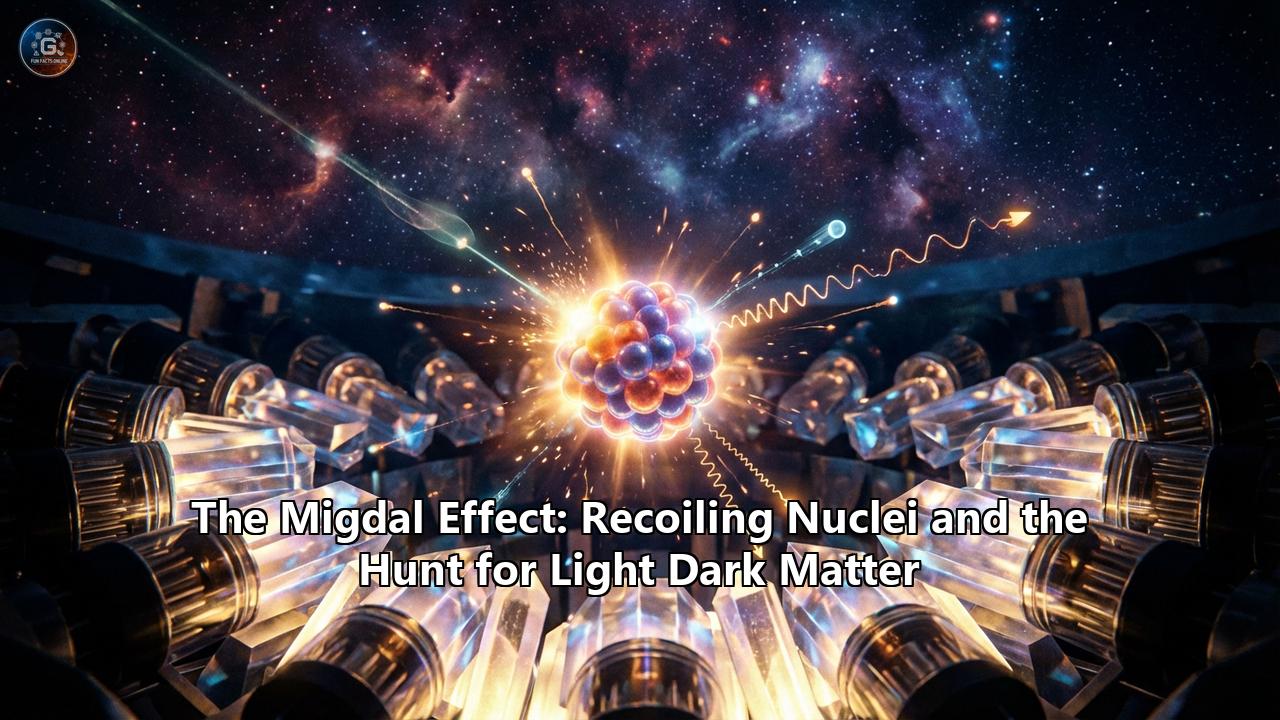
For decades, physicists have been staring into massive, ultra-pure vats of liquid xenon and argon buried deep within the Earth’s crust, waiting for a ghost to strike. The ghost in question is dark matter, the invisible scaffolding of the universe that binds galaxies together, yet steadfastly refuses to interact with light. According to standard cosmological models, dark matter particles are constantly streaming through our planet, our bodies, and our underground detectors. The hope has always been that, very occasionally, one of these phantom particles will collide head-on with an atomic nucleus in a detector, producing a tiny, measurable flash of light and a release of electric charge.
This paradigm, known as direct detection, was primarily built to hunt for Weakly Interacting Massive Particles (WIMPs)—heavyweight dark matter candidates packing enough mass to give a xenon atom a solid, detectable shove. But as the years have turned into decades and the giant vats have remained stubbornly quiet, a chilling realization has crept into the particle physics community: what if dark matter isn't a heavyweight bruiser? What if it is incredibly light?
If dark matter particles are "light"—with masses falling below a few gigaelectronvolts (GeV), perhaps closer to the mass of an electron than a whole atom—the traditional direct detection method hits a fundamental physical wall. A light dark matter particle bouncing off a massive xenon nucleus is like a ping-pong ball striking a bowling ball. The bowling ball barely moves, and the energy transferred is virtually zero. The resulting nuclear recoil falls well below the energy threshold of our most sensitive instruments, rendering the collision entirely invisible.
Enter the Migdal effect.
First predicted in 1939 by the brilliant Soviet theoretical physicist Arkady Migdal, this obscure quirk of quantum mechanics was originally a footnote in atomic theory. It describes what happens to the electron cloud of an atom when its nucleus is suddenly jolted. For over eighty years, it remained largely a theoretical curiosity. Today, however, it has become the sharpest new tool in the global hunt for dark matter, allowing physicists to effectively "amplify" the signal of ultra-light dark matter collisions. And in a historic milestone in January 2026, the effect was finally observed directly in a laboratory, shattering an 87-year-old wait and opening a vast new frontier in the dark universe.
To understand how a nearly forgotten quantum prediction from the eve of World War II is reshaping 21st-century astrophysics, we must first dive into the atomic scale and examine the kinematic nightmare of hunting for light dark matter.
The Kinematic Nightmare of the Dark Matter Hunt
The fundamental architecture of a dark matter detector relies on elastic scattering. Imagine a billiard table in the dark. You cannot see the cue ball (the dark matter), but you can hear and measure the impact when it strikes a target ball (the atomic nucleus). In detectors like XENON1T in Italy, LUX-ZEPLIN (LZ) in the United States, or PandaX in China, the target balls are tightly packed atoms of noble elements.
When a WIMP hits a target nucleus, the nucleus recoils. This kinetic energy is deposited into the surrounding medium in three primary ways: scintillation (flashes of light), ionization (freed electrons), and phonons (microscopic vibrations or heat). The detectors are heavily shielded by kilometers of rock to block out cosmic rays, leaving only the most elusive particles to trigger these incredibly faint signals.
The mathematics governing this collision are unforgiving. The maximum energy transfer between two colliding objects depends heavily on their mass ratio. If a dark matter particle weighs 100 GeV (roughly the mass of a silver atom), a collision with a xenon nucleus (mass ~131 GeV) is highly efficient. The energy transfer is substantial, yielding a robust, easily detectable signal.
However, if the dark matter particle weighs only 0.1 GeV (100 MeV), the mass mismatch is severe. The momentum of the dark matter is so low that the massive xenon nucleus barely registers the impact. The kinetic energy transferred to the nucleus is measured in fractions of a kiloelectronvolt (keV)—an amount of energy that simply dissipates as undetectable heat without ever freeing a single electron or producing a single photon of light.
For years, this kinematic wall meant that direct detection experiments were essentially blind to sub-GeV dark matter. To see lighter particles, physicists assumed they would have to completely abandon liquid noble gas targets and invent entirely new detector technologies based on superconductors or exotic crystal lattices with zero energy thresholds.
They were wrong. The target atoms had a secret weapon all along.
A Ghost from 1939: The Physics of "Electron Shake-off"
In the standard model of an atomic collision, physicists rely on the Born-Oppenheimer approximation. This principle assumes that because electrons are thousands of times lighter than the nucleus, they move incredibly fast—so fast that their quantum states adjust instantaneously to any movement of the central nucleus. If you kick the nucleus, the electron cloud is assumed to move with it perfectly, like a rigid shell.
In 1939, Arkady Migdal, a young student of the legendary physicist Lev Landau, realized that this assumption was not perfectly true.
Migdal pondered what would happen if a nucleus was subjected to a sudden, violent perturbation—for instance, during alpha or beta radioactive decay. He applied a concept known in quantum mechanics as the "sudden approximation". Migdal theorized that if a nucleus is abruptly accelerated, the electron cloud does not actually adjust instantly. There is a microscopic, fleeting lag. It takes time for the electrons to "catch up" to the recoiling nucleus.
In the frame of reference of the suddenly moving nucleus, the electron cloud appears to be forcefully pulled backward. This sudden relative motion acts as a shock to the atomic system. Migdal calculated that there is a small but mathematically definite probability that this shock will inject enough kinetic energy into the electron cloud to promote an electron to a higher energy shell (excitation) or strip it away entirely, ejecting it into the surrounding space (ionization).
This phenomenon came to be known as the Migdal effect, or "electron shake-off."
For decades, the Migdal effect was observed in the aftermath of radioactive decay, but it was largely ignored by the broader physics community when it came to external nuclear scattering. The probability of it happening during an elastic collision was simply too low to matter for standard nuclear physics. When a neutron or a heavy ion strikes an atom, the primary recoil of the nucleus is so energetic and obvious that nobody bothered to look for the tiny, rare "shake-off" electron trailing behind it.
Resurrecting the Theory for the Dark Matter Cause
Fast forward to the late 2010s. Theoretical physicists, desperately looking for ways to push the sensitivity of dark matter detectors below the 1 GeV mass threshold, began re-evaluating atomic physics. A landmark paper by Masahiro Ibe and colleagues reformulated Migdal's original 1939 calculations specifically in the context of dark matter-nucleus collisions.
The theoretical breakthrough was a masterstroke of lateral thinking. Yes, a 100 MeV dark matter particle will barely move a xenon nucleus, resulting in an undetectable nuclear recoil. But, if that undetectable collision triggers the Migdal effect, the atom will eject an electron.
Why does this matter? Because of the mass difference. Electrons are vanishingly light. When an electron is shaken off via the Migdal effect, it carries away a significant fraction of the interaction's energy, but because it is so light, it travels rapidly through the liquid xenon, ionizing other atoms and creating a massive, highly visible cascade of secondary electrons.
Unlike nuclear recoils—which lose most of their energy to invisible heat (phonons)—electronic recoils convert almost all of their energy into detectable charge and light.
The Migdal effect thus acts as an atomic amplifier. The primary collision (the dark matter hitting the nucleus) is totally invisible. But the secondary effect (the ejected electron) shines like a beacon. The community quickly realized that if they searched their existing detector data not for the traditional "bump" of a nuclear recoil, but for the distinct signature of an isolated, low-energy electronic recoil caused by the Migdal effect, they could lower their mass thresholds by orders of magnitude.
Data Mining the Dark Universe
Equipped with this resurrected quantum theory, the world’s leading dark matter collaborations raced to re-analyze their old data. They didn't need to build new multibillion-dollar detectors; they just needed to look at the data they already had through the lens of Arkady Migdal's math.
The XENON1T experiment, nestled deep beneath the Gran Sasso mountains in Italy, was the first major player to capitalize on this. Utilizing an "S2-only" analysis—focusing entirely on the ionization signal and ignoring the scintillation light to push their threshold as low as 1 keV—the XENON collaboration searched for the tell-tale spray of electrons predicted by the Migdal effect.
The results were spectacular. By including the Migdal probability in their models, XENON1T drastically extended its sensitivity, setting world-leading upper limits on dark matter particles with masses dipping all the way down to 85 MeV—a mass regime previously thought to be totally invisible to liquid noble detectors.
Other collaborations quickly followed suit. The SuperCDMS (Cryogenic Dark Matter Search) experiment, which utilizes ultra-cold germanium and silicon crystals, applied the Migdal framework to search for sub-GeV dark matter. Similarly, the EDELWEISS collaboration re-examined their data, using the combined response of the nucleus and its electron cloud to probe the low-mass dark matter parameter space.
Practically overnight, the Migdal effect became a pillar of modern dark matter astrophysics. Papers were published, new limits were drawn, and the theoretical boundaries of the unknown universe were pushed back.
The Skeptic’s Dilemma
However, there was an elephant in the room—and it was a massive one.
While physicists were confidently publishing sweeping exclusions of dark matter models based on the Migdal effect, the experimental foundation of the effect itself remained unproven in the context of nuclear scattering.
Yes, the math was beautiful. Yes, electron shake-off had been seen in radioactive decay. But despite being predicted in 1939, the Migdal effect had never been directly and unambiguously observed occurring from a neutral particle colliding with a nucleus.
This caused persistent unease within the scientific community. Dark matter experiments were relying on an atomic process to rule out the existence of fundamental particles, yet no one had actually verified that the process happened during elastic scattering in a laboratory. What if the Born-Oppenheimer approximation held stronger than Migdal thought? What if the complex multi-body interactions of a heavy xenon atom suppressed the shake-off probability? If the Migdal effect in nuclear scattering was a mathematical mirage, all the new sub-GeV dark matter limits would instantly crumble.
An experimental validation of the effect was desperately needed. No longer could astrophysics rely solely on theoretical trust; the Migdal effect had to be caught in the act.
The MIGDAL Experiment at RAL: Recreating the Unseen
To solve this crisis of empirical proof, a dedicated international collaboration was formed, simply named the MIGDAL experiment (Migdal In Galactic Dark mAtter expLoration). Situated at the Rutherford Appleton Laboratory (RAL) in the United Kingdom, specifically at the Neutron Irradiation Laboratory for Electronics (NILE) facility, this team set out to observe the unobservable.
Because nobody can generate a beam of dark matter in a lab, the MIGDAL collaboration used the next best thing: fast neutrons. Like dark matter, neutrons are electrically neutral. When they pass through a medium, they ignore the electron clouds and crash directly into the atomic nuclei. By firing an intense beam of neutrons into a detector, the physicists could perfectly simulate the physics of a dark matter collision.
The challenge was capturing the signature. A Migdal event is incredibly rare, and its visual footprint is vanishingly small. When the neutron strikes the nucleus, the nucleus recoils. If the Migdal effect occurs, an electron is ejected simultaneously from the exact same point in space.
To see this, the MIGDAL team constructed a highly specialized Optical Time Projection Chamber (OTPC). Unlike massive dark matter detectors filled with dense liquid xenon, the MIGDAL detector was a tabletop device filled with low-pressure carbon tetrafluoride (CF4) gas, operating at just 50 Torr (a fraction of normal atmospheric pressure).
The low pressure was the key. In a dense liquid, a recoiling nucleus and a low-energy electron would stop moving almost instantly, their tracks overlapping into an indistinguishable blob of light. But in a low-pressure gas, the particles could travel macroscopic distances—several millimeters—before coming to a halt.
The detector featured a stack of glass Gas Electron Multipliers (GEMs), a CMOS camera, and a photomultiplier tube. When a neutron struck a CF4 molecule, the camera waited for a very specific topological fingerprint: a microscopic "V" shape. One branch of the "V" would be a short, thick track representing the heavy recoiling nucleus, displaying high energy loss. The other branch would be a longer, thinner, meandering track representing the ejected Migdal electron. Because they originated from the exact same collision, the two tracks had to share a common vertex.
Armed with cutting-edge D-D (deuterium-deuterium) and D-T (deuterium-tritium) neutron generators, and utilizing advanced machine learning algorithms like YOLOv8 to sort through millions of particle tracks in real time, the collaboration began its hunt for the elusive "V".
The 2026 Breakthrough: A Prediction Confirmed
For years, the global community held its breath as various test runs and background calibrations took place. Distinguishing a true Migdal electron from ambient gamma radiation, cosmic rays, and standard instrumental noise required unprecedented precision.
Finally, the watershed moment arrived.
On January 15, 2026, a groundbreaking study was published in the journal Nature. A research team led by scientists from the University of Chinese Academy of Sciences (UCAS)—including corresponding scientist Professor Zheng Yangheng and Professor Liu Qian—announced the first-ever direct experimental observation of the Migdal effect in neutral-particle nuclear collisions.
Using a newly developed, ultra-sensitive detection system that combined a micro-pattern gas detector with a pixelated readout chip, the Chinese team effectively built a high-speed "quantum camera" capable of capturing the exact moment an electron is violently shaken free during atomic recoil.
Bombarding their detector's gas with a compact deuterium-deuterium neutron generator, the UCAS team scoured the data for the signature topological track. By meticulously mapping the ionization profiles, they successfully isolated the definitive pair of tracks—the recoiling nucleus and the ejected Migdal electron—originating from a single, shared vertex. They proved beyond a shadow of a doubt that the tracks were not artifacts of background gamma rays or cosmic radiation.
Eighty-seven years after Arkady Migdal first scribbled his sudden approximation calculations on a chalkboard, his theory was proven right.
"This study overcomes a long-standing threshold bottleneck in light dark matter detection," noted Professor Zheng Yangheng. He emphasized that for more than eight decades, the lack of direct experimental confirmation had left dark matter experiments vulnerable to persistent doubts. With this landmark observation, those doubts have been permanently erased.
The Dawn of a New Era in Astrophysics
The confirmation of the Migdal effect is far more than a triumph of historical atomic physics; it is the starting gun for the next generation of dark matter exploration. Now that the theoretical foundation is experimentally rock-solid, the particle physics community is rapidly moving to exploit the Migdal effect in ever more innovative ways.
Molecular Migdal and Directional Dark MatterRecent theoretical advancements have shown that the Migdal effect is not limited to isolated noble gas atoms; it also occurs in complex molecules and crystalline semiconductors. In molecules, the breaking of spherical symmetry introduces a "molecular Migdal effect." Because chemical bonds dictate electron distributions, the probability of electron shake-off depends on the angle at which the dark matter particle strikes the molecule. This anisotropy could allow future detectors to determine the direction from which dark matter is arriving. As the Earth rotates through the galactic dark matter halo, a directional Migdal detector would see a daily modulation in its signal—a smoking-gun signature of dark matter that would be impossible for local background radiation to mimic.
Semiconductor TargetsFurthermore, in semiconductors like silicon and germanium, the energy gap required to excite an electron is significantly lower than the ionization energy of a noble gas atom. The Migdal rate in these materials is exponentially higher, meaning detectors like SuperCDMS and SENSEI can use the effect to probe dark matter masses even deeper into the sub-MeV regime.
HydroX and Doped DetectorsOther boundary-pushing concepts include "HydroX"—doping massive liquid xenon detectors (like LZ) with hydrogen. Because hydrogen is so light, it acts as a much better kinematic match for light dark matter (solving the bowling-ball-and-ping-pong-ball problem). A light dark matter particle scattering off a hydrogen proton transfers much more energy. If that proton recoil subsequently triggers a Migdal-like electronic excitation in the surrounding xenon matrix, the signal is dramatically enhanced.
The Hunt ContinuesAs we look forward to the colossal next-generation detectors planned for the late 2020s and 2030s—such as DarkSide-20k, XLZD, and Argo—the Migdal effect will be programmed into their core analysis pipelines from day one. These multi-ton behemoths will no longer be restricted to the heavy WIMP paradigm.
The story of the Migdal effect is a testament to the beautiful, interwoven nature of physics. It proves that no scientific theory is ever truly obsolete. An obscure quantum correction, theorized during the dawn of nuclear physics to explain the behavior of radioactive isotopes, slumbered in the archives for the better part of a century. Today, it has been revived and empirically validated, serving as humanity's most powerful lens to illuminate the dark matter that holds the very cosmos together.
While the ghost of dark matter has not yet been caught, the 2026 confirmation of the Migdal effect ensures that the trap is now perfectly set. By finally understanding how an atom trembles when struck in the dark, we have moved one massive step closer to answering one of the deepest mysteries of the universe.
Reference:
- https://www.ppd.stfc.ac.uk/Pages/MIGDAL-Experiment.aspx
- https://xenonexperiment.org/search-for-light-dark-matter-interactions-enhanced-by-the-migdal-effect-in-xenon1t/
- https://migdal.pp.rl.ac.uk/about.html
- https://www.researchgate.net/publication/358942812_Exploiting_the_Migdal_effect_to_improve_the_sensitivity_to_light_dark_matter
- https://indico.global/event/12917/contributions/113447/attachments/52553/101030/Migdal_CYGNUS_meeting_JLN.pdf
- https://www.globaltimes.cn/page/202601/1353286.shtml
- https://news.cgtn.com/news/2026-01-15/Chinese-scientists-achieve-first-direct-observation-of-Migdal-effect-1JWWDW0mEmY/p.html
- https://pos.sissa.it/360/029/pdf
- https://arxiv.org/pdf/2208.09002
- https://www.osti.gov/servlets/purl/2203329
- https://indico.cern.ch/event/1283224/contributions/5590453/attachments/2725475/4736583/2023_10-cpan.pdf
- https://indico.global/event/6083/contributions/50052/contribution.pdf
- https://kclpure.kcl.ac.uk/portal/en/publications/the-migdal-experiment-measuring-a-rare-atomic-process-to-aid-the-/
- https://helda.helsinki.fi/bitstreams/7385f96e-1be4-4e14-a904-c39f7970a317/download
- https://findanexpert.unimelb.edu.au/scholarlywork/1886159-exploring-light-dark-matter-with-the-migdal-effect-in-hydrogen-doped-liquid-xenon