
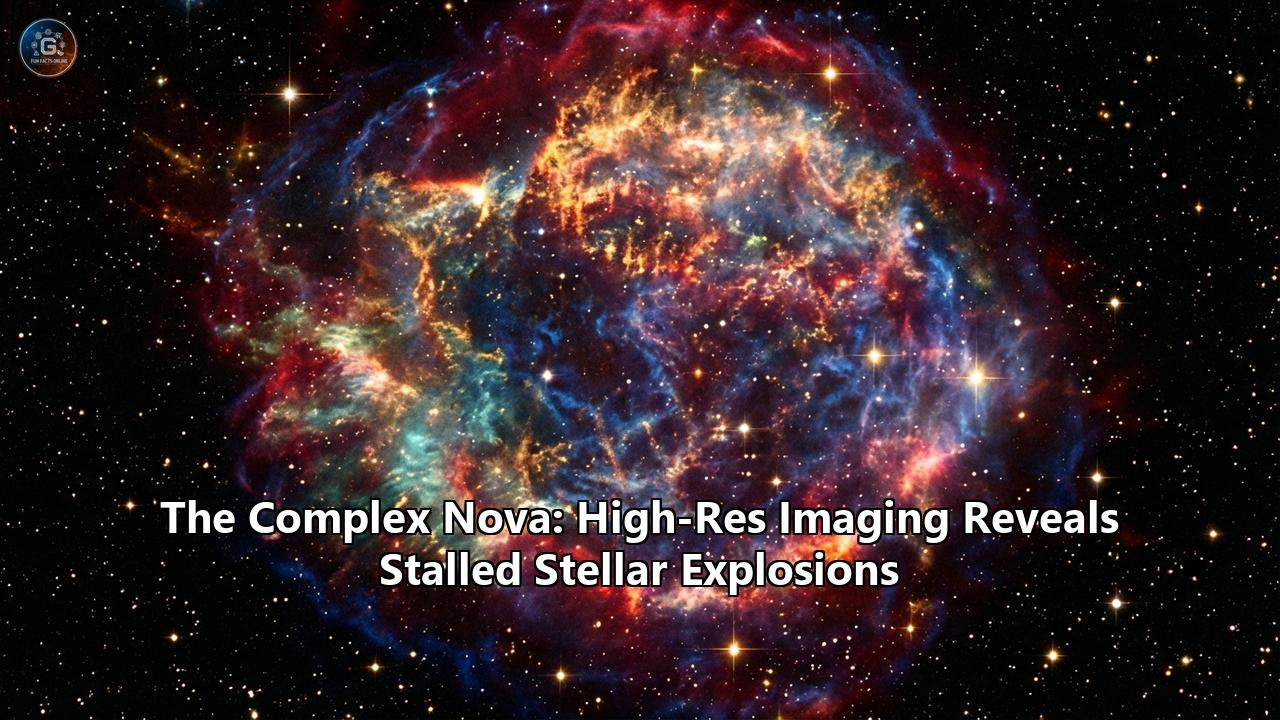
In the vast, silent theater of the cosmos, stars do not simply live and die; they perform. For centuries, astronomers have watched "guest stars"—novae—flare into brilliance and fade away, interpreting them as simple, violent hiccups in the lives of binary star systems. We believed we understood the script: a vampire star steals gas from a victim, wraps itself in a volatile blanket, and eventually sneezes it off in a spherical fireball. It was a neat, orderly picture of stellar pyrotechnics.
That picture has just been shattered.
Groundbreaking observations from the Center for High Angular Resolution Astronomy (CHARA) Array, released in late 2025, have peeled back the blinding glare of these explosions to reveal something far more chaotic, structural, and frankly, bizarre. We have now seen novae that do not just explode; they stall. We have witnessed fireballs that hesitate, waver, and trapped in a gravitational limbo for months before finally breaking free. We have imaged shock waves carving hourglass shapes into the void, and jets of plasma warring with each other in real-time.
This is the story of the "Complex Nova," a new paradigm in stellar astrophysics that suggests these common explosions are not merely nuclear flashes, but intricate, multi-stage engines that churn out the building blocks of the universe and serve as the most accessible laboratories for extreme physics we have ever found.
Part I: The Shattered Spheres
To understand why the new imaging is so revolutionary, we must first appreciate the "spherical cow" of the past. In theoretical physics, there is a running joke about simplifying problems by assuming a cow is a sphere to make the math easier. For decades, novae were our spherical cows.
A classical nova occurs in a binary system containing a white dwarf—the super-dense, Earth-sized corpse of a sun-like star—and a companion star, usually a red giant or a main-sequence star. Gravity acts as a siphon, pulling hydrogen-rich material from the companion onto the surface of the white dwarf. This material spirals down, forming an accretion disk, and eventually piles up on the white dwarf's surface.
Under the crushing gravity of the white dwarf, the pressure and temperature at the bottom of this hydrogen ocean climb until they hit a critical threshold (about 20 million Kelvin). At this point, the hydrogen ignites in a thermonuclear runaway. It is, effectively, a planet-sized hydrogen bomb. The energy released is enough to blow the accumulated atmosphere off the star at speeds of millions of miles per hour, causing the system to brighten by a factor of 100,000 or more.
For a long time, models assumed this ejection was roughly spherical—a bubble expanding evenly in all directions. Light curves (graphs of brightness over time) were interpreted as the cooling of this expanding ball of gas.
The Resolution Revolution
The problem with the "spherical cow" model wasn't that astronomers were lazy; it was that novae are incredibly far away. Even the closest are thousands of light-years distant. To a standard telescope, a nova is just a point of light—a single pixel that gets brighter and dimmer. We could study its spectrum (the rainbow of light split into colors) to learn about its chemistry and speed, but we couldn't see the shape of the explosion.
Enter the CHARA Array. Perched atop Mount Wilson in California, CHARA is not a single telescope, but a collection of six 1-meter telescopes spaced hundreds of meters apart. By combining their light using a technique called interferometry, the array acts like a single, massive telescope with a mirror spanning the distance between them. This gives CHARA the visual acuity to spot a dime in Tokyo from the vantage point of Los Angeles.
In late 2025, a team of international astronomers turned this high-resolution eye toward two novae that had erupted recently: V1405 Cassiopeiae and V1674 Herculis. What they saw effectively rewrote the textbook on stellar explosions.
Part II: The Tale of Two Novae
The two objects chosen for this study could not have been more different, and their divergence is what provided the smoking gun for the "Complex Nova" theory. One was a sprinter, the other a marathon runner. One was a clean shot, the other a messy, stalled disaster.
The Speed Demon: V1674 Herculis
V1674 Herculis exploded into our view with startling speed. It was a "fast nova," brightening and then fading away in a matter of days. In the old model, this would simply mean a very violent, energetic ejection.
But when CHARA looked at V1674 Her, it didn't see a sphere. It saw an hourglass.
The images revealed distinct streams of gas acting like jets, shooting out in perpendicular directions. It wasn't a single "poof" of gas; it was a structured, directional ejection. The gas flows were collimated, likely shaped by the interaction of the white dwarf's magnetic field and the accretion disk that surrounds it.
This structure was critical because it matched data coming from a completely different kind of instrument: the Fermi Gamma-ray Space Telescope. Fermi detects gamma rays, the most energetic form of light in the universe. For years, Fermi had been picking up gamma-ray signals from novae, a phenomenon that puzzled theorists. A simple fireball shouldn't produce high-energy gamma rays; those usually come from particle accelerators like black holes or supernova remnants.
The CHARA images of V1674 Her provided the missing link. The perpendicular jets were not moving into empty space; they were crashing into slower-moving debris from earlier phases of the eruption. These collisions created shocks—supersonic pressure waves that accelerated particles to near-light speed, generating the gamma rays Fermi observed. We were seeing, for the first time, the engine of a particle accelerator operating in real-time on the surface of a star.
The Stalled Giant: V1405 Cassiopeiae
If V1674 Her was the orderly (albeit violent) one, V1405 Cassiopeiae was the chaotic rebel. This nova, located in the constellation Cassiopeia, didn't follow the rules.
When a nova erupts, we expect the "common envelope"—the cloud of gas surrounding the binary pair—to be ejected almost immediately. The explosion triggers, the gas flies off, and we see the light.
V1405 Cas did not do this. The CHARA data showed that the explosion started, but the material... stayed. For an agonizing 50 days, the outer layers of the star remained bound to the system. The explosion had technically occurred—the nuclear fire was burning—but the ejection was "stalled."
Imagine a rocket engine igniting but the rocket failing to lift off, vibrating on the pad for nearly two months before finally launching. That is effectively what happened to V1405 Cas.
This "stall" phase is a revelation. It suggests that the energy of the thermonuclear runaway isn't always enough to instantly overcome the gravitational grip of the white dwarf and the friction of the companion star's envelope. The material churned, boiled, and circulated, trapped in a gravitational tug-of-war.
During this 50-day stall, the system was a maelstrom of activity. The white dwarf was likely orbiting inside this puffed-up, stalled cloud of fire. The friction from this motion—a star ploughing through a thermonuclear storm—injected extra energy into the gas. Only after weeks of this churning did the system finally build up enough energy to eject the shell in a massive, delayed release.
This finding explains a long-standing mystery: "slow novae" or "jittering" light curves. Astronomers had often seen novae that brightened, dimmed, brightened again, and took months to reach peak luminosity. We now know that these aren't just slow explosions; they are stalled explosions, struggling to break free from their own gravity.
Part III: The Physics of the Stall
To understand how an explosion as powerful as a hydrogen bomb can "stall," we have to dive into the extreme physics of the Common Envelope Phase.
In a binary system, the two stars are dancing around a common center of gravity. When the nova erupts, the ejected gas doesn't just fly into empty space; it has to navigate the complex gravitational environment of the two stars.
If the ejection speed is high enough (as in V1674 Her), the gas blasts past the companion star and escapes effortlessly. But in V1405 Cas, the ejection speed was initially lower, or the envelope was denser. The gas expanded but couldn't reach escape velocity. It formed a "common envelope"—a shared atmosphere engulfing both stars.
Inside this envelope, physics gets messy.
- Drag Forces: The companion star is now orbiting inside the gas cloud. This creates immense drag, like a hand waving through water. This drag transfers orbital energy (the motion of the stars) into heat energy in the gas.
- Shock Heating: The supersonic motion of the stars through the gas creates bow shocks, further heating the stalled envelope.
- The Breakout: Eventually, the added heat from the drag forces, combined with the continuous nuclear burning on the white dwarf's surface, provides the extra "kick" needed. The envelope expands past the critical point and is flung into space.
This 50-day delay in V1405 Cas is the first direct visual evidence of this "common envelope evolution" happening in real-time. It validates decades of theoretical models that suggested binaries could share and eject envelopes, a process that is also thought to be responsible for the formation of certain types of supernovae and binary black holes.
Part IV: The Shock Wave Paradigm
The discovery of stalled explosions and structured jets leads us to the most significant shift in nova science in fifty years: the Shock Wave Paradigm.
Historically, we thought the visible light of a nova came from the hot, glowing ball of gas cooling down—thermal emission. It turns out this is only half the story.
The "Complex Nova" findings, supported by earlier data from V906 Carinae (another well-studied nova), show that a huge fraction of the light we see—sometimes the majority of it—is powered by shocks.
Here is the mechanism:
- The Slow Flow: The nova begins with a relatively slow, dense ejection of gas (often the "stalled" phase).
- The Fast Wind: As the nuclear reaction on the white dwarf continues, it launches a faster, lighter wind of particles behind the initial slow cloud.
- The Collision: The fast wind catches up to the slow cloud and slams into it.
- The Shock: This collision creates a shock wave. The kinetic energy of the fast wind is instantly converted into heat and radiation (light) and gamma rays.
It’s like a car crash where the energy of motion is turned into the crunch of metal and heat. In a nova, the "crunch" releases visible light.
This realization has terrifying implications for our measurements. If a significant part of a nova's brightness comes from shocks (which depend on the angle and timing of collisions) rather than just the surface area of the fireball, our distance estimates to these stars might need refining. It also means that novae are far more efficient particle accelerators than we dreamed.
Part V: The Lithium Mystery
While the dynamics of the explosion are fascinating, the debris of these stalled explosions tells an even more fundamental story about our universe. The stalled churning of V1405 Cas turns out to be a cosmic kitchen mixing up a very specific recipe: Lithium.
Lithium is a problematic element for cosmologists. The Big Bang produced plenty of Hydrogen and Helium, and a tiny dash of Lithium. But when we look at the universe today, we see "too much" Lithium in some places and "too little" in others compared to our models. We call this the "Lithium Problem."
Where is the universe getting its fresh supply of Lithium? Stars destroy lithium in their cores (it burns at relatively low temperatures). So, normal stars deplete it, they don't create it.
The answer lies in the "Complex Nova."
Inside the thermonuclear runaway on the white dwarf, a reaction sequence called the pp-chains and the CNO cycle operates. One specific branch of this fusion creates an isotope called Beryllium-7. Beryllium-7 is unstable; it decays into Lithium-7 with a half-life of about 53 days.
If Beryllium-7 stayed deep in the hot star, it would capture a proton and burn into Helium. But in a nova, the explosion blasts the material out into space before it can burn. The Beryllium-7 is ejected into the cold void, where it can safely decay into Lithium-7 without being destroyed.
The "stalled" phase of V1405 Cas is particularly interesting here. The 50-day delay is suspiciously close to the 53-day half-life of Beryllium-7. The mixing and churning during the stall might play a crucial role in how much of this precious isotope survives or is destroyed.
Recent observations from the Subaru Telescope have confirmed the presence of massive amounts of Beryllium-7 in nova ejecta. This confirms that novae are the "Lithium Factories" of the galaxy. The battery in your smartphone likely contains atoms that were forged in the stalled, shocked throat of a white dwarf explosion billions of years ago.
Part VI: Looking to the Future
The high-resolution imaging of V1405 Cas and V1674 Her is just the beginning. The CHARA Array has proven that we can spatially resolve these explosions, turning them from points of light into geographic maps.
This opens up a new era of Time-Domain Interferometry. We are no longer just taking snapshots; we are making movies of stellar death.
What’s Next?- More Eyes: Future upgrades to CHARA and the European Southern Observatory's VLTI (Very Large Telescope Interferometer) will allow us to see even fainter novae, building a catalog of "stalled" vs. "fast" explosions.
- Supernova Precursors: By understanding how white dwarfs eject mass (or fail to), we gain insight into Type Ia Supernovae. These occur when a white dwarf gains too much mass and explodes completely, destroying the star. Does a "stalled" nova retain more mass than it ejects? If so, stalled novae might be the ticking time bombs that eventually become supernovae—the standard candles we use to measure the expansion of the universe.
- The Fermi Link: The correlation between the shape of the explosion (seen by CHARA) and the energy of the explosion (seen by Fermi) allows us to decode the physics of shock acceleration. This physics applies everywhere, from solar flares to the jets of supermassive black holes. Novae are the "scale models" that let us test these theories in our own backyard.
Conclusion: The Universe is Not Spherical
The revelation of stalled stellar explosions teaches us a humble lesson: the universe is rarely as simple as our models. The "Complex Nova" is a beast of friction, magnetism, and shock. It is a star that tries to explode, fails, struggles, and finally bursts free, leaving behind a sculpture of gas and a legacy of new elements.
For decades, we looked at novae and saw a flashbulb popping. Now, thanks to the sharpness of modern interferometry, we see the filament, the glass, and the smoke. We see the mechanics of the event. And in that mechanics, we find the story of matter itself—how it is churned, shocked, and scattered to eventually form planets, batteries, and life.
The spherical cow is dead. Long live the complex, stalled, and beautiful reality of the nova.
Reference:
- https://scitechdaily.com/astronomers-finally-see-what-really-happens-during-stellar-nova-explosions/
- https://en.wikipedia.org/wiki/Nova_Cassiopeiae_2021
- https://subarutelescope.org/en/results/2015/02/18/2280.html
- https://dailygalaxy.com/2025/12/astronomers-shockwaves-nova-explosions/
- https://www.sciencedaily.com/releases/2025/12/251227082708.htm
- https://www.researchgate.net/publication/366013474_The_Periodic_Signals_of_Nova_V1674_Herculis_2021
- https://www.researchgate.net/publication/356762724_The_Remarkable_Spin-down_and_Ultrafast_Outflows_of_the_Highly_Pulsed_Supersoft_Source_of_Nova_Herculis_2021
- https://www.youtube.com/watch?v=bsfITaEonlU
- https://galaxies.se/spectroscopy/nova-cas-2021.html
- https://astrobites.org/2013/02/12/are-we-seeing-common-envelopes-after-all/
- https://en.wikipedia.org/wiki/Common_envelope
- https://www.nasa.gov/universe/nasa-missions-help-reveal-the-power-of-shock-waves-in-a-nova-explosion/
- https://www.forbes.com/sites/startswithabang/2020/06/03/lithium-mystery-solved-its-exploding-stars-not-the-big-bang-or-cosmic-rays/
- https://www.techexplorist.com/classical-novae-responsible-most-lithium-galaxy/32737/
- https://www.youtube.com/watch?v=zBoqshO62WE