
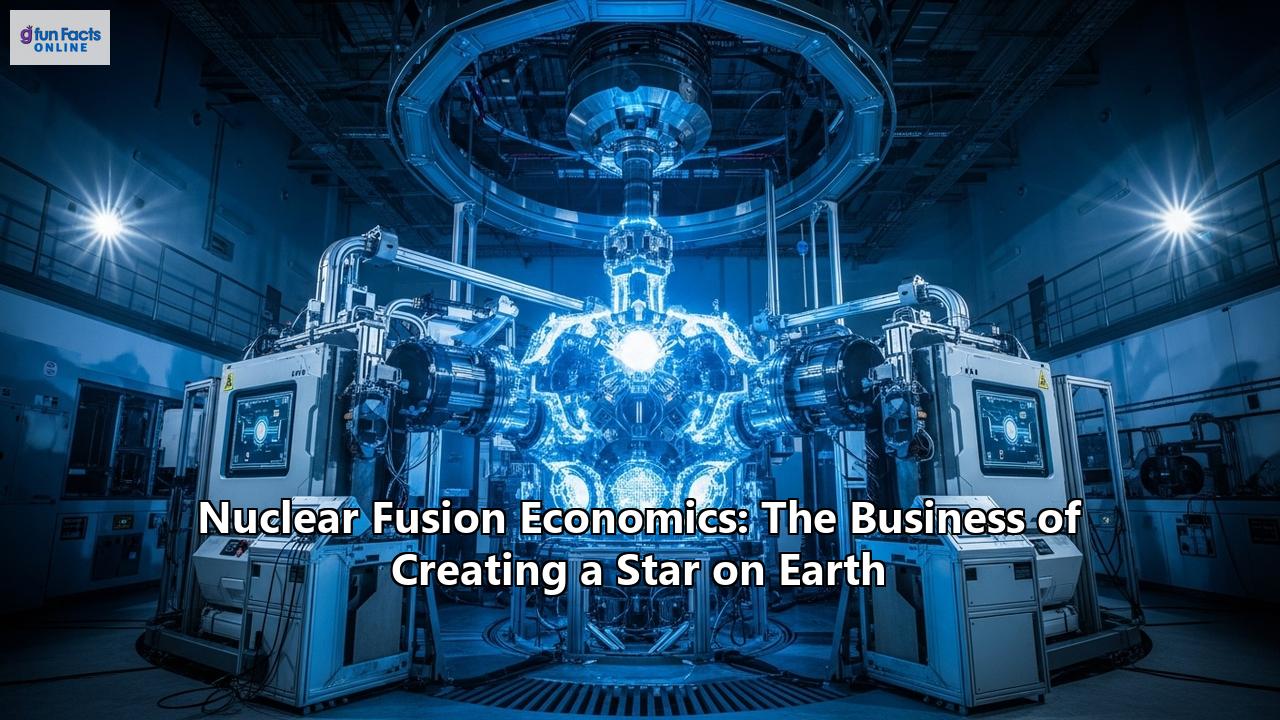
The Dawn of a New Sun: Deconstructing the Multibillion-Dollar Gamble on Nuclear Fusion
The quest to replicate the power of the sun on Earth is no longer confined to the realm of science fiction. Nuclear fusion, the process that fuels stars, is steadily moving from theoretical physics to the brink of commercial reality. This audacious endeavor, often dubbed "creating a star on Earth," is attracting a torrent of investment and igniting a global race with profound economic and geopolitical implications. The promise is tantalizing: a source of clean, virtually limitless energy that could redefine our world. But the path to a fusion-powered future is paved with immense scientific, engineering, and, most critically, economic challenges. This is the story of the business of building a star, a high-stakes venture where fortunes will be made and lost in the pursuit of the ultimate energy prize.
The Staggering Promise: Why We're Chasing the Sun
To understand the economic fervor surrounding nuclear fusion, one must first grasp its transformative potential. Unlike nuclear fission, which splits heavy atoms and produces long-lived radioactive waste, fusion combines light atomic nuclei, typically isotopes of hydrogen like deuterium and tritium, to release massive amounts of energy. The advantages are profound and manifold, forming the bedrock of the economic argument for its development.
At its core, fusion promises an abundant and virtually inexhaustible fuel supply. Deuterium can be extracted from seawater, and tritium can be produced from lithium, a relatively common element. This stands in stark contrast to the finite and geographically concentrated reserves of fossil fuels that have long dictated global energy politics. A gram of fusion fuel has the potential to generate as much energy as burning 10 tonnes of coal, showcasing an extraordinary energy density that could power our civilization for millennia.
From an environmental standpoint, fusion is a game-changer. Fusion reactors produce no greenhouse gases during operation, offering a direct and powerful tool in the fight against climate change. The primary byproduct of the most common fusion reaction is helium, an inert and non-toxic gas. While fusion does generate some radioactive waste from the activation of reactor components, this waste is significantly less hazardous and shorter-lived than the high-level waste from fission reactors. Many components could potentially be recycled or reused within a century.
Safety is another cornerstone of fusion's appeal. The process is inherently safer than fission. There is no risk of a meltdown, as the precise conditions required for fusion are incredibly difficult to maintain; any disruption causes the plasma to cool within seconds, halting the reaction. Furthermore, the amount of fuel in the reactor at any given moment is only enough for a few seconds of operation, and there is no possibility of a chain reaction. The byproducts of fusion reactions also cannot be used to produce nuclear weapons, mitigating proliferation risks.
The potential economic benefits extend beyond clean energy. The development and deployment of fusion power could spur significant economic growth, with some estimates valuing the global fusion industry at a staggering $40 trillion. For a country like India, securing a proportionate share could add trillions to its economy. Moreover, by reducing dependence on imported fossil fuels, fusion can bolster national energy security and economic resilience. The construction and operation of fusion power plants would also create a substantial number of high-skilled jobs, from physicists and engineers to technicians and manufacturing specialists. A prototype fusion plant in the UK, for instance, is projected to create over 8,000 jobs during its construction phase alone.
The Titans of Fusion: A New Industrial Revolution
The pursuit of fusion energy has given rise to a dynamic and increasingly crowded field of players, from massive, government-backed international collaborations to nimble and ambitious private startups. This burgeoning ecosystem is a clear indicator of the growing confidence in fusion's commercial viability.
The Public Behemoth: ITERFor decades, the face of fusion research has been the International Thermonuclear Experimental Reactor (ITER), a colossal project under construction in France. Backed by a consortium of 35 nations, including the European Union, China, India, Japan, Korea, Russia, and the United States, ITER is one of the most ambitious science experiments in human history. Its goal is to prove the scientific and technological feasibility of fusion power by producing net energy gain, a crucial milestone where the fusion reaction generates more energy than is required to heat the plasma.
ITER's approach is based on the tokamak, a donut-shaped device that uses powerful magnetic fields to confine the superheated plasma. However, the project's massive scale, complexity, and ballooning budget, with estimates ranging from $22 billion to over $65 billion, have led to significant delays. Originally slated for earlier operation, full operations are now not expected until 2039. Despite the setbacks, ITER's contributions are invaluable. It is a crucible for developing and testing the technologies that will be essential for future commercial reactors and serves as a vital hub for international scientific collaboration.
The Rise of Private Enterprise: A Silicon Valley Approach to a Stellar ChallengeIn recent years, the fusion landscape has been revolutionized by a surge in private investment, bringing a "fail-fast" Silicon Valley ethos to a field traditionally characterized by long-term, government-funded projects. This influx of private capital, exceeding $7.1 billion globally, has accelerated the pace of innovation and fostered a healthy sense of competition. Over 50 fusion startups are now competing worldwide, each with its own unique technological approach and ambitious timeline.
Among the frontrunners are companies that have attracted significant funding and forged strategic partnerships:
- Commonwealth Fusion Systems (CFS): A spin-off from MIT's Plasma Science and Fusion Center, CFS has raised over $2 billion from a roster of high-profile investors including Bill Gates, Google, and the Italian energy giant Eni. Their key innovation lies in the development of high-temperature superconducting magnets, which allow for smaller, more powerful, and potentially more cost-effective tokamak reactors. Their SPARC project aims to demonstrate net energy gain by 2025, with a commercial power plant, ARC, slated for the early 2030s.
- Helion Energy: This Washington-based company has garnered over $577 million in funding and a landmark power purchase agreement with Microsoft, aiming to have the first-ever commercially operating fusion plant online by 2028. Helion is pursuing a pulsed, non-tokamak approach, which they believe will be a faster and more direct path to commercial electricity generation.
- TAE Technologies: One of the older private players in the field, TAE has secured over $1.2 billion in funding from investors like Google and Chevron. Their approach utilizes a linear, non-tokamak design and aims for an aneutronic reaction (one that produces few or no neutrons), which could simplify materials challenges and reduce radioactive waste. TAE has a bold goal to deliver energy to the grid by the early 2030s.
- General Fusion: Backed by investors like Cenovus Energy, this Canadian company is developing a Magnetized Target Fusion (MTF) system, a hybrid approach that combines elements of magnetic and inertial confinement. They are building a demonstration plant in the UK, with the goal of commercial pilot plants in the late 2020s.
Other notable players include Zap Energy, which is developing a Z-pinch technology, and a growing number of startups in Europe and Asia, such as Tokamak Energy and Proxima Fusion. This diversification of approaches is crucial, as it increases the probability of a successful breakthrough.
The synergy between public and private efforts is becoming increasingly important. Public programs like ITER are focused on foundational science, while private companies are driving innovation in specific technologies and commercialization pathways. Governments are recognizing this and are increasingly promoting public-private partnerships to accelerate progress.
The Colossal Cost: Deconstructing the Economics of a Fusion Power Plant
The dream of fusion energy comes with a hefty price tag. The economics of fusion are complex and multifaceted, dominated by high upfront capital costs, long development timelines, and the need for significant technological advancements to achieve cost-competitiveness with other energy sources.
The Price of a Star: Capital Costs and LCOEThe single largest economic hurdle for fusion energy is the immense capital cost of building a power plant. Estimates for a commercial-scale fusion reactor vary widely, reflecting the nascent stage of the technology and the different approaches being pursued. Projections range from as low as $2,700 per kilowatt of capacity to as high as $9,700 per kilowatt. For a 1,000-megawatt plant, this translates to a staggering initial investment of $2.7 billion to $9.7 billion. The international ITER project, a research facility and not a power plant, has seen its cost estimates soar to between $22 billion and $65 billion.
These high costs are driven by the complexity of the technology and the specialized materials required. The powerful superconducting magnets, the massive vacuum vessels, and the sophisticated heating and cooling systems are all major cost drivers.
To compare the cost-effectiveness of different energy sources, economists use the Levelized Cost of Energy (LCOE), which represents the average revenue per unit of electricity generated that would be required to recover the costs of building and operating a power plant over its lifetime. LCOE is a crucial metric for determining fusion's future competitiveness in the energy market.
Current LCOE estimates for fusion are highly speculative and vary significantly depending on the assumed technology, construction costs, and operational efficiency. Some studies project a future LCOE for fusion that is competitive with modern nuclear fission and renewable energy sources, potentially as low as $25-$70 per megawatt-hour (MWh) for mature technologies. Others are more pessimistic, suggesting that the first generation of fusion plants could be significantly more expensive. One report suggests initial capital costs for new fusion reactors could be around £100/MWh, with a target of £60-£70/MWh after a substantial program of standardized builds. Another analysis, based on the DEMO2 model, found a model LCOE of around $160/MWh. For comparison, the LCOE for advanced nuclear fission is around $63/MWh, while onshore wind and large-scale solar are in the range of $33-$52/MWh.
Achieving a competitive LCOE for fusion will hinge on several factors:
- Reducing Construction Costs: Innovations in design, such as the use of high-temperature superconducting magnets to create smaller, more compact reactors, could significantly reduce capital costs. Standardization of designs and the experience gained from building multiple plants ("technological learning") are also expected to drive down costs over time.
- Improving Operational Efficiency: The capacity factor, or the amount of time a plant is operational, is a critical determinant of LCOE. Fusion plants will need to achieve high availability to be economically viable, which requires durable components that can withstand the harsh reactor environment for long periods.
- Materials Longevity: The materials used in the reactor, particularly those facing the plasma, will need to be replaced periodically due to damage from high-energy neutrons. The frequency of these replacements will have a major impact on operating costs and the plant's overall availability.
While the fuel for fusion is abundant, the supply chain for building and operating a fusion power plant presents its own set of economic challenges and opportunities. Fusion developers spent over $500 million on their supply chains in 2022, a figure projected to grow to over $7 billion for the construction of first-of-a-kind power plants.
The supply chain for fusion reactors encompasses a wide range of components, from standard industrial materials like concrete and steel to highly specialized technologies. Key areas of unique supply chain needs include:
- High-Powered Magnets: Superconducting magnets are essential for confining the plasma in tokamak and stellarator designs. The development of high-temperature superconductors is a major area of innovation and a critical supply chain component.
- Advanced Materials: Fusion reactors require materials that can withstand extreme temperatures, intense neutron bombardment, and corrosive environments. This includes materials for the "first wall" facing the plasma, as well as specialized steels and alloys for the reactor structure. There is currently no industrial supply chain that can produce the required tonnage of certain advanced materials, such as the vanadium alloy V44.
- Tritium Breeding and Handling: While deuterium is readily available, tritium is a radioactive isotope of hydrogen that must be produced, or "bred," within the fusion reactor itself by reacting neutrons with lithium. The technology for tritium breeding blankets is still under development and represents a critical challenge for the fusion fuel cycle. There is also a very limited external supply of tritium for starting up the first generation of fusion reactors.
- Specialized Components: Other critical components include high-power lasers for inertial confinement fusion, sophisticated diagnostic equipment, and robotic systems for remote maintenance.
A major challenge for the fusion supply chain is the need for suppliers to scale up production ahead of demand, a risky proposition given the long-term and uncertain nature of fusion development. This creates a classic "chicken and egg" problem that will require close collaboration and risk-sharing between fusion developers and their suppliers.
Navigating the Gauntlet: The Road to Commercialization
The journey from scientific breakthrough to a commercially viable fusion power plant is fraught with challenges that extend beyond the laboratory and the balance sheet. Overcoming these hurdles will require a concerted effort from scientists, engineers, policymakers, and the public.
The Technological Frontier: From Breakeven to a Burning PlasmaThe primary scientific and engineering challenge is to create and sustain a "burning plasma," a state in which the fusion reaction is self-heating, requiring minimal external energy input to maintain its temperature. This involves solving a complex interplay of physics and engineering problems:
- Plasma Confinement: Containing a plasma at temperatures of over 100 million degrees Celsius is a monumental task. Tokamaks and stellarators use powerful magnetic fields to create a "magnetic bottle," but instabilities in the plasma can cause it to leak, disrupting the reaction. Recent breakthroughs, such as surpassing the "Greenwald limit" for plasma density, are pushing the boundaries of what is possible.
- Materials Science: The materials used to build fusion reactors must withstand an incredibly harsh environment of intense heat and neutron radiation. Neutron bombardment can cause materials to become brittle and radioactive, requiring the development of new, radiation-resistant alloys. The lack of facilities to test materials under realistic fusion conditions is a significant bottleneck.
- Heat Extraction and Power Conversion: Efficiently extracting the heat generated by the fusion reaction and converting it into electricity is a critical engineering challenge. The design of the "blanket" that surrounds the plasma is key to both breeding tritium and capturing the energy of the neutrons.
As fusion technology matures, a clear and supportive regulatory framework will be essential for its commercial deployment. Encouragingly, there is a growing consensus that fusion should be regulated differently from nuclear fission, given its inherent safety advantages. In the United States, the Nuclear Regulatory Commission (NRC) has voted to regulate fusion under a framework similar to that used for particle accelerators, which is simpler and less costly than the regulations for fission reactors. This provides regulatory certainty that is crucial for attracting investment and encouraging innovation.
However, establishing these new regulatory frameworks is a complex process that requires international collaboration to ensure consistency and avoid unnecessary hurdles. Public perception will also play a critical role.
Winning Hearts and Minds: Public Perception and TrustThe successful rollout of fusion energy will depend not only on technical and economic viability but also on public acceptance. While public perception of fusion is generally positive, there are concerns about safety, cost, and radioactive waste, often stemming from a confusion with nuclear fission.
Building public trust will require a concerted effort of transparent communication and education. The fusion industry must be proactive in addressing public concerns, highlighting the safety and environmental benefits of the technology, and providing realistic timelines for its development. Engaging with communities and stakeholders throughout the development and deployment process will be crucial for building the social license to operate.
The Dawn of a Fusion-Powered World: Economic and Geopolitical Ripples
The successful commercialization of nuclear fusion would not just be a technological triumph; it would be a transformative event with profound economic and geopolitical consequences. The country or bloc that first achieves commercial fusion could gain a significant strategic advantage, reshaping the global energy landscape and the balance of power.
The Geopolitical ChessboardThe race for fusion energy is already becoming a key element of geopolitical competition, particularly between the United States and China. China has made fusion a strategic priority, with significant government funding and a centralized national strategy. The US, while leading in private sector investment and innovation, has a more decentralized approach and faces challenges with aging research infrastructure.
The nation that successfully commercializes fusion could achieve energy independence, reducing the influence of traditional energy producers and limiting the use of energy as a geopolitical weapon. This could also shift global alliances, as countries may align with fusion leaders to gain access to this transformative technology.
Beyond Electricity: New Economic FrontiersThe economic impact of fusion extends beyond just generating electricity for the grid. The high-grade heat produced by fusion reactors could be used for a variety of industrial applications, including:
- Hydrogen Production: Fusion could provide the heat and electricity needed for large-scale, clean hydrogen production, a key element of a future low-carbon economy.
- Industrial Process Heat: Many industrial processes, such as steel and cement manufacturing, require large amounts of high-temperature heat. Fusion could provide a clean and reliable source of this heat.
- Seawater Desalination: Fusion power could be used to desalinate seawater, providing a sustainable source of fresh water in arid regions.
- Space Propulsion: The principles of fusion could also be applied to develop advanced propulsion systems for spacecraft, enabling faster and more efficient exploration of our solar system.
The emergence of a global fusion industry will create a significant demand for a new generation of skilled workers. This includes not only physicists and engineers but also technicians, manufacturing specialists, and those with expertise in areas like AI and robotics. Developing a robust workforce through education, training, and apprenticeship programs will be crucial for realizing the full economic potential of fusion energy.
The Verdict: A High-Stakes Gamble on a Brighter Future
The journey to a fusion-powered world is a marathon, not a sprint. The economic challenges are as daunting as the scientific ones, and the timelines for commercialization are still subject to significant uncertainty. Ambitious private companies are targeting the 2030s for the first grid-connected fusion power plants, while more conservative estimates place widespread commercial deployment in the 2050s or beyond.
Despite the hurdles, the momentum is undeniable. A confluence of factors – a torrent of private investment, rapid technological advancements, and the urgent need for a clean energy transition – is accelerating the pace of innovation. The business of creating a star on Earth is a high-risk, high-reward endeavor. It is a testament to human ingenuity and a bold bet on a future powered by clean, abundant, and sustainable energy. The economic and societal prize is so immense that it is a gamble the world is increasingly willing to take.
Reference:
- https://www.peaknano.com/blog/fusion-energys-strategic-impact
- https://www.world-nuclear-news.org/Articles/Fusion-report-focuses-on-future-workforce-challeng
- https://www.weforum.org/stories/2025/01/fusion-energy-future/
- https://consensus.app/questions/what-challenges-achieving-nuclear-fusion-sustainable/
- https://www.fusionindustryassociation.org/fia-outlines-fusion-workforce-opportunities-and-projections-in-skills-report/
- https://www.rechargenews.com/energy-transition/nuclear-fusion-will-be-a-tool-of-geopolitics-ive-been-called-into-the-white-house-multiple-times/2-1-1486649?zephr_sso_ott=JvkWjW
- https://scientific-publications.ukaea.uk/wp-content/uploads/UKAEA-STEP-PR2312.PDF
- https://www.innovationnewsnetwork.com/fusion-as-the-future-of-baseload-energy-powering-a-decarbonised-world/52112/
- https://www.ecssr.ae/en/research-products/reports/2/200917
- https://www.precedenceresearch.com/fusion-energy-market
- https://www.innovationnewsnetwork.com/how-nuclear-fusion-innovation-is-unlocking-a-sustainable-energy-future/58696/
- https://tracxn.com/d/venture-capital/fusion-fund/__p8CYMRglcviMRH_01UAy3UNmohii-QPsRj26mUZZ-IM
- https://fusionenergyinsights.com/blog/post/fusion-skills-equipping-the-workforce-for-commercial-fusion
- https://app.dealroom.co/lists/25184
- https://www.fusionindustryassociation.org/wp-content/uploads/2023/07/FIA%E2%80%932023-FINAL.pdf
- https://www.iaea.org/newscenter/news/the-use-of-nuclear-power-beyond-generating-electricity-non-electric-applications
- https://arxiv.org/pdf/2501.03372
- https://www.iter.org/node/20687/ai-ignites-innovation-fusion
- https://news.mit.edu/2025/unlocking-secrets-fusions-core-ai-enhanced-simulations-0218
- https://www.energy.gov/sites/default/files/2024-06/fusion-energy-strategy-2024.pdf
- https://acee.princeton.edu/wp-content/uploads/2016/05/ACEE-Fusion-Distillate-Article-4.pdf
- https://www.researchgate.net/publication/388752888_AI-Driven_Fusion_Unlocking_Net-Positive_Energy_for_a_Sustainable_Future
- https://www.innovationnewsnetwork.com/fusion-energy-explained-powering-the-future-of-clean-energy/58361/
- https://www.fusionsenergi.dk/-/media/sites/fusionsenergi/oppeu-report.pdf
- https://www.numberanalytics.com/blog/advancing-fusion-energy-conceptual-studies
- https://scipub.euro-fusion.org/wp-content/uploads/eurofusion/WPS2PR15_14259_submitted.pdf
- https://www.iaea.org/bulletin/closing-fusions-materials-and-technology-gaps
- https://fusionenergyinsights.com/blog/post/fusion-investment-trends-in-2025-in-relation-to-other-clean-firm-power
- https://www.researchgate.net/publication/384846027_The_Global_Race_for_Fusion_Energy_China's_Surge_and_What's_at_Stake_for_the_US_Vol_1_Issue_4
- https://www.globenewswire.com/news-release/2025/04/30/3071147/28124/en/Nuclear-Fusion-Energy-Industry-Forecast-2025-2045-Unprecedented-Private-Capital-Technological-Breakthroughs-and-Climate-Urgency-are-Accelerating-Development-Timelines.html
- https://heds-center.llnl.gov/sites/heds_center/files/2024-08/6-1-23_slides_-_silva_jenkins.pdf
- https://news.mit.edu/2024/more-durable-metals-fusion-power-reactors-0819
- http://documenta.ciemat.es/bitstream/123456789/3901/1/FED_%20ManuscriptRevisedJuly2020.pdf
- https://www.ou.edu/news/articles/2024/april/americans-supportive-but-misinformed-about-fusion-energys-promise
- https://fusionenergyinsights.com/blog/post/inside-view-public-perception-of-fusion
- https://www.powerengineeringint.com/nuclear/significant-growth-in-fusion-workforce-needed-fia-finds/