
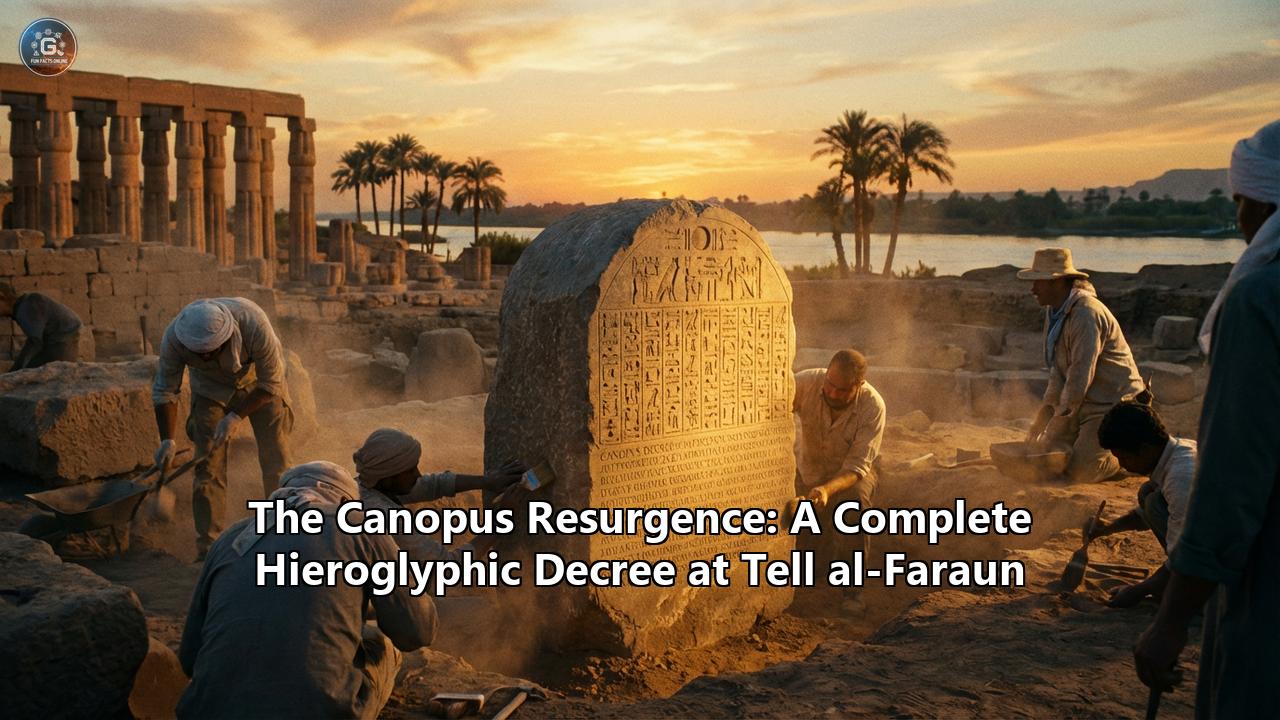
The sun over the eastern Nile Delta burns with the same intensity today as it did in 238 BC, when a procession of priests gathered to chisel a proclamation that would challenge the flow of time itself. For centuries, the sands of Tell al-Faraun—the site of the ancient city of Imet—held a secret that has only now, in the cooling months of late 2025, been revealed to the world.
The discovery of a pristine, complete, and unique copy of the Decree of Canopus has sent a shockwave through the archaeological community, a phenomenon already being termed the "Canopus Resurgence." This is not merely another stone in the museum; it is a time capsule that rewrites our understanding of the Ptolemaic Dynasty, the resilience of the Egyptian priesthood, and the very mechanics of the ancient calendar.
The Awakening at Imet: A Discovery in the Delta
In September 2025, an Egyptian archaeological mission working under the Supreme Council of Antiquities in the Sharqia Governorate struck sandstone. They were excavating at Tell al-Faraun, near the modern city of Husseiniya. This site, known to the ancients as Imet, was a bustling religious metropolis, a cult center for the cobra goddess Wadjet, and a strategic node in the eastern defenses of the Delta. While Imet has long been known for its Ramesside connections, few expected it to yield a masterpiece of the Ptolemaic era.
The artifact that emerged from the earth was breathtaking in its preservation. Standing 127.5 centimeters tall and 83 centimeters wide, the stela was carved from solid sandstone, its surface relatively unmarred by the two millennia that have passed since its creation.
But as the dust was brushed away, the epigraphers realized they were looking at something anomalous. The famous decrees of the Ptolemaic era—the Rosetta Stone, the Decree of Memphis, and the previously known copies of the Decree of Canopus—were celebrated for being trilingual. They were the "Rosetta style" stones, speaking in the tongues of the gods (Hieroglyphs), the documents (Demotic), and the Greeks (Greek).
This stela was different. From the winged sun disk at its rounded apex to the final benediction at its base, the stone spoke in only one voice: Hieroglyphs.
It is the first complete copy of the Canopus Decree found in over 150 years, and its monolingual nature suggests a "resurgence" of traditional Pharaonic identity in a city far removed from the Greek capital of Alexandria. It was a message intended not for the Greek ruling elite or the common market-goer, but for the gods and the priests alone.
The Decree of Canopus: A Crisis and a Coronation
To understand the magnitude of this find, we must step back to the year 238 BC. Egypt was under the rule of Ptolemy III Euergetes, a king of the Greek Ptolemaic dynasty. While the Ptolemies were Macedonian Greeks, they understood that to rule Egypt, they had to become Egypt. They adopted the double crown, worshipped the Apis bull, and poured vast fortunes into the native temples.
The Decree of Canopus was the result of a grand synod—a meeting of the highest priests from across the Nile Valley, gathered in the coastal city of Canopus. The text they produced was a masterclass in political theology. It was designed to accomplish three things:
- Deify the Royal Couple: Ptolemy III and his wife, Queen Berenice II, were elevated to the status of "Beneficent Gods" (Theoi Euergetai).
- Address a Tragedy: The decree established a cult for the royal couple's young daughter, Princess Berenice, who had died suddenly, creating a wave of national mourning.
- Reform the Universe: It attempted to fix the broken Egyptian calendar.
The text found at Tell al-Faraun preserves these proclamations with startling clarity. It speaks of the King’s military campaigns in Asia, from which he returned with sacred statues of Egyptian gods that had been stolen by the Persians centuries earlier—a feat that earned him the love of the priesthood. It details the King’s benevolence during a year of low Nile floods, when he imported grain from Syria and Phoenicia to prevent famine, saving the population from starvation.
But the true genius of the Canopus Decree lies in its astronomical ambition.
The Leap Year That Wasn't
Buried within the thirty lines of sunk-relief hieroglyphs on the Imet stela is a passage that represents one of the greatest "what ifs" in the history of science.
The ancient Egyptian civil calendar was 365 days long. It was simple, efficient, and slightly wrong. The solar year is actually about 365.25 days long. Over centuries, that missing quarter-day added up. The seasons drifted; the summer festivals began to occur in winter.
The priests at Canopus, undoubtedly the finest astronomers of their age, proposed a radical solution. The decree states:
"In order that the seasons may correspond to the fixed rules of the heavens... one day shall be added to the five epagomenal days every four years."
It was the invention of the Leap Year.
Had this decree been fully adopted in 238 BC, the calendar we use today would have effectively begun in ancient Egypt, two centuries before Julius Caesar introduced the Julian Calendar in Rome (with the help of an Alexandrian astronomer, Sosigenes, who likely read the Canopus Decree).
However, the reform failed to take root among the conservative populace, who were attached to their traditional 365-day rhythm. The finding of the Tell al-Faraun stela offers new insight into how this decree was disseminated. The fact that this specific copy was written only in Hieroglyphs—the "Words of God"—suggests that in provincial centers like Imet, the decree was viewed primarily as a religious obligation rather than an administrative law. The priests here may have been more concerned with the theological implications of the leap year (keeping the star Sirius rising at the correct time) than the civil convenience of it.
The Mystery of the Monolingual Script
The most debated aspect of the "Canopus Resurgence" is the absence of Greek and Demotic on the Tell al-Faraun stela.
Most famous bilingual or trilingual inscriptions were propaganda tools. They were meant to be read by the Greek administrators (Greek), the local Egyptian scribes and officials (Demotic), and the high priesthood (Hieroglyphs).
Why, then, did the priests of Imet commission a stone solely in Hieroglyphs?
Scholars propose a fascinating theory: Resistance through Purity. By 238 BC, Greek influence was permeating the Delta. But Imet, an ancient city with deep roots in the Middle Kingdom and the worship of Wadjet, may have been a bastion of orthodoxy. By carving the decree only in the sacred script, the priests were perhaps making a subtle statement. They were accepting the Macedonian King's benefactions and divinity, yes, but they were recording it in the language of the ancestors—a language that the Greek king himself likely could not read.
It was a "sacred contract" sealed within the walls of the temple, shielded from the profane eyes of the Greek bureaucracy. This "Imet Version" represents the decree in its most elevated form, stripped of the administrative necessity of translation.
The Iconography of Power
The visual elements of the stela are as significant as the text. The lunette (the rounded top) features the Winged Sun Disk of Behedet, a symbol of divine protection that hovers over all Pharaohs. Flanking the sun are two Uraei—royal cobras. One wears the White Crown of Upper Egypt, the other the Red Crown of Lower Egypt.
This duality is central to the Ptolemaic claim to legitimacy. Despite being foreigners, they are depicted here not as Hellenistic monarchs, but as the dual guardians of the Two Lands. Between the cobras, the hieroglyphs read "Di-Ankh"—"Given Life."
The carving style is described as "medium-quality sunk relief." It lacks the exquisite, jewelry-like detail of the finest temple walls, which humanizes the artifact. It suggests a local workshop working with urgency to fulfill the royal order: Copy this decree and set it up in the sanctuary. We can almost see the dusty workshop in Imet, the master scribe dictating from a papyrus sent from Alexandria, ensuring that the local stonecutter gets the complex honorific titles of Queen Berenice just right.
A Window into the Delta's Heart
The discovery shines a spotlight on Tell al-Faraun itself. Often confused with Tell el-Fara'in (Buto) in the western Delta, Tell al-Faraun (Imet) in the east was a city of immense strategic importance. It guarded the eastern approaches to Egypt from the Sinai.
The recovery of this stela confirms that Imet remained a high-status religious center well into the Ptolemaic period. It was not a backwater; it was a city whose temples were significant enough to receive a copy of the primary state decree. The stela mentions donations made to the temples—likely including the Temple of Wadjet at Imet—funded by the King’s treasury. This economic injection would have revitalized the city, funding new construction and priesthoods, a "resurgence" of the city's own fortunes that mirrors the name of the modern discovery.
The Future of the Past
As the Tell al-Faraun stela moves from the excavation trench to the laboratory, it is poised to become a star of the Grand Egyptian Museum.
Philologists are already lining up to compare its text with the other six known copies of the Canopus Decree. Every copy has slight variations—scribal errors, local adaptations, or different spellings that reveal how the Egyptian language was pronounced in different regions. This new text, being a "pure" hieroglyphic version, might offer the most grammatically archaic and "theologically correct" version of the text known to exist.
Furthermore, it validates the efforts of the Supreme Council of Antiquities to explore the Delta. For decades, the wet, agricultural soil of the Delta was thought to be too destructive to preserve widespread monuments. The "Canopus Resurgence" proves that the mud of the Delta still protects the history of Egypt's most cosmopolitan age.
In the end, the priests of Imet achieved their goal. They inscribed the name of Ptolemy and Berenice in hard stone so that it might "remain forever." They could not have predicted that their calendar reform would take two thousand years to fully conquer the world, or that their temple would crumble to dust. But they knew the power of the written word.
Twenty-two centuries later, the voice of Imet speaks again—not in Greek, not in the language of the streets, but in the holy signs of the gods. The Canopus Resurgence is complete.
Reference:
- https://archaeology.org/news/2025/09/12/new-complete-copy-of-canopus-decree-recovered/
- https://www.ancient-origins.net/artifacts-ancient-writings-news-history-archaeology-history-important-events/complete-canopus
- https://archaeologymag.com/2025/09/complete-copy-of-the-canopus-decree/
- https://english.ahram.org.eg/News/552903.aspx
- https://see.news/discovery-of-a-new-complete-copy-of-the-canopus-decree-of-king-ptolemy-iii-in-sharqia
- https://greekreporter.com/2025/09/10/hieroglyphic-canopus-decree-pharaoh-ptolemy-egypt/
- https://news.artnet.com/art-world/archaeologists-find-new-version-decree-of-canopus-hieroglyphics-2687455
- https://en.wikipedia.org/wiki/Archaeology_of_ancient_Egypt