
I. The Ghost of a Celestial Crown
Imagine standing on the shores of a primordial ocean, 466 million years ago. The air is thick and warm, richer in carbon dioxide than the atmosphere we breathe today. The land behind you is barren rock and red dust, largely devoid of greenery, for the great forests have not yet risen. But the sea before you teems with life—trilobites scuttling across the sediment, orthocone nautiloids patrolling the currents like shelled submarines, and the earliest ancestors of vertebrates darting through the shallows.
Yet, if you were to look up, the most breathtaking sight would not be the alien life in the water, nor the desolate continents. It would be the sky.
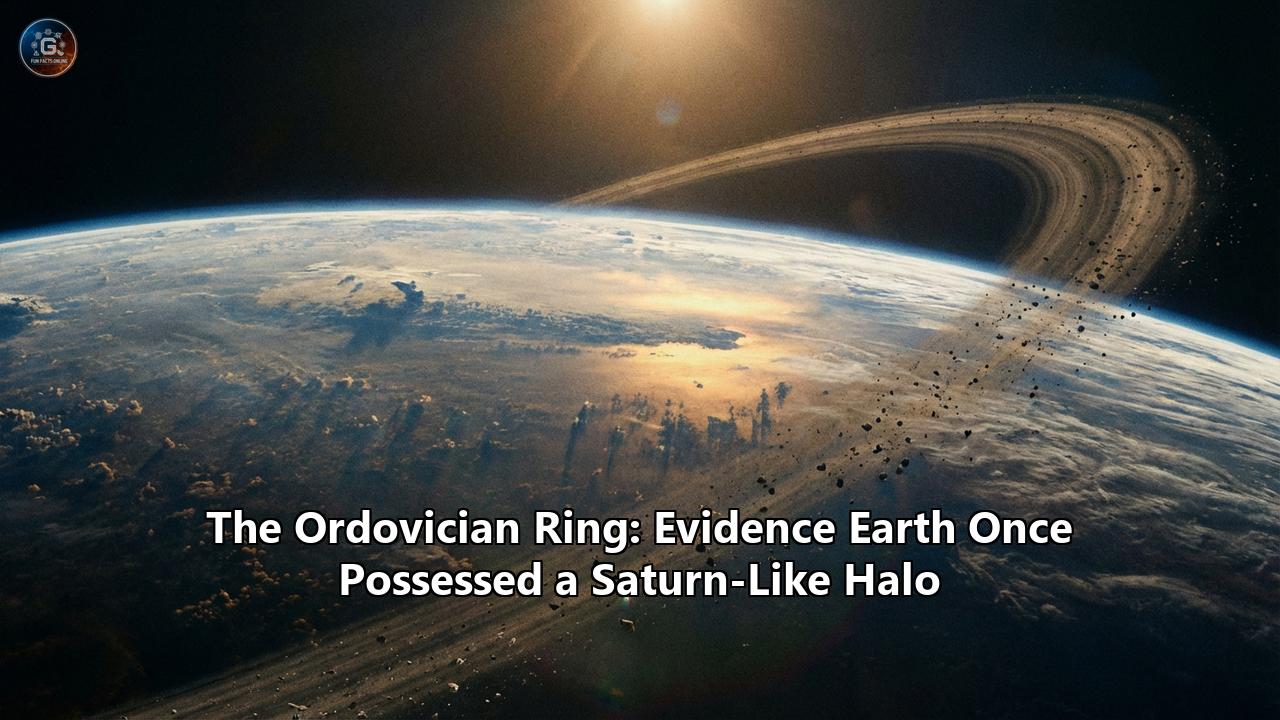
Arching across the heavens, bisecting the day and glowing with a pale, ghostly luminescence during the night, is a colossal ring. Like a bridge made of diamond dust and rocky shards, it spans the horizon, casting a broad, dark shadow across the equatorial latitudes. It is a spectacle of cosmic grandeur, a halo of debris that rivals the rings of Saturn. For millions of years, this celestial crown adorned our planet, raining fire upon the surface and shading the world into a deep, icy slumber.
This is not a scene from science fiction, but a reconstruction of a newly discovered chapter in Earth’s deep history. For decades, geologists have been puzzled by a strange anomaly in the fossil and rock records of the Ordovician period: a sudden, violent spike in meteorite impacts coupled with a baffling global cooling event. In 2024, a team of researchers led by Professor Andy Tomkins at Monash University proposed a unifying theory that accounts for these mysteries. Earth, they argue, captured a passing asteroid, tore it apart with tidal forces, and wore its remains as a ring.
This is the story of the Ordovician Ring—how it formed, how it doomed the planet to an ice age, and how its discovery is rewriting the history of the solar system.
II. The Geological Anomalies: Clues in the Stone
To understand the magnitude of this discovery, we must first look at the clues that have baffled scientists for generations. The story begins not in an astronomy tower, but in the limestone quarries of Sweden and the crater-scarred landscapes of the ancient continents.
The Impact SpikeGeologists divide Earth’s history into distinct periods, and the Middle Ordovician (roughly 470 to 450 million years ago) stands out for its violence. The inner solar system is generally a quiet place, with major collisions happening millions of years apart. However, during this specific window of time, Earth was pummeled.
Researchers studying sedimentary rocks from this era have long noticed an unusual abundance of extraterrestrial material. In the Thorsberg limestone quarry in southern Sweden, workers have recovered over a hundred fossil meteorites—stony remnants of space rocks that fell into the ancient seabed and were preserved alongside sea shells. Chemical analysis reveals that these are almost exclusively "L-chondrites," a specific type of stony meteorite low in iron.
Typically, meteorites found on Earth are a diverse mix. To find such a massive concentration of a single type suggests a specific event: the disruption of a massive parent body. For years, the prevailing theory was that a collision in the asteroid belt between Mars and Jupiter sent a shower of debris careening toward Earth. But this "asteroid shower" theory had holes. If the debris came directly from the asteroid belt, it should have hit Earth randomly, peppering the globe at all latitudes.
The Equatorial MysteryThis is where the detective work of Professor Tomkins and his team becomes crucial. They analyzed the location of 21 confirmed impact craters dated to the Ordovician impact spike. These craters are found today on continents as far apart as North America, Europe, and Australia. However, the Earth’s tectonic plates are constantly moving. The continents of today are not where they were 466 million years ago.
Using advanced plate tectonic reconstruction models, the team rewound the clock. They moved the continents back to their Ordovician positions, assembling the ancient landmasses of Gondwana, Laurentia, and Baltica.
The result was a statistical shock.
When mapped onto the Ordovician globe, all 21 craters lined up in a neat, narrow band along the equator. Specifically, they were all located within 30 degrees of the paleo-equator.
To understand how unlikely this is, consider the geometry of Earth. The equatorial band (0–30 degrees latitude) represents only a fraction of the planet's surface area. Furthermore, during the Ordovician, approximately 70% of the land capable of preserving a crater (cratonic crust) was located outside this equatorial band, in higher latitudes.
If the impacts were coming from a random shower of asteroids from the main belt, they should have struck the large landmasses in the higher latitudes just as often, if not more so, than the equator. The probability of 21 consecutive impacts hitting only the equator by pure chance is approximately 1 in 25 million.
It was a "smoking gun." The asteroids were not coming from deep space directly; they were falling from above the equator.
III. The Roche Limit and the Celestial Capture
How does a planet acquire a ring? The mechanics of celestial ring formation are governed by gravity and a critical threshold known as the Roche limit.
Named after the French astronomer Édouard Roche, this limit is the minimum distance a satellite (like a moon or an asteroid) can approach a primary body (like Earth) without being torn apart by tidal forces. Gravity is not uniform; it pulls harder on the side of the satellite facing the planet than on the side facing away. If the satellite gets too close, this differential pull—the tidal force—overcomes the internal gravity holding the satellite together.
The ScenarioAround 466 million years ago, a large asteroid—likely the parent body of the L-chondrites, estimated to be roughly 150 kilometers in diameter—had a close encounter with Earth. It didn't collide directly. Instead, it passed within the Roche limit, perhaps just a few thousand kilometers above the atmosphere.
The result was catastrophic. The asteroid groaned and fractured, its rocky spine snapping under the immense gravitational torque of the Earth. In slow motion, the mountain-sized rock disintegrated. It didn't just explode; it unspooled.
The debris from this breakup didn't immediately fall. Instead, it was captured into orbit. The larger chunks and clouds of dust spread out, colliding with one another, grinding down into smaller and smaller pieces. Over time, due to the physics of orbital mechanics, this cloud flattened into a disk aligned with Earth’s equator—the plane of least resistance.
Earth had acquired a ring.
The Appearance of the RingUnlike Saturn’s rings, which are largely composed of water ice and shine with a brilliant white albedo, Earth’s Ordovician ring was made of rock and dust. It would have been darker, perhaps reddish-grey, similar to the color of the Moon or the dusty surface of Mars.
However, even a rocky ring would scatter sunlight. From the surface, it would have appeared as a colossal arch. At the equator, it would be a thin line directly overhead, bisecting the sky. As one traveled north or south, the ring would broaden into a wide band near the horizon. During the day, it might have looked like a second, stationary cloud layer, glittering where the sun caught the fresh fracture faces of silicate minerals. At night, it would be illuminated by earthshine and the sun (since the ring is high enough to catch sunlight even when the surface is in darkness), glowing like a pale, dusty rainbow.
IV. The Bombardment: Life Under the Halo
The formation of the ring was not a peaceful event. It was the beginning of an era of bombardment. The ring was not a stable, permanent feature like Saturn’s rings appear to be (though even Saturn's rings are ephemeral on cosmic timescales). The Ordovician ring was a "decaying orbit" system.
Atmospheric drag at the inner edge of the ring and gravitational perturbations from the Moon and the Sun caused material to constantly de-orbit. For millions of years, the Earth experienced a continuous rain of shooting stars.
The L-Chondrite RainThis explains the abundance of L-chondrite meteorites found in Sweden and elsewhere. These weren't isolated events; they were the daily reality of the Ordovician world. The sky would frequently streak with fireballs. Most of the dust burned up in the atmosphere, creating a stratospheric haze, but larger rocks punched through, creating the craters we see today.
This bombardment likely had a profound effect on the biosphere. The Middle Ordovician was a time of the Great Ordovician Biodiversification Event (GOBE), where life in the oceans exploded in diversity. While large impacts can be extinction-level events, a steady influx of smaller impacts and extraterrestrial dust might have spurred evolution.
Some researchers hypothesize that the stress of a changing environment forces life to adapt. The constant localized destruction from meteorites, combined with the influx of extraterrestrial minerals (some of which can act as fertilizers for plankton), might have accelerated the evolutionary engine. The "Ordovician Meteor Event" might have been a catalyst for the complexity of life we see today.
However, the ring had a more sinister weapon than just falling rocks: Shadow.
V. The Hirnantian Icehouse: A World in Shadow
The most profound implication of the Ordovician Ring hypothesis connects geology to climate science. The Ordovician period ended with one of the most severe and puzzling climate events in Earth’s history: the Hirnantian Glaciation.
The Paradox of the Late OrdovicianFor most of the Ordovician, Earth was a "greenhouse" world. CO2 levels were significantly higher than they are today, and the planet was balmy. There were no polar ice caps; the oceans were warm. Then, almost abruptly (in geological terms), the planet plunged into a deep freeze.
Glaciers grew on the supercontinent of Gondwana (which was sitting over the South Pole). The global temperature dropped sharply. This cooling caused a massive drop in sea levels as water was locked up in ice, destroying the shallow marine habitats where most life existed. This triggered the Late Ordovician Mass Extinction, the first of the "Big Five" mass extinctions, wiping out nearly 85% of marine species.
Scientists have debated the cause of this sudden ice age for decades. Was it a drop in CO2 caused by the weathering of rising mountains? Was it a volcanic winter?
The Ring as a SunshadeProfessor Tomkins and his colleagues propose a chillingly simple answer: The ring blocked the sun.
Because the ring was located around the equator, it would have cast a shadow directly on the tropical regions of Earth. In a greenhouse world, the heat engine of the planet is the tropics. Sunlight strikes the equator, warms the oceans and atmosphere, and that heat is redistributed to the poles.
If you place a ring of dust and rock around the equator, you effectively install a solar shade. The ring doesn't just block light; the dust from de-orbiting material in the upper atmosphere increases the planet's albedo (reflectivity). Less sunlight reaches the surface. The tropics cool down.
As the tropics cool, the global heat transport system falters. The cooling spreads. Ice sheets begin to nucleate on Gondwana. As the white ice expands, it reflects even more sunlight (the albedo feedback loop), locking the planet into a freeze.
The timing fits. The ring formed around 466 million years ago. The cooling trend began shortly after, culminating in the Hirnantian peak glaciation around 445 million years ago. The ring, slowly decaying over 20 to 40 million years, would have maintained this cooling effect just long enough to freeze the world.
It is a terrifying concept: a celestial accident that literally shadowed the Earth, turning a tropical paradise into an icehouse and driving a mass extinction.
VI. The Dissipation: Where Did the Ring Go?
Rings around rocky planets are gravitationally unstable. Unlike the gas giants, which have immense gravity and many shepherd moons to maintain their rings, Earth’s gravity is lumpy, and our large Moon acts as a disruptor.
The Moon exerts significant tidal forces on Earth. Any ring system around Earth would be tugged and warped by the Moon’s gravity. Over millions of years, these perturbations would destabilize the ring particles.
- Inward Migration: Much of the material would lose energy due to drag from the Earth's extended atmosphere (exosphere) and crash down to the surface. This accounts for the impact craters and the fossil meteorites.
- Outward Diffusion: Some material might have been flung outward, escaping Earth's orbit or impacting the Moon. (Interestingly, there is a spike in impact spherules on the Moon that roughly correlates with this period, though the dating is less precise).
By the end of the Ordovician, roughly 40 million years after it formed, the ring was largely gone. The "diamond bridge" had crumbled. As the sky cleared and the sun shone with its full intensity once more, the Hirnantian ice sheets began to retreat. The Earth warmed, the sea levels rose, and the Silurian period began—a recovery from the frozen catastrophe.
VII. A New Perspective on Earth's History
The confirmation of the Ordovician Ring hypothesis would be a paradigm shift in geology and astronomy. It challenges the "uniformitarian" view of Earth—the idea that the planet has always been essentially the same, just slowly changing.
Earth is Not SpecialWe often think of rings as a feature of gas giants—Saturn, Jupiter, Uranus, Neptune. But we now know that rings are not exclusive to them. The asteroid Chariklo has rings. The dwarf planet Haumea has rings. Mars is expected to develop rings in the distant future when its moon Phobos disintegrates.
If Earth had a ring, it means that terrestrial planets can host these structures. It suggests that Venus or Mars may have had rings in their pasts as well. It implies that rings are a standard phase in the life cycle of planets, usually following a catastrophic capture event.
The Archive of the RingThis hypothesis forces geologists to look at the rock record with fresh eyes. Are there other "impact spikes" in Earth's history that were actually ring events?
- The Eocene Ring? Some scientists have previously suggested a smaller ring might have formed around 35 million years ago, linking a cluster of craters (including Chesapeake Bay) to a minor cooling event. The Ordovician evidence strengthens this possibility.
- The Paleoproterozoic Snowball? Could the ancient "Snowball Earth" events (where the entire planet froze over) have been triggered by even more massive rings from larger captured bodies?
If the ring hypothesis holds, it links the history of life even more tightly to the cosmos. Evolution is not just a response to terrestrial volcanoes and shifting continents. It is driven by the mechanics of the solar system. The fish that evolved in the Silurian—the ancestors of all vertebrates, including us—might owe their dominance to the ecological void cleared by the Ring Extinction. We are, in a sense, the children of the Ring.
VIII. Conclusion: The Ringed Earth
When we look at Saturn through a telescope, we are filled with wonder at its beauty. But the Ordovician Ring hypothesis tells us that we don't need to look billions of miles away to imagine such splendor. We are standing on a world that once wore the same crown.
For forty million years, the nights were brighter, the days were dimmer, and the sky was a canvas of moving stone. It was a time of fire from the heavens and ice on the ground.
The discovery of the Ordovician Ring reminds us of the violence and dynamism of our solar system. Earth is not a closed box; it is a traveler in a busy cosmic street, occasionally sideswiped by the traffic. The 21 craters near the equator are the scars of that encounter, a geological Morse code that has taken us nearly half a billion years to decipher.
We may not see the ring today—the sky is blue and empty of debris—but its legacy is written in the stone beneath our feet and the DNA within our cells. Once, long ago, Earth was the Lord of the Rings.
Extended Analysis: The Science Behind the Discovery
To fully appreciate the weight of this hypothesis, we must delve deeper into the specific scientific mechanisms and the rigor of the study produced by Tomkins, Martin, and Cawood (2024).
1. The Statistical Impossibility of Randomness
The core of the argument is statistical. The surface area of a sphere (Earth) is $4\pi r^2$. The surface area of a spherical band defined by latitudes $\phi_1$ and $\phi_2$ is $2\pi r^2 |\sin(\phi_1) - \sin(\phi_2)|$.
The equatorial band of +/- 30 degrees covers exactly half the surface area of the globe ($sin(30) = 0.5$, so the band covers from -0.5 to +0.5 of the sine projection).
Correction: Wait, the band is +/- 30 degrees. The area of a band from -30 to +30 is $2\pi r^2 (\sin(30) - \sin(-30)) = 2\pi r^2 (0.5 - (-0.5)) = 2\pi r^2 (1)$.Actually, the total surface area is $4\pi r^2$. The area of the band is $2\pi r^2$. So the band is exactly 50% of the Earth's total area.
However, the "bias" comes from the preservation of craters. Craters are only preserved on stable continental crust (cratons). They disappear in the ocean (subducted) or in active tectonic zones (mountains).
The researchers calculated the distribution of cratonic crust during the Ordovician. They found that only roughly 30% of the suitable crust was near the equator. 70% was at higher latitudes (specifically, large parts of Gondwana and Baltica were in the southern high latitudes).
If impacts were random, 70% of craters should be found on that 70% of land. Instead, 100% of the craters (21 out of 21) were found on the 30% of land at the equator.
The odds of rolling a 30% chance 21 times in a row are $0.3^{21} \approx 10^{-11}$. This is statistically vanishing. It effectively disproves the random impact theory.
2. The L-Chondrite Fingerprint
The specific type of meteorite is crucial. L-chondrites are "ordinary chondrites." They are the most common type of meteorite falling on Earth today. But before the Ordovician, they were rare. The "Ordovician Meteor Event" marks the moment when L-chondrites became the dominant debris in the inner solar system.
The "fossil meteorites" found in the Kinnekulle quarry in Sweden are preserved in stratified limestone. These rocks show that the flux of meteorites was up to 100 times higher than today.
Furthermore, sedimentary rocks worldwide contain high levels of exotic extraterrestrial chromite grains (spinels). These grains are resistant to weathering. You can dissolve a ton of ancient limestone in acid, and what's left behind are these tiny chrome-spinel crystals from the disintegrated asteroids. The stratigraphy shows a massive spike in these grains starting exactly at the proposed ring formation time.
3. The Shadow Modeling
Climate modeling of the Ordovician Ring is complex. A ring consists of particles ranging from micrometers (dust) to meters (boulders).
- Optical Depth: The "thickness" of the ring determines how much light it blocks. A ring with a high optical depth (like Saturn's B ring) creates a pitch-black shadow. A wispy ring (like Saturn's C ring) creates a grey veil.
- Inclination: Because the ring is equatorial, its shadow moves with the seasons.
Equinox: The sun is over the equator. The ring’s shadow falls on the ring itself (edge-on). The shadow on Earth is a thin line.
Solstice: The Earth is tilted. The ring casts a broad shadow over the winter hemisphere's tropics.
This seasonal shadowing is particularly effective at cooling the planet because it reduces the maximum insolation received by the tropics. By cutting off the peak heat input, the global average temperature drops.
The Tomkins study suggests that the ring could have reduced global insolation by enough to trigger the 5°C drop in ocean temperatures observed in oxygen isotope records from the era.
The Future of the Hypothesis
Science is a process of verification. How will the scientific community test the "Ordovician Ring" theory in the coming years?
- Search for More Craters: If a 22nd crater is found from this era, and it is located at the South Pole, the theory takes a hit. However, if new craters are found and they also cluster at the paleo-equator, the theory solidifies.
- Specific Tsunami Deposits: A ring system implies a lot of debris hitting the ocean. We should look for "tsunamites" (sedimentary layers left by tsunamis) in ancient tropical coastlines, corresponding to frequent splash-downs of ring moonlets.
- Helium-3 Isotopes: Extraterrestrial dust is rich in Helium-3. A ring would constantly rain this dust into the atmosphere. Measuring He-3 levels in Ordovician sediments with high resolution could reveal the "pulse" of the ring's decay.
- Comparative Planetology: As we observe the decay of Phobos around Mars, or study the rings of Chariklo, we refine our math on how rocky rings behave. This will help refine the timeline of Earth's ancient halo.
A Final Thought: The Fragility of the Sky
The Ordovician Ring serves as a memento mori for our planet's stability. We tend to assume the sky is a permanent fixture—the sun, the moon, the stars. But the sky is a dynamic arena. It can change. A stray asteroid can tear itself apart and draw a curtain across the sun.
For humanity, currently worried about anthropogenic climate change, the Ordovician Ring offers a perspective on "cosmic climate change." It shows how delicate the thermal balance of our world truly is. A slight reduction in sunlight, caused by a veil of dust, was enough to freeze the oceans and end an era of life.
The ring is gone, but the ghost of its shadow remains in the frozen rocks of the Sahara (which was at the pole then) and the cratered heart of the American Midwest. It is a testament to the time when Earth was not just a blue marble, but a ringed jewel, beautiful and deadly in equal measure.
Reference:
- https://www.business-standard.com/world-news/recent-study-reveals-that-earth-had-saturn-like-rings-for-ten-million-years-124091900987_1.html
- https://www.zmescience.com/science/news-science/earth-might-have-had-a-ring-system/
- https://www.earth.com/news/study-earth-had-planetary-rings-like-saturn-466-million-years-ago/
- https://www.forbes.com/sites/davidbressan/2024/09/23/earth-may-once-have-had-a-ring-system/
- https://www.monash.edu/science/news-events/news/2024/earth-may-have-had-a-ring-system-466-million-years-ago
- https://www.sci.news/space/ordovician-earth-ring-system-13270.html
- https://thenaturalhistorian.com/2024/09/20/did-earth-have-a-ring-in-the-past/
- https://eos.org/articles/a-close-asteroid-encounter-may-have-once-given-earth-a-ring
- https://en.wikipedia.org/wiki/Rings_of_Earth
- https://en.wikipedia.org/wiki/Ordovician_meteor_event
- https://www.labrujulaverde.com/en/2024/09/earth-had-a-ring-like-saturns-for-millions-of-years-and-its-shadow-triggered-an-ice-age/
- https://timesofindia.indiatimes.com/science/study-reveals-earth-once-had-rings-similar-to-saturns-read-on-to-find-out-more/articleshow/113455510.cms
- https://en.wikipedia.org/wiki/Hirnantian_glaciation
- https://modernsciences.org/earth-ring-system-hypothesis-may-2025/
- https://earthsky.org/earth/did-earth-have-rings-asteroid-ordovician-period/
- https://en.wikipedia.org/wiki/L_chondrite
- https://www.researchgate.net/publication/358976028_Impact-crater_ages_and_micrometeorite_paleofluxes_compared_Evidence_for_the_importance_of_ordinary_chondrites_in_the_flux_of_meteorites_and_asteroids_to_Earth_over_the_past_500_million_years