
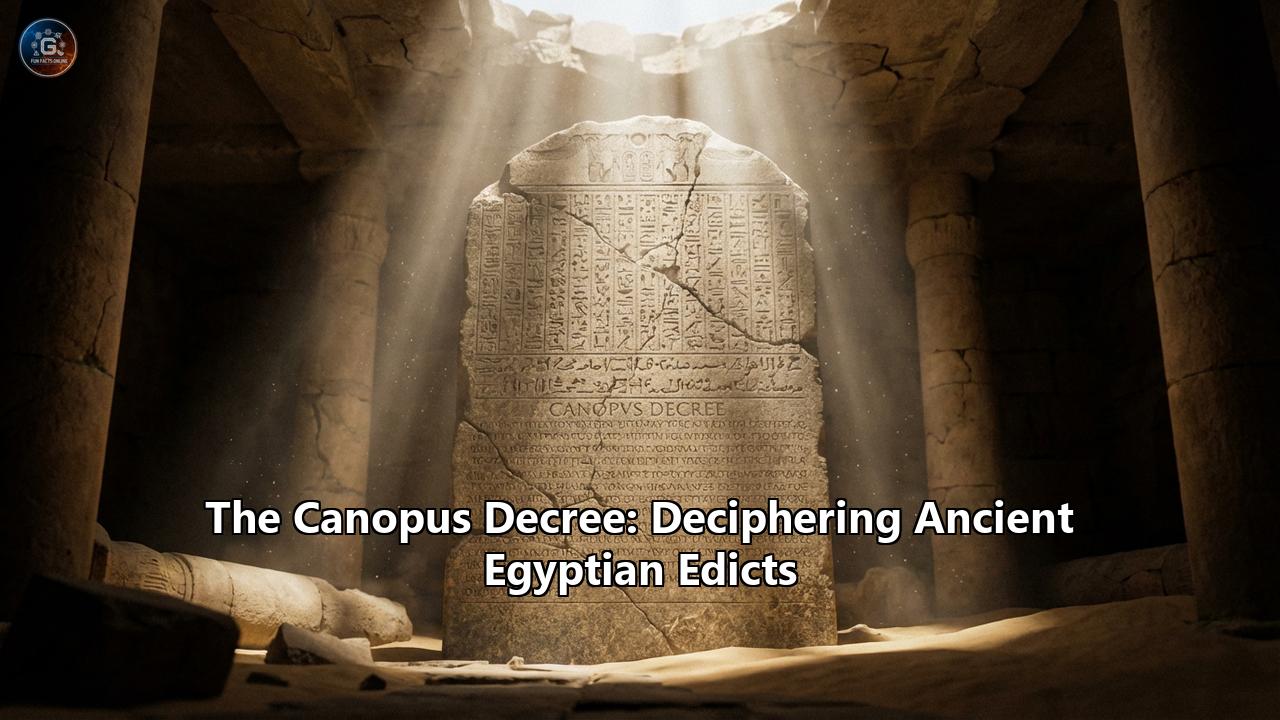
In the annals of Egyptology, one artifact looms so large that it often eclipses all others: the Rosetta Stone. Its discovery in 1799 is celebrated as the key that unlocked the secrets of hieroglyphs, ending over a millennium of silence from one of humanity’s greatest civilizations. Yet, the story of decipherment is not a solo act. Decades after Jean-François Champollion’s initial breakthrough, another stone emerged from the sands of the Nile Delta—one that was older, more complete, and in many ways, scientifically superior. This was the Decree of Canopus.
Issued in 238 BC by a synod of priests gathered to honor Pharaoh Ptolemy III Euergetes and his wife Queen Berenice II, the Canopus Decree is a masterclass in ancient political theater, religious synthesis, and scientific ambition. It is a document that attempted to rewrite time itself, proposing a calendar reform that predated Julius Caesar’s leap year by two centuries. It captures the grief of a royal family losing a child and the astute maneuvering of a Greek dynasty trying to present itself as the legitimate successors to the Pharaohs of old.
For the modern scholar, the Decree of Canopus is not merely a backup to the Rosetta Stone; it is a "Rosetta Stone 2.0"—a trilingual text of such philological richness that it served as the final confirmation that hieroglyphs had indeed been deciphered. And in a twist of fate that proves history is never truly finished, a groundbreaking discovery in September 2025 at Tell el-Pharaeen has thrust this ancient edict back into the global spotlight, offering a pristine, monolingual hieroglyphic version that challenges our understanding of how these decrees were disseminated.
This article explores the Canopus Decree in exhaustive detail, traveling from the war-torn Levant of the Third Syrian War to the quiet study rooms of 19th-century linguists, and finally to the muddy excavations of the modern Delta where the sands continue to yield their secrets.
Chapter I: The Geopolitical Stage – The Rise of Euergetes
To understand the text of the decree, one must first understand the world that produced it. The year is 238 BC. The Ptolemaic Kingdom, founded by Alexander the Great’s general Ptolemy I Soter, is at the zenith of its power. Sitting on the throne is Ptolemy III, known by the epithet Euergetes—"The Benefactor."
The Third Syrian War (The Laodicean War)
The decree’s opening lines are laden with praise for the King’s military prowess, specifically referencing his campaigns in "Asia." This is not empty propaganda; it refers to the Third Syrian War (246–241 BC), a conflict sparked by a Game of Thrones-style succession crisis.
When the Seleucid King Antiochus II died, a power struggle erupted between his two wives: Laodice I and Berenice Syra (the sister of Ptolemy III). Laodice, operating from Ephesus, claimed her son was the heir and moved quickly to eliminate her rival. By the time Ptolemy III marched his army out of Egypt to aid his sister, it was too late—Berenice and her infant son had been murdered.
Enraged, Ptolemy III launched a "war of vengeance" that saw Egyptian troops march deeper into Seleucid territory than ever before. Historical records suggest he reached as far as Babylon and perhaps even the borders of Bactria. The Canopus Decree alludes to this when it mentions him "bringing back the sacred images of the gods" that had been stolen by the Persians centuries earlier.
The Return of the Gods
This specific act—the repatriation of divine statues—was a masterstroke of domestic policy. In 525 BC, the Persian Emperor Cambyses II had conquered Egypt, and according to Egyptian memory, had looted the temples, carrying off statues of gods like Amun, Ptah, and Osiris to Persia. For nearly 300 years, this theft was a spiritual wound in the Egyptian psyche.
When Ptolemy III returned from his campaign, he didn't just bring back gold and silver; he brought back these lost gods. The decree explicitly thanks him for this act, stating:
"And the sacred images which had been carried off from the land of Egypt by the Asiatics, he recovered, and brought them back to Egypt, and restored them to the temples from which they had been taken."
By doing this, the Greek King Ptolemy presented himself not as a foreign occupier, but as the restorer of Ma’at (cosmic order). He was more Egyptian than the Egyptians, righting the wrongs of the hated Persian past. This context is crucial: the priests assembled at Canopus were not just flattering a tyrant; they were genuinely grateful to a monarch who had restored their religious heritage.
The Famine and the "Benefactor"
War was not the only crisis Ptolemy III faced. The decree also records a near-disaster: the failure of the Nile flood. In an agricultural society like Egypt, a "low Nile" meant famine. The annual inundation was the heartbeat of the economy; if the waters did not rise enough to irrigate the fields, the crops would fail, and starvation would follow.
The decree notes that during a year of low inundation, the King and Queen did not collect the usual taxes. Instead, they dipped into their own treasury to import grain from Syria, Phoenicia, and Cyprus to feed the population.
"They took care for the lives of all those who dwelt in the temples, and of all the other inhabitants of Egypt... spending much gold for the purchase of corn."
This act of "welfare" earned Ptolemy the title Euergetes (Benefactor). It solidified the bond between the palace and the priesthood. The priests, who controlled the grain silos and the temple lands, understood that their survival depended on a king willing to prioritize stability over profit. In exchange for this economic bailout, they were prepared to offer him something priceless: divinity.
Chapter II: The Synod of Canopus
The decree was not issued from the royal palace in Alexandria, but from a synod—a gathering of priests. These synods were a distinct feature of the Ptolemaic era, a mechanism by which the indigenous clergy and the Greek administration negotiated their relationship.
The Location: Canopus
Canopus (ancient Egyptian Peguat) was a coastal city located about 25 kilometers east of Alexandria. Today, it is largely submerged in the Bay of Abu Qir, a victim of rising sea levels and liquefaction, but in 238 BC, it was a bustling port and religious center. It housed a famous temple to Osiris, who was worshipped there in the form of a jar with a human head—the origin of the term "Canopic jar" used by early Egyptologists (a misnomer that stuck).
The choice of Canopus was significant. It was close enough to the capital, Alexandria, to be under royal supervision, but it was an ancient Egyptian city with deep religious roots, unlike the purely Greek metropolis of Alexandria. It was a bridge between the two worlds.
The Date
The decree specifies the date with precision: the 9th year of the reign of Ptolemy III, on the 17th day of the Egyptian month Tybi, which corresponded to the 7th day of the Macedonian month Apellaios. In our modern calendar, this date is March 7, 238 BC.
The synod was attended by high priests, prophets, "stolistes" (priests who dressed the statues), and "pterophores" (feather-bearers or scribes) from all over Egypt. They had gathered originally to celebrate the King's birthday and his accession day, but the agenda quickly expanded to include a comprehensive reform of religious and civil life.
Chapter III: The Content of the Decree
The text of the Canopus Decree is a dense, multi-layered document. It can be divided into four main sections:
- Royal Encomium: Praise of the King and Queen for their military and economic deeds.
- Priestly Honors: The creation of a new class of priests to serve the royal cult.
- The Calendar Reform: The introduction of the leap year.
- The Cult of Princess Berenice: The deification of the royal couple's deceased daughter.
1. The New Priestly Tribe
To honor the King and Queen, the synod decided to reorganize the priesthood itself. traditionally, the priests of each temple were divided into four "phylai" (tribes or shifts), each serving for one month in rotation. The decree established a fifth tribe, to be named the "Tribe of the Benefactor Gods" (Euergetai).
This was a radical administrative change. It meant adding new priests, creating new revenue streams, and altering the rotation schedules of every temple in Egypt. It embedded the worship of Ptolemy and Berenice directly into the daily life of the holy places. Every time a priest identified himself, he had to state which tribe he belonged to; now, 20% of them would identify directly with the King.
2. The Calendar Reform: A Scientific Revolution
The most famous section of the Canopus Decree is its attempt to fix the Egyptian calendar.
The Problem: The Wandering YearThe ancient Egyptian civil calendar was deceptively simple: 12 months of 30 days, plus 5 extra days (epagomenal days) added at the end of the year to make 365.
- Total: 365 days.
- Actual Solar Year: ~365.25 days.
Because the calendar was short by a quarter of a day every year, it "wandered." Every four years, it fell one day behind the seasons. Over 1,460 years (a period known as the Sothic Cycle), the calendar would rotate completely backward through the seasons until New Year's Day once again coincided with the heliacal rising of the star Sirius (Sothis).
For a farmer, this was confusing but manageable. For priests, it was a theological crisis. It meant that summer festivals would eventually be celebrated in the dead of winter. The decree states the problem clearly:
The Solution: The Leap Day"In order that the seasons may correspond to the fixed order of the world... and that it may not happen that some of the national festivals kept in the winter may come to be kept in the summer, the sun changing one day in every four years..."
The solution proposed by the priests (likely with input from Alexandrian astronomers) was elegant. They decreed that every fourth year, a sixth epagomenal day should be added to the usual five. This day was to be dedicated to the Benefactor Gods.
"From now on, one day, a festival of the Benefactor Gods, shall be added every four years to the five additional days."
This is the first recorded instance of a leap year in human history. It predates the Julian Calendar of Julius Caesar (45 BC) by nearly two centuries. Had it been successfully implemented, the "Alexandrian Calendar" would have kept perfect time with the seasons from 238 BC onward.
The FailureRemarkably, the reform failed. The Egyptian priesthood, deeply conservative and attached to the rhythm of the "wandering year" which allowed festivals to tour through the seasons, largely ignored the instruction. After Ptolemy III died, the leap day was abandoned. It wasn't until the Roman conquest, under Augustus in 25 BC, that the leap year was forcibly reintroduced in Egypt, creating the Coptic Calendar which is still used by the Coptic Church today.
3. The Tragedy of Princess Berenice
The emotional core of the decree is the section concerning the death of Princess Berenice, the young daughter of the King and Queen. She died suddenly during the synod, casting a pall over the proceedings.
The priests turned this tragedy into a moment of religious innovation. They deified the child, giving her the title "Berenice, Lady of Virgins" (or Anas-nefer in Egyptian). The decree lays out elaborate rituals for her worship:
- The Bread of Berenice: A special loaf of bread, shaped specifically for her cult (some translations suggest it was shaped like a qefen or "cake"), was to be distributed to the wives of priests.
- The Gold Statue: A gold statue of the princess, inlaid with precious stones, was to be placed in the holy of holies of the first and second rank temples.
- The Procession: Her statue was to be carried in processions alongside the great god Osiris. The decree specifies that her statue should wear a unique crown: a diadema combining the royal uraeus (cobra) with ears of corn (symbolizing harvest and resurrection).
- The Hymns: Sacred hymns were commissioned to be sung by priestesses in her honor.
This section reveals the human side of the ancient world. Amidst the high politics and calendar math, there is a palpable sense of mourning. The deification was likely a way for the priests to comfort a grieving King and Queen, assuring them that their daughter lived on among the gods.
Chapter IV: The Steles – Witnesses to History
Like the Rosetta Stone, the Canopus Decree was ordered to be inscribed on steles of stone or bronze in three scripts:
- Hieroglyphs: The "script of the divine words" (for the gods).
- Demotic: The "script of the documents" (for the Egyptian people).
- Greek: The "script of the Ionians" (for the ruling administration).
The Tanis Stone (1866)
For centuries, the decree was known only from passing references. Then, in 1866, the Prussian Egyptologist Karl Richard Lepsius made a stunning discovery in the ruins of Tanis (San el-Hagar) in the eastern Delta.
Lepsius found a limestone stele, 2.2 meters high, largely intact. When he examined it, he realized he had found the "other" Rosetta Stone. It contained 37 lines of hieroglyphs, 76 lines of Greek, and 74 lines of Demotic.
The Tanis Stone was crucial because the hieroglyphic section of the Rosetta Stone is broken—only the last 14 lines remain. The Tanis Stone provided a complete hieroglyphic text that could be compared directly with a complete Greek translation. It served as the final "proof of concept" for Champollion’s decipherment system. Skeptics who argued that Champollion had "guessed" the values of signs on the Rosetta Stone were silenced by the Canopus Decree, which yielded perfect translations using Champollion’s grammar.
The Kom el-Hisn Stela (1881)
Fifteen years later, French Egyptologist Gaston Maspero found a second copy at Kom el-Hisn in the western Delta. This version was also trilingual but helped fill in minor gaps and showed how the decree was distributed to different regions.
The 2025 Discovery: The Tell el-Pharaeen Stela
Fast forward to September 2025. An Egyptian mission led by the Supreme Council of Antiquities was excavating at Tell el-Pharaeen (ancient Imet or Buto) in the Sharqia Governorate. There, buried in the sand, they found a pristine sandstone stele.
Physical Description:- Height: 127.5 cm
- Width: 83 cm
- Thickness: 48 cm
- Material: Sandstone
- Header: A winged sun disk flanked by two uraei (cobras) wearing the White and Red Crowns of Upper and Lower Egypt. Between them is the sign Di-Ankh ("Given Life").
Why is a hieroglyph-only version important? It challenges the standard narrative that these decrees were always trilingual. The existence of a monolingual copy suggests that in some temples—perhaps those in highly traditional or strictly Egyptian sanctuaries like Buto—the Greek and Demotic versions were considered unnecessary or perhaps even unwelcome in the inner sanctum. It implies a "target audience" of high priests who were fluent in the sacred script, rendering the vernacular (Demotic) and the administrative (Greek) scripts redundant for the specific ritual context of that temple.
This find, occurring 159 years after Lepsius’s discovery, serves as a potent reminder that the soil of Egypt is far from exhausted. It allows philologists to study the hieroglyphic text in isolation, free from the "contamination" of being a direct translation exercise on the same stone, and to see how the text might have been adapted for a purely Egyptian context.
Chapter V: The Decree vs. The Rosetta Stone
It is impossible to discuss the Canopus Decree without comparing it to its younger, more famous sibling, the Rosetta Stone (The Memphis Decree of 196 BC).
| Feature | The Canopus Decree (238 BC) | The Rosetta Stone (196 BC) |
| :--- | :--- | :--- |
| Pharaoh | Ptolemy III Euergetes | Ptolemy V Epiphanes |
| Context | Victory, Prosperity, Confidence | Civil War, Weakness, Rebellion |
| Completeness | Several intact copies found | Only one broken fragment found |
| Scripts | Hieroglyphs, Demotic, Greek | Hieroglyphs, Demotic, Greek |
| Key Innovation | The Leap Year (Solar Calendar) | Tax Amnesty (to quell revolt) |
| Philological Value | Higher (more varied vocabulary) | Symbolic (the first key) |
Why is Rosetta more famous?Timing and politics. The Rosetta Stone was found first (1799) during the Napoleonic Wars, at a time when Europe was desperate to crack the code. By the time the Canopus Decree was found (1866), the code was already cracked. Had the order of discovery been reversed, the "Tanis Stone" would likely be the icon sitting in the British Museum today, and "Rosetta" would be a footnote.
However, linguistically, Canopus is superior. The Greek text on the Canopus stela is written in high-quality, flowery Hellenistic Greek, whereas the Rosetta Greek is dry and bureaucratic. The hieroglyphs on Canopus are also more intricate, using a wider range of signs that helped refine the understanding of the complex Ptolemaic writing system, which was far more decorative and cryptic than the classical Pharaonic script.
Chapter VI: Legacy and Echoes
The legacy of the Canopus Decree extends far beyond the Ptolemaic Period.
The Calendar that Wouldn't Die:Although the leap year reform failed in 238 BC, the idea didn't disappear. It sat in the archives of Alexandria, waiting. When Julius Caesar arrived in Egypt in 48 BC and had his romance with Cleopatra VII (a descendant of Ptolemy III), he was introduced to the Alexandrian astronomer Sosigenes. Sosigenes likely explained the Canopic reform to Caesar. Caesar took this Egyptian idea back to Rome, implementing it as the Julian Calendar.
Every time we add a nearly Feb 29th to our calendar, we are following an instruction first carved onto the Canopus stone 2,200 years ago. We are living in the time of Ptolemy III.
The City Beneath the Sea:The decree also verified the importance of Heracleion and Canopus as major ports. For a long time, these cities were considered semi-mythical. But in the late 20th and early 21st centuries, underwater archaeologist Franck Goddio discovered the sunken ruins of these cities in Abu Qir Bay. There, underwater, he found more steles and statues, confirming the descriptions in the decree. The stone text served as a treasure map, guiding divers to the remains of a lost world.
Conclusion
The Canopus Decree is more than a slab of granite. It is a hologram of a civilization in transition. It shows us a Greek king trying to be a Pharaoh, a priesthood trying to preserve their traditions through adaptation, and a society grappling with the mechanics of the cosmos.
From the grief of losing a princess to the audacity of correcting the sun itself, the decree covers the full spectrum of the human experience. The 2025 discovery of the hieroglyphic version at Tell el-Pharaeen proves that this story is still being written. As we brush the sand off these new inscriptions, we find that the voices of 238 BC are as clear, as urgent, and as innovative as they were two millennia ago. The Rosetta Stone may have given us the alphabet, but the Canopus Decree gave us the world.
Extended Analysis: The Textual Nuances
(For the dedicated enthusiast, we delve deeper into specific passages) The Bread of BereniceThe decree mentions a specific type of bread: “And the bread which is given to the wives of the priests... shall have a special shape and be called the Bread of Berenice.”
Scholars debate the word used here. The hieroglyphic text uses a determiner for a loaf. This offers a rare glimpse into the "kitchen religion" of Egypt—how high theology was translated into the food eaten by the temple staff. It suggests that the memory of the princess was kept alive not just in hymns, but in the daily breaking of bread.
The "Asiatics" and the StatuesThe term used for the Persians in the hieroglyphic text is often derogatory. The return of the statues was a reversal of the trauma of the Persian Period (27th Dynasty). The Decree of Canopus can be read as a declaration of independence from Asian influence, asserting Egypt (under Greek rule) as a sovereign power capable of humiliating the East. This geopolitical posturing is relevant even today in understanding the cycles of empire in the Levant.
The "Sothis" ConnectionThe decree explicitly mentions the star Sopdet (Sirius). The Egyptians knew that Sothis rose roughly every 365.25 days. The resistance to the calendar reform wasn't scientific ignorance; it was religious adherence. The "Wandering Year" allowed festivals to cycle through the seasons, meaning every god got to be celebrated in summer, winter, spring, and autumn over the course of a Sothic Cycle. Fixing the calendar would have "frozen" the gods in specific seasons, which the priests likely felt limited the divine power. Ptolemy’s rational, Greek attempt to "fix" the chaos clashed with the Egyptian cyclical view of time.
Final Thoughts
The Canopus Decree remains one of the greatest intellectual achievements of the ancient world. It represents a moment where science (the 365.25-day year) and religion (the deification of royalty) met on a stone tablet. It is a testament to the multicultural experiment of Ptolemaic Egypt—a fusion that ultimately shaped the Roman world and, by extension, our own. Whether viewed through the lens of archaeology, astronomy, or philology, the Decree of Canopus stands as a towering monument to human ingenuity.
Reference:
- https://news.artnet.com/art-world/archaeologists-find-new-version-decree-of-canopus-hieroglyphics-2687455
- https://arkeonews.net/archaeologists-discover-unique-hieroglyphic-version-of-ptolemy-iiis-canopus-decree/
- https://archaeology.org/news/2025/09/12/new-complete-copy-of-canopus-decree-recovered/
- https://www.britannica.com/place/Canopus-ancient-city-Egypt
- https://egyptianmuseumcairo.eg/artefacts/stela-with-canope-decree/
- https://egypt-museum.com/osiris-canopic-jar/
- https://cleopatrancienthegyptianmummy.com/Treasure_Archaeology/Canopus_Greek_Kanobus_Temple_Serapis_Osiris_Ancient_Egyptian_Monuments_Remains_Archaeology_Mediterranean_Sea.html
- https://en.wikipedia.org/wiki/Canopus,_Egypt
- https://www.britannica.com/topic/Decree-of-Canopus
- https://en.wikipedia.org/wiki/Decree_of_Canopus
- https://www.britannica.com/science/Egyptian-calendar
- https://en.wikipedia.org/wiki/Egyptian_calendar
- https://en.wikipedia.org/wiki/Sothic_cycle
- https://academic.oup.com/book/27844/chapter/198160619
- https://archaeologymag.com/2025/09/complete-copy-of-the-canopus-decree/
- https://eclass.uoa.gr/modules/document/file.php/BAAG178/5.%20INTERSTATE%20RELATIONS%20IN%20THE%20THIRD%20CENTURY%20.pdf
- https://www.metmuseum.org/art/collection/search/545980
- https://dn790008.ca.archive.org/0/items/decreesofmemphis03budg/decreesofmemphis03budg.pdf