
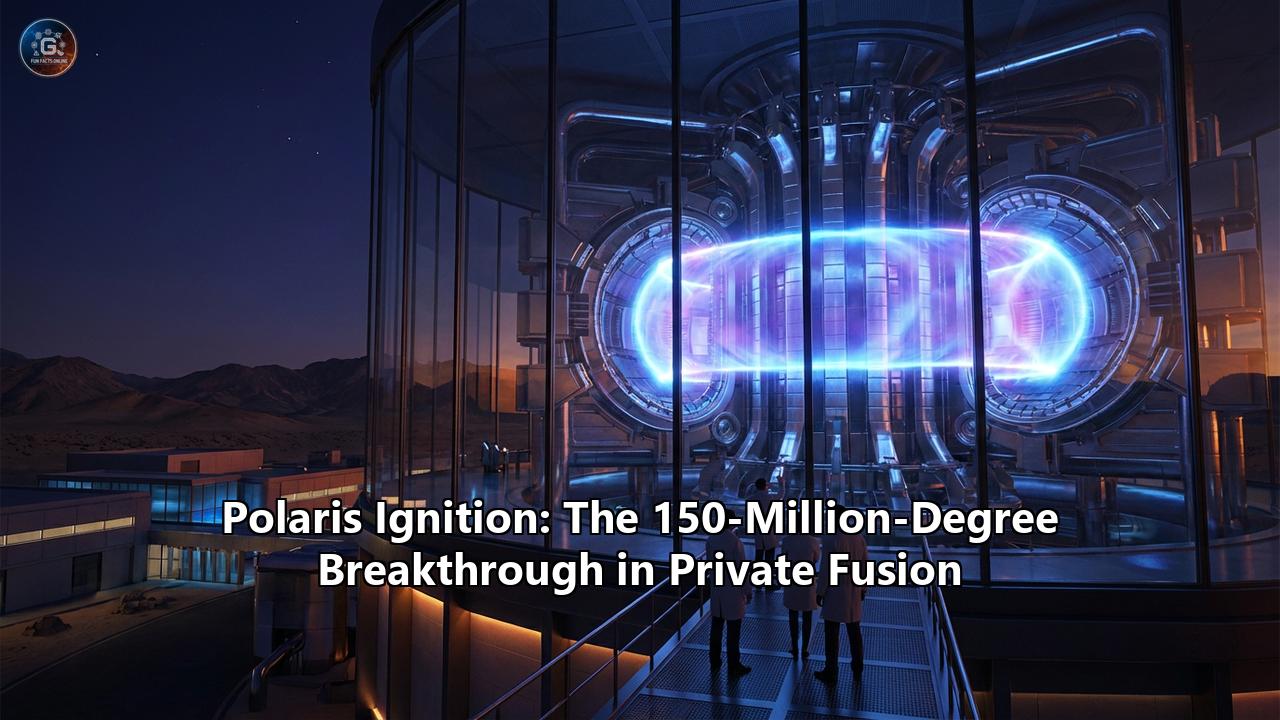
Part I: The Spark in the Dark
The 150-Million-Degree TelegramOn a rainy Tuesday in Everett, Washington, inside a nondescript warehouse that looks more like a logistics center than the birthplace of a new star, a computer monitor flickered with a single line of data that would ripple through the global energy markets.
The number was 15.2 keV.
To a layman, it is a meaningless metric of kinetic energy. To a plasma physicist, it translates to roughly 176 million degrees Kelvin, or about 150 million degrees Celsius. It is ten times hotter than the core of the Sun. It is the temperature at which deuterium and tritium—isotopes of hydrogen found in seawater and lithium—stop behaving like gas and start behaving like stars. They fuse, releasing the binding energy of the cosmos in a burst of fast neutrons and alpha particles.
This wasn’t a government lab. It wasn’t the ITER megaproject in France, funded by thirty-five nations and costing over $25 billion. This was Polaris, the seventh-generation prototype from Helion Energy, a private company backed by Silicon Valley capital and led by a team of engineers who believe they can beat physics with engineering.
The announcement that followed was understated, but the implications were seismic. For the first time in history, a private entity had achieved the thermal conditions necessary for deuterium-tritium (D-T) fusion ignition. While Helion’s ultimate goal lies with a different fuel—the elusive deuterium-helium-3 (D-³He)—this 150-million-degree benchmark proved that their unique magnetic compression technology was not just a theoretical model on a whiteboard. It was real, it was hot, and it was scaling faster than any government timeline had predicted.
The breakthrough comes at a precarious moment for civilization. The hunger for energy has never been greater, driven by the dual leviathans of artificial intelligence and electrification. Data centers for AI training runs are now consuming gigawatts of power, rivaling the consumption of small nations. The world needs a miracle: a baseload, carbon-free, limitless energy source that can be deployed not in fifty years, but in five.
Helion has promised exactly that. They have signed a binding Power Purchase Agreement (PPA) with Microsoft to deliver 50 megawatts of fusion electricity to the grid by 2028. To the skeptics, this timeline is science fiction—a "thermonuclear Theranos" waiting to collapse. To the believers, the 150-million-degree plasma in Everett is the proof that the impossible is merely an engineering problem waiting for the right iteration.
This is the story of that machine, the physics that drives it, and the high-stakes race to bottle a star.
Part II: The Diesel Engine of the Stars
The FRC DifferenceTo understand why Polaris is different, one must first understand the orthodoxy of fusion. For seventy years, the dominant design has been the tokamak—a Russian invention that looks like a hollow donut. In a tokamak, massive superconducting magnets hold a plasma in a steady, continuous ring. The goal is to keep the plasma burning forever, like a gas pilot light. This approach, exemplified by ITER and Commonwealth Fusion Systems (CFS), requires immense scale and magnetic fields of crushing strength to prevent the superheated gas from touching the walls.
Helion took a look at the tokamak and said: “Too complicated. Too fragile.”
Instead of a steady ring, Helion built something that resembles a diesel engine. Their device is a long, dumbbells-shaped cylinder. The process, known as Magneto-Inertial Fusion (MIF), happens in pulses, not a continuous stream.
Here is the choreography of a single Helion pulse, which happens in milliseconds:
- Formation: At both ends of the machine, injectors blast deuterium fuel into the chamber. Magnetic coils instantly ionize this gas into a plasma configuration known as a Field Reversed Configuration (FRC). Imagine a smoke ring made of lightning, spinning so fast it creates its own magnetic field that holds it together.
- Acceleration: Magnets along the length of the machine fire in sequence, acting like a railgun. The two FRC smoke rings are accelerated toward the center of the machine at over one million miles per hour.
- Collision and Compression: The two rings slam into each other in the central chamber. At the exact moment of impact, a powerful external magnetic field clamps down, compressing the merged plasma to a fraction of its original size.
- Ignition: This violent compression raises the pressure and temperature instantaneously. This is the "diesel" moment—just as a piston compresses air and fuel until it explodes without a spark plug, Helion’s magnets compress the plasma until it reaches 150 million degrees. Fusion occurs. Atoms merge, releasing energy.
- Expansion and Capture: This is the magic trick. In a traditional reactor, fusion heats water, which turns to steam, which spins a turbine. It is 19th-century steam technology attached to 22nd-century physics. Helion skips the steam. As the fusion reaction releases energy, the plasma ball expands violently. This expanding magnetic field pushes back against the machine’s magnets. Through Faraday’s Law of Induction, this change in magnetic flux induces a current directly in the coils.
The machine is the generator. It recaptures the electricity used to compress the plasma, plus the new energy created by fusion.
The 150-Million-Degree ThresholdWhy is the number 150 million so critical?
In nuclear physics, fusion is a probability game. Two atomic nuclei are positively charged; they naturally repel each other like the north poles of two magnets. To get them to fuse, you have to smash them together with enough speed (heat) to overcome this "Coulomb barrier."
For Deuterium-Tritium (D-T) fuel, the probability of fusion (the cross-section) skyrockets around 100 million degrees Celsius. Below this temperature, you are just spending energy to heat gas. Above it, you enter the regime where the energy released by fusion can theoretically exceed the energy lost to radiation (bremsstrahlung) and conduction.
Reaching 150 million degrees in Polaris proves that Helion’s magnetic compression can impart enough energy to the ions to cross this barrier. It validates the "heating" leg of the fusion tripod. The other two legs—density (how many particles are packed together) and confinement time (how long they stay hot)—are the remaining hurdles. But temperature is the gatekeeper. Without it, the door to fusion remains locked.
Part III: The Fuel War
The Neutron ProblemIf 150 million degrees is enough for fusion, why hasn't Helion declared victory? The answer lies in the fuel.
Most of the world, including ITER and CFS, is betting on Deuterium-Tritium (D-T).
- Deuterium is easy; it’s in seawater.
- Tritium is hard. It is a radioactive isotope of hydrogen with a half-life of 12 years. It doesn't exist in nature; it must be "bred" inside the reactor by bombarding lithium blankets with neutrons.
- The reaction: D + T → Helium-4 + Neutron.
That neutron is a problem. It carries 80% of the energy from the reaction. Because it has no electrical charge, it cannot be contained by magnetic fields. It smashes into the walls of the reactor like a microscopic bullet, turning the steel brittle and radioactive over time. This is why tokamaks need walls made of exotic materials like beryllium and tungsten, and why they need steam turbines—the only way to capture the neutron's energy is to let it heat up the walls and boil water.
The Helion Gamble: Deuterium-Helium-3Helion wants to bypass the steam turbine and the neutron damage. Their goal is Deuterium-Helium-3 (D-³He) fusion.
- The reaction: D + ³He → Helium-4 + Proton.
Notice the difference? The output is a proton, not a neutron. A proton is positively charged. It can be manipulated by magnetic fields. This means its energy can be captured directly by the coils (the expansion phase described earlier) with up to 95% efficiency, compared to the 30-40% efficiency of a steam turbine.
There are two catches to D-³He fusion:
- Physics: It is harder to ignite. The Coulomb barrier is higher because Helium-3 has two protons, doubling the repulsive force. You need temperatures of 200 million degrees or more to make it viable. The 150 million degrees achieved by Polaris is a stepping stone, not the finish line for this fuel.
- Supply: Helium-3 is incredibly rare on Earth. It is abundant on the Moon, but mining the Moon is not in Helion’s business plan for 2028.
So where does Helion get the Helium-3? They plan to make it.
When you smash Deuterium atoms together (D-D fusion), about half the time they produce Helium-3 directly. The other half of the time, they produce Tritium. But remember, Tritium decays into Helium-3 over time.
Helion’s patent, the "HelCat" (Helion Catalyzed) cycle, proposes running the reactor in a "breeding mode" using pure Deuterium. They will harvest the Helium-3 produced by the D-D reactions and the decaying Tritium, store it, and then inject it back into the machine for the high-efficiency D-³He pulses. It is a closed-loop fuel cycle that turns seawater (deuterium source) into electricity, with Helium-3 as the internal catalyst.
The 150-million-degree milestone in Polaris was likely achieved using a D-T mix to prove the temperature capabilities, but the ultimate commercial machine, Orion, must run on D-³He to make the economics of direct electricity capture work.
Part IV: The Competitive Landscape
Helion is not running this race alone. The private fusion industry has exploded into a $7 billion sector, with over 40 companies vying for the prize. Here are the other "Fusion Unicorns" chasing the same grail.
1. Commonwealth Fusion Systems (CFS)- HQ: Devens, Massachusetts (Spun out of MIT).
- Tech: High-Field Tokamak (SPARC).
- The Edge: They invented a new kind of magnet using High-Temperature Superconductors (HTS) made of Rare Earth Barium Copper Oxide (REBCO). These magnets are insanely powerful (20 Tesla), allowing them to shrink the tokamak from the size of a stadium (ITER) to the size of a tennis court.
- Status: SPARC is under construction. They aim for "Net Energy" (Q > 1) by 2027.
- Contrast: CFS is the "safe bet" scientifically because tokamaks are well-understood. If the magnets work, the physics should work. Helion is the "wildcard" because FRC physics is less mature, but the engineering payoff (direct capture) is higher.
- HQ: Foothill Ranch, California.
- Tech: Beam-driven FRC.
- The Edge: Like Helion, they use FRCs, but they form them differently—using neutral particle beams to heat and stabilize the plasma. They are aiming for an even harder fuel: Hydrogen-Boron (p-B11), which requires billions of degrees but is completely aneutronic and uses abundant fuel.
- Status: Their "Copernicus" reactor is aiming for net energy around the same time as Helion. They recently achieved stable plasmas at 75 million degrees.
- HQ: Everett, Washington (Neighbors to Helion).
- Tech: Sheared-Flow Z-Pinch.
- The Edge: No magnets. Zap uses the electric current inside the plasma to generate the magnetic field that squeezes it (the "pinch" effect). It is elegantly simple and compact.
- Status: Their "FuZE-Q" device is pushing toward energy breakeven. They recently demonstrated remarkable plasma stability, solving a problem that plagued Z-pinch research for decades.
- HQ: Vancouver, Canada.
- Tech: Magnetized Target Fusion (MTF).
- The Edge: Steampunk Fusion. They spin a tank of liquid metal (lithium-lead) to create a vortex, inject a plasma, and then use steam-powered pistons to collapse the liquid metal wall, crushing the plasma.
- Status: Building a demonstration plant in the UK.
Helion’s 150-million-degree achievement puts them arguably in the lead for thermal performance among the alternative (non-tokamak) concepts. While tokamaks have hit higher temperatures in the past (JET, JT-60SA), they have not done so in a machine designed for commercial pulsed electricity generation. Helion is proving that a "cheap" machine can get hot enough.
Part V: The Valley of Death
Why 2028 Might Be ImpossibleDespite the celebration, the path from 150 million degrees to a lightbulb glowing in a Microsoft data center is fraught with peril. This gap is known in venture capital as the "Valley of Death." For fusion, it is a canyon.
1. The Q-Value TrapTemperature is necessary, but not sufficient. You also need density and confinement time. The product of these three (Temperature × Density × Time) is the Lawson Criterion.
Tokamaks are great at confinement time (seconds) but struggle with density. Helion is great at density (compression) but struggles with confinement time (milliseconds).
To get net electricity, Helion needs a "Wall-Plug Efficiency" (Q_eng) greater than 1. This means the electricity coming out of the wire must be greater than the electricity pulled from the grid to charge the capacitors, run the vacuum pumps, and cool the magnets.
Currently, no fusion device on Earth has achieved Q_eng > 1. The National Ignition Facility (NIF) achieved "scientific ignition" (fusion energy > laser energy hitting the target), but the wall-plug efficiency was less than 1% because the lasers were inefficient.
Helion claims their energy recovery is 95% efficient. If true, they don't need a massive Q_plasma (raw fusion gain) to get positive electricity. They just need a Q_plasma of slightly above 1. But that 95% recovery figure is a bold engineering claim that has yet to be proven at full 150-million-degree loads.
2. The First Wall NightmareEven with D-³He, there will be side reactions (D-D) that produce neutrons. In a pulsed machine, these neutrons arrive in shockwaves. The "first wall" of the reactor—the quartz or metal tube containing the plasma—will be subjected to pulsed thermal shocks and radiation damage that no material in history has ever withstood for long periods.
If Helion’s reactor wall degrades after a week of operation, the economics collapse. They need a machine that can pulse once every second, 24/7, for months without maintenance.
3. The Microsoft ContractThe PPA with Microsoft is a double-edged sword. It validates the technology commercially, but it imposes a brutal deadline. 2028 is essentially "tomorrow" in infrastructure time. It usually takes 4-5 years just to permit and build a standard gas power plant. Helion has to finalize the physics, design the commercial plant (Orion), build a factory to manufacture the capacitors (they need millions), get regulatory approval from the NRC (which recently ruled to regulate fusion more lightly than fission—a huge win), and construct the facility.
If they miss the deadline, they face financial penalties. But more importantly, they risk the credibility of the entire private fusion sector. A high-profile failure could freeze investment for a decade.
Part VI: The Economic Singularity
What If It Works?Let us suspend disbelief. Let us assume the 150 million degrees scales to 200 million. Let us assume the capacitors hold, the walls hold, and the electrons flow in 2028.
What happens to the world?
1. The End of Resource ScarcityEnergy is the master resource. Water scarcity is just energy scarcity (desalination requires energy). Food scarcity is energy scarcity (fertilizer and transport require energy). If Helion can deliver electricity at their projected cost—1 cent per kilowatt-hour—the cost of living collapses.
We could afford to desalinate the entire Pacific Ocean to irrigate the American West. We could scrub gigatons of CO2 from the atmosphere (Direct Air Capture is energy-intensive). We could synthesize liquid fuels from thin air for aviation.
2. The AI UnlocksArtificial Intelligence is currently constrained by power. Training a GPT-5 or GPT-6 model requires hundreds of megawatts. Microsoft’s interest in Helion isn't just about being green; it's about survival. They know that the grid cannot support the AI scaling laws. A modular 50 MW fusion reactor that can be placed next to a data center is the Holy Grail for Tech Giants. It decouples their growth from the aging, regulated utility grid.
3. Geopolitics RewrittenOil is the currency of geopolitics. Wars are fought over pipelines and shipping lanes. Fusion fuel (deuterium) is available to every nation with a coastline. A fusion-powered world is one where energy independence is the default, not the exception. The influence of petrostates wanes; the influence of "technostates" (those who hold the IP for the reactors) waxes.
4. The Space Age, For RealHelion’s technology—pulsed magnetic propulsion—is actually a rocket engine in disguise. In fact, Helion’s CEO David Kirtley originally worked on plasma thrusters for NASA. A fusion drive would open up the solar system. A trip to Mars would take weeks, not months. The same reactor that powers the data center could power the ship that mines the Helium-3 from the Moon.
Part VII: Conclusion
The Last Great FilterThe achievement of 150 million degrees in the Polaris machine is a "Sputnik moment" for private fusion. It proves that the barrier to entry for stellar physics is no longer the GDP of a superpower. It can be done in a warehouse in Washington State.
But a hot plasma is not a power plant. The distance between a burning match and a steam locomotive is vast. Helion is currently walking that distance, in the dark, at a sprint.
There is a concept in fermi paradox theory called the "Great Filter"—a hurdle so difficult that it stops civilizations from advancing. For humanity, sustainable, dense energy is our Great Filter. Fossil fuels got us this far, but they are choking us. Wind and solar are vital, but intermittent. Fission is powerful, but politically and economically brittle.
Fusion is the only door left. It is the energy of the universe, the fire of the gods. For 70 years, we have been trying to steal it.
In Everett, inside a magnetic chrysalis, the fire is finally burning hot enough. Now, we just have to see if we can keep it lit.
If Helion succeeds, 2026 will be remembered not as the year of political turmoil or economic shifts, but as the year the Promethean flame was finally passed to private hands. The age of fire is ending. The age of plasma has begun.
Reference:
- https://www.reddit.com/r/energy/comments/1r3u0p0/sam_altmans_fusion_startup_helion_energy_hits_150/
- https://www.geekwire.com/2026/helion-reaches-record-150-million-degrees-celsius-as-it-strives-for-ambitious-commercial-fusion-launch/
- https://thetechmarketer.com/fusion-startup-helion-blistering-temps-2028-deadline/
- https://www.reddit.com/r/fusion/comments/1m7hon2/microsofts_2028_fusion_deal_with_helion_is_a/
- https://torontostarts.com/2025/02/24/helions-fusion-reactor-by-2028/
- https://www.youtube.com/watch?v=jCP0VNrKeJs
- https://www.youtube.com/watch?v=V9lU9AExWMA
- https://www.energy-reporters.com/industry/big-money-bets-private-companies-claim-fusion-will-change-everything-by-2025-but-critics-warn-of-dangerous-overpromises/
- https://finance.biggo.com/news/202508040132_Helion_Fusion_Plant_Skepticism
- https://fusionxinvest.com/news/7598/commonwealth-fusion-systems-sparc-construction/
- https://carboncredits.com/google-and-chevron-back-tae-technologies-as-it-nears-fusion-power-breakthrough/
- https://www.cleanenergy-platform.com/insight/inside-taes-2025-plasma-breakthroughand-how-it-changed-fusions-trajectory
- https://www.youtube.com/watch?v=tlRLKGQBEcQ
- https://portside.org/2022-12-18/fusion-skepticism-follows-century-genius-fraud-and-hype
- https://www.forbes.com/sites/drewbernstein/2026/02/12/who-will-be-first-to-unlock-nuclear-fusion/
- https://www.sunya.ai/news/tae-technologies-raises-150-million-in-latest-funding-round
- https://www.neimagazine.com/news/funding-secured-for-hydrogen-boron-fusion-reactor/
- https://www.zapenergy.com/news/doe-century-milestone
- https://fusionenergyinsights.com/blog/post/fei-monthly-roundup-november-2025