
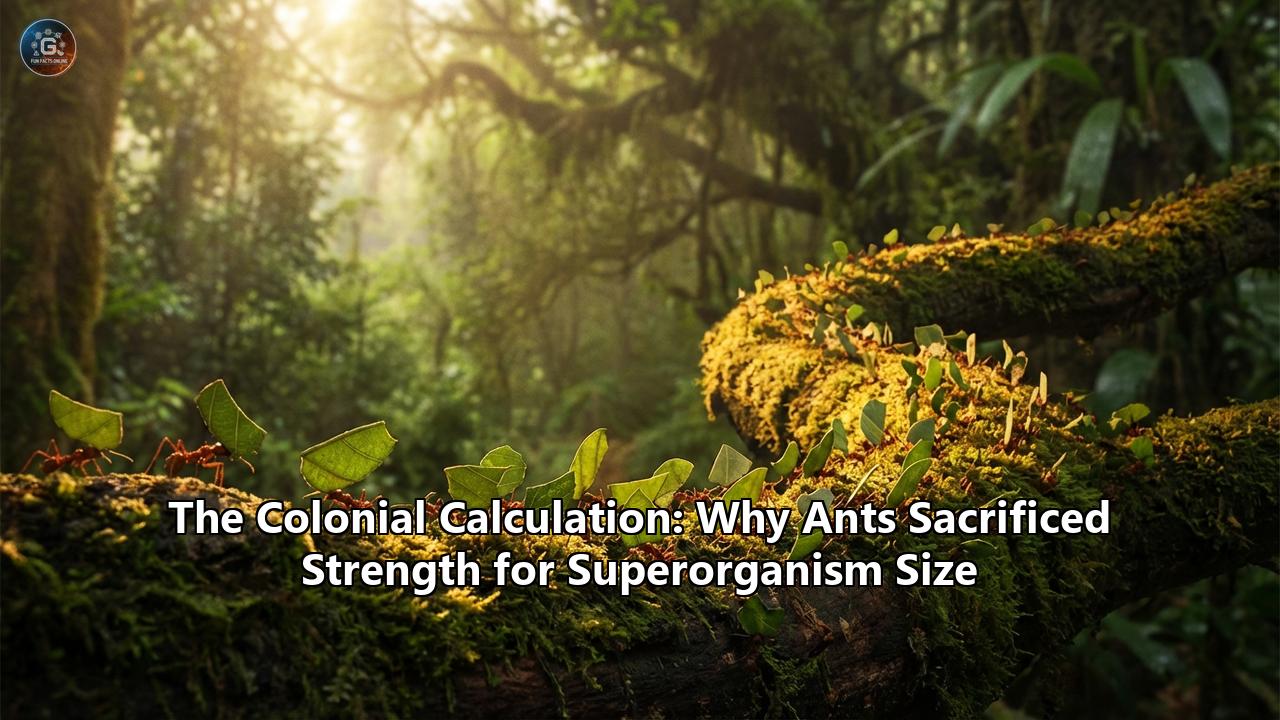
The forest floor is a battlefield, and for over 140 million years, it has been the stage for one of evolution’s most ruthless experiments. On one side, we find the "knights" of the undergrowth: large, heavily armored, solitary hunters equipped with terrifying mandibles and thick, impenetrable exoskeletons. On the other, we find the "legions": frail, soft-bodied, diminutive creatures that, individually, would perish in seconds.
Logic dictates that the strong should survive. Yet, if you look at the ground beneath your feet, the knights are rare, hiding in small pockets of the world. The legions, however, are everywhere. They cover every continent, consume more biomass than all vertebrates combined, and effectively rule the terrestrial ecosystem.
Recent groundbreaking research has finally illuminated the mathematical precision behind this paradox. It is known as The Colonial Calculation—an evolutionary turning point where ant species made a critical trade-off, sacrificing the strength of the individual for the overwhelming power of the superorganism. This is the story of how ants stripped away their armor to conquer the world.
Part I: The Biological Budget
The High Cost of Being Indestructible
To understand why ants became "weak," we must first understand the "cost" of being strong. In the insect world, strength is physical. It is defined by the exoskeleton—the cuticle. This rigid outer shell serves as both skeleton and shield. It anchors muscles, allowing for leverage and lifting power, and it protects the soft internal organs from desiccation, disease, and predators.
For a long time, it was assumed that a thicker cuticle was always better. Why wouldn’t an organism want more armor? The answer lies in the soil: Nitrogen.
Building a thick, durable exoskeleton requires complex polymers interwoven with chitin and proteins. These proteins are nitrogen-heavy. In nature, nitrogen is a "limiting factor"—a currency that is often scarce and difficult to harvest. For a developing colony, every microgram of nitrogen harvested by foragers is a precious coin that must be spent wisely.
Research led by the Okinawa Institute of Science and Technology (OIST) and the University of Cambridge has revealed that the "heavy armor" of primitive ants is incredibly expensive. To build a worker with a cuticle that makes up 35% of its body mass requires a massive upfront investment of food. It takes time, energy, and, most crucially, rare nutrients to forge these biological tanks.
Consequently, colonies that invest in "high-quality" workers hit a hard ceiling. They simply cannot afford to produce many of them. A colony of Dinoponera (giant Amazonian ants) might only number a few dozen individuals because each one is a nutritional masterpiece. They are the Ferraris of the insect world: high performance, high maintenance, and low production volume.
The Economy of "Squishability"
Somewhere along the evolutionary timeline, a lineage of ants stumbled upon a radical economic strategy: Cheaper workers.
By reducing the investment in the cuticle—thinning the armor and reducing the nitrogen requirement—a colony could produce significantly more workers for the same amount of food. A worker with a cuticle comprising only 6% of its body mass is fragile, yes. It can be crushed by a raindrop or snapped in half by a rival. But it is cheap.
This seemingly simple reduction in individual quality unlocked a geometric explosion in colony size. If you can produce ten cheap workers for the price of one expensive warrior, you suddenly have a numerical advantage. This is the core of the Colonial Calculation: Evolutionary success shifted from the survival of the fittest individual to the survival of the largest colony.
Part II: The Rise of the Superorganism
From Village to Empire
This shift from "quality" to "quantity" didn't just change the ants' bodies; it fundamentally rewired their society. When a colony has only 50 individuals, every ant matters. If a Dinoponera hunter is killed, the colony loses 2% of its workforce and a significant portion of its defensive capability. Each individual must be a generalist—capable of hunting, fighting, and navigating independently. They are less like cells in a body and more like members of a small tribe.
However, when a colony creates cheap workers and expands to 500,000 individuals, the death of a single ant becomes statistically irrelevant. This expendability is the key that unlocked Superorganismality.
With a massive, expendable workforce, ants could begin to specialize in ways that solitary or small-colony species never could. This is analogous to the evolution of multicellular life. Just as single-celled organisms banded together to form tissues and organs, individual ants began to function as "castes" or distinct biological tissues within the colony body.
- The Foraging Tissue: Thousands of cheap workers could form a living net, retrieving food with an efficiency no solitary hunter could match.
- The Defensive Tissue: Instead of individual strength, the colony could rely on "swarming" defenses. A million weak mandibles can strip a vertebrate to the bone faster than ten strong ones can.
- The Reproductive Tissue: The queen became a specialized egg-laying machine, fed by the constant stream of resources delivered by her cheap daughters.
The Cognitive Trade-Off
The "cheapening" of the worker extended beyond the exoskeleton. It also affected the brain. In small societies of "elite" ants, individuals often display surprising intelligence. They can hunt alone, navigate complex landmarks, and make independent decisions.
In the massive supercolonies of "cheap" ants, individual intelligence is often replaced by Swarm Intelligence. The individual ant doesn't need to be a genius; it just needs to follow simple algorithms (pheromone trails, alarm signals). The "brain" is no longer in the head of the ant; it is in the network of interactions between millions of ants. This allowed the individual ant to become biologically simpler even as the colony became socially complex.
Part III: The Spectrum of War
The Knights: Dinoponera and the Ponerines
To see the Colonial Calculation in reverse, we look to the Ponerinae subfamily. These are often considered "primitive" ants, retaining many traits of their wasp ancestors.
- The Look: These ants are formidable. Species like Dinoponera australis are massive, sometimes exceeding 3 centimeters in length. They have powerful stings, thick exoskeletons, and distinct individual behaviors.
- The Society: Their colonies are tiny, often fewer than 100 individuals. There is often high conflict within the colony; workers may fight for dominance, and the distinction between queen and worker is sometimes blurred.
- The Strategy: They rely on brute force. A single Ponerine ant can take down large prey. But they cannot dominate a landscape. They are like solitary tigers—apex predators, but low in density.
The Legions: Solenopsis and Linepithema
On the other end of the spectrum are the masters of the Colonial Calculation.
- Fire Ants (Solenopsis invicta): A mature colony contains hundreds of thousands of workers. Individually, a fire ant is soft and easily crushed. But they possess a "distributed armor." Their defense is not a thick shell, but a cloud of venom. They act as a fluid, pouring over enemies and stinging in unison.
- Argentine Ants (Linepithema humile): These ants are small, soft, and individually weak. Yet, they have formed a "global supercolony" that stretches across continents. Their workers are incredibly cheap to produce, allowing them to out-breed and out-eat almost any native species they encounter. They win wars not by dueling, but by attrition. They simply throw wave after wave of expendable bodies at the enemy until the enemy runs out of energy.
The Specialized Industrialists: Leaf-Cutter Ants
The Leaf-Cutters (Atta and Acromyrmex) represent the pinnacle of this calculation. They didn't just make workers cheap; they made them polymorphic.
They produce millions of tiny "minima" workers—so cheap they are barely visible—to tend their fungus gardens.
They produce massive "major" soldiers—expensive tanks—only when needed for defense.
By optimizing the size and cost of every single member of the colony, they have created the most complex societies on Earth next to humans. They are the ultimate example of "allocating the budget" effectively.
Part IV: Ecological Domination
Conquering the Nutrient-Poor
One of the most profound implications of the "cheap worker" strategy is the ability to colonize difficult environments.
In tropical rainforests, nitrogen is cycled rapidly and competition is fierce. In deserts or scrublands, resources are scarce. A species that requires a high "startup cost" (lots of nitrogen) to build a single worker will struggle in these environments.
However, the "cheap" ant, which requires very little nitrogen to reach adulthood, can thrive on low-quality diets. This is why aggressive, large-colony species often dominate disturbed habitats or invasive ranges. They can turn garbage into an army. They are not limited by the need for high-quality protein to build thick shells; they can subsist on sugary nectar or aphid honeydew (which is basically sugar water) to fuel their high-energy, high-tempo lifestyle, while saving the scarce protein for the queen and larvae.
The Feedback Loop of Success
The Colonial Calculation created a positive feedback loop that drove the evolution of ants:
- Thinner Cuticle → Lower Cost per Ant.
- Lower Cost → Larger Colony Size.
- Larger Colony → Better Resource Gathering.
- More Resources → Even Larger Colony.
- Massive Colony → Emergence of Complex Social Behaviors (agriculture, slavery, war).
This loop allowed ants to diversify into the 14,000+ species we see today. It allowed them to become the "soil engineers" of the planet. It is why, if you were to weigh all the ants in the Brazilian rainforest, they would outweigh all the mammals.
Part V: The Human Parallel
It is impossible to view the Colonial Calculation without seeing a reflection of human history.
We, too, have faced the trade-off between the "Hero" and the "Organization." In feudal times, warfare was dominated by the Knight—a heavily armored, expensive, elite unit. A king could only afford a few of them.
As states became more complex and centralized, the Knight was replaced by the Soldier—individually less protected, equipped with standardized gear, but deployable in armies of thousands. The "State" became the superorganism.
In our economies, we moved from the master craftsman (creating one high-quality item at a time) to the assembly line (creating millions of adequate items cheaply). The logic of the Colonial Calculation—scaling through efficiency and cost-reduction—is the logic of civilization itself.
Conclusion
The next time you brush a tiny, fragile ant off your picnic table, do not mistake its weakness for failure. That fragility is its greatest weapon. By shedding its armor, that ant's ancestors unlocked the power of the million. They realized that in the grand calculus of survival, the individual is nothing, but the colony is everything. The ant sacrificed its strength to become the strongest creature on Earth.
The Colonial Calculation was not a surrender. It was a purchase. And the ants bought the world.Reference:
- https://www.discovermagazine.com/ants-make-individuals-weaker-to-build-bigger-societies-48437
- https://www.miragenews.com/ant-societies-trade-individual-safety-for-group-1594080/
- https://scitechdaily.com/ants-traded-strength-for-numbers-and-it-worked/
- https://www.popsci.com/environment/how-ants-conquer-earth/