
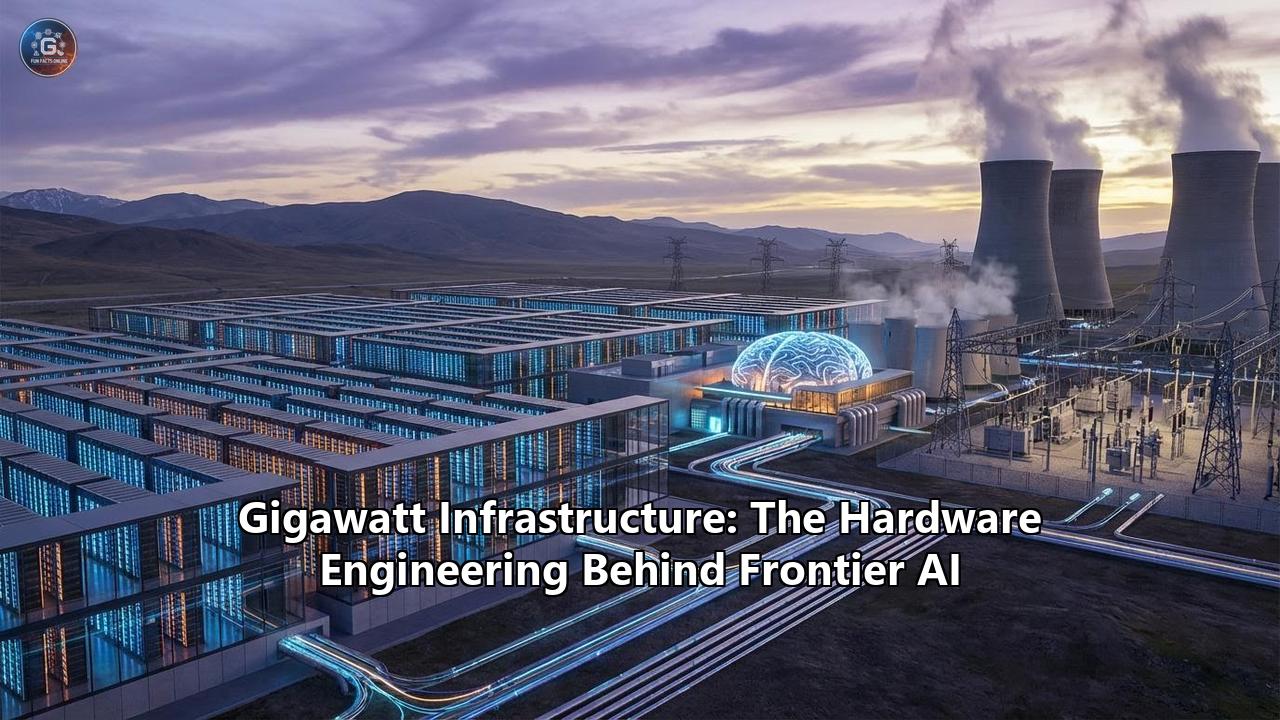
The digital world is entirely physical. When you query a frontier artificial intelligence model, your prompt does not float into an ethereal “cloud.” It travels at the speed of light through fiber-optic cables to a massive, heavily fortified industrial complex. Inside, hundreds of thousands of microscopic transistors fire in unison, consuming staggering amounts of electrical power and generating intense physical heat. For years, the physical footprint of the internet was easily abstracted away. But as we chase Artificial General Intelligence (AGI), the abstraction is breaking down. We have entered the era of gigawatt infrastructure.
To understand the sheer scale of the modern AI revolution, you have to look past the algorithmic breakthroughs and focus on the thermodynamics, the material science, and the civil engineering. The data center—once a quiet warehouse of humming servers—has evolved into the most complex and power-dense supercomputer humanity has ever constructed. Tech giants are no longer just software companies; they are energy brokers, nuclear investors, and advanced thermodynamics engineering firms.
This is the hardware engineering behind frontier AI. It is a story of chips pushed to the limits of atomic physics, cooling systems that move rivers of synthetic fluid, and power demands so vast they are single-handedly reviving the global nuclear energy industry.
The Scale of the Gigawatt MegaCampus
Before 2024, a "massive" hyperscale data center consumed roughly 50 to 100 megawatts (MW) of power. To put that in perspective, 100 MW is enough to power a small city. But the training demands of models like GPT-4, Claude 3, and Gemini Ultra fundamentally broke the old scaling laws. Training a state-of-the-art model today requires orchestrating over 100,000 graphics processing units (GPUs) in a single, synchronized run.
As of early 2026, the industry standard for frontier AI facilities has shifted from megawatts to gigawatts (GW). One gigawatt is 1,000 megawatts—equivalent to the power output of a large nuclear reactor, or enough to power approximately 750,000 to one million homes. Projects like the Stargate campus in Abilene, Texas, were designed to draw 1.2 GW of power, with plans to expand toward 2 GW. Globally, there are now dozens of gigawatt-scale projects in the pipeline, representing over $100 billion in committed capital.
These MegaCampuses are not just larger versions of old data centers; they are a completely new species of infrastructure. They cover hundreds of acres, requiring their own dedicated high-voltage electrical substations, advanced water treatment facilities, and onsite power generation. The sheer density of these campuses means that the primary bottleneck to AI development is no longer coding or data availability—it is the availability of concrete, copper, power transformers, and grid interconnection rights.
Silicon Behemoths: Pushing the Reticle Limit
At the heart of these gigawatt campuses are the AI accelerators. The evolution from general-purpose CPUs to highly specialized GPUs and Tensor Processing Units (TPUs) is well documented, but the engineering required to build the 2026 generation of silicon borders on science fiction.
Traditional chips were small and sleek. Modern AI chips are massive, hot, and dense. Take Nvidia’s architectural roadmap. The transition from the Hopper architecture to Blackwell pushed die sizes to their physical manufacturing limits—the "reticle limit" of photolithography machines. To bypass this hard limit of physics, engineers began stitching multiple silicon dies together into a single "Superchip" using incredibly fast interconnects.
As we look toward Nvidia's Vera Rubin architecture (deploying heavily through 2026) and the subsequent Rubin Ultra (expected in 2027), the raw compute numbers are staggering. The Rubin NVL144 architecture crams 144 GPU dies into a single rack. When Rubin Ultra arrives with its NVL576 configuration, it will package an astonishing 576 GPUs into a single rack unit, delivering up to 15 ExaFLOPS of dense FP4 inference compute and utilizing High Bandwidth Memory (HBM4 and HBM4e) offering 13 terabytes per second of memory bandwidth per GPU.
But these chips suffer from a voracious appetite. As transistor density increases, so does the electrical current required to switch them. A single frontier AI GPU now draws between 1,000 and 1,200 watts of power. When you group them into rack-scale systems, the power density curve goes vertical.
The Density Crisis and the Death of Air Cooling
For decades, the standard data center rack consumed about 10 to 15 kilowatts (kW) of power. Cooling these racks was relatively simple: blow cold air through the front of the servers and use giant air conditioning units (CRAHs) to collect the hot air exhausted out the back.
With the advent of the Blackwell generation, rack densities skyrocketed to 120-140 kW. With the 2026 Rubin rollouts, densities are hitting 240 kW. By 2027, the Rubin Ultra NVL576 is projected to demand a mind-bending 600 kW per rack. Looking further down the roadmap, the upcoming "Feynman" architecture projects a full 1 Megawatt (1,000 kW) per rack.
At 100 kW, traditional air cooling is functionally obsolete. Air simply does not have the thermal mass required to carry away that much heat. If you attempted to air-cool a 600 kW rack, the velocity of the fans would rival a jet engine, and the acoustic vibration alone would physically destroy the spinning hard drives and delicate optics in the same room. A single 1 MW rack produces as much heat as 200 electric ovens running at maximum temperature.
The Liquid Cooling MandateTo survive the thermodynamics of the gigawatt era, the industry has universally pivoted to liquid cooling. Water carries approximately 3,500 times the heat capacity of air per unit volume.
- Direct-to-Chip Liquid Cooling (DLC): The most common solution for frontier AI. Cold plates made of pure copper are mounted directly onto the silicon dies of the GPUs, CPUs, and network switches. Micro-channels, etched into the copper, force synthetic coolants or treated water across the hottest parts of the chip. The heated fluid is then pumped out of the rack to a Coolant Distribution Unit (CDU), which exchanges the heat with the facility's massive exterior cooling towers.
- Two-Phase Immersion Cooling: An even more radical approach. Entire racks of servers are lowered into sealed vats filled with a specialized, non-conductive fluorochemical fluid. The fluid is engineered to boil at a low temperature (often around 50°C). As the chips generate heat, the fluid boils, turning into vapor. The vapor rises, hits water-cooled condenser coils at the top of the tank, turns back into liquid, and rains back down onto the servers. This eliminates the need for fans entirely and provides near-perfect thermal transfer.
- Rear-Door Heat Exchangers: A hybrid approach where essentially a giant radiator is attached to the back of the server rack. As hot air leaves the servers, it passes through chilled liquid coils, neutralizing the heat before it even enters the data center floor.
Liquid cooling reduces the infrastructure energy overhead dramatically. In older data centers, cooling accounted for up to 40% of total power consumption. With advanced liquid loops, cooling overhead drops to under 10%. In a 1 GW facility, saving 30% on cooling efficiency translates to 300 MW of power that can be redirected to actual AI computation.
The Nervous System: Interconnects and Silicon Photonics
Training a trillion-parameter model is not about the speed of a single GPU; it is about orchestrating tens of thousands of GPUs to work as a single, unified brain. If the network connecting these chips bottlenecks, the most expensive processors on earth will sit idle, waiting for data. In the gigawatt age, the network is the computer.
The challenge of networking at this scale is heavily dictated by the physics of copper wire. As data transmission speeds exceed 800 Gigabits to 1.6 Terabits per second, electrical signals traveling over copper degrade rapidly over very short distances. In a modern AI rack, the heavy copper spines used to stitch GPUs together (via proprietary fabrics like Nvidia's NVLink) are so thick and heavy that specialized robotics are often required to install them.
But you cannot string copper across a million-square-foot data center. To scale out, data must be converted from electrons into photons—light.
Silicon PhotonicsThe traditional method of converting electrical signals to optical signals involves separate transceiver modules. But pushing electrical signals even a few inches across a motherboard to a transceiver consumes precious power and adds latency.
The frontier of AI hardware engineering is Co-Packaged Optics (CPO) and Silicon Photonics. Instead of placing the optical transceiver at the edge of the server board, microscopic lasers and optical modulators are integrated directly onto the silicon package alongside the GPU. Data leaves the chip as light. This reduces interconnect power consumption by up to 50% and dramatically lowers latency. Millions of kilometers of microscopic glass fibers thread through gigawatt facilities, carrying the immense weight of AI's data flows at literal light speed.
The Power Crisis: Why AI is Going Nuclear
The single greatest existential threat to the AI industry is the electrical grid. In the United States, electricity demand had been virtually flat for two decades. The grid was optimized for slow, predictable growth. Suddenly, gigawatt-scale data centers are dropping into regional grids, demanding 24/7 continuous baseload power.
Utility companies in places like Northern Virginia (the historic "Data Center Alley"), Texas, and Ireland are warning that they simply cannot build transmission lines fast enough. The interconnection queues—the waiting list to attach a new gigawatt-scale load to the utility grid—can stretch from 5 to 10 years.
AI waits for no one. To bypass the grid bottlenecks, tech giants have taken unprecedented steps into behind-the-meter power generation, pouring billions of dollars into an energy source capable of providing massive, carbon-free, uninterrupted power: Nuclear energy.
Small Modular Reactors (SMRs)While hyperscalers have heavily funded solar and wind, renewables are intermittent. An AI training run cannot pause because the wind stopped blowing. It requires steady, unyielding baseload power. Traditional gigawatt-scale nuclear plants are incredibly expensive and take a decade to build. The industry's solution is the Small Modular Reactor (SMR).
SMRs are advanced nuclear reactors that generate between 50 MW and 300 MW per unit. Unlike traditional plants, SMRs are designed to be manufactured in a central factory, shipped on flatbed trucks, and assembled on-site like Lego bricks. If an AI campus needs 1 GW of power, an operator can string together four 250 MW SMRs.
Tech giants have committed over $10 billion to nuclear partnerships, with roughly 22 gigawatts of SMR projects currently in development globally. Companies like X-Energy, NuScale, and Oklo are pioneering these designs. Modern SMRs utilize passive safety systems—relying on the physics of gravity and natural convection rather than mechanical pumps—meaning that in the event of a total power loss, the reactor cools itself automatically without human intervention. Furthermore, many next-generation reactors use High-Assay Low-Enriched Uranium (HALEU) or specialized TRISO fuel particles that physically cannot melt down, even at extreme temperatures.
By pairing a gigawatt data center directly with an onsite SMR array, hyperscalers completely bypass the aging electrical grid. The first commercial SMR-powered AI data centers are slated to come online between 2027 and 2030, fundamentally altering the trajectory of global energy infrastructure.
The Jevons Paradox of AI Efficiency
A common misconception is that as chips become more efficient, the power demands of the industry will shrink. This ignores the Jevons Paradox: an economic principle stating that as technological progress increases the efficiency with which a resource is used, the rate of consumption of that resource rises, not falls.
It is absolutely true that a single 600 kW Vera Rubin rack in 2027 will process data up to 50 times more efficiently than an equivalent array of older hardware. A model that took 100 days to train in 2024 might take just 4 days on next-generation architecture.
However, AI labs do not use efficiency gains to save power; they use them to build larger models. If a gigawatt data center can perform 50 times more compute for the same energy cost, researchers will simply increase the parameter count of their models by 50 times, incorporating more complex mixture-of-experts architectures, vast synthetic data generation, and deeper reinforcement learning phases. The drive toward AGI ensures that demand for compute is functionally infinite. Every drop of power that can be generated will be consumed.
Sustainable AI: The Ultimate Circular Equation
The environmental optics of consuming gigawatts of power to train software models are heavily scrutinized. A 1 GW data center can consume as much water for evaporative cooling as a small agricultural town, and if that power is sourced from natural gas or coal, the carbon emissions are massive.
The industry's defense is twofold. First, the aggressive push into nuclear SMRs and massive geothermal investments aims to decouple AI growth from carbon emissions entirely. Second, the models themselves are being weaponized to solve the very energy crisis they are exacerbating.
Frontier AI models are currently deployed to optimize plasma containment in experimental nuclear fusion reactors. They are redesigning the chemical compositions of solid-state batteries. They are routing power through national grids with unprecedented efficiency and optimizing the aerodynamic designs of wind turbine blades. AI is even being used to design the next generation of SMRs—a symbiotic loop where AI designs the power plants that will in turn power the next generation of AI.
The Cathedrals of the 21st Century
To walk onto a gigawatt-scale AI campus today is to look at the modern equivalent of the Apollo program or the construction of the transcontinental railroad. These are not just buildings; they are hyperscale engines of knowledge generation.
The hardware engineering behind frontier AI has pushed humanity to master extreme thermodynamics, manipulate light at the atomic level, and revive the dormant promise of nuclear energy. The 600-kilowatt, liquid-cooled racks and the multi-billion-dollar energy pacts are the necessary physical toll for artificial general intelligence. As the models grow more ethereal, speaking to us in human voices and solving complex mathematical theorems, it is worth remembering the brutal, beautiful physical reality keeping them alive: miles of copper, rivers of chilled fluid, and gigawatts of raw, relentless power.
Reference:
- https://michaelbommarito.com/wiki/datacenters/projects/gigawatt/
- https://introl.com/blog/smr-nuclear-power-ai-data-centers-2025
- https://blogs.nvidia.com/blog/networking-matters-more-than-ever/
- https://www.shumaker.com/insight/nuclear-powered-artificial-intelligence-ai-small-modular-reactors-as-an-emerging-power-source-for-ai-data-centers/
- https://hexatronicdatacenter.com/en/knowledge/considerations-for-the-coming-megacampus-gigawatt-data-center
- https://www.investing.com/analysis/ai-capex-boom-confronts-power-supply-limits-and-regulatory-pressure-200676468
- https://www.reddit.com/r/MechanicalEngineering/comments/1isfjx3/do_you_agree_with_ai_data_centers_consuming/
- https://lancium.com/locations/
- https://medium.com/@noahbean3396/stargates-first-crack-reveals-the-fault-lines-beneath-ai-s-trillion-dollar-buildout-1a3e5476b760
- https://www.theregister.com/2025/03/19/nvidia_charts_course_for_600kw/
- https://www.tomshardware.com/pc-components/gpus/nvidia-announces-rubin-gpus-in-2026-rubin-ultra-in-2027-feynam-after
- https://impakter.com/is-ai-worth-the-electricity-poured-into-data-centres/
- https://introl.com/blog/nvidia-vera-rubin-gpu-600kw-racks-2027
- https://www.computerweekly.com/news/366639658/Huge-grid-and-heat-challenges-ahead-as-Nvidia-set-for-1MW-rack
- https://www.datacenterknowledge.com/energy-power-supply/from-mw-to-gw-how-ai-is-forcing-a-complete-rethink-of-data-center-power
- https://andreazanon.medium.com/the-data-center-revolution-inside-the-gigawatt-supercomputers-reshaping-our-world-db24be2238d8?source=rss------artificial_intelligence-5
- https://itbrief.co.uk/story/cooling-power-scale-what-it-really-takes-to-support-ai-in-the-data-centre
- https://www.irecruit.co/insights/smr-nuclear-powered-data-center-developments
- https://www.stantec.com/en/ideas/topic/energy-resources/pairing-small-modular-reactors-with-ai-data-centers
- https://www.iaea.org/bulletin/data-centres-artificial-intelligence-and-cryptocurrencies-eye-advanced-nuclear-to-meet-growing-power-needs