
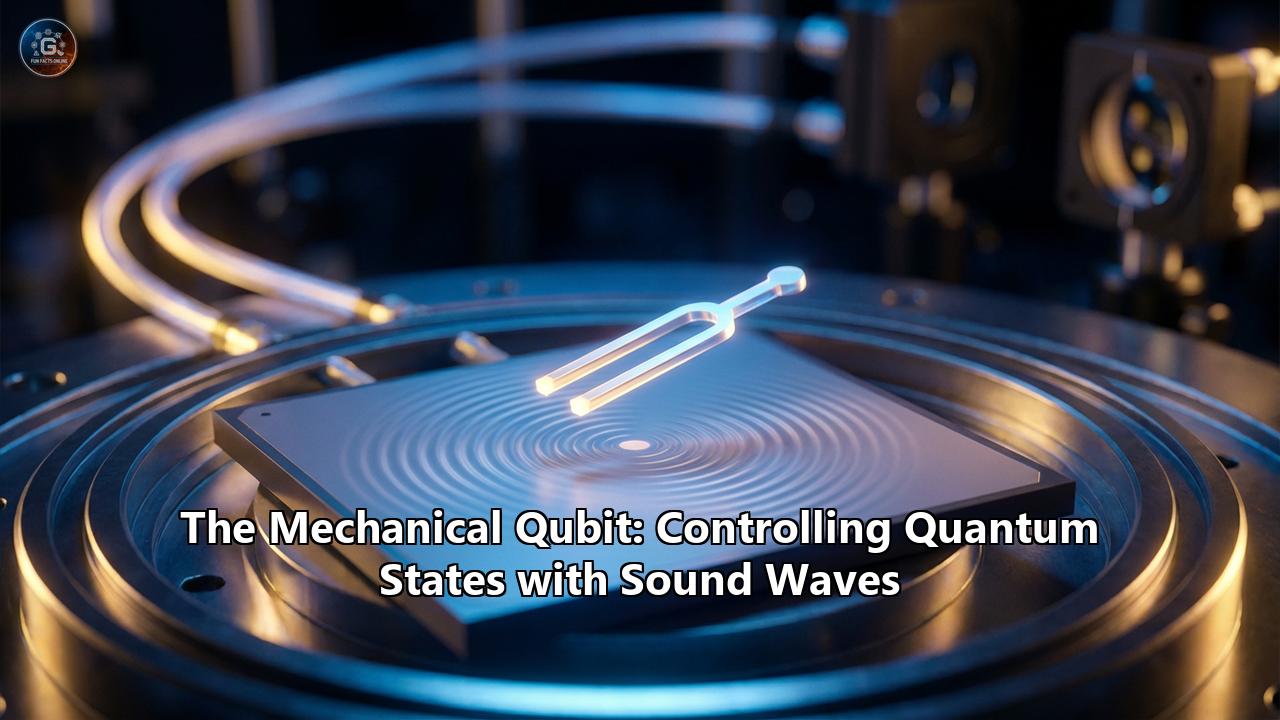
1. Introduction: The Symphony of the Quantum Realm
For the better part of the 21st century, the race to build a quantum computer has been dominated by two physical players: electrons and photons. We trap ions in electromagnetic fields, we steer electrons through superconducting loops, and we guide pulses of light through fiber optic cables. These particles—matter and light—have been the undisputed soloists of the quantum revolution. But a new player has entered the orchestra, one that is older than the concept of computing itself but entirely new to the quantum stage: sound.
This emerging field is known as Quantum Acoustics, and its fundamental unit of information is the Mechanical Qubit.
To the classical observer, sound is a mundane phenomenon—a pressure wave moving through air or a vibration traveling through a solid. But zoom in to the atomic scale, and sound reveals its quantum nature. Just as light is composed of discrete packets called photons, sound is composed of discrete packets of vibrational energy called phonons. For decades, phonons were viewed merely as pests—sources of heat and noise that decohered fragile quantum states in superconducting processors. They were the enemy to be suppressed, frozen out, and shielded against.
However, in a paradigm shift that has accelerated dramatically between 2023 and 2025, physicists have stopped fighting the phonon and started controlling it. Groups at leading institutions like the University of Chicago, ETH Zurich, Caltech, and Stanford have demonstrated that mechanical resonators—tiny, vibrating drums and strings—can be placed into entangled quantum states. They can store quantum information for seconds, lifetimes vastly longer than their electromagnetic counterparts. Most importantly, they can act as universal translators, converting the language of superconducting quantum computers (microwaves) into the language of the quantum internet (optical light).
This article explores the rise of the mechanical qubit, a technology that promises to do for quantum networking what the transistor did for classical electronics. It is a story of slowing down to speed up, of leveraging the sluggish speed of sound to perform operations that light moves too fast to allow, and of building the "acoustic pipes" that will connect the quantum computers of the future.
2. The Physics of Quantum Sound
To understand the mechanical qubit, one must first discard the intuitive notion of sound as a continuous wave. In the quantum regime, a mechanical oscillator—whether it's a nano-scale beam or a surface wave on a crystal—has energy levels that are "quantized." It cannot vibrate at just any amplitude; it can only contain integer numbers of phonons: 0, 1, 2, and so on.
From Classical Waves to Phonons
The transition from a vibrating guitar string to a quantum mechanical oscillator is defined by temperature. At room temperature, a 5-gigahertz (GHz) mechanical oscillator is swamped by thermal phonons from the environment. The "noise" of heat drowns out the "signal" of quantum discreteness. But when cooled to millikelvin temperatures in a dilution refrigerator, the thermal energy drops below the energy of a single phonon. The oscillator settles into its "ground state" (zero phonons). From this silent vacuum, researchers can inject a single quantum of vibration—a single phonon. This is the acoustic equivalent of a single photon, but instead of an oscillating electromagnetic field, it is a collective oscillation of billions of atoms in a crystal lattice.
The Speed of Sound Advantage: "In-Flight" Manipulation
One of the most compelling arguments for using sound in quantum systems is its speed—or rather, its lack thereof. Light travels at approximately 300,000 kilometers per second. In the time it takes a quantum processor to perform a single logic gate (nanoseconds), a photon has traveled meters, leaving the chip entirely. This makes "feedback" operations—where you measure a particle and then adjust it based on the result—extremely difficult with light.
Sound in solids, however, travels about 100,000 times slower than light (roughly 3,000 to 11,000 meters per second depending on the material). A microwave-frequency phonon (5 GHz) has a wavelength of less than a micron, meaning an entire complex quantum pulse can be contained within a device the width of a human hair. This "slow" speed allows for "in-flight" manipulation. Researchers can launch a phonon, perform an operation on it while it is traveling across a chip, and catch it at the other end. This capability is unique to the mechanical domain and opens up new architectures for signal processing that are impossible with purely photonic systems.
Coupling Mechanisms: How Sound Talks to Qubits
A mechanical object, no matter how small, is electrically neutral. So how do we control it with the electronic circuits of a quantum computer? The answer lies in piezoelectricity.
Materials like Lithium Niobate ($LiNbO_3$) and Aluminum Nitride ($AlN$) are piezoelectric: when you apply a voltage across them, they deform. Conversely, when they deform, they generate a voltage. By patterning metallic electrodes on top of these materials, researchers create Interdigitated Transducers (IDTs). When a microwave electrical signal from a superconducting qubit hits the IDT, it is converted into a mechanical wave (a phonon). This process is bidirectional and coherent, meaning the quantum phase of the electrical signal is perfectly preserved in the mechanical vibration.
- Electromechanical Coupling Strength ($g$): The critical metric in these systems is the coupling rate $g$. If $g$ is faster than the rate at which the phonon decays (loss), the system is in the "strong coupling regime." In 2024, devices reached cooperativities (a measure of coupling quality) exceeding 100, allowing phonons and qubits to swap information back and forth hundreds of times before the signal is lost.
Surface Acoustic Waves (SAW) vs. Bulk Acoustic Waves (BAW)
There are two main ways to guide these phonons:
- Surface Acoustic Waves (SAW): These are ripples that travel along the surface of a material, exactly like earthquakes or ocean waves. They are easy to access and manipulate because they are on the surface. You can put electrodes anywhere along their path to tweak them. This is the preferred mode for "flying qubit" architectures.
- Bulk Acoustic Waves (BAW): These vibrations travel through the body of the crystal. Because they are buried inside the material, they are less sensitive to surface imperfections and air, leading to higher Quality Factors ($Q$). A specific type, the High-overtone Bulk Acoustic Resonator (HBAR), essentially bounces sound back and forth between two surfaces of a chip, acting as an exceptionally long-lived quantum memory.
3. Anatomy of a Mechanical Qubit
A "mechanical qubit" is rarely just a vibrating beam. A pure harmonic oscillator is linear—its energy levels are equally spaced (0, 1, 2...). To function as a qubit (which requires distinct 0 and 1 states that can be manipulated without accidentally triggering state 2), you need non-linearity.
The Superconducting Partner
Therefore, most mechanical qubits are hybrid systems. They consist of a linear mechanical resonator coupled to a non-linear superconducting qubit (usually a Transmon). The Transmon acts as the "controller" or the "non-linear key."
- The Interaction: The Transmon creates a superposition of electrical states ($|g\rangle + |e\rangle$). Via the piezoelectric coupling, this electrical superposition is mapped onto the mechanical resonator, creating a superposition of vibrational states (e.g., "vibrating" and "not vibrating" at the same time).
- The Result: The mechanical object becomes the qubit. Once the state is transferred, the Transmon can be detuned, leaving the phonon to evolve on its own.
Phononic Crystals: Bandgap Engineering for Sound
To prevent these precious phonons from leaking away into the substrate, engineers use Phononic Crystals. These are periodic structures—holes drilled in a pattern or alternating layers of materials—that act as acoustic mirrors. Just as a photonic crystal can block light of certain colors, a phononic crystal creates a "bandgap" where sound cannot propagate. By placing the mechanical qubit inside a "defect" in a phononic crystal, the sound is trapped in a tiny cage, bouncing back and forth with nowhere to go. This "acoustic shielding" is crucial for reaching the long coherence times needed for computation.
4. Fabrication: Building the Quantum Harp
Building a mechanical qubit is a feat of extreme nanofabrication. The structures are often carved from Lithium Niobate (LN), a material known as the "silicon of photonics" due to its potent optical and piezoelectric properties.
The "Release-Free" Revolution
Historically, mechanical resonators had to be suspended—like tiny bridges or diving boards—so they could vibrate freely without touching the substrate. These suspended structures were fragile and, crucially, had poor thermal contact. A laser beam used to read them out would heat them up, destroying the quantum state.
In 2024 and 2025, a major breakthrough occurred with the development of "Release-Free" mechanical resonators. Teams at Caltech and Stanford developed methods to confine sound in tight waveguides on the surface of a chip without suspending them. They used acoustic impedance mismatch (using materials that sound hates to travel into) to trap the wave.
- Why this matters: A device sitting directly on a sapphire substrate can dissipate heat thousands of times more efficiently than a suspended beam. This allows researchers to pump the system with higher power lasers for better readout signals without "melting" the fragile quantum state.
Fabrication Challenges
- Roughness: At the scale of nanometers, a "smooth" surface looks like a mountain range. Surface roughness scatters high-frequency phonons, causing energy loss. The latest fabrication uses atomic layer etching to achieve surfaces smooth to within a few atoms.
- Material interfaces: Combining a superconductor (like Aluminum) with a piezoelectric (like Lithium Niobate) is chemically tricky. Oxides can form at the interface, absorbing the microwave signals. New "flip-chip" techniques, where the qubit and the resonator are made on separate chips and then pressed together with nanometer precision, have helped solve this by allowing each component to be optimized separately.
5. Breakthroughs in Control (2024-2025)
The last two years have transformed the mechanical qubit from a theoretical curiosity into a functional technology.
Entangling Remote Mechanical Resonators
In a landmark 2024 experiment, the Cleland group at the University of Chicago demonstrated the entanglement of two surface acoustic wave resonators on two separate chips. They used a superconducting cable to link them.
- The Experiment: They generated a "half-phonon" state (a superposition of 0 and 1) in resonator A. Using a "pitcher-catcher" protocol, they sent half of that state to resonator B. The result was a Bell state where the two drums were vibrating in perfect unison, entangled across a macroscopic distance. This proved that sound can carry quantum information between "nodes" of a network.
The Acoustic Hong-Ou-Mandel Effect
The Hong-Ou-Mandel (HOM) effect is a famous experiment in quantum optics where two indistinguishable photons hitting a beamsplitter always exit together—they "bunch." It is the gold standard proof of quantum behavior.
- The Acoustic Version: Researchers built a "phonon beamsplitter" using coupled acoustic waveguides. When they sent single phonons from two different sources into the splitter, they observed the same bunching behavior. This confirmed that phonons are identical bosons and can be used for "linear optical quantum computing" schemes—but using sound instead of light.
Deterministic Phase Control
In 2025, a joint theoretical-experimental effort demonstrated deterministic phase control of phonons. In photonics, generating single photons often involves a probabilistic process (you try to generate one, and sometimes you get zero or two). The mechanical system, however, is deterministic. You can "load" exactly one phonon into the resonator with nearly 100% probability using the superconducting qubit as a loader. This reliability is a massive advantage for error-corrected quantum computing.
6. The Killer Application: Quantum Transduction
Why go to all this trouble? Why not just stick with superconducting qubits? The answer is the Internet.
Superconducting qubits operate at microwave frequencies (~5 GHz). Optical fibers, which carry the world's data, operate at optical frequencies (~193,000 GHz). You cannot simply send a microwave photon down an optical fiber; it's incompatible. This is the Interconnect Bottleneck.
Mechanical qubits are the perfect bridge.
- The Mechanism: A mechanical resonator can couple to both microwaves (via piezoelectricity) and light (via the photoelastic effect or optomechanics).
- The Process:
1. A superconducting qubit sends a microwave photon to the mechanical resonator.
2. The resonator vibrates (converts microwave to phonon).
3. A laser beam hits the vibrating resonator. The vibration modulates the light (like an FM radio signal), upconverting the phonon into an optical photon carrying the same quantum information.
4. The optical photon travels down a fiber to the next quantum computer.
In 2025, groups at Caltech and Stanford achieved record-breaking efficiencies in this transduction process using the new "release-free" lithium niobate devices. They demonstrated bi-directional conversion with less than one quantum of added noise—the critical threshold needed to entangle two quantum computers over the internet. This technology effectively enables the "quantum modem."
7. Beyond Computing: Quantum Sensing and Memory
The utility of the mechanical qubit extends into fundamental physics.
Mass Sensing at the Yoctogram Scale
Because mechanical frequency is determined by mass, a tiny change in mass causes a frequency shift. A mechanical qubit in a superposition state is an interferometer for mass. If a stray molecule—or potentially even a dark matter particle—hits the resonator, it disrupts the superposition. This offers a path to sensors with yoctogram ($10^{-24}$ grams) sensitivity, opening new doors for searching for dark matter candidates that interact only through gravity.
Phononic Quantum Memory
Superconducting qubits are fast but forgetful; their states decay in microseconds. Mechanical modes in ultra-pure crystals can ring for seconds or even minutes. A hybrid architecture could use superconducting qubits for fast processing and then "park" the information in a mechanical HBAR (High-overtone Bulk Acoustic Resonator) for storage. This "acoustic RAM" would drastically reduce the overhead for quantum error correction.
8. Challenges and The Road Ahead
Despite the triumphs, the field faces significant hurdles.
- The Heating Problem: The "transduction" process requires strong lasers. Even a tiny fraction of absorbed light heats the device. At 10 millikelvin, even a nanowatt of heat is a problem. The new 2D optomechanical crystals and "b-dagger" designs help, but thermal management remains the primary bottleneck for scaling.
- Frequency Disparity: Coupling a 5 GHz phonon to a 193 THz photon is a massive energy mismatch. The process is inherently inefficient. Current record efficiencies are around 1-5%. To be viable for a commercial quantum internet, this needs to exceed 50%.
- Fabrication Consistency: Making two mechanical resonators exactly identical (so they can talk to each other) is harder than making identical transistors. Nanometer-scale variations in the wall of a resonator change its pitch, requiring complex "tuning" mechanisms (like applying DC voltages) to bring them into resonance.
9. Conclusion: The Future Sounds Like Quantum
The Mechanical Qubit has graduated from a niche curiosity to a cornerstone of the future quantum infrastructure. It is no longer just about "controlling sound"; it is about using sound to control the flow of information in a hybrid quantum network.
As we look toward 2030, we can expect to see Phononic Quantum Networks—clusters of superconducting processors connected within a cryostat by acoustic buses, and connected to the outside world by optomechanical transducers. The symphony of the future will not just be played with light and electricity, but with the silent, quantized vibrations of the mechanical qubit. We are learning to play the quantum harp, and the music is just beginning.
Reference:
- https://www.researchgate.net/publication/338637334_Microwave-to-Optical_Transduction_Using_a_Mechanical_Supermode_for_Coupling_Piezoelectric_and_Optomechanical_Resonators
- https://www.researchgate.net/publication/259106141_A_phononic_bandgap_shield_for_high-Q_membrane_microresonators
- https://pubs.aip.org/aip/app/article/10/1/010801/3331821/Design-of-a-release-free-piezo-optomechanical
- https://www.mdpi.com/2072-666X/15/4/485
- https://www.caltech.edu/about/news/low-noise-transducers-to-bridge-the-gap-between-microwave-and-optical-qubits
- https://pmc.ncbi.nlm.nih.gov/articles/PMC8596963/