
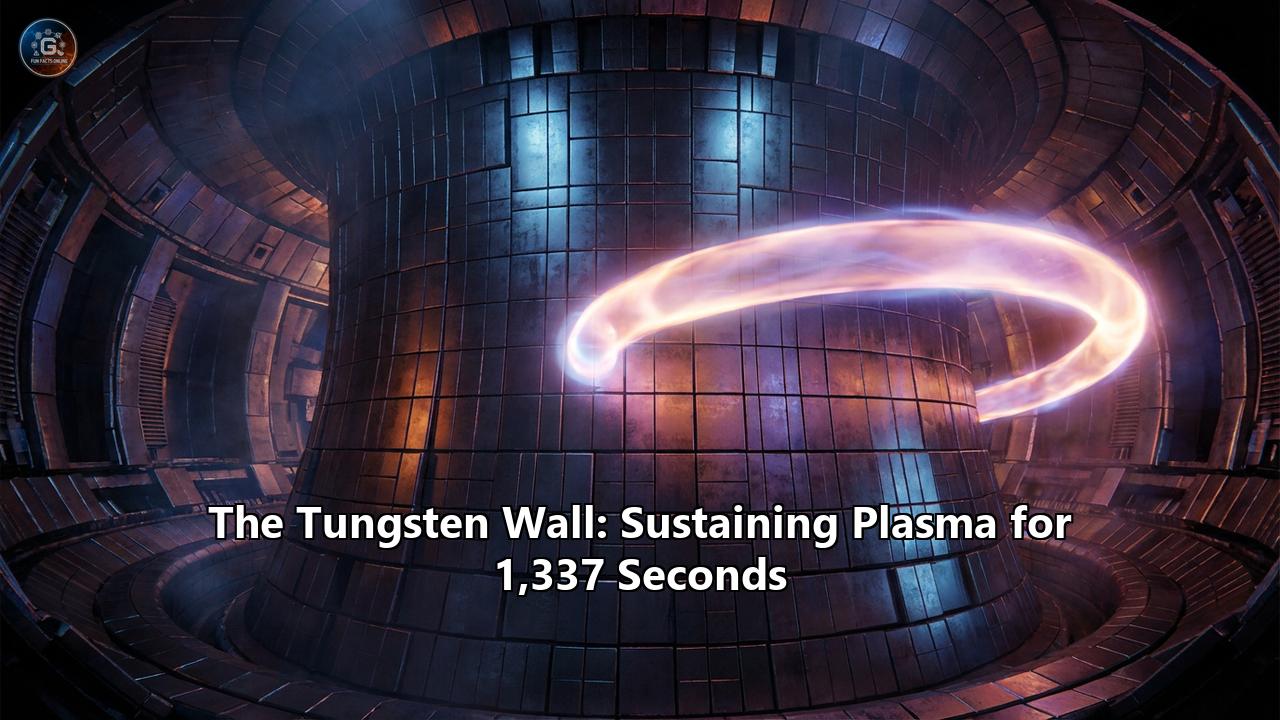
On a crisp Wednesday afternoon, specifically February 12, 2025, the control room of the WEST tokamak in Cadarache, Southern France, fell into a hush that was louder than any alarm. Monitors flickered with the real-time heartbeat of a man-made star, a loop of superheated plasma that had been burning for ten minutes, then fifteen, then twenty. When the plasma finally extinguished, the clock stopped at exactly 1,337 seconds.
For the uninitiated, 1,337 might just be a number. For the internet generation, it is "leet" (elite) speak. But for the physicists and engineers at the French Alternative Energies and Atomic Energy Commission (CEA) and their partners at the Princeton Plasma Physics Laboratory (PPPL), it represented something far more profound than a digital coincidence. It was the moment the "Tungsten Wall"—a technological barrier that has bedeviled fusion researchers for decades—was not just breached, but shattered.
This 22-minute, 17-second endurance run didn't just break the previous world record held by China’s EAST reactor; it fundamentally validated the design philosophy of the massive international ITER project rising nearby. It proved that a fusion reactor clad in tungsten, a metal notorious for its scientific capriciousness, could sustain a stable, high-performance plasma for durations relevant to commercial energy production.
This is the story of that 1,337-second odyssey, the machine that made it possible, and why a greyish metal with the highest melting point of any element has become the linchpin of our clean energy future.
Part I: The Tungsten Dilemma
To understand the magnitude of the WEST achievement, one must first understand the "vessel problem" in fusion energy. For decades, the dream of fusion—replicating the power of the sun by fusing hydrogen isotopes into helium—has been contained within magnetic bottles known as tokamaks. These donut-shaped machines use powerful magnetic fields to suspend plasma heated to temperatures exceeding 100 million degrees Celsius.
However, the magnetic cage is never perfect. Stray particles, high-energy neutrons, and intense radiation constantly bombard the inner walls of the reactor. This interaction between the "fourth state of matter" (plasma) and the solid matter of the reactor wall is one of the most brutal environments in the known universe.
The Carbon Era
In the early days of fusion research, and indeed in many current experimental reactors, the material of choice for the inner wall was carbon (graphite). Carbon is forgiving. It sublimes rather than melts, it doesn't radiate much energy away from the plasma if it flakes off, and it is relatively easy to work with.
But carbon has a fatal flaw for commercial fusion: it is a sponge for tritium. Tritium, a radioactive isotope of hydrogen and a key fuel for fusion, gets trapped inside the porous carbon structure. In a commercial power plant, you cannot afford to have your expensive, radioactive fuel permanently soaking into the walls. It creates a safety hazard and a fuel efficiency nightmare.
Enter the Wolf
The alternative is Tungsten. Known by the chemical symbol W (from its Germanic name, Wolfram), tungsten is a metal of extremes. It possesses the highest melting point of all elements (3,422°C), conducts heat efficiently, and, crucially, does not absorb tritium. It is the ideal armor for a machine that must withstand the heat flux of a returning space shuttle every second of every day.
But tungsten has a dark side. It is a "high-Z" material, meaning it has a high atomic number (74). If even a tiny flake of tungsten sputters off the wall and enters the plasma, it acts as a phenomenal radiator. Unlike carbon, which burns up harmlessly, heavy tungsten atoms strip heat from the plasma core and radiate it away as X-rays. This "radiative cooling" can drop the plasma temperature instantly, causing the fusion reaction to collapse—a phenomenon known as a "disruption."
For years, skeptics argued that a tungsten-walled reactor would be too unstable to operate for long durations. The plasma would inevitably "poison" itself with tungsten impurities. The "Tungsten Wall" was not just a physical component; it was a metaphorical barrier to commercial fusion.
Part II: The Machine Called WEST
This is where the WEST tokamak comes in. Its name is a recursive acronym: W (Tungsten) Environment in Steady-state Tokamak.
Located at the CEA Cadarache research center, WEST is a machine born from reincarnation. It was originally built as Tore Supra, a legendary superconducting tokamak that began operations in 1988. Tore Supra was famous for its long-duration discharges, thanks to its actively cooled components. In 2013, a decision was made to gut the machine and rebuild it with a specific mission: to become a risk-reduction testbed for ITER.
ITER, the $25 billion international fusion experiment under construction just a few kilometers away, had made the bold decision to use a tungsten divertor (the "exhaust pipe" of the reactor). The scientific community needed a machine that could test this configuration before ITER was fully operational. They needed a machine that looked like ITER on the inside but could be pushed to the breaking point today.
The Engineering Marvel
The conversion from Tore Supra to WEST involved installing a completely new vacuum vessel interior. The key feature is the divertor, a series of armored cassettes at the bottom of the donut. This is where the plasma impurities and heat are channeled. In WEST, these divertor plates are made of thousands of small tungsten blocks, actively cooled by a high-pressure water loop.
The engineering challenge here is immense. The heat load on these tungsten plates can reach 10 megawatts per square meter. To put that in perspective, it is roughly the same heat load as the surface of the Sun, or what a spacecraft experiences during reentry—but sustained continuously, not just for a few minutes.
The WEST team, led by the CEA and supported heavily by the European consortium EUROfusion and the U.S. Department of Energy (via PPPL), spent years refining the magnetic geometry to keep the plasma hot while protecting these tungsten tiles.
Part III: The 1,337-Second Shot
The road to February 12, 2025, was paved with incremental victories and frustrating setbacks. In 2024, the team had achieved a 6-minute pulse, a record at the time for a tungsten machine. But the goal was always the 1,000-second mark—a duration that in the world of plasma physics is effectively "steady-state." If you can hold a plasma for 1,000 seconds, the physics stops changing. You have reached equilibrium.
The Setup
On the morning of the record attempt, the control room was staffed by a multinational team. The plan was to use Lower Hybrid Current Drive (LHCD) to sustain the plasma current.
In a tokamak, a massive electrical current must flow through the plasma to generate the magnetic field that twists and confines it. Traditionally, this current is induced by a central solenoid (a giant transformer coil). But a transformer can only ramp up current for so long before it has to discharge. It is inherently pulsed.
To run continuously, WEST uses LHCD. This system beams powerful microwave waves (at 3.7 GHz) into the plasma. These waves push the electrons, driving the current non-inductively. It’s like pushing a merry-go-round with a hose of water instead of your hands; as long as the water (microwaves) flows, the merry-go-round (current) spins.
The Countdown
The shot began at 2:00 PM. The central solenoid provided the initial spark, ionizing the hydrogen gas into a glowing pink plasma. Then, the Lower Hybrid antennas kicked in, injecting 2 megawatts of power. The solenoid ramped down, handing over control to the radio waves.
For the first few minutes, the tension was palpable. The operators watched the "impurity monitors" like hawks. This was the danger zone. As the plasma heated to 50 million degrees Celsius, ions slammed into the tungsten wall. If the wall sputtered, the X-ray detectors would spike, indicating tungsten was poisoning the core.
But the wall held.
The Steady State
At the 500-second mark, the plasma entered a state of serene equilibrium. The feedback loops—algorithms designed to tweak the magnetic fields thousands of times a second—were locked in. The active cooling system pumped water through the tungsten tiles, carrying away the 2.6 gigajoules of energy being dumped into the system.
At 1,000 seconds, the previous internal goal was met. The room began to fill with observers from other departments. A "failed" shot earlier in the day had sent some researchers home, but as the counter ticked past 1,066 seconds (the previous record set by China’s EAST tokamak), the crowd swelled.
1337
The plasma finally terminated not because of a disruption, but due to the scheduled end of the pulse window and system limits. The final duration: 1,337 seconds.
The significance of this number was not lost on the younger engineers. In internet culture, "1337" spells "LEET" (elite). It was a fitting, if accidental, badge of honor. The WEST reactor had just performed an "elite" maneuver, sustaining a high-temperature, tungsten-walled plasma for over 22 minutes.
Part IV: The Science of Survival
How did they do it? How did they stop the tungsten from killing the plasma? The answer lies in a combination of boronization, magnetic geometry, and advanced diagnostics.
The Boron Shield
One of the key techniques employed by the team, with significant input from PPPL researchers, was the use of a boron dropper. Boron is a light element (low-Z). By dropping boron powder into the plasma discharge, or coating the walls with it beforehand, the scientists created a sacrificial layer. The boron coats the tungsten, preventing the heavy metal from sputtering off.
If a boron atom enters the plasma, it is stripped of its electrons fully and becomes a bare nucleus. Because it has a low charge, it doesn't radiate much energy. It acts as a "buffer," allowing the plasma to touch the wall without dragging heavy tungsten into the mix.
X-Ray Vision
A critical piece of technology that enabled this record was the ME-SXR (Multi-Energy Soft X-Ray) camera. Developed by PPPL, this diagnostic tool allowed the operators to see the temperature profile of the plasma in real-time with unprecedented precision.
Tungsten impurities tend to accumulate in the core of the plasma. The ME-SXR camera could detect the specific X-ray signature of tungsten. If the camera saw a buildup beginning, the control system could slightly alter the heating power or the magnetic shape to "flush" the impurities out before they caused a collapse. This active impurity management is the holy grail of steady-state fusion.
Part V: Why This Matters for the World
It is easy to dismiss a 22-minute record as just another science experiment. But in the context of the global energy crisis, the "Tungsten Wall" breakthrough is pivotal.
The ITER Connection
ITER, the massive reactor being built in France, is designed to produce 500 megawatts of fusion power for 400 seconds or longer. ITER uses a tungsten divertor. Until WEST proved it possible, there was a lingering fear that the tungsten divertor might be the Achilles' heel of the entire $25 billion project.
The 1,337-second shot effectively de-risks ITER’s operation. It proves that the cooling systems, the tile designs, and the plasma control software can handle the "tungsten environment." It provides ITER operators with a playbook: Here is how you handle the impurities. Here is how you manage the heat flux.
Commercial Viability
Beyond ITER, this record speaks to the future of DEMO, the proposed demonstration power plant that will actually put electricity onto the grid. A commercial reactor cannot run for 10 seconds and then stop for an hour. It must run 24/7. It must use materials that don't absorb fuel (like tungsten).
By proving that a tungsten machine can run in a "stationary regime" (steady state) for nearly half an hour, WEST has shown that the materials science of fusion is catching up to the plasma physics. We now have a vessel that can hold the star.
Part VI: The Human Element
The achievement is also a testament to international cooperation. Fusion is unique in the scientific world; it is almost entirely open-source. The WEST team includes researchers from France, the United States, Germany, India, China, and Korea.
During the record shot, PhD students sat alongside veteran physicists who had been working on tokamaks since the 1980s. Juan Javier Palacios Roman, a PhD student from the Dutch institute DIFFER who was in the control room, described the atmosphere shifting from routine monitoring to electric excitement as the 500-second mark was passed. "After this 'failed' shot earlier, many people left the room," he noted. "When the pulse passed 500 seconds and kept going, there was great interest again. More and more people joined... photographs were taken."
This human element—the shared anxiety and triumph—reminds us that fusion is not just a machine; it is a multi-generational relay race. The 1,337-second record is the baton being passed from the experimental era of the 20th century to the industrial era of the 21st.
Part VII: What Comes Next?
The 1,337-second record is a floor, not a ceiling. The WEST team has already outlined their next objectives.
- More Power: The record was achieved with 2 MW of heating. To simulate reactor conditions more closely, they aim to ramp this up to 10 MW or more using additional Ion Cyclotron Resonance Heating (ICRH) antennas.
- Longer Duration: The theoretical limit of WEST is determined only by the water cooling and the electricity bill. Pulses of several hours are technically feasible if the plasma stability can be maintained.
- Harder Environments: Future campaigns will intentionally try to destabilize the plasma to test safety systems, pushing the tungsten wall to its absolute thermal limits to see exactly when it fails.
Conclusion: The Wall Has Fallen
For decades, the "Tungsten Wall" was a symbol of the immense difficulty of fusion energy. It represented the clash between the need for a robust material and the delicate nature of high-temperature plasma. It was the rock upon which many plasma discharges crashed and died.
On February 12, 2025, that wall didn't disappear, but it was tamed. The 1,337-second plasma at WEST proved that we can build fusion reactors out of the materials necessary for commercial life. We can cool them, we can control them, and we can sustain them.
As the plasma faded in the WEST chamber that Wednesday afternoon, leaving behind a cooling tungsten vessel and a room full of cheering scientists, the message was clear: The age of the carbon tokamak is ending. The age of the tungsten reactor—the age of the power plant—has begun. And it began with a number that the internet would be proud of: 1337.
Reference:
- https://www.reddit.com/r/fusion/comments/1ism3ae/west_beats_the_world_record_for_plasma_duration/
- https://www.pacw.org/nuclear-fusion-record
- https://www.pppl.gov/news/2024/fusion-record-set-tungsten-tokamak-west
- https://www.popularmechanics.com/science/green-tech/a69918315/fusion-reactor-tungsten-breakthrough-science/
- https://www.chalmers.se/en/current/news/see-1337-seconds-the-longest-fusion-experiment-ever/
- https://euro-fusion.org/member-news/cea/world-record-fusion-plasma-in-europe/
- https://www.differ.nl/news/world-record-WEST
- https://www.cea.fr/english/Pages/News/nuclear-fusion-west-beats-the-world-record-for-plasma-duration.aspx
- https://www.energylivenews.com/2025/12/19/tokamak-energy-ends-2025-with-record-fusion-results/
- https://irfm.cea.fr/en/2025/02/west-sets-a-new-plasma-duration-record/
- https://www.youtube.com/watch?v=9Ak48HAaaw0
- https://news.ycombinator.com/item?id=43094094
- https://www.advancedsciencenews.com/french-west-reactor-breaks-record-in-nuclear-fusion/