
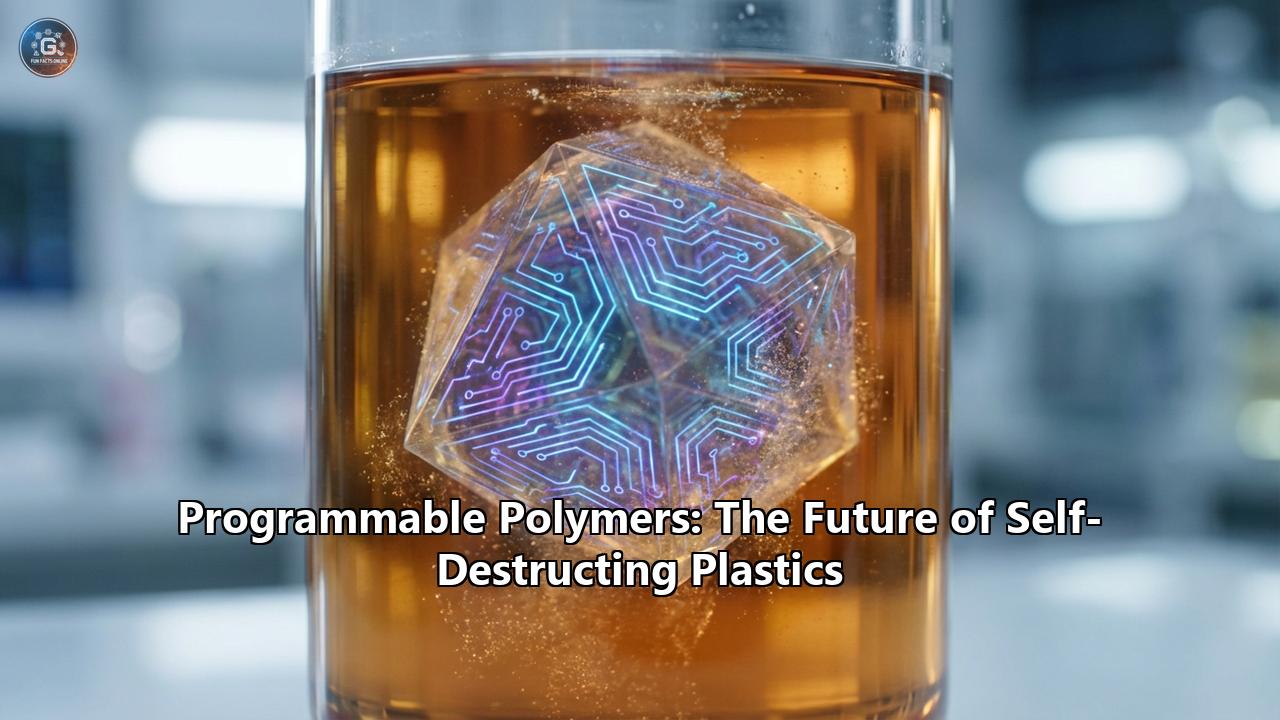
Imagine a world where a plastic water bottle, once empty, doesn't sit in a landfill for 450 years but instead dissolves into harmless byproducts the moment it touches seawater. Picture a military drone that, upon completing its mission, vaporizes into thin air to protect its technology from enemy hands. Envision agricultural sensors that monitor soil health for a single growing season and then decompose into fertilizer to nourish the very crops they once tracked.
This is not the stuff of science fiction. It is the rapidly emerging reality of Programmable Polymers—a revolutionary class of materials designed with a built-in "death clock."
For over a century, humanity has perfected the art of making materials that last forever. We engineered plastics to be virtually indestructible, impervious to rot, rust, and time. We succeeded too well. Now, facing a planetary crisis of persistent waste, materials scientists are reversing course. They are engineering materials to die.
This article explores the cutting-edge science, the economic upheaval, and the futuristic applications of self-destructing plastics. We will journey from the molecular "zippers" that allow hard plastics to unspool like thread, to the "living plastics" embedded with sleeping bacteria, and finally to the ethical landscape of a world where objects are designed to disappear.
Part 1: The Science of Self-Destruction
The core innovation of programmable polymers is the shift from passive degradation to active, triggered transience. Traditional "biodegradable" plastics (like PLA) rely on vague environmental conditions—heat, moisture, microbes—to slowly break down, often requiring industrial composting facilities to work at all. Programmable polymers, by contrast, are like time bombs waiting for a specific code.
1. The Molecular Zipper: Self-Immolative Polymers (SIPs)
At the forefront of this field are Self-Immolative Polymers (SIPs). Unlike normal plastics, which degrade randomly into smaller microplastic chunks, SIPs are designed to "unzip" all the way back to their original, harmless monomers.
- The Domino Effect: The mechanism is often compared to a row of dominoes. A standard polymer chain is stable. However, scientists attach a specific "end-cap" molecule to the head of the chain. This end-cap acts like a lock. As long as it is in place, the plastic is durable and strong.
- The Trigger: When a specific stimulus removes this end-cap, the first "domino" falls. This reaction destabilizes the next link in the chain, which destabilizes the next, and so on. A single trigger event causes the entire macroscopic object to essentially depolymerize in minutes or hours.
- Quinone-Methide Elimination: One of the most common chemical pathways for this is quinone-methide elimination. Research from groups like the Phillips Lab has shown how these cascades can be tuned. You can have a plastic that is stable in acid but vanishes in base, or a material that is rock-hard in the dark but liquefies under UV light.
2. Structural Pre-Folding: The "Origami" Trick
Researchers at Rutgers University have pioneered a different approach inspired by nature. Natural polymers like DNA and proteins fold into complex 3D shapes. Synthetic plastics are usually long, tangled spaghetti-like chains.
- The Breakthrough: By using a technique called "conformational pre-organization," scientists can create synthetic polymers that are "pre-folded" into specific shapes. This is analogous to creasing a piece of paper before you try to tear it. The paper is strong, but if you pull it, it tears perfectly along the crease.
- Programmable Weakness: These molecular creases create weak points that are protected during normal use but become exposed under specific conditions. This allows for "burstable" plastics that hold their integrity perfectly until the exact moment they are needed to fail.
3. Living Plastics: The Spore-Embedded Matrix
Perhaps the most radical approach comes from the intersection of synthetic biology and materials science. In 2024, researchers from the Chinese Academy of Sciences (CAS) unveiled "living plastics."
- Sleeping Agents: The team genetically engineered Bacillus subtilis bacteria—a common soil microbe—to secrete a powerful plastic-eating enzyme called lipase BC. However, they didn't just mix the bacteria in; they stressed the bacteria with heavy metal ions to force them into a dormant "spore" state.
- The Trojan Horse: These spores are incredibly resilient. They can survive the high heat and pressure of industrial plastic manufacturing (extrusion). They sit inside the solid plastic, dormant and harmless, acting like a filler material that actually reinforces the plastic's strength (similar to rebar in concrete).
- The Awakening: The "self-destruct" code is simple: surface erosion or composting. Once the plastic surface is scratched or placed in soil, the spores are exposed to nutrients/water. They "wake up," germinate, and immediately begin secreting enzymes that eat the plastic from the inside out. In tests, these plastics degraded completely in just 6–7 days, leaving no microplastics behind.
Part 2: The Triggers – How to Kill a Plastic
The "programmability" comes from the trigger. Scientists are developing a vast library of inputs that can initiate the breakdown.
1. The "Cinderella" Trigger: Time and Light
For single-use packaging, light is the ideal trigger. We don't want a wrapper to dissolve on the shelf, but we do want it to vanish if littered outdoors.
- Sunlight Sensitivity: New additives can make bonds sensitive to specific UV wavelengths found only in direct sunlight, not indoor LED bulbs. A wrapper dropped in a park would become brittle and dissolve into wax within weeks, while one in a pantry stays fresh for years.
- The Vampire Drone: DARPA’s VAPR (Vanishing Programmable Resources) program explored polymers that sublime (turn from solid to gas) when exposed to sunrise, ensuring that crashed drones effectively "vanish" at dawn to prevent technology capture.
2. The "Wicked Witch" Trigger: Water and pH
Water-soluble electronics are a major focus for medical and environmental applications.
- Transient Electronics: Labs are building circuits using magnesium (conductor), silicon nanomembranes (semiconductor), and silk protein (substrate). The silk can be programmed to dissolve in minutes or years depending on how it is crystallized. When the silk dissolves, the ultra-thin silicon and magnesium components simply fall apart and hydrolyze into harmless minerals that the body or soil can absorb.
3. The "Secret Agent" Trigger: Radio and Heat
For high-security applications, you need a trigger that can be activated remotely.
- Thermal runaway: Some programmable polymers contain embedded resistive heating elements. A specific radio frequency signal sent by a command center can induce a current, heating the polymer to a critical temperature where it instantly depolymerizes. This is the ultimate "Mission Impossible" self-destruct button for encrypted hard drives or military sensors.
Part 3: Applications – A World of Transient Objects
The shift from permanent to transient materials will disrupt dozens of industries. Here is where the revolution is already happening.
1. Military and Espionage: "Hardware like Snapchat"
The US military loses thousands of sensors, radios, and drones in the field every year. If captured, these provide adversaries with critical intel.
- The Solution: DARPA’s "Vanishing Programmable Resources" (VAPR) and subsequent "ICARUS" programs have successfully demonstrated gliders made of sublime-able polymers. These delivery vehicles can drop supplies to special forces and then simply evaporate, leaving no trace of their existence.
- Leave-Behind Sensors: Imagine scattering thousands of "dust mote" sensors over a conflict zone to monitor troop movements. Instead of retrieving them, commanders simply wait. After 30 days, the sensors dissolve into the dust, leaving the environment pristine and the technology secure.
2. Digital Agriculture: Sensors as Fertilizer
Precision agriculture requires data—soil moisture, pH, nitrogen levels. But sticking plastic sensors into millions of acres of farmland creates a massive e-waste problem.
- The "Plant Food" Sensor: Researchers at the University of Glasgow and University of Chicago are developing sensors made from biodegradable polymers and compostable conductive inks.
- The Lifecycle: A farmer prints these sensors on a standard inkjet printer modified for bio-inks. They scatter them across the field. The sensors transmit data for the growing season. When harvest comes, the sensors are plowed into the soil. Because they are made of carbon-based polymers and minerals (magnesium/zinc), they degrade into micronutrients that actually feed the next crop.
3. The Packaging Revolution: Eating the Wrapper
This is the "Holy Grail" of the industry. Companies are racing to replace the trillion-dollar single-use plastic market.
- Notpla: A UK startup, winner of the Earthshot Prize, uses seaweed to create transparent, plastic-like films. Their "Ooho" sachets for water and condiments are edible. They have partnered with Just Eat to provide seaweed-lined takeaway boxes that degrade in a home compost pile in weeks—acting like a fruit peel rather than a plastic bag.
- Polymateria: This British company takes a different approach. They don't make new plastic; they hack old plastic. Their "biotransformation" masterbatch technology is an additive mixed into standard Polypropylene (PP) and Polyethylene (PE) during manufacturing.
The Time-Lock: The additive creates a "dormant" state for a set shelf life (e.g., 6 months for a granola bar).
The Transformation: If the plastic becomes "fugitive" (littered) and is exposed to nature, the additive attacks the polymer's crystalline structure, turning the hard plastic into a bio-available wax. Bacteria naturally present in the environment recognize this wax as food and digest it, leaving zero microplastics.
4. Healthcare: The Doctor Inside You
Transient implants are changing surgery.
- No Removal Necessary: Currently, if you break a bone, you might get titanium screws installed. Often, a second surgery is needed to remove them. Programmable polymer screws (made from silk or PLGA) can hold the bone together for exactly 6 weeks—the time needed for healing—and then dissolve.
- Smart Drug Delivery: "Logic gate" polymers can release drugs only when specific conditions are met. For example, a polymer nanoparticle carrying insulin could be programmed to dissolve only when blood glucose pH changes, creating an artificial pancreas system that responds in real-time without electronics.
Part 4: The Economic and Industrial Reality
If this technology is so amazing, why isn't everything made of it yet? The answer lies in the "Plastic Economy."
1. The "Frankenstein" Supply Chain
Our entire global manufacturing infrastructure is built for materials that melt, flow, and harden—and stay hard.
- Thermal Sensitivity: Many programmable polymers, especially enzyme-embedded ones, are sensitive to heat. Standard plastic extrusion happens at 170°C–250°C. This kills most enzymes. The breakthrough by CAS (using spores) and companies like Carbios (using thermostable enzymes) was finding biological agents that can survive this "hellfire" of manufacturing.
- Retooling Costs: Factories don't want to buy new billion-dollar machines. The success of companies like Polymateria lies in their "drop-in" solution—pellets that can be thrown into existing hoppers without changing the machinery.
2. The Cost Premium
Currently, programmable polymers cost 20–50% more than virgin fossil-fuel plastics.
- The "Green Premium": While consumers say they want eco-friendly products, few are willing to pay extra for a water bottle. The cost is driven by complex synthesis (creating self-immolative linkers is harder than refining oil) and lower economies of scale.
- The Tipping Point: Analysts predict that as carbon taxes on non-recycled plastics rise (like the UK’s Plastic Packaging Tax), the cost gap will close. If a company has to pay for the 400-year lifecycle of a PET bottle, a self-destructing bottle suddenly becomes the cheaper option.
3. The Recycling Paradox
This is the most contentious issue in the industry.
- Contamination: What happens if you throw a self-destructing bottle into a recycling bin? It might degrade during the recycling process, ruining the batch of recycled plastic (rPET) by introducing weak points.
- The "Recycle-Ready" Defense: Newer technologies are designing "switchable" degradation. For example, a polymer might be stable during mechanical recycling (chopping/melting) but degrade only under industrial composting conditions or specific enzymatic baths. This dual-capability is essential to prevent the "contamination" argument from killing the industry.
Part 5: The Future – "Matter with a Mind"
As we look toward 2030 and beyond, the definition of "plastic" will change. We are moving toward Programmable Matter.
- Self-Healing before Self-Destructing: The ultimate material is one that repairs itself like skin for a set lifespan, and then dies like an organism when its time is up. Research into "vitrimers" (a new class of plastics) allows for infinite reshuffling of bonds (healing) until a specific trigger locks them into a degradation phase.
- Swarm Robotics: Imagine releasing a swarm of thousands of micro-gliders to map a hurricane. Today, that’s littering. Tomorrow, it’s a biodegradable weather service.
- The Ethics of Transience: There is a dark side. If your car is made of programmable polymers, could a hacker "trigger" your bumper to disintegrate on the highway? As materials become digitized and programmable, they become susceptible to the same security threats as software. "Material Cyber-Security" will likely become a new field of study.
Conclusion: The End of "Forever"
For the last century, human progress was measured by durability. We built things to last. But in a finite world, infinite durability is a bug, not a feature.
Programmable polymers represent a profound maturity in materials science. We are finally admitting that death is a necessary part of a lifecycle, even for our objects. By programming the end into the beginning, we are creating a future where technology flows through the environment like a stream—useful, present, and then, gracefully, gone.
The future of plastic isn't about making it stronger. It's about teaching it how to say goodbye.
Reference:
- https://www.pmi.org/most-influential-projects-2024/disappearing-packaging
- https://thebetterindia.com/279804/uk-startup-polymateria-first-biodegradable-recyclable-plastics-technology-innovation/
- https://notpla.shop/pages/sustainability
- https://www.researchgate.net/publication/378433476_Self-Immolative_Polymers_From_Synthesis_to_Applications
- https://english.cas.cn/newsroom/research_news/life/202408/t20240822_683736.shtml
- https://newatlas.com/bacterial-spores-degradable-living-plastic/
- https://pubmed.ncbi.nlm.nih.gov/39169270/
- https://www.synbiobeta.com/read/engineered-spores-create-living-plastics-and-the-future-of-biodegradable-materials
- https://www.zmescience.com/science/news-science/scientists-make-living-plastic/
- https://www.hackster.io/news/biodegradable-sensors-deliver-important-soil-health-data-and-turn-into-plant-food-afterwards-e2ae95232fdf
- https://www.polymateria.com/plastic-fantastic-article/
- https://chemistryforsustainability.org/safer-alternatives/biotransformation-technology-polymateria
- https://packagingsouthasia.com/type-of-packaging/transformation-polymaterias/
- https://www.azosensors.com/article.aspx?ArticleID=3031