
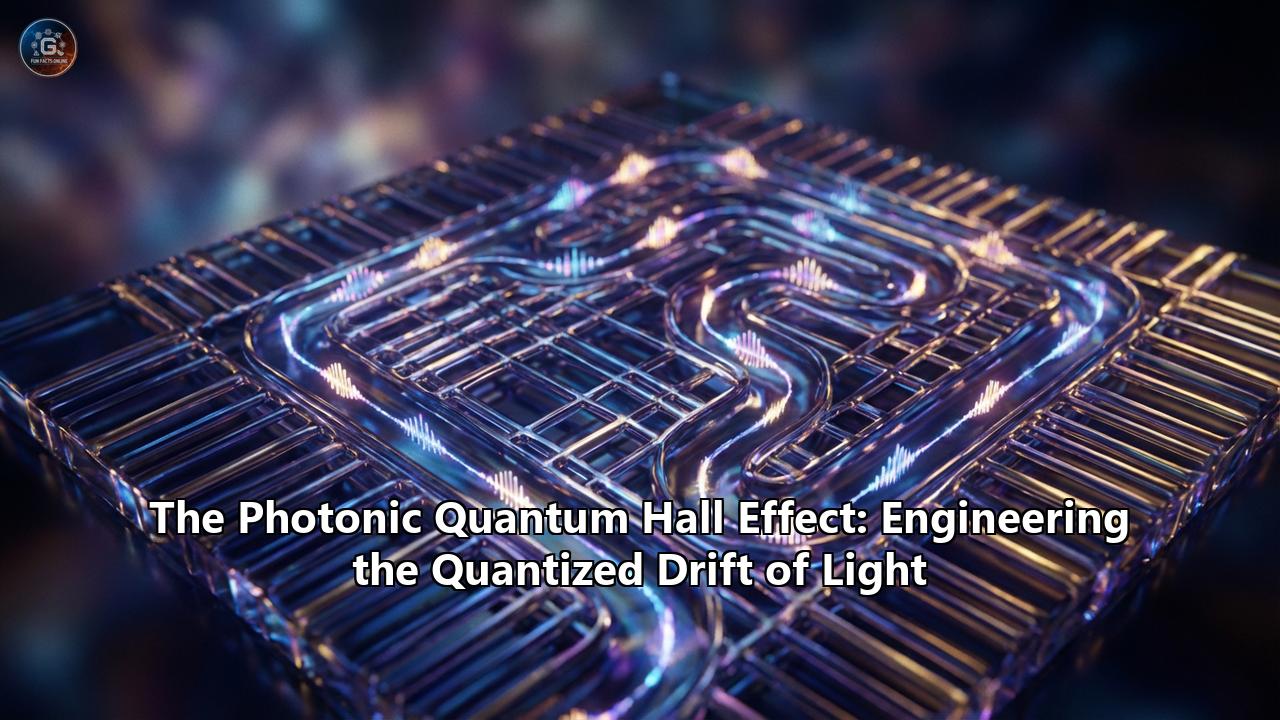
Light, in its essence, is a rebel of the physical universe. It is the ultimate speedster, an ethereal entity composed of oscillating electric and magnetic fields that bows to almost no external force. If you fire an electron through a magnetic field, it violently curves, spiraling into elegant loops dictated by the fundamental laws of electromagnetism. But if you shine a beam of light through that exact same magnetic field, the light simply pierces through, entirely unbothered. This stark difference originates from a foundational distinction in quantum physics: electrons are charged fermions, whereas photons—the fundamental particles of light—are neutral bosons. Photons carry no electric charge, meaning they remain deaf to the classical commands of the Lorentz force that so easily manipulates matter.
For decades, this fundamental immunity was viewed as an unalterable truth of nature. However, a silent revolution has been brewing at the intersection of optics, quantum mechanics, and topology. Physicists have asked a wildly ambitious question: What if we could trick light? What if we could engineer an artificial environment so precisely structured that light forgets it is neutral and begins to drift, curve, and flow exactly as if it were an electron caught in a tremendous magnetic field?
In a landmark achievement in March 2026, published in the prestigious journal Physical Review X, an international team of researchers achieved exactly this. Led by Philippe St-Jean, a physics professor at the Université de Montréal, scientists successfully demonstrated the "quantized transverse drift of light". They coaxed photons into drifting sideways in perfectly defined, universal steps—a direct optical analogue to the legendary quantum Hall effect that has dominated condensed matter physics for nearly half a century. This breakthrough is not merely a parlor trick of advanced physics; it is a monumental leap that promises to redefine the global standards of metrology, birth entirely new classes of environmental sensors, and provide the bedrock for resilient, topological quantum computers.
To truly understand the magnitude of this achievement, we must embark on a journey through time and scale, tracing the evolution of the Hall effect from a 19th-century laboratory anomaly to the cutting-edge photonic chips of the 21st century.
The Legacy of the Hall Effect: From Classical to Quantum
The story begins in 1879, with an American physicist named Edwin Hall. Working at Johns Hopkins University, Hall discovered that when he applied a magnetic field perpendicular to a thin sheet of gold carrying an electrical current, a measurable voltage appeared across the sideways direction of the conductor. This occurred because the magnetic field exerted a Lorentz force on the moving electrons, pushing them to one edge of the material. This accumulation of negative charge on one side and positive charge on the other created a transverse voltage. For over a century, this classical "Hall effect" was perfectly understood and became a standard tool for determining the charge carrier density in semiconductors.
However, the realm of physics was violently shaken a century later. In 1980, German physicist Klaus von Klitzing was studying a two-dimensional electron gas (an ultra-thin layer of electrons confined in a semiconductor heterostructure) subjected to incredibly low temperatures and immensely powerful magnetic fields. Classical physics predicted that as the magnetic field increased, the transverse Hall resistance should increase in a smooth, linear fashion. Instead, von Klitzing observed something seemingly impossible: the resistance did not rise smoothly. It rose in stark, flat steps.
These flat plateaus were perfectly quantized. More shockingly, the exact value of the resistance at these plateaus did not depend on the purity of the semiconductor, the geometry of the sample, or any microscopic flaws in the material. The resistance was governed entirely by two fundamental constants of the universe: the elementary charge of an electron ($e$) and the Planck constant ($h$). This phenomenon, known as the Integer Quantum Hall Effect (IQHE), was so revolutionary that it earned von Klitzing the Nobel Prize in Physics in 1985.
The quantum Hall effect fundamentally changed how physicists view matter. It introduced the concept of "topological protection" into condensed matter physics. In a quantum Hall state, the interior (bulk) of the material becomes a perfect insulator, while the edges of the material become perfect, one-way conductors. Electrons travel along the boundary of the material in a unidirectional stream. Because they can only move forward and there are no available quantum states that allow them to scatter backward, they simply flow around impurities, defects, and sharp corners without losing any energy. This topological robustness—which was further expanded upon by the discoveries of the fractional quantum Hall effect and topological insulators, earning Nobel Prizes in 1998 and 2016 respectively—became the holy grail for modern electronics.
The Bosonic Dilemma: Why Light Resists the Magnetic Dance
Given the profound benefits of topological protection—namely, the ability to transport energy and information without any loss to scattering—physicists naturally wanted to apply this concept to light. Optical communications and photonic chips suffer greatly from scattering losses caused by fabrication imperfections, rough surfaces, and sharp bends. If light could be made to exhibit a quantum Hall effect, we could create optical waveguides where photons flawlessly bypass any defect.
But nature presented a seemingly insurmountable roadblock: the bosonic dilemma.
The quantum Hall effect fundamentally relies on the interaction between a charged particle and a magnetic field. When electrons are confined to two dimensions and subjected to a strong perpendicular magnetic field, their classical circular orbits are quantized into discrete energy levels known as Landau levels. The gaps between these Landau levels are what give rise to the insulating bulk and the conducting edge states.
Photons, as neutral bosons, do not experience the Lorentz force. They cannot form Landau levels in the presence of a real magnetic field. Furthermore, while electrons are fermions and obey the Pauli exclusion principle (which naturally leads to the filling of these energy levels step-by-step), photons are bosons that prefer to clump together in the same quantum state. Consequently, replicating the quantum Hall effect with light was long considered an extraordinary, if not impossible, challenge.
The Dawn of Topological Photonics
The theoretical paradigm shifted dramatically in 2008. Physicists Duncan Haldane (co-recipient of the 2016 Nobel Prize) and Srinivas Raghu published a visionary theoretical paper. They realized that the macroscopic Maxwell equations governing the propagation of electromagnetic waves in a periodic dielectric medium (a photonic crystal) share a deep, underlying mathematical symmetry with the Schrödinger equation describing electrons in a crystalline lattice.
Haldane and Raghu proposed that if one could break time-reversal symmetry in a photonic crystal—analogous to applying a magnetic field to an electron—one could open up a "topological bandgap" for light. In this bandgap, light would not be allowed to propagate through the bulk of the crystal, but it would be absolutely forced to travel along the edges in a single direction, utterly immune to backscattering. To break time-reversal symmetry without using moving charges, they suggested using magneto-optical (gyromagnetic) materials, which inherently possess a cross-coupling between electric and magnetic fields when biased by an external static magnet.
This theoretical dream became an experimental reality just a year later, in 2009, when an MIT research group led by Zheng Wang, Yidong Chong, John Joannopoulos, and Marin Soljačić built the first photonic topological insulator. Operating in the microwave regime, they used an array of yttrium iron garnet (YIG) rods subjected to a magnetic field. When they beamed microwaves into the structure, the light tightly hugged the perimeter. Even when the researchers intentionally placed a large metallic obstacle in the wave's path, the microwave energy seamlessly flowed around the obstacle and continued on its way, completely eliminating backscattering.
Topological photonics was born.
However, a massive technological barrier remained. The gyromagnetic effect is relatively strong at microwave frequencies, but it becomes vanishingly weak at the optical and near-infrared frequencies used in telecommunications and modern lasers. To achieve the same topological protection for visible light using real magnetic fields, one would need magnets generating thousands of Teslas—magnitudes stronger than the most powerful continuous electromagnets on Earth.
Forging the Invisible: The Engineering of Synthetic Magnetic Fields
If a real magnetic field cannot influence light, the solution is to engineer an environment that simulates the effect of a magnetic field. The overarching goal of topological photonics over the last decade has been to construct "synthetic gauge fields" for photons.
In quantum mechanics, the influence of a magnetic field on a charged particle can be understood not just through force, but through phase. When an electron travels in a closed loop enclosing a magnetic flux, its quantum wavefunction acquires a geometric phase shift, known as the Aharonov-Bohm phase. To trick a photon into thinking it is an electron in a magnetic field, scientists had to find a way for the photon to acquire a highly specific, direction-dependent phase shift as it hopped through an optical lattice.
Researchers devised breathtakingly clever architectural solutions to achieve this. One of the most prominent methods involves arrays of coupled optical ring resonators. Imagine a microscopic silicon chip etched with hundreds of tiny circular tracks. Light injected into one track (a resonator) circulates endlessly like a racecar. If another ring is placed just nanometers away, the light can quantum mechanically "tunnel" or hop from the first ring to the second.
By precisely tailoring the length of the connecting waveguides and the resonant frequencies of the rings, engineers can force the light to accumulate an exact, artificial "Peierls phase" upon hopping. When light completes a closed loop across several rings, the total phase accumulated mimics the exact mathematical footprint of a magnetic flux. Suddenly, the uncharged photons behave as if they are being bombarded by a fictitious, ultra-strong magnetic field.
Other approaches emerged, such as the Photonic Quantum Spin Hall Effect, which leverages the intrinsic polarization (or "spin") of light. By utilizing bi-anisotropic metamaterials or carefully designed crystalline symmetries, researchers created systems where right-circularly polarized light travels clockwise around an edge, while left-circularly polarized light travels counter-clockwise. While this system preserves time-reversal symmetry (unlike the true quantum Hall effect), it provided a highly accessible route to robust waveguiding on standard silicon photonic chips. Furthermore, Floquet topological insulators were developed, where the refractive index of waveguides is dynamically modulated in time, effectively substituting temporal variation for the magnetic field.
The 2026 Breakthrough: The Quantized Drift of Light
Despite the tremendous progress in creating robust edge states and synthetic gauge fields, the ultimate manifestation of the Hall effect—the direct observation of the quantized transverse drift of particles across a bulk medium in universal steps—remained elusive for light.
That is, until March 2026.
An international team spearheaded by Philippe St-Jean and his colleagues at the Université de Montréal shattered this barrier, publishing their findings in Physical Review X. The team did not merely show that light can travel around an obstacle; they successfully demonstrated that light itself can drift sideways in a strictly quantized manner, dictated entirely by universal steps.
"Light drifts in a quantized manner, following universal steps analogous to those seen with electrons under strong magnetic fields," Professor St-Jean noted.
The magnitude of this challenge cannot be overstated. "Observing a quantized drift of light is uniquely challenging, for photonic systems are inherently out of equilibrium," St-Jean explained. Unlike electrons in a supercooled semiconductor, which sit comfortably in a thermodynamic equilibrium (a "Fermi sea") waiting to be gently pushed by a voltage, photons are ephemeral. They are constantly leaking out of waveguides, being absorbed by materials, or scattering into free space. A photonic system is intrinsically a driven-dissipative system; you must continuously pump light into it, and light is continuously bleeding out.
To observe the quantized drift, the team had to elevate optical engineering to an unprecedented level of meticulous control, manipulation, and stabilization. Utilizing advanced synthetic dimensions, the researchers constructed a high-dimensional optical lattice where photons were subjected to an intense effective magnetic field. By driving the system and carefully monitoring the steady-state photon distribution, they observed that the transverse displacement of the optical center of mass did not scale continuously with the applied synthetic force.
Instead, the light hopped in perfectly rigid, flat plateaus.
Just as the electrical resistance in von Klitzing's 1980 experiment locked into values determined solely by fundamental constants, the optical drift observed by St-Jean's team locked into geometric steps that depend exclusively on the underlying topological invariants (the Chern numbers) of the synthetic bands. These values are universal. They do not care if the silicon chip has a slight manufacturing defect; they do not care if the temperature in the laboratory fluctuates slightly. The mathematical topology of the system forces the light to obey the quantized steps.
A New Gold Standard: Revolutionizing Metrology
The implications of the 2026 breakthrough extend far beyond the confines of theoretical physics; they strike at the very heart of how humanity measures reality.
Metrology, the science of measurement, relies on absolute, unvarying standards. Historically, measurements were based on physical artifacts—like the platinum-iridium cylinder held in a Parisian vault that defined the kilogram. However, physical artifacts degrade, gather dust, and change over time. In 2019, the global scientific community overhauled the International System of Units (SI), redefining all base units in terms of universal constants of nature.
The electronic quantum Hall effect played a pivotal role in this revolution. The universal plateaus of the Hall resistance provided an exact, macroscopic manifestation of the Planck constant and the elementary charge. "The quantum Hall plateaus give us exactly that. Thanks to them, every country in the world shares an identical definition of mass, without relying on physical artifacts," stated the researchers. Using a device called a Kibble balance, scientists now weigh electromagnetic forces—calibrated by the quantum Hall effect—against mechanical forces to define the kilogram.
However, utilizing the electronic quantum Hall effect is agonizingly cumbersome. It requires massive, room-sized dilution refrigerators capable of cooling samples to near absolute zero (millikelvins), paired with giant superconducting electromagnets. It is an infrastructure that only elite national laboratories can afford to maintain.
The photonic quantum Hall effect offers a dazzling alternative. Because the topological protection of light in these engineered optical lattices does not rely on thermal electron distributions, the effects can often be observed at significantly higher temperatures—sometimes even at room temperature.
With the successful demonstration of the quantized drift of light, optical systems are now poised to become a new universal reference standard. In the near future, precision metrology could transition from the cumbersome cryogenic chambers of electronic systems to sleek, chip-scale optical devices. A photonic quantum standard could eventually complement or entirely replace electronic systems in defining fundamental units, democratizing access to perfect calibration for laboratories worldwide.
Engineering Resilient Quantum Technologies
Beyond metrology, the ability to enforce a quantized drift on light unlocks unprecedented capabilities in quantum information processing and advanced photonics.
We are currently in the midst of a quantum computing arms race. Quantum computers utilize qubits to perform calculations at speeds exponentially faster than classical computers for specific tasks. However, qubits are notoriously fragile. The slightest interaction with the environment—a stray magnetic field, a tiny temperature fluctuation, or a microscopic material defect—can cause the qubit to lose its quantum state, a process known as decoherence.
Photons are excellent candidates for carrying quantum information (flying qubits) because they barely interact with their environment. However, when building integrated quantum photonic circuits, the routing of these photons is plagued by scattering at corners and beam splitters. If a single photon carrying vital quantum information hits a rough patch in a waveguide and scatters backward, the entire quantum calculation is corrupted.
By utilizing the principles of the photonic quantum Hall effect, engineers can design topologically protected quantum circuits. Single photons injected into a topologically nontrivial waveguide are forced by the synthetic gauge field to travel strictly forward. The backscattering channels are entirely eliminated by the fundamental laws of topology.
St-Jean highlighted that gaining precise, quantized control over the flow of light will lead to more resilient quantum photonic computers. In these topological circuits, quantum entanglement can be preserved over complex, winding paths on a chip, drastically reducing the error rates of optical quantum processors.
Furthermore, this topological resilience is actively revolutionizing laser technology. Traditional semiconductor lasers are highly sensitive to manufacturing defects, which can cause them to emit light across multiple, undesirable modes, reducing their efficiency and coherence. By fabricating a laser array using a topological lattice, the optical modes are forced into a single, topologically protected edge state. These "topological lasers" channel energy with unprecedented efficiency, forcing the entire array of resonators to phase-lock and emit highly coherent, single-mode light, even when the underlying structure is aggressively flawed.
Recent advancements have also utilized the photonic quantum Hall effect to generate multiplexed light sources with massive orbital angular momentum (OAM). By structuring concentric rings of topologically dissimilar photonic crystals, researchers can coax light into leaky circular orbits. As the topologically protected light travels around the ring, it emits beams carrying perfectly quantized orbital angular momentum. Because the OAM of light provides an infinitely high-dimensional degree of freedom, these topological structures serve as the ultimate multiplexed sources for next-generation, high-bandwidth optical communications and advanced imaging techniques.
Sensing the Imperceptible: Environmental Probes
Perfect topological quantization is a beautiful phenomenon, but pure perfection is rare in the chaotic real world. Paradoxically, the extreme robustness of the photonic quantum Hall effect makes it the ultimate canvas for detecting the imperceptible.
In a standard topological photonic system, the quantized drift of light is immune to local, microscopic defects. You can remove a resonator from the array, or slightly alter the dimensions of a waveguide, and the topological invariant remains unchanged; the light continues its quantized march unaffected.
However, if a global disturbance occurs—a macroscopic strain on the material, a significant shift in the ambient temperature altering the refractive index of the entire chip, or a subtle variation in the driving frequency—the perfect quantization can begin to fray.
St-Jean and his team recognized this immense potential. "Minute deviations from perfect quantization could be harnessed to detect subtle environmental disturbances," they noted, "heralding the advent of sensitive new types of sensors".
Because the baseline measurement of the transverse drift is flawlessly flat and defined by universal constants, any breakdown or deviation from this plateau is highly measurable and mathematically predictable. This opens the door to creating optical sensors of terrifying sensitivity. A chip utilizing the photonic quantum Hall effect could be deployed to detect microscopic seismic shifts, infinitesimal changes in chemical concentrations, or localized gravitational anomalies.
In the more exotic realms of physics, these sensors could even be purposed for dark matter detection. Certain theoretical models suggest that dark matter passing through Earth might occasionally interact with electromagnetic fields, inducing fleeting, ultra-weak perturbations. A topologically protected optical system, resting perfectly on its quantized plateau, could potentially register the microscopic "jerk" caused by such an interaction, providing a new window into the dark universe.
The Symphony of Geometry and Topology
To appreciate the architecture of these new devices, one must look closely at the mathematical concepts binding them. The behavior of light in these systems is dictated by a topological invariant known as the Chern number.
Imagine a coffee mug and a donut. To a topologist, they are the exact same shape because both possess exactly one hole. You can continuously deform a donut made of clay into a coffee mug without tearing the clay, but you cannot deform it into a sphere without violently altering its structure (closing the hole). The number of holes is a topological invariant.
In condensed matter and topological photonics, the "shape" being studied is not a physical object in real space, but the geometry of the energy bands (the allowed states of light) in momentum space. The Chern number mathematically describes the twisting and knotting of the light's wavefunctions across these bands. When the optical lattice is engineered such that the energy bands have a non-zero Chern number, the system is topologically non-trivial.
The bulk-edge correspondence theorem states that at the physical boundary between a topological material (Chern number $\neq 0$) and a trivial material (like empty space, Chern number $= 0$), the gap in the topological invariants absolutely requires the existence of conducting, unidirectional edge states. The number of these edge channels is exactly equal to the difference in the Chern numbers.
By designing complex, amorphous, or disordered topological graphs, scientists can manipulate the synthetic magnetic fluxes across different polygonal plaquettes of the material. In some architectures, the synthetic magnetic field threading each area varies, creating a non-uniform flux that enhances nonlinear phenomena. These structurally disordered but topologically protected systems can trap light for incredibly long periods, enhancing the generation rate of correlated photon pairs—a critical requirement for quantum cryptography and quantum networking.
The Future Woven from Topological Light
The demonstration of the quantized transverse drift of light in 2026 marks the culmination of an eighteen-year odyssey that began with a theoretical whisper by Haldane and Raghu in 2008. It is a profound testament to the power of human ingenuity. We have taken the photon—a neutral particle of light that naturally ignores magnetic fields—and through the masterful manipulation of geometry, resonance, and phase, forced it to dance to a tune written exclusively for charged electrons.
We are entering a new era of engineering where the flow of light is no longer limited by the chaotic, scattering-prone realities of classical optics. The photonic quantum Hall effect proves that we can imprint the austere, perfect mathematics of topology directly onto beams of light.
The road ahead is luminous. In the pristine laboratories of national measurement institutes, chips of silicon radiating trapped light may soon replace complex mechanical balances and superconducting coils, providing humanity with unshakeable optical standards for our universal units. In the data centers of the future, topologically protected quantum networks will route entangled photons with zero error, executing computations that unravel the complexities of molecular biology and advanced materials. And in the field, hyper-sensitive topological sensors will continuously read the microscopic heartbeat of our environment, alerting us to the faintest shifts in the physical world.
Light, the universe's ultimate rebel, has not been tamed. Instead, it has been given a new, perfect path to follow—a quantized drift paved by the immutable laws of topology. As we continue to refine these synthetic gauge fields and explore higher-dimensional optical lattices, we are bound to discover phenomena that have no analogue in classical matter. The engineering of the quantized drift of light is not just the end of a long-standing physical challenge; it is the bright, resplendent dawn of topological optical science.
Reference:
- https://www.sciencedaily.com/releases/2026/02/260228093446.htm
- https://pmc.ncbi.nlm.nih.gov/articles/PMC10075993/
- https://www.researchgate.net/publication/349382202_Quantum_Hall_phases_emerging_from_atom-photon_interactions
- https://www.frontiersin.org/journals/physics/articles/10.3389/fphy.2021.771481/full
- https://einstein.nju.edu.cn/upload/uploadify/20221204/20220928-Chip-Onchiptopologicalnanophotonicdevices_202212041219085340.pdf
- https://www.researchgate.net/publication/363501895_An_operator-based_approach_to_topological_photonics