
The jungle of the Oaxacan highlands has always known how to keep a secret. For fourteen centuries, beneath the rolling earth of San Pablo Huitzo, a door to the underworld lay sealed, guarded by the stone visage of a great owl. It was not until early 2026 that the silence was broken—not by the respectful trowel of an archaeologist, but by the jagged pry bar of a looter. Yet, in a twist of fate that favored history over greed, the damage was halted, and what lay beyond that breached threshold has now been revealed as the most significant Zapotec discovery in a decade.
This is the story of The Painted Antechamber, a 600 CE royal tomb that has shattered our understanding of the Cloud People’s engagement with death, divinity, and the eternal power of lineage.
Part I: The Broken Seal
The Shadow in the Valley
The Central Valleys of Oaxaca are a landscape written in stone and time. To the south lies the grand capital of Monte Albán, the mountaintop city that once commanded an empire. But the Zapotec civilization was not a monolith; it was a constellation of power centers, each with its own lords, its own rituals, and its own secrets. San Pablo Huitzo, known in ancient times as Huijazoo ("Fortress of War"), was one such sentinel, guarding the northern frontier.
For residents of the modern town, the mounds of earth on the periphery were simply part of the geography—silent hills that had always been there. But for the saqueadores (looters), they were banks waiting to be robbed. In late 2025, an anonymous tip reached the National Institute of Anthropology and History (INAH). Men had been seen digging at night on the Cerro de la Cantera. They had breached a wall.
When the INAH rescue team arrived, they feared the worst. The history of Mesoamerican archaeology is too often a catalog of emptiness—tombs stripped of their jade, their urns, and their bones, leaving only dust. The archaeologists approached the rough excavation pit the looters had abandoned. They peered into the darkness of the jagged hole.
What stared back at them was not the void, but an eye. A wide, terrifying, stone eye.
The First Breath of 1,400 Years
The looters had been stopped mere inches from destroying the primary seal. They had exposed the façade but had not penetrated the inner sanctum. As the archaeologists carefully cleared the debris, the full majesty of the entrance was revealed, causing even seasoned veterans of Oaxacan excavation to gasp.
It was a portal to the underworld, anchored by a masterwork of sculpture. Carved into the lintel was a colossal owl, its wings spread in a silent embrace of the stone. In Zapotec cosmology, the owl is the messenger of the dark, the herald of the House of Shadows. But this was no ordinary bird. Its beak was hooked and open, and emerging from the throat of the predator was the face of a man.
He was sculpted in high relief and painted in a red so vibrant it seemed to pulse with blood. His eyes were wide, his expression one of fierce, eternal wakefulness. He was not a victim being devoured; he was a lord wearing the owl as a second skin, a shamanic transformation captured in stucco and stone. This was the first sign that the tomb belonged to a figure of immense power—a "Coqui," or Zapotec lord, who had mastered the transition between the world of the living and the domain of the dead.
Part II: The Architecture of the Afterlife
The Threshold of Guardians
The tomb is constructed in a cruciform style, a hallmark of elite Zapotec funerary architecture, but its preservation is unrivaled. As the excavation widened, the full context of the "Owl Lintel" came into view. Flanking the entrance were two vertical jambs, each carved with a guardian figure.
To the left stood a woman, her posture rigid and noble. She wore a quechquemitl (a triangular shoulder cape) and a skirt adorned with jade beads. In her hands, she held a vessel, perhaps containing the water of purification or the fermented pulque used in sacred rites. To the right stood a man, a warrior-priest with a headdress of feathers and a staff of authority. These were not generic figures; their faces were individualized, suggesting they were portraits of the Lord’s immediate family—perhaps his parents or his children—standing eternal vigil.
Above them, a frieze of limestone slabs bore the inscriptions of the Zapotec calendar. The glyphs, still being deciphered by epigraphers, likely spell out the genealogy of the occupant. In the Zapotec world, your name was your birthday—12 Rabbit, 5 Flower, 9 Grass. These names were more than labels; they were destinies. The presence of such prominent glyphs confirms that the individual inside was a pivot point in history, a man whose birth and death were cosmic events.
Entering the Painted Antechamber
The tomb is divided into two distinct spaces: the Antechamber and the Burial Chamber. The Antechamber served as a liminal space, a zone of interaction where the living priests would have performed rituals to honor the dead.
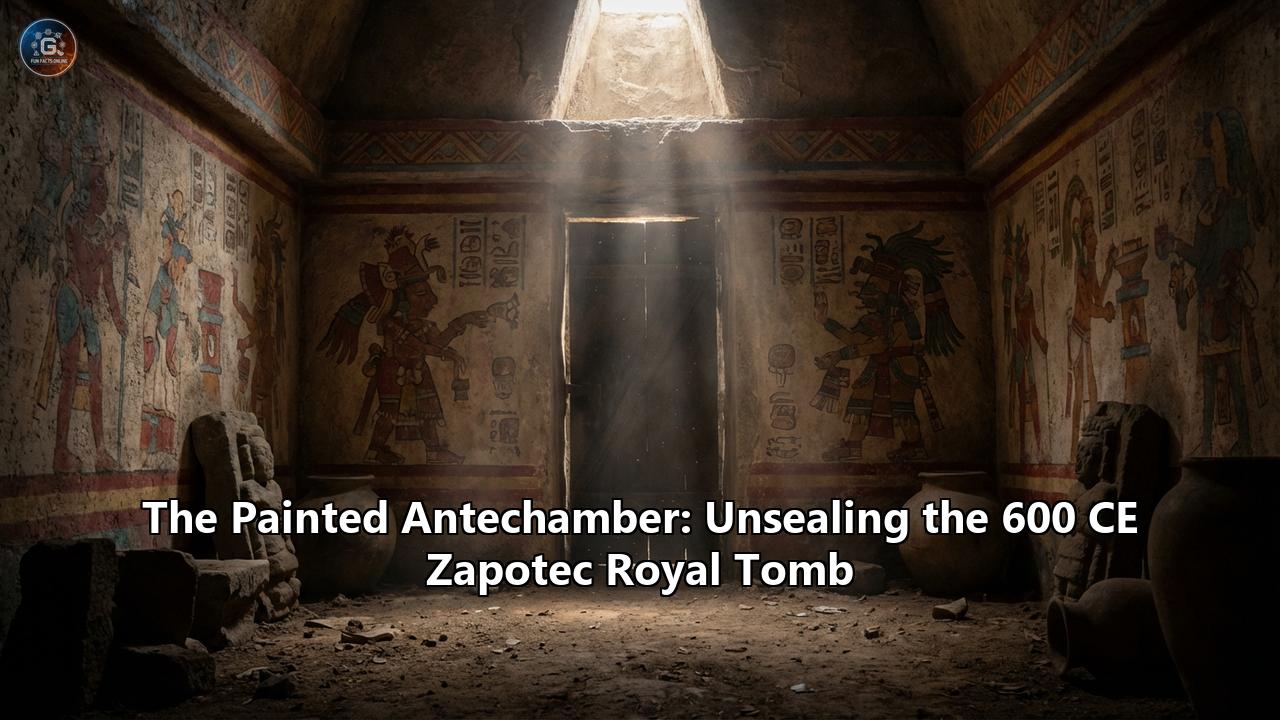
Stepping into this space (a privilege currently reserved for the conservation team) is like walking into a painting. The walls are coated in a fine white stucco, smoothed to the consistency of porcelain. Upon this canvas, artists from 600 CE unleashed a riot of color.
Unlike the faded fragments often found in exposed ruins, these murals are electric. The palette is dominated by hematite red, limonite ochre, malachite green, and a deep Maya blue. The air in the tomb, sealed for over a millennium, preserved the pigments in a state of suspended animation.
The murals in the antechamber depict the preparation for the journey. We see figures dressing the Lord, adorning him with jade ear spools, tying the leather sandals that will carry him across the nine rivers of the underworld. The details are microscopic: the weave of the cotton mantles, the spots on a jaguar-skin cape, the delicate feathers of a quetzal headdress. It is a documentary of elite life, frozen in time.
Part III: The Procession of the Copal Bearers
The Inner Sanctum
Beyond the antechamber lies the Burial Chamber itself. Here, the iconography shifts from preparation to action. The walls of this inner room display a grand procession.
Dozens of figures march towards the rear of the tomb. They are not warriors, but priests and nobles. Each carries a specific offering. The most prominent attribute is the Bolsa de Copal—the incense bag. In Mesoamerican rituals, copal (tree resin) was the food of the gods. Burning it released white smoke that formed clouds, connecting the earth to the sky.
The figures are depicted in profile, the classic Zapotec stance. They have sloping foreheads (a mark of beauty achieved through cranial deformation) and large, aquiline noses. Their mouths are open, as if chanting. Scroll-like shapes emerge from their lips—speech scrolls—indicating that the tomb was not a place of silence, but a place of perpetual song. They are singing the Lord into the afterlife.
The Lord of the Owl
At the center of the chamber, the physical remains were found. The skeleton of the Lord lay extended, his head oriented toward the south, the direction of the underworld. He was not alone.
The team discovered that he was buried with a "kill partner"—a canine companion. The bones of a Xoloitzcuintli dog were curled at his feet. In Zapotec belief, the dog guides the soul across the dark river that separates the living from the dead.
The Lord himself was draped in the remnants of a red shroud. While the fabric had largely disintegrated, the non-organic treasures remained. He wore a necklace of spherical jade beads, each the size of a plum. On his chest lay a pectoral mirror made of polished pyrite. In its day, it would have shone like the sun; now, it is oxidized and dark, a black mirror for a dark world.
But the most shocking find was the mask. Covering the skull was a mosaic mask made of turquoise and shell. It is stylistically distinct from the Teotihuacan masks often found in the region, suggesting a purely local, Zapotec masterpiece. The mask’s eyes are made of polished obsidian, giving the skull a penetrating, lifelike gaze.
Part IV: The Science of Resurrection
The Conservation Challenge
The "unsealing" of the tomb was a moment of triumph, but it immediately triggered a crisis. The murals, having adjusted to a stable humidity and temperature for 1,400 years, are now at extreme risk. The introduction of fresh air, light, and fungal spores can cause the stucco to crumble and the pigments to flake within days.
INAH has deployed a "triage tent" over the site. The tomb is now an airlocked clean room. Technicians in Tyvek suits work in shifts, monitoring sensors that track humidity levels to the decimal point. They are using a Japanese technique of facing—applying thin tissue paper with a reversible adhesive to the murals to hold the paint in place while the stucco is re-adhered to the stone walls.
The "Owl Lintel" faces a different threat: the salt in the soil. As the moisture evaporates from the newly exposed stone, salts crystallize and expand, threatening to shatter the delicate nose of the sculpted Lord. Chemical poultices are being applied to draw the salts out gently.
Decoding the Genetics
While the art historians marvel at the walls, the physical anthropologists are focused on the bones. Small samples of the Lord’s teeth have been sent to labs in Mexico City for DNA and isotopic analysis.
We are on the verge of knowing:
- What he ate: Isotopic ratios will tell us if he grew up in the valley eating corn, or if he spent time on the coast eating seafood.
- Who he was: DNA will allow us to compare his genome with modern Zapotec populations living in San Pablo Huitzo today. It is entirely possible that the people walking the streets of the town above are the direct descendants of the man in the tomb.
- How he died: Was it old age? Disease? Or perhaps a ritual sacrifice? The initial inspection of the bones shows signs of arthritis, suggesting he was a man of advanced age—a revered elder who had survived the brutal politics of the Classic period.
Part V: The Zapotec Worldview Reframed
The Cult of Ancestors
This discovery forces a rewriting of the textbooks regarding Zapotec religion. Previously, it was believed that the Zapotecs feared the dead, burying them beneath the floors of their houses to keep them close but contained. The Painted Antechamber suggests a far more complex relationship.
The specialized architecture—the antechamber specifically designed for ongoing visitation—indicates that the tomb was not a "case closed" burial. It was a temple. The living would descend into the earth to consult with the Lord. The face in the owl’s mouth is likely a representation of this oracular function. The ancestor speaks through the bird; the bird speaks from the dark.
The "unsealing" is, in a way, a restoration of the tomb's original purpose. It was built to be opened. The stone doors were designed to pivot. For centuries, before the city was abandoned and the tomb lost, priests likely entered this space once a year, burning copal and consulting the bones of the Lord on matters of war, harvest, and justice.
A Bridge to the Present
President Claudia Sheinbaum Pardo, in announcing the find, called it "a powerful testament to Mexico's millennia-old cultural legacy." But for the Zapotec communities of Oaxaca, it is more than a testament; it is a vindication.
The language spoken by the builders of this tomb—Dizá—is still spoken in the markets of Oaxaca today. The copal incense depicted on the walls is the same copal burned in the church of Santo Domingo this morning. The "Cloud People" did not vanish. They merely changed.
The Painted Antechamber connects the modern Zapotec identity directly to the splendors of the Classic era. It proves that their ancestors were not just farmers, but architects, astronomers, theologians, and master artists who commanded a civilization that rivaled Rome or Egypt.
Conclusion: The Owl Watches On
As the sun sets over the Valley of Oaxaca, the shadows lengthen across the Cerro de la Cantera. The tomb is silent again, save for the hum of the climate control generators. The Lord of the Owl has been disturbed, but he has also been remembered.
In unsealing the tomb, we have not just found a collection of bones and painted walls. We have recovered a chapter of human history that was thought lost. We have looked into the eyes of the owl and found that the past is not dead—it is merely waiting for the right moment to speak.
The Painted Antechamber is open. The procession continues. And across the span of 1,400 years, the Zapotec Lord still holds court.
Reference:
- http://www.thehistoryblog.com/archives/75227
- https://www.smithsonianmag.com/smart-news/this-carved-painted-zapotec-tomb-is-mexicos-most-important-archaeological-discovery-in-a-decade-180988162/
- https://arkeonews.net/extraordinary-polychrome-mural-reveals-1400-year-old-zapotec-tomb-in-oaxaca/
- https://www.ancient-origins.net/news-history-archaeology/zapotec-tomb-discovery-00102475
- https://www.youtube.com/watch?v=CfMG2FdFqQA
- https://archaeology.org/news/2026/01/27/intact-zapotec-tomb-discovered-in-oaxaca/
- https://gulfnews.com/world/americas/1400-year-old-tomb-stuns-archaeologists-with-vivid-murals-giant-owl-1.500425871
- https://www.livescience.com/archaeology/1-400-year-old-zapotec-tomb-discovered-in-mexico-features-enormous-owl-sculpture-symbolizing-death
- https://lugares.inah.gob.mx/en/node/5597
- https://www.jpost.com/archaeology/archaeology-around-the-world/article-886629
- https://www.gettyimages.com/detail/news-photo/reproduction-of-the-murals-from-tomb-105-in-monte-alban-news-photo/548666319
- https://indiandefencereview.com/mexico-archaeological-find-zapotec-tomb-murals-revealed/