
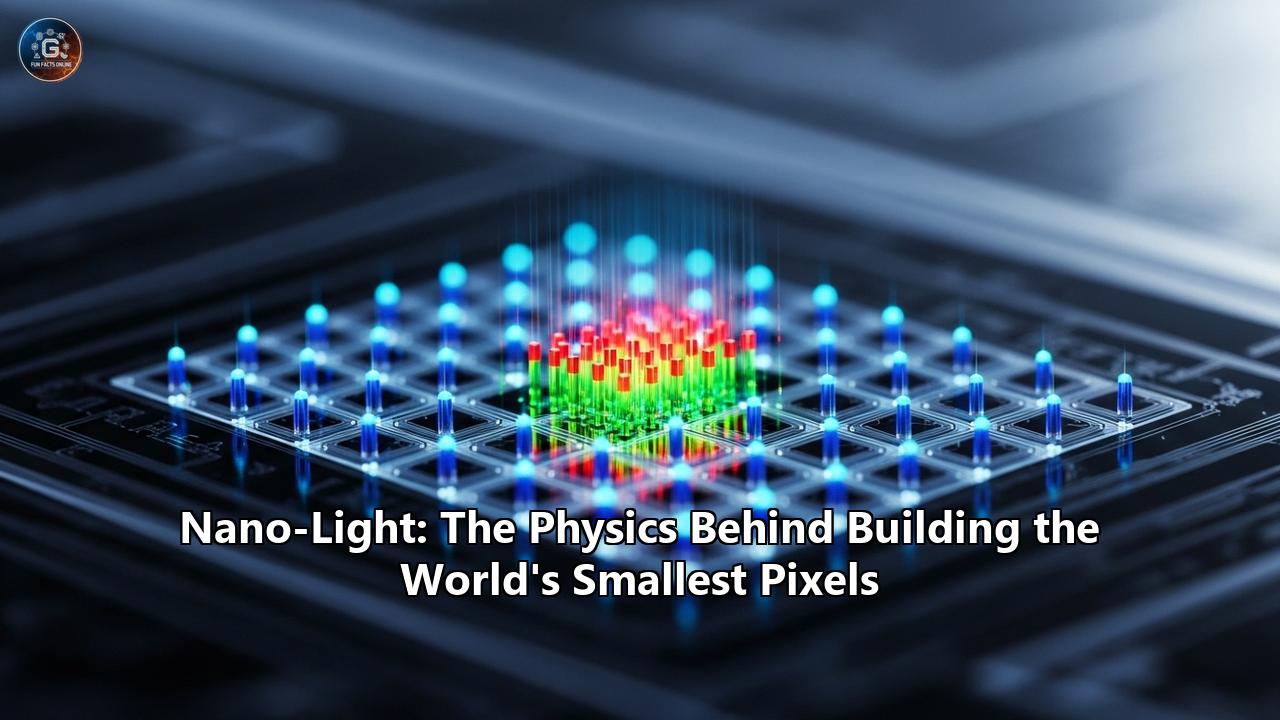
The Unseen Revolution: How Nano-Light is Forging the World's Smallest Pixels
In the relentless pursuit of visual perfection, humanity has journeyed from the soft glow of cathode ray tubes to the vibrant, ultra-thin displays that dominate our modern world. Yet, we stand on the precipice of another, more profound revolution, one that is unfolding at a scale almost too small to comprehend. This is the realm of "nano-light," a field where scientists and engineers are not just shrinking pixels but are fundamentally reimagining how light is generated and manipulated. By harnessing the bizarre and wonderful principles of quantum mechanics and electromagnetism at the nanoscale, they are building the world's smallest pixels, paving the way for displays with resolutions that could one day be indistinguishable from reality itself.
This journey into the infinitesimal is not merely about creating sharper smartphone screens or more immersive virtual reality experiences, though those are certainly on the horizon. It is about unlocking a new paradigm in how we interact with the digital world, where displays can be flexible enough to wrap around any surface, transparent enough to be integrated into our windows, and so small they could be woven into the fabric of our clothes or even placed on a contact lens. The physics behind this revolution is a captivating story of light and matter engaged in an intricate dance, a story of plasmons, quantum dots, and metamaterials. This article will delve into the extraordinary science that is making these futuristic visions a tangible reality.
A New Dawn for Display Technology: Beyond the Conventional Pixel
For decades, the pixel has been the fundamental building block of our digital visual world. From the bulky television sets of the past to the sleek OLED and QLED screens of today, the principle has remained largely the same: a grid of tiny, individually controlled light sources or filters that collectively form an image. The march of progress has been a story of miniaturization, of packing more and more pixels into a given area to enhance resolution and visual fidelity.
However, conventional display technologies are beginning to encounter fundamental physical limitations. As pixels shrink to the micrometer scale, issues like "crosstalk" between adjacent pixels can degrade image quality, and the efficiency of light emission can plummet. The intricate manufacturing processes required to create these microscopic structures also become increasingly complex and costly.
This is where the paradigm of nano-light steps in, offering a radical departure from traditional pixel architecture. Instead of simply shrinking existing technologies, nanophotonics—the study of the interaction of light with nanoscale structures—provides a new toolkit for controlling light in ways that were previously the stuff of science fiction. This field is not just about making things smaller; it's about leveraging the unique and often counterintuitive properties of matter that emerge at the nanoscale.
At this minuscule level, the familiar rules of classical physics begin to give way to the strange and wonderful principles of quantum mechanics. Materials can interact with light in entirely new ways, allowing scientists to trap, guide, and even sculpt it with unprecedented precision. This has given rise to three revolutionary approaches to creating the world's smallest pixels: plasmonics, quantum dots, and metamaterials. Each of these technologies offers a unique pathway to a future of displays that are not only smaller and sharper but also more energy-efficient and versatile than anything we have seen before.
Plasmonics: Painting with Light at the Nanoscale
One of the most promising avenues in the quest for the ultimate pixel lies in the shimmering, vibrant world of plasmonics. This field of nanophotonics is not about creating light, but rather about manipulating it in extraordinary ways using the collective oscillations of electrons in metallic nanostructures. The result is a new form of "structural color," where the hue is not determined by pigments or dyes but by the physical shape and arrangement of these infinitesimally small structures.
The history of plasmonic color is surprisingly ancient, with its roots stretching back to the artisans of the Roman Empire. The famous Lycurgus Cup, a 4th-century Roman glass chalice, exhibits a remarkable dichroic effect, appearing green in reflected light and red when light is transmitted through it. This is due to the presence of gold and silver nanoparticles embedded within the glass. While the Roman craftsmen were unaware of the underlying physics, they had stumbled upon the power of plasmonics.
The Physics of Surface Plasmon Resonance
The magic behind plasmonic pixels is a phenomenon known as surface plasmon resonance (SPR). When light interacts with a metallic nanostructure, such as a nanoparticle or a thin film, its electromagnetic field can couple with the sea of free electrons at the metal's surface, causing them to oscillate in a collective, wave-like motion. These oscillations are called surface plasmons.
At a specific frequency—the resonance frequency—this coupling becomes incredibly strong, leading to a dramatic enhancement of light absorption and scattering at that particular wavelength. This resonance is highly sensitive to the size, shape, and composition of the nanostructure, as well as the surrounding dielectric environment. By carefully engineering these properties, scientists can precisely control which colors of light are absorbed and which are scattered, effectively "tuning" the color of the nanostructure.
For example, smaller nanoparticles tend to scatter shorter wavelengths of light, appearing blue or green, while larger nanoparticles scatter longer wavelengths, appearing red or orange. This is the fundamental principle that allows for the creation of plasmonic color.
There are two main types of surface plasmons relevant to nano-pixel technology:
- Localized Surface Plasmons (LSPs): These are non-propagating oscillations of electrons confined to a metallic nanostructure, such as a nanoparticle. When light of a specific wavelength strikes the nanoparticle, it excites an LSP, leading to strong light scattering and absorption at that wavelength. This is the primary mechanism behind the colors seen in stained glass and the Lycurgus Cup.
- Surface Plasmon Polaritons (SPPs): These are electromagnetic waves that are coupled to the collective oscillations of electrons and propagate along the interface between a metal and a dielectric material. SPPs are crucial for guiding and manipulating light in more complex plasmonic devices.
Crafting the Plasmonic Pixel
Building a plasmonic pixel involves creating a precisely patterned array of metallic nanostructures on a substrate. These nanostructures can take various forms, including nanorods, nanodisks, nanoantennas, and even more complex geometries. The choice of material is also critical, with gold and silver being the most commonly used due to their excellent plasmonic properties in the visible spectrum. However, researchers are also exploring more abundant and cost-effective materials like aluminum.
The color of a plasmonic pixel is determined by several factors:
- Nanostructure Geometry: The size and shape of the individual nanostructures are the primary determinants of the plasmon resonance wavelength and thus the color. By varying the dimensions of the nanostructures, it's possible to generate a wide range of colors.
- Array Periodicity: The spacing between the nanostructures in the array also plays a crucial role. When the periodicity is on the order of the wavelength of light, diffractive effects can occur, leading to angle-dependent colors. To create angle-independent colors, the nanostructures are typically spaced much closer together, at subwavelength distances.
- Material Composition: The choice of metal and the surrounding dielectric material influences the plasmon resonance. For instance, changing the dielectric constant of the material surrounding the nanostructures can shift the resonance wavelength and thus the color.
One of the key advantages of plasmonic pixels is their potential for extremely high resolution. Since the individual nanostructures can be fabricated at the nanoscale, it's possible to create pixels that are far smaller than what can be achieved with conventional technologies. Researchers have already demonstrated plasmonic pixels with dimensions on the order of a few hundred nanometers.
Dynamic Plasmonic Displays: Making Colors Change on Demand
While static plasmonic color printing is impressive, the true potential for display technology lies in creating dynamic plasmonic pixels that can change color on demand. Researchers are exploring several ingenious approaches to achieve this:
- Mechanical Deformation: By embedding plasmonic nanostructures in a flexible substrate, the spacing between them can be altered by stretching or compressing the material, leading to a change in the diffractive coupling and thus a shift in color.
- Liquid Crystal Integration: Liquid crystals, the workhorse of modern LCDs, can be used to change the refractive index of the material surrounding the plasmonic nanostructures. By applying an electric field, the liquid crystal molecules can be reoriented, altering the plasmon resonance and switching the color of the pixel.
- Electrochemical Modulation: In some designs, an electrochemical reaction is used to modify the properties of the nanostructures or the surrounding material. For example, researchers at the University of Cambridge have created "nano-pixels" by coating gold nanoparticles with a conductive polymer. Applying an electrical voltage causes a chemical change in the polymer, altering its refractive index and changing the color of the pixel. This approach has the advantage of being bistable, meaning the pixels retain their color even after the power is turned off, leading to extremely low energy consumption.
- Phase-Change Materials: Another innovative approach involves using phase-change materials, such as germanium-antimony-tellurium (GST), the same type of material used in rewritable DVDs. By applying a brief electrical pulse, the material can be switched between a crystalline and an amorphous state, each of which has different optical properties. This change in the material's state alters its interaction with light, allowing the pixel to be switched on and off.
The development of dynamic plasmonic displays is still in its early stages, but the progress has been rapid. Researchers have already demonstrated fast switching speeds and a wide range of colors. As these technologies mature, they could pave the way for a new generation of reflective displays that are not only ultra-high resolution but also incredibly energy-efficient, as they rely on ambient light rather than a power-hungry backlight.
Quantum Dots: The Tiny Crystals That Glow with Perfect Color
While plasmonic pixels masterfully manipulate existing light, another class of nano-pixels, based on quantum dots (QDs), generates light of its own with breathtaking precision. These minuscule semiconductor nanocrystals, often just a few nanometers in diameter, are at the heart of the "QLED" displays that have become a mainstay in the premium television market. Their ability to produce pure, vibrant colors with exceptional efficiency is a direct consequence of the strange and wonderful rules of quantum mechanics.
The story of quantum dots begins in the early 1980s with the pioneering work of Russian physicist Alexei Ekimov and American chemist Louis Brus. Working independently, they discovered that the optical properties of semiconductor nanoparticles were not fixed but depended on their size. This groundbreaking discovery, which earned them the 2023 Nobel Prize in Chemistry along with Moungi Bawendi, laid the foundation for the field of quantum dot research.
The Physics of Quantum Confinement
The remarkable color-tunability of quantum dots stems from a quantum mechanical phenomenon known as quantum confinement. In a bulk semiconductor material, electrons have a continuous range of energy levels they can occupy. However, when the semiconductor is shrunk down to the nanoscale, to a size comparable to the natural wavelength of the electron, the electron's movement becomes restricted in all three dimensions.
This confinement has a profound effect on the electron's energy levels. Instead of a continuous band, the energy levels become discrete and quantized, much like the energy levels of an individual atom. The spacing of these energy levels is inversely proportional to the size of the quantum dot. Smaller dots have more widely spaced energy levels, while larger dots have more closely spaced energy levels.
When a quantum dot absorbs a photon of light, an electron is excited from a lower energy level (the valence band) to a higher energy level (the conduction band), leaving behind a "hole." This electron-hole pair is called an exciton. When the electron falls back down to recombine with the hole, it releases a photon of light. The energy, and therefore the color, of this emitted photon is determined by the energy difference between the excited state and the ground state.
Because the energy levels are determined by the size of the quantum dot, the color of the emitted light can be precisely tuned simply by changing the size of the nanocrystal. Smaller quantum dots, with their larger energy gaps, emit higher-energy, shorter-wavelength light, such as blue or green. Larger quantum dots, with their smaller energy gaps, emit lower-energy, longer-wavelength light, such as orange or red. This size-dependent color emission is the defining characteristic of quantum dots and is what makes them so powerful for display applications.
Quantum Dots in Modern Displays
In today's QLED displays, quantum dots are typically used in a photoluminescent manner. This means they are not directly stimulated by an electric current but instead absorb light from a separate source and then re-emit it at a different color. The most common architecture involves a backlight of blue LEDs. This blue light then passes through a film containing a mixture of red and green quantum dots.
The green quantum dots absorb some of the blue light and re-emit it as pure green light, while the red quantum dots absorb another portion of the blue light and re-emit it as pure red light. The remaining blue light from the backlight passes through unaltered. The result is a high-purity white light source that is then passed through a liquid crystal layer and color filters to create the final image. This approach offers several advantages over traditional LCDs with white LED backlights:
- Wider Color Gamut: Because quantum dots emit light in very narrow, specific wavelengths, they can produce much purer and more saturated colors than the broad-spectrum light from conventional LEDs. This allows QLED displays to reproduce a much wider range of colors, getting closer to the full spectrum that the human eye can perceive.
- Higher Brightness and Efficiency: The conversion of light by quantum dots is a highly efficient process, meaning less energy is wasted. This allows for brighter displays without a significant increase in power consumption.
- Improved Durability: Unlike the organic molecules used in OLED displays, quantum dots are inorganic and are less susceptible to degradation over time, reducing the risk of "burn-in."
The Future of Quantum Dot Pixels: Towards Electroluminescence
While photoluminescent quantum dots have already made a significant impact on the display market, the ultimate goal is to create electroluminescent quantum dot displays, or "true" QLEDs. In this type of display, the quantum dots would be directly stimulated by an electric current, acting as individual light-emitting diodes. This would eliminate the need for a backlight and color filters altogether, leading to even greater efficiency and thinner, more flexible displays.
Significant progress is being made in this area. Researchers are developing new quantum dot materials and device architectures to improve the efficiency and stability of electroluminescent QDs. For example, recent breakthroughs in the synthesis of cadmium-free quantum dots are addressing environmental concerns associated with earlier QD technologies. Researchers at Curtin University have developed highly efficient and stable blue quantum dots that do not use the toxic heavy metal cadmium, a significant step towards more sustainable display technologies. Furthermore, researchers at Soochow University and Macau University of Science and Technology have developed a novel synthesis strategy for red quantum dots with exceptional efficiency and stability, paving the way for ultra-high-definition displays.
The development of electroluminescent QD displays that can be patterned at the nanoscale is the next frontier in this field. This would enable the creation of ultra-high-resolution displays with all the advantages of quantum dot technology. As fabrication techniques become more refined, we can expect to see the emergence of true nano-pixel QD displays that will once again redefine the boundaries of visual fidelity.
Metamaterials: Bending the Rules of Light
The third and perhaps most exotic pathway to building the world's smallest pixels involves a class of materials that seemingly defy the laws of nature: metamaterials. These are not naturally occurring substances but are artificially engineered structures with properties that are not found in their constituent materials. By arranging these structures in precise, repeating patterns at a subwavelength scale, scientists can manipulate electromagnetic waves, including light, in extraordinary ways.
The concept of metamaterials was first envisioned by Russian physicist Victor Veselago in 1967. He theorized that a material with both negative electrical permittivity and negative magnetic permeability would exhibit a negative refractive index, a property that had never been observed in nature. For decades, this remained a theoretical curiosity. However, in the late 1990s and early 2000s, the work of researchers like John Pendry and David Smith brought Veselago's vision to life, leading to the first experimental demonstrations of metamaterials.
The Physics of Negative Refraction and Beyond
The defining characteristic of many metamaterials is their ability to exhibit a negative refractive index. In conventional materials, light bends in a predictable way when it passes from one medium to another, a phenomenon known as refraction. A negative refractive index means that light bends in the "wrong" direction, a property that opens up a host of mind-bending possibilities, including the creation of "superlenses" that can overcome the diffraction limit of light and image objects smaller than the wavelength of light itself.
The unusual properties of metamaterials arise from their carefully designed internal structure. They are typically composed of an array of tiny, resonant elements, such as split-ring resonators or metallic wires, that are much smaller than the wavelength of the light they are designed to interact with. These "meta-atoms" respond to the electric and magnetic components of the light wave, and their collective response determines the overall optical properties of the material.
By tailoring the shape, size, and arrangement of these meta-atoms, scientists can precisely engineer the material's permittivity and permeability, the two fundamental parameters that govern how a material interacts with electromagnetic fields. This allows them to create materials with properties that are simply not found in nature, such as a negative refractive index.
Beyond negative refraction, metamaterials offer an unprecedented level of control over light. They can be designed to:
- Focus light to a point smaller than the diffraction limit: This could lead to revolutionary advances in microscopy and data storage.
- Guide and steer light beams with incredible precision: This is crucial for creating compact and efficient optical circuits and beam-shaping devices.
- Create "invisibility cloaks": By bending light around an object, metamaterials could one day make objects appear to disappear. While a true invisibility cloak is still a long way off, the principle has been demonstrated at microwave frequencies.
Metamaterial-Based Pixels and Displays
The ability of metamaterials to manipulate light at the subwavelength scale makes them a compelling candidate for creating a new generation of displays. A two-dimensional version of a metamaterial, known as a metasurface, can be used to control the phase, amplitude, and polarization of light on a flat surface. By patterning a metasurface with an array of nanoantennas, it's possible to create ultra-thin, flat optical components that can perform the same functions as bulky lenses and prisms.
This technology is being explored for a variety of display applications:
- Holographic Displays: Metasurfaces can be used to create highly realistic 3D holographic images with a much wider field of view than is possible with current holographic technologies.
- Augmented and Virtual Reality: The compact and lightweight nature of metasurface optics makes them ideal for use in AR and VR headsets, where they can be used to create more immersive and comfortable viewing experiences.
- Dynamic Color Displays: Researchers are developing dynamic metamaterial pixels that can change their optical properties in response to an external stimulus, such as an electric field or heat. This could be achieved by incorporating materials like liquid crystals or phase-change materials into the metamaterial structure.
One of the key challenges in creating metamaterial-based displays is the complexity of the fabrication process. Creating the intricate, subwavelength patterns required for metamaterials is a difficult and often expensive process, typically relying on techniques like electron-beam lithography. However, researchers are developing new, more scalable manufacturing techniques, such as nanoimprint lithography and self-assembly, which could one day make metamaterial displays a commercially viable reality.
The Dawn of the Nano-Pixel Era: A Comparative Look and Future Horizons
The journey into the world of nano-light has revealed three distinct yet equally fascinating paths to creating the world's smallest pixels. Plasmonics, quantum dots, and metamaterials each offer a unique set of advantages and challenges, and the ultimate display technology of the future may well involve a combination of these approaches.
A Tale of Three Technologies: A Comparative Overview
| Feature | Plasmonic Pixels | Quantum Dot Pixels | Metamaterial Pixels |
| :--- | :--- | :--- | :--- |
| Principle | Manipulate ambient light through surface plasmon resonance. | Generate light through quantum confinement and photoluminescence/electroluminescence. | Manipulate light through engineered subwavelength structures. |
| Color Generation | Structural color determined by nanostructure geometry and arrangement. | Size-tunable emission of pure, monochromatic colors. | Color filtering or generation through resonant scattering and diffraction. |
| Resolution | Extremely high, limited only by the size of the nanostructures. | Potentially very high, especially with electroluminescent QDs. | Extremely high, determined by the size of the "meta-atoms." |
| Energy Efficiency | Very high, as they are typically reflective and don't require a backlight. | High, especially with direct electroluminescence. | Potentially very high, depending on the specific design. |
| Fabrication | Can be fabricated using a variety of techniques, including lithography and self-assembly. | Well-established synthesis for photoluminescent QDs; electroluminescent fabrication is more complex. | Fabrication is complex and often requires advanced lithography techniques. |
| Maturity | Research and development stage for dynamic displays. | Commercially available in photoluminescent form (QLED); electroluminescent displays are emerging. | Early research and development stage. |
Plasmonic pixels excel in their potential for creating ultra-high-resolution, low-power reflective displays. Their ability to manipulate ambient light makes them ideal for applications where visibility in bright sunlight is important, such as e-readers and outdoor signage. However, achieving dynamic color control with fast switching speeds remains a key research challenge. Quantum dot pixels have already made a significant impact on the display market with their ability to produce vibrant, saturated colors. The transition to electroluminescent QD displays promises even greater efficiency and a wider range of applications. The main challenges lie in improving the stability and lifetime of blue QDs and developing cost-effective manufacturing processes for high-resolution patterning. Metamaterial pixels represent the most futuristic and potentially transformative of the three technologies. Their ability to manipulate light in ways that are not possible with natural materials opens up a vast design space for creating novel optical components and displays. However, the complexity of their design and fabrication currently makes them the least mature of the three approaches.The Road Ahead: Challenges and Opportunities
The path to a future dominated by nano-pixel displays is not without its obstacles. Several key challenges must be overcome to bring these technologies from the laboratory to the living room:
- Manufacturing and Scalability: Developing cost-effective, high-throughput manufacturing processes for creating these intricate nanoscale structures is perhaps the single biggest hurdle. While techniques like nanoimprint lithography and self-assembly show promise, they are still a long way from matching the scale and efficiency of current display manufacturing.
- Material Stability and Durability: The long-term stability of these nanomaterials, particularly under exposure to heat, light, and oxygen, is a critical concern. Ensuring that these displays have a lifespan comparable to conventional technologies is essential for their commercial success.
- Integration with Electronics: Developing the a.m. to individually address and control billions of nano-pixels is a significant engineering challenge. This will require new approaches to display driver electronics and circuitry.
- Environmental and Safety Concerns: The potential environmental impact and health risks associated with the large-scale production and disposal of nanomaterials must be carefully assessed and mitigated. Regulations and safety standards will need to be established to ensure the responsible development of these technologies.
Despite these challenges, the potential rewards are immense. The era of nano-light promises a future of displays that are not just sharper and more vibrant, but also more deeply integrated into our lives. We can envision a world of:
- True 3D Holographic Displays: Metasurfaces could finally make the kind of holographic displays seen in science fiction a reality, revolutionizing everything from communication and entertainment to medical imaging and design.
- Smart Windows and Surfaces: Displays could be integrated into windows, walls, and other surfaces, allowing them to change color, display information, or even become transparent on demand.
- Wearable and Implantable Displays: The small size and flexibility of nano-pixel displays could enable their integration into clothing, contact lenses, and even biomedical implants, providing a seamless interface between the digital and physical worlds.
- Advanced Camouflage and Cloaking: The ability of metamaterials to manipulate light could lead to the development of active camouflage systems that can instantly adapt to their surroundings.
Conclusion: A Future Illuminated by Nano-Light
The quest to build the world's smallest pixels is more than just a technological race; it is a fundamental exploration of the nature of light and matter. By delving into the quantum realm, scientists are unlocking a new set of rules for how we can control and manipulate our visual world. The physics of plasmonics, quantum dots, and metamaterials, once the domain of theoretical physicists and materials scientists, is now being harnessed to create a new generation of displays that will be smaller, sharper, and more deeply integrated into our lives than ever before.
The road ahead is long, and there are significant scientific and engineering challenges to overcome. But the progress has been nothing short of astounding. From the ancient Roman artisans who unknowingly harnessed the power of plasmons to the Nobel Prize-winning scientists who unraveled the mysteries of quantum dots, the journey of nano-light is a testament to human ingenuity and our relentless desire to push the boundaries of what is possible. As we stand at the dawn of this new era, one thing is clear: the future of displays will not be measured in inches or even millimeters, but in the shimmering, vibrant, and infinitesimally small world of nanometers. The future will be illuminated by nano-light.
Reference:
- https://bioengineer.org/breakthrough-in-quantum-dot-technology-enhances-brightness-and-eco-friendliness-of-led-displays/
- https://www.beilstein-journals.org/bjnano/content/pdf/2190-4286-9-201.pdf
- https://portal.findresearcher.sdu.dk/en/publications/plasmonic-colour-generation/
- https://www.idtechex.com/en/research-article/illuminating-the-future-quantum-dots-reshaping-display-technology/29886
- https://arxiv.org/pdf/2411.15984
- https://pubmed.ncbi.nlm.nih.gov/24084836/
- https://pmc.ncbi.nlm.nih.gov/articles/PMC8992011/
- https://en.wikipedia.org/wiki/Photonic_metamaterial
- https://www.researchgate.net/publication/267761621_Light-matter_interactions_at_the_nanoscale
- https://quantumzeitgeist.com/metamaterials-shaping-the-future-of-optics-and-electromagnetism/
- https://www.photonics.com/Articles/Nanopixels-Could-Be-Used-for-Creating/a64701
- https://pmc.ncbi.nlm.nih.gov/articles/PMC9740896/
- https://pmc.ncbi.nlm.nih.gov/articles/PMC10929592/
- https://web.mit.edu/redingtn/www/netadv/Xmetamater.html
- https://www.fda.gov/apology_objects/abuse-detection-apology.html
- https://www.researchgate.net/publication/388913760_Quantum_dots_for_display_A_review_of_three_key_milestones
- https://fiveable.me/introduction-nanotechnology/unit-11/light-matter-interactions-nanoscale/study-guide/plu1uL5A8gPcYZGw
- https://www.researchgate.net/publication/365189583_Review_of_foundational_concepts_and_emerging_directions_in_metamaterial_research_Design_phenomena_and_applications
- https://2024.sci-hub.se/7355/09e4a8d9a6ae16fb551380e160b00132/li2018.pdf
- https://www.azonano.com/news.aspx?newsID=41555
- https://quantumzeitgeist.com/quantum-dots-breakthrough-new-technology-achieves-more-realistic-colors-and-longer-lifespan-for-displays/
- https://www.semiconductor-digest.com/quantum-dot-technology-breakthrough-more-realistic-in-color-lasts-longer/
- https://www.azooptics.com/Article.aspx?ArticleID=2511
- https://physics.anu.edu.au/study/projects/project.php?ProjectID=23
- https://www.researchgate.net/publication/303414197_Electrodynamics_of_metamaterials
- https://australiansciencejournals.com/ajnst/article/download/1782/1875
- https://www.nano.uw.edu/research/scalable-nanomanufacturing/
- https://pmc.ncbi.nlm.nih.gov/articles/PMC6190475/
- https://pmc.ncbi.nlm.nih.gov/articles/PMC4918223/
- https://physicstoday.aip.org/news/exploring-the-environmental-impact-of-quantum-dots
- https://www.hsa.ie/eng/your_industry/chemicals/legislation_enforcement/nanomaterials/
- https://www.bfr.bund.de/cm/349/regulation-of-nanomaterials-in-consumer-products.pdf
- https://www.azonano.com/article.aspx?ArticleID=6885