
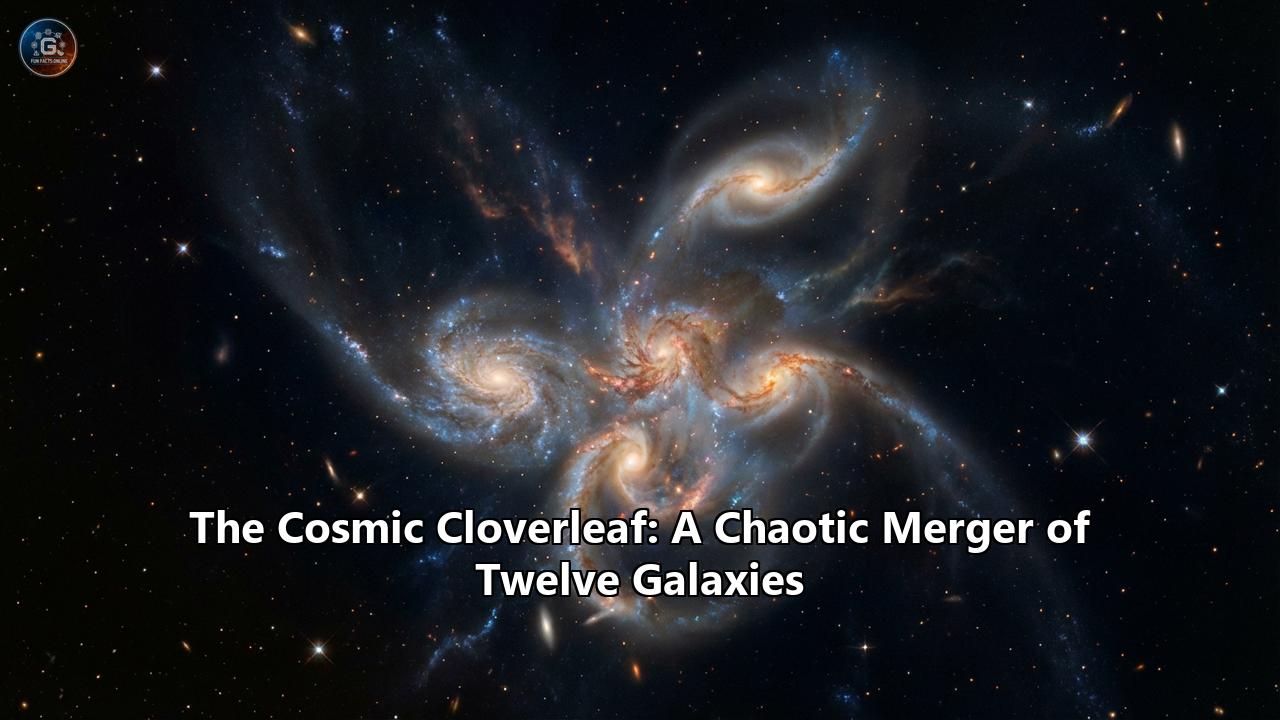
The universe is often depicted as a silent, static tapestry of light—a gallery of frozen spirals and elliptical islands floating in the dark. But this serenity is an illusion. To the eyes of our most advanced instruments, the cosmos is a violent, dynamic arena where gravity sculpts structure through cataclysmic collisions. Nowhere is this more evident than in the recent, groundbreaking unraveling of the "Cosmic Cloverleaf"—a system that has rewritten our understanding of galactic evolution and solved one of the most puzzling mysteries of modern radio astronomy.
For years, astronomers were baffled by "Odd Radio Circles" (ORCs)—gigantic, ghostly rings of radio emission that encircled galaxies like smoke rings, defying explanation. They fit no known model of planetary nebulae, supernova remnants, or star-forming bursts. It was not until the multi-wavelength analysis of a specific ORC, dubbed the "Cloverleaf," that the truth emerged. We were not looking at a mere explosion, but a crash scene on a cosmological scale: a chaotic merger of twelve individual galaxies, caught in the very act of coalescing into a single massive cluster.
This article delves deep into the anatomy of this cosmic train wreck. We will explore the history of the ORC mystery, the detective work that linked faint radio rings to a violent group merger, the physics of the shockwaves that lit up the sky, and the profound implications this event has for our understanding of how the largest structures in the universe are born.
Part I: The Mystery of the Ghostly Rings
To understand the significance of the Cosmic Cloverleaf, we must first rewind to the discovery that set the stage. In late 2019, the Australian Square Kilometre Array Pathfinder (ASKAP), a radio telescope situated in the silent outback of Western Australia, began surveying the sky with unprecedented sensitivity. Its mission was to map millions of galaxies, but it found something it wasn't looking for.
Buried in the terabytes of data were faint, circular patches of radio emission. They were enormous—spanning hundreds of thousands of light-years, larger than the Milky Way itself—yet they were invisible to optical telescopes. They had no central bright star, no obvious connection to the galaxies they surrounded. They were simply... circles.
Astronomers were stumped. Was it a glitch in the software? A reflection of Earthly interference? Or a new class of astronomical object? As more were found, they were officially cataloged as "Odd Radio Circles," or ORCs. The name was a placeholder, a scientific shrug. Theories abounded: were they the throats of wormholes? The expanding shells of a new type of supernova? The shockwaves from a binary black hole merger?
For five years, the ORCs remained an enigma. They were ghosts in the machine, spectral rings that hinted at a violent process we couldn't quite see. That changed with the discovery of the Cloverleaf.
Part II: Unveiling the Cloverleaf
The Cloverleaf ORC (technically cataloged in association with the galaxy group near redshift z=0.05) looked different. While it shared the characteristic ring structure of its cousins, it was messier, more complex. It wasn't just a simple circle; it had lobes and irregularities that earned it the moniker "Cloverleaf."
But the breakthrough didn't come from looking at the radio waves alone. It came when a team of astrophysicists, led by researchers at the Max Planck Institute for Extraterrestrial Physics, decided to look at the "scene of the crime" with a different set of eyes: X-ray vision.
Using the European Space Agency's XMM-Newton space telescope, the team peered at the center of the Cloverleaf. X-rays are the universe's thermometer; they are emitted by gas that has been heated to millions of degrees. If the ORCs were just gentle bubbles of gas, the X-ray image should have been faint or non-existent.
Instead, the XMM-Newton data lit up like a flare.
The telescope revealed a colossal cloud of superheated gas, glowing at a staggering 15 million degrees Fahrenheit (roughly 8 million degrees Celsius). This was no gentle bubble. This was the thermal signature of a massive gravitational crunch. The gas was shaped perpendicular to the radio ring, filling the space between a swarm of galaxies.
When the team overlaid the X-ray map with deep optical images from the Dark Energy Camera, the culprit was finally revealed. The Cloverleaf wasn't a single galaxy blowing a bubble. It was a swarm. At the heart of the radio ring lay not one, but twelve distinct galaxies, packed into a volume of space that should normally host only one or two.
The pieces of the puzzle clicked into place. The "Odd Radio Circle" was not a mysterious object in itself; it was the smoke from a gun that had just been fired. The gun was the gravitational merger of two entire groups of galaxies, smashing into each other at millions of miles per hour.
Part III: The Anatomy of a Galactic Train Wreck
The Cosmic Cloverleaf represents a specific and violent phase in the hierarchy of the universe: the transition from "Group" to "Cluster."
Galaxies are gregarious; they rarely live alone. The Milky Way, for instance, is part of the "Local Group," a small family that includes Andromeda and about 50 smaller dwarf galaxies. But in the grander scheme, groups are destined to fall together to form "Clusters," which can contain thousands of galaxies.
The Cloverleaf captures the very moment two independent groups—each containing roughly half a dozen major galaxies—collided.
1. The Initial Approach
Imagine two swarms of bees flying toward each other. In the vast emptiness of space, the "bees" (the stars within the galaxies) rarely collide because the distance between them is immense. You could throw two galaxies through each other, and it is statistically likely that not a single pair of stars would physically crash.
However, galaxies are not just made of stars. They are filled with the Interstellar Medium (ISM)—clouds of gas and dust—and surrounded by a halo of tenuous, hot gas known as the Intra-Group Medium.
2. The Collision of Gas
When the two galaxy groups of the Cloverleaf slammed together, the stars slipped past each other, but the gas clouds did not. They crashed with the force of a billion atomic bombs. The gas in the merging groups underwent "ram pressure stripping" and violent shock heating. The kinetic energy of the galaxies' motion was instantly converted into thermal energy, heating the intra-group gas to the 15 million degrees observed by XMM-Newton.
This superheated plasma is what generates the X-rays. It effectively traces the gravitational well of the merging system, outlining the chaotic potential energy pit into which the twelve galaxies are falling.
3. The Shockwave (The Radio Ring)
This is where the ORC comes in. When you have a collision this energetic, it drives a shockwave outward through the tenuous gas of the intergalactic medium, much like a sonic boom from a supersonic jet, but on a scale of 600,000 light-years.
This shockwave acts as a cosmic particle accelerator. The universe is filled with "fossil electrons"—old, low-energy electrons left over from ancient supernovae or the past activity of supermassive black holes. On their own, these electrons are invisible. But when the merger shockwave sweeps over them, it kicks them, accelerating them to near light-speed.
As these relativistic electrons spiral around magnetic fields in the shock front, they emit "synchrotron radiation"—which appears to our telescopes as radio waves. The giant, ghostly ring of the Cloverleaf is essentially the "sonic boom" of the galaxy crash, illuminated by these re-accelerated electrons.
Part IV: The Twelve Titans
Who are the actors in this cosmic drama? The twelve galaxies identified in the Cloverleaf merger are a motley crew of ellipticals and spirals, each being traumatized by the event.
- The Anchor Galaxies: At the center of the two merging subgroups are likely two massive elliptical galaxies. These are the gravitational anchors. As they spiralled toward each other, they dragged their satellite galaxies with them.
- The Stripped Spirals: Several of the smaller members appear to be spiral galaxies that are losing their shape. As they plunge through the dense, hot gas of the merger center, their own gas is being stripped away—a process called "jellyfish galaxy" formation. They leave trails of star-forming gas behind them, doomed to become "red and dead" ellipticals as their fuel is stolen.
- The Agitated Nuclei: The merger has likely disrupted the central supermassive black holes of the twelve galaxies. The gravitational tidal forces torque gas into these black holes, causing them to flare up as Active Galactic Nuclei (AGN). It is possible that the "fossil electrons" lighting up the radio ring were originally spewed out by one of these black holes millions of years ago, only to be re-awakened by the merger shock today.
Part V: Why the Cloverleaf is Unique
Galaxy mergers happen all the time. The Universe has been building itself "bottom-up" for 13.8 billion years. So why is the Cloverleaf so special? Why don't we see ORCs everywhere?
The answer lies in the geometry and the timing.
1. The "Goldilocks" Geometry:For an ORC to be visible as a perfect ring, we generally need to be viewing the shockwave "face-on." If the merger were happening edge-on relative to Earth, we might see a complex mess or a "relic" structure, but not a beautiful circle. The Cloverleaf offers a rare, perpendicular viewing angle of the shock front expanding outward.
2. The Evolutionary Sweet Spot:The Cloverleaf is caught in a transient phase. If we looked a few hundred million years earlier, the groups would be too far apart to generate the shock. If we looked a billion years later, the shock would have dissipated, the gas would have cooled, and the twelve galaxies would have merged into a single, giant elliptical galaxy at the center of a new cluster. We are catching a fleeting moment of maximum violence.
3. The Fossil Electron Reservoir:The leading theory for why the Cloverleaf is so bright in radio waves is that the region was already "polluted" with high-energy particles. It implies that one of the twelve galaxies was a radio-loud quasar in the past, filling the surrounding space with plasma. When the merger shock hit this pre-existing plasma, it lit up brilliantly. Without that pre-existing reservoir of electrons, the shockwave might have been invisible to our radio telescopes.
Part VI: Implications for Cosmology
The study of the Cosmic Cloverleaf goes far beyond explaining a pretty picture. It serves as a laboratory for high-energy astrophysics and dark matter dynamics.
Tracking Dark Matter:We cannot see dark matter, but we know it drives these mergers. The visible galaxies are like corks bobbing on a river of dark matter. By modeling the dynamics of the 12 visible galaxies and the temperature of the X-ray gas, astronomers can map the distribution of the invisible dark matter halo enveloping the system. The Cloverleaf provides a unique test case for how dark matter halos merge and relax.
Understanding Galaxy Quenching:One of the biggest questions in astronomy is why massive galaxies stop forming stars. The Cloverleaf shows us the mechanism in action. The violent heating of the gas (to 15 million degrees) prevents it from cooling down to form new stars. Furthermore, the shockwaves strip the galaxies of their existing fuel. This merger is effectively a "sterilization" event, ensuring that the resulting massive cluster galaxy will be composed of old, red stars—a cosmic retirement home.
The Future of the Milky Way:In about 4.5 billion years, our Milky Way will merge with the Andromeda galaxy. While that will be a merger of just two major giants (a binary merger), the physics will be similar. Looking at the Cloverleaf is like looking at a hyper-accelerated, magnified version of our own distant future. It reminds us that our galactic home is not a permanent fixture, but a fluid structure subject to the violent tides of gravity.
Part VII: The Future of Observation
The unraveling of the Cloverleaf mystery is just the beginning. The "current" time of 2026 marks a golden age for this research because of the synergy between instruments.
- The SKA (Square Kilometre Array): As the SKA comes online, it will likely find thousands more ORCs. Astronomers estimate that ORCs might be more common than we thought, but most are too faint for current telescopes. The Cloverleaf is likely just the brightest tip of an iceberg.
- Athena (Advanced Telescope for High-ENergy Astrophysics): Future X-ray missions will map the temperature structure of the Cloverleaf's gas with higher precision, allowing us to see the turbulence and "weather" inside the merger cloud.
- Spectroscopic Surveys: Instruments like the VLT (Very Large Telescope) and orbiting observatories are now turning to the individual stars within those twelve galaxies. They are looking for "tidal tails"—streams of stars ripped out during the dance—to reconstruct the exact trajectories of the collision.
Conclusion: A Rosetta Stone for Chaos
The Cosmic Cloverleaf is more than just a chaotic merger of twelve galaxies; it is a Rosetta Stone for understanding the violent growth of the universe. It bridges the gap between the invisible (dark matter and magnetic fields), the thermal (hot X-ray gas), and the relativistic (radio-emitting shockwaves).
It teaches us that the "empty" space between galaxies is not empty at all. It is a reservoir of potential energy, fossil particles, and magnetic fields waiting to be awakened by the crash of cosmic giants.
For five years, the Odd Radio Circles were a ghostly riddle. Today, thanks to the Cloverleaf, they are recognized as the shock-fronts of creation itself—the ringing bells that announce the birth of a new galaxy cluster. As the twelve galaxies of the Cloverleaf slowly spiral inward, destined to lose their individual identities and merge into a single super-galaxy, they leave behind a radiant halo that tells the story of their dramatic union across 600 million light-years of void.
In the grand tapestry of the cosmos, the Cloverleaf is a knot being tied—a vivid, chaotic, and beautiful reminder that the universe is still being built, one collision at a time.
Reference:
- https://www.youtube.com/watch?v=CDgZhgBK-iY
- https://en.wikipedia.org/wiki/Galaxy_merger
- https://www.astronomy.com/science/mysterious-cloverleaf-odd-radio-circle-could-be-a-merger-of-dozen-galaxies/
- https://www.earth.com/news/odd-radio-circle-orc-named-cloverleaf-captured-xmm-newton/
- https://www.space.com/xmm-newton-x-ray-odd-radio-circle-cloverleaf
- https://www.researchgate.net/publication/379862707_The_galaxy_group_merger_origin_of_the_Cloverleaf_odd_radio_circle_system
- https://universemagazine.com/en/dance-of-the-three-dragons-unique-triple-galaxy-merger-discovered/
- https://www.youtube.com/watch?v=v2jeqTXv8KI
- https://academic.oup.com/mnras/article/473/2/2335/4222622
- https://earthsky.org/space/giant-galaxies-formed-early-universe/
- https://www.eso.org/public/austria/news/eso8806/?lang