
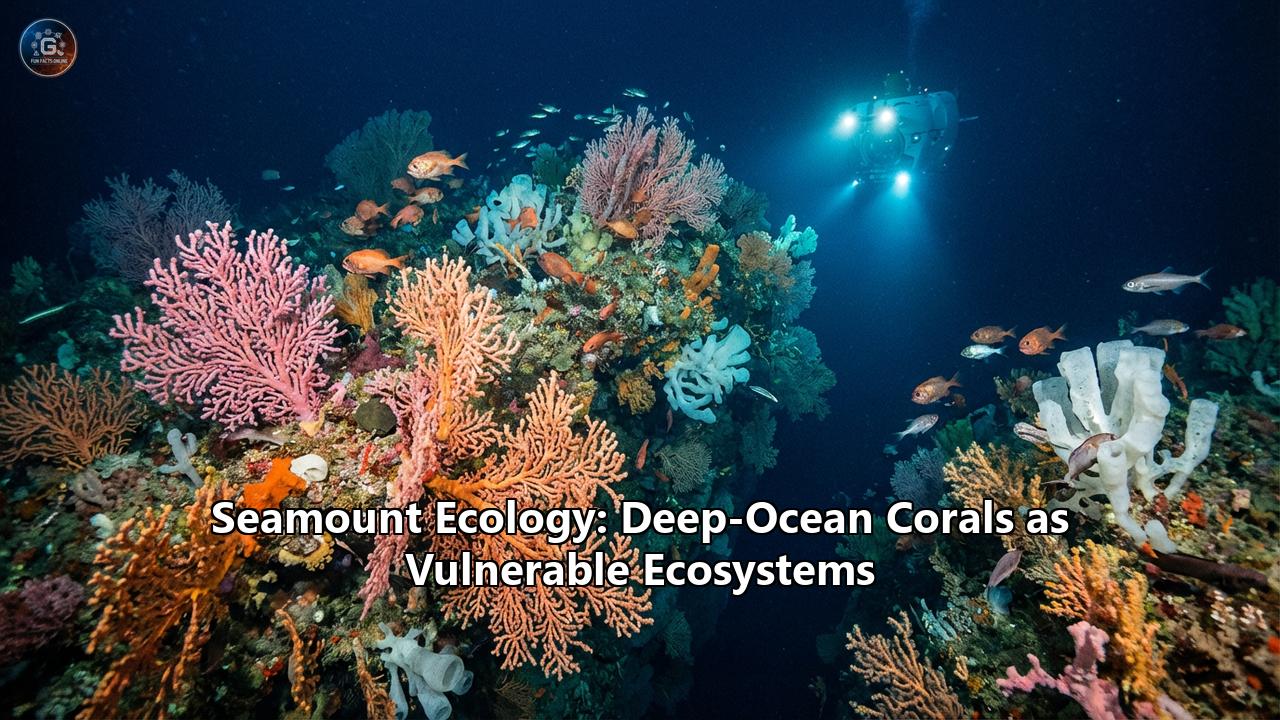
Far beneath the sunlit surface of the ocean, plunging into the perpetual twilight and absolute darkness of the abyss, lies a hidden topography as dramatic and varied as any landscape on Earth. Here, colossal underwater mountains known as seamounts rise from the abyssal plain, piercing the ocean’s currents and creating isolated oases of life. Blanketed in cold, crushing waters, these submerged peaks are home to some of the most enigmatic, ancient, and fragile organisms on our planet: deep-ocean corals. Long hidden from human view, these ecosystems are now coming to light through advanced deep-sea exploration, revealing a gothic, alien world of staggering biodiversity. Yet, just as we begin to map these vibrant underwater cities, they face existential threats from industrialized human activity. To understand seamount ecology and the deep-water corals that build these vulnerable ecosystems is to recognize one of the greatest conservation frontiers of the twenty-first century.
The Geologic Majesty and Oceanography of Seamounts
To grasp the ecological significance of seamounts, one must first understand their geologic origins and the profound ways they alter their physical environment. Seamounts are generally defined as steep-sided, extinct underwater volcanoes that rise at least 1,000 meters from the seafloor without breaking the ocean's surface. While some are solitary giants, many form extensive chains mapping the slow drift of tectonic plates over stationary mantle hotspots, much like the Hawaiian-Emperor seamount chain. According to modern bathymetric estimates, there may be as many as 50,000 seamounts in the Pacific Ocean alone, and over 100,000 scattered across the global ocean.
The mere presence of a seamount radically transforms the local oceanography. The deep ocean is largely characterized by immense, flat abyssal plains covered in thick layers of fine marine snow and sediment. In this relatively featureless desert, a seamount acts as a massive physical obstacle to deep ocean currents. When deep, nutrient-rich currents strike the flanks of a seamount, they are forced upward. This upwelling brings vital nutrients from the ocean depths toward the shallower, photic zones, sparking explosive localized phytoplankton blooms.
Furthermore, the interaction between the seamount's topography and ocean currents often generates complex hydrodynamic phenomena, most notably "Taylor columns." A Taylor column is a rotating cylinder of water that forms above the seamount, effectively trapping water and nutrients in a localized vortex. This hydrodynamic retention system prevents the immediate dispersal of pelagic larvae and organic matter, sustaining a concentrated web of life directly above and around the seamount. Because food supplies are typically scarce in the open ocean, the seamount and the water column above it become vital feeding grounds, mating sites, and navigational waypoints for pelagic predators, including sharks, sea turtles, marine mammals, and seabirds.
However, the most spectacular biological communities are found clinging to the hard, rocky flanks of the seamounts themselves. Because seamounts are swept by accelerated currents that scour away soft sediments, they provide expansive, exposed basaltic rock—the ideal foundational substrate for sessile, suspension-feeding organisms. This combination of hard substrate, accelerated water flow, and enhanced nutrient delivery creates the perfect conditions for deep-ocean corals to thrive.
Deep-Ocean Corals: Architects of the Abyss
When most people envision a coral reef, they picture the warm, shallow, sun-drenched waters of the tropics, where corals rely on a symbiotic relationship with photosynthetic algae called zooxanthellae. Deep-ocean corals, or cold-water corals, are entirely different. Living at depths ranging from 50 to 6,000 meters, these organisms exist far beyond the reach of sunlight. Because they cannot rely on photosynthesis for energy, deep-sea corals are entirely azooxanthellate; they are voracious suspension feeders that use their tentacles to capture zooplankton, krill, and organic detritus sweeping past them in the deep ocean currents.
Deep-sea corals are a rich, paraphyletic group comprising more than 3,300 known species. They include stony corals (Scleractinia), soft corals and sea fans (Octocorallia), black corals (Antipatharia), and lace corals (Hydrozoa). While some, like the cup coral Desmophyllum, live as solitary polyps, others are massive, colonial framework-builders. In the Atlantic Ocean, the stony coral Lophelia pertusa creates sprawling bioherms—deep-water reefs that can cover several square kilometers and rival their tropical counterparts in structural complexity. In the Pacific Ocean, seamount ecosystems are often dominated by magnificent forests of gorgonian octocorals, giant sea fans, and deep-sea bubblegum corals (Paragorgia arborea), alongside sprawling black corals.
The life history of these deep-water architects is defined by the extreme environment they inhabit. The deep sea is cold—often just a few degrees above freezing—and the scarcity of food dictates a life in the slow lane. Consequently, deep-sea corals exhibit remarkably slow growth rates, often expanding just a few millimeters per year. This glacial pace of growth means that deep-sea corals are incredibly ancient. Radiocarbon dating of proteinaceous deep-water corals like Gerardia (gold coral) and Leiopathes (black coral) has revealed colonies that have been growing continuously for thousands of years. Some black coral colonies are estimated to be over 4,000 years old, making them among the oldest continuously living organisms on Earth. Even the sprawling structural reefs built by stony corals represent thousands, sometimes hundreds of thousands, of years of continuous biogenic accumulation.
By building three-dimensional structures over millennia, these corals act as primary ecosystem engineers. They introduce immense structural complexity to the otherwise barren rock of the seamount. The branches, crevices, and matrices of the corals create a wealth of microhabitats, providing refuge from predators, nursery grounds for juvenile deep-sea fish, and an anchoring point for thousands of other invertebrate species.
Hotspots of Endemism and Symbiosis
The ecological networks supported by deep-sea corals are staggering in their complexity. A single deep-water coral reef can harbor thousands of associated species. Because seamounts are geographically isolated from one another by vast stretches of deep abyssal mud, they function much like oceanic islands. This isolation drives extraordinary rates of endemism; many species found on a particular seamount chain—or even a single seamount—are found nowhere else on Earth.
The biodiversity within these coral gardens is heavily intertwined through highly specialized symbiotic relationships. For instance, recent scientific expeditions have documented deep-sea brittle stars tightly wrapped around the branches of specific gorgonian corals. These relationships are often species-specific, with the brittle star acting as a dedicated custodian. By consuming the organic detritus and excess mucus that settles on the coral, the brittle star prevents the coral polyps from being smothered, ensuring the coral can efficiently exchange oxygen and capture food. In return, the coral provides the brittle star with an elevated perch in the water column to filter feed, as well as protection from bottom-dwelling predators.
Our understanding of these remote ecosystems is rapidly expanding thanks to a golden age of deep-sea exploration driven by advanced Remotely Operated Vehicles (ROVs) and autonomous submersibles. In late 2023, scientists utilizing the ROV SuBastian discovered two pristine, ancient cold-water coral reefs in the Galápagos Marine Reserve. Situated at depths of 370 to 420 meters, the larger of these reefs spans over 800 meters in length—roughly the size of eight football fields—and exhibits a rich diversity of stony corals that have been supporting marine life for millennia. High-resolution laser scanning technology utilized during this expedition produced two-millimeter resolution maps, allowing scientists to identify living animals on the seafloor in unprecedented detail.
Similarly, in early 2026, a groundbreaking expedition led by Greenpeace to the remote Lord Howe Rise in the South Pacific uncovered highly vulnerable marine ecosystems on previously unsurveyed seamounts. The researchers catalogued over 350 corals and sponges, many of which were over a century old and stood nearly two meters tall. Furthermore, a 2026 Ocean Census expedition journeyed to the extreme depths of the South Sandwich Islands near Antarctica, documenting dense cold-water coral gardens and sponge fields. These discoveries continually prove that cold-water corals are not confined to a specific latitude, but are globally distributed, critical components of the ocean's biological pump and deep-sea biodiversity.
The Looming Threats: Bottom Trawling
Despite their extreme remoteness, seamount ecosystems are highly vulnerable to anthropogenic impacts. The very characteristics that make deep-ocean corals so ecologically significant—their slow growth, immense age, physical fragility, and specific habitat requirements—make them highly susceptible to disturbance and critically slow to recover.
The most immediate and catastrophic threat to seamount ecology is commercial bottom trawling. As coastal, shallow-water fisheries have become depleted, the global fishing industry has pushed further offshore and deeper underwater, targeting seamounts for aggregations of commercially valuable fish like orange roughy, pelagic armorhead, and Patagonian toothfish. Bottom trawling involves dragging heavy nets, weighted down with massive steel doors and rollers, directly across the seafloor.
When a bottom trawl sweeps over a seamount, the devastation is absolute. The heavy gear acts like a bulldozer, ripping up ancient coral colonies, crushing sponges, and leveling the complex, three-dimensional biogenic habitat to bare rock and rubble. The bycatch from these operations often includes massive quantities of ancient corals, starfish, and deep-sea megafauna. Footage of bottom trawling operations has been likened to "a horror film," with centuries-old organisms uprooted and crushed in seconds. Furthermore, abandoned or "ghost" fishing gear presents an ongoing hazard. A comprehensive study of the Cobb Seamount in the North Pacific revealed hundreds of thousands of items of derelict fishing gear entangled on the seafloor, continuously suffocating and breaking the remaining biological structures decades after the gear was lost.
The long-term impacts of trawling on seamounts are profound. Studies comparing heavily fished seamounts to unfished seamounts off the coast of Tasmania revealed that trawling reduced the bottom cover of the matrix-forming coral Solenosmilia variabilis by two orders of magnitude. This loss of coral translated directly to a three-fold decline in the richness and diversity of all other benthic megafauna. Most alarmingly, scientists studying these seamounts found no clear signs of biological recovery even five to fifteen years after trawling operations had completely ceased. Because of the biological tempo of the deep sea, the scars left by a few minutes of trawling may persist for hundreds, if not thousands, of years.
The Shadow of Deep-Sea Mining
As if the impacts of industrial fishing were not enough, seamounts are now in the crosshairs of a newly emerging extractive industry: deep-sea mining. Seamounts are prime targets for mining because their rocky flanks accumulate cobalt-rich ferromanganese crusts over millions of years. These crusts contain high concentrations of cobalt, nickel, tellurium, and rare earth elements—materials increasingly demanded by the global market for electric vehicle batteries, solar panels, and modern electronics.
Extracting these crusts would require deploying massive robotic continuous miners to grind away the top layer of the seamount rock. This process would not only completely obliterate the benthic coral communities living on the rock but would also generate massive sediment plumes. In the clear, low-sediment waters surrounding seamounts, a sudden cloud of abrasive, suspended mining dust would be carried by ocean currents, potentially smothering surrounding coral colonies and suffocating filter-feeding organisms miles away from the mining site. Marine experts and conservationists have warned that mining these crusts would be as destructive, if not more so, than bottom trawling, resulting in an irreversible loss of deep-sea biodiversity.
Climate Change: The "Mountain Trap"
Beyond direct physical destruction, deep-ocean corals face insidious threats from global climate change. The oceans absorb roughly 30% of anthropogenic carbon dioxide emissions, which fundamentally alters the chemistry of the seawater, leading to ocean acidification. The deep ocean is naturally less saturated with carbonate ions than surface waters, making deep-water corals particularly vulnerable. As the aragonite saturation horizon (the depth below which calcium carbonate dissolves) becomes shallower due to acidification, deep-sea stony corals will find it increasingly difficult—and eventually energetically impossible—to calcify and build their vital skeletal frameworks.
Furthermore, rising ocean temperatures and deoxygenation are fundamentally altering the deep-sea environment. A fascinating, albeit concerning, 2024 study in theoretical ecology highlighted how changing climates could effectively trap cold-water corals. Over hundreds of thousands of years, these corals construct massive biogenic mountains to reach higher up into the water column where nutrient flow is optimal. However, as the ocean warms, the ideal temperature bandwidth for these cold-water species is pushed deeper. Unlike mobile species, a mature coral reef cannot simply "walk down the mountain". Although they disperse via larvae, the specific hydrodynamic flow patterns on the lower flanks of these biological mountains are often unconducive to feeding, creating an ecological trap where the corals are stranded in warming waters at the peak.
The Imperative for Protection and Global Policy
The growing awareness of the fragility and importance of seamounts has sparked a fierce international push for deep-sea conservation. The unique challenge of protecting seamounts is that the vast majority of them exist in the High Seas—areas beyond the national jurisdiction (EEZ) of any single country. For decades, the High Seas have been a regulatory wild west, managed loosely by fragmented Regional Fisheries Management Organizations (RFMOs).
However, the tide of international marine policy is turning. Under the United Nations General Assembly Resolution 61/105, individual states and RFMOs have been called upon to protect Vulnerable Marine Ecosystems (VMEs)—which explicitly include seamounts and cold-water corals—from destructive fishing practices and to prevent Significant Adverse Impacts (SAIs). This has led to the establishment of some protective closures, such as the temporary trawling bans on certain Lord Howe Rise seamounts. However, these protections are often fragile and subject to political pressure. For example, in early 2026, the New Zealand government controversially submitted proposals to the South Pacific Regional Fisheries Management Organisation (SPRFMO) to increase the allowable bycatch of vulnerable deep-sea corals, threatening to reopen previously paused seamounts to destructive trawling.
The greatest beacon of hope for seamount ecology is the BBNJ Agreement, commonly known as the High Seas Treaty. Formally addressing the "Conservation and Sustainable Use of Marine Biological Diversity of Areas beyond National Jurisdiction," this landmark treaty provides a legal mechanism to establish vast Marine Protected Areas (MPAs) in international waters. These MPAs could effectively shield vulnerable seamount ecosystems from both bottom trawling and the looming specter of deep-sea mining. By mid-2025, the treaty had gained significant momentum, with 49 nations having ratified the agreement—closing in rapidly on the 60 ratifications required to make it legally binding.
At the national level, countries are beginning to realize the value of their deep-water heritage. In the United States, places like the Davidson Seamount off the coast of California have been incorporated into National Marine Sanctuaries. Extensive ecological characterization of the Davidson Seamount has revealed it to be a deep-sea "island" of extraordinary biodiversity, featuring massive coral gardens and newly discovered octopus nurseries sustained by warm water seeps. Protecting these areas allows scientists to establish vital ecological baselines, monitor temporal changes, and study the age structure of coral communities in an undisturbed state.
Conclusion
Seamounts and their resident deep-ocean corals represent one of the final, great frontiers of biological discovery on Earth. Far from being desolate rocks in the dark, these underwater mountains are bustling, ancient metropolises of life. They are built by the patient, millimeter-by-millimeter growth of cold-water corals that have survived the rise and fall of human civilizations. They are crucial engines of oceanic biodiversity, providing refuge, nursery grounds, and sustenance in the harsh landscape of the deep ocean.
Yet, they exist on a knife's edge. The biological traits that have allowed deep-sea corals to thrive for millennia—their longevity, slow growth, and specialized habitats—render them uniquely defenseless against the speed and sheer mechanical power of modern industrial fishing and the unprecedented pace of anthropogenic climate change. When a deep-sea coral reef is destroyed by a bottom trawl or suffocated by mining dust, it is not merely a localized habitat loss; it is the erasure of a biological legacy that took thousands of years to build, and one that will not recover within human lifetimes.
As technological advancements in ROVs and deep-sea mapping continue to lift the veil on the abyss, humanity is presented with a choice. We are the first generation to truly see and understand the majesty of seamount ecology, and perhaps the last generation with the opportunity to save it. The implementation of the High Seas Treaty and the strict enforcement of Vulnerable Marine Ecosystem protections are not just political milestones; they are essential life-support measures for the hidden architects of the abyss. Protecting seamounts is a profound test of our commitment to preserving the Earth's most ancient and fragile ecosystems, ensuring that the vibrant coral gardens of the deep ocean continue to thrive in the dark for millennia to come.
Reference:
- https://tos.org/oceanography/article/deep-sea-corals-on-seamounts
- https://schmidtocean.org/healthy-deep-sea-coral-reef-and-new-seamounts-in-the-galapagos/
- https://www.youtube.com/watch?v=Ur1Fhn7Ox1k
- https://oceanbites.org/bottom-trawling-may-irreparably-damage-seamount-habitats/
- https://portals.iucn.org/library/sites/library/files/documents/Rep-2004-003.pdf
- https://sanctuaries.noaa.gov/science/assessment/monterey-bay/davidson-seamount.html
- https://pubmed.ncbi.nlm.nih.gov/39824878/
- https://www.researchgate.net/publication/44301557_Deep-Sea_Corals_on_Seamounts
- https://www.smithsonianmag.com/science-nature/the-hidden-world-of-cold-water-corals-rises-to-the-surface-with-these-glass-sculptures-that-are-resurrecting-a-lost-craft-180988011/
- https://www.researchgate.net/publication/250219632_Impacts_of_bottom_trawling_on_deep-coral_ecosystems_of_seamounts_are_long-lasting
- https://www.greenpeace.org/aotearoa/press-release/revealed-scientists-discovery-of-ancient-deep-sea-corals-brings-new-hope-for-protection-against-threat-of-industrial-fishing/
- https://epic.awi.de/id/eprint/24870/1/Wea2011a.pdf
- https://insideclimatenews.org/news/09062025/un-deep-sea-mining-bottom-trawling-moratorium/
- https://www.frontiersin.org/journals/marine-science/articles/10.3389/fmars.2020.00017/full
- https://www.sciencedaily.com/releases/2024/02/240214122625.htm