
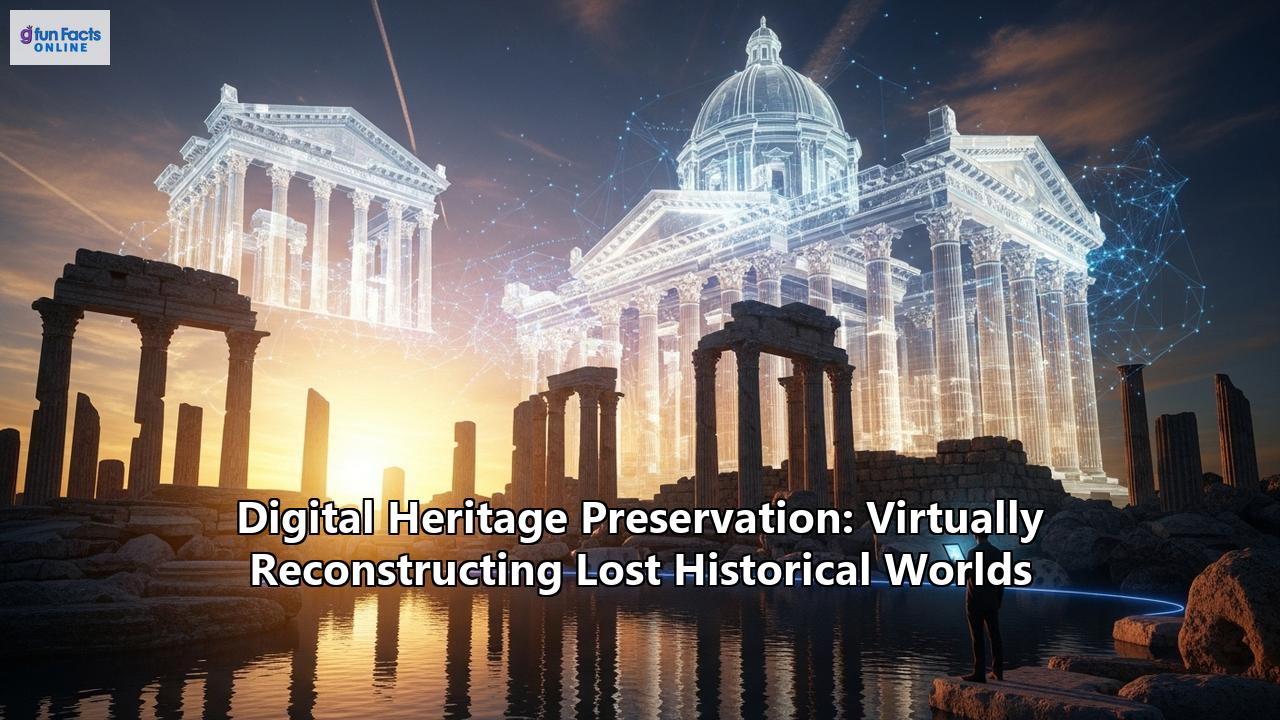
In an age where the tangible echoes of our past are increasingly silenced by the ravages of time, conflict, and environmental change, a new frontier in preservation has emerged from the confluence of technology and archaeology. Digital heritage preservation, specifically the virtual reconstruction of lost historical worlds, offers a powerful and evocative means to not only safeguard our collective memory but also to resurrect entire civilizations from the digital ether. This practice transcends mere data collection; it is a meticulous art and science that breathes life back into ruins, allowing us to walk the streets of ancient cities, marvel at the intricate details of long-vanished temples, and experience historical events with an unprecedented sense of presence. By harnessing the power of cutting-edge technologies, researchers, historians, and digital artists are collaboratively building bridges to the past, offering immersive journeys into worlds that were once thought to be lost forever.
The Imperative for Digital Preservation: A World in Peril
Our global heritage is under constant threat. The gradual erosion of ancient structures due to natural elements is a relentless process. More sudden and devastating are the losses inflicted by human actions, from urban development paving over archaeological sites to the deliberate destruction of cultural landmarks during acts of war and terrorism. The destruction of the ancient city of Palmyra in Syria and the Buddhas of Bamiyan in Afghanistan are stark reminders of the fragility of our shared history. In response to such irreversible losses, the global community has increasingly turned to digital technologies as a vital tool for preservation and reconstruction.
Digital preservation, in this context, is more than just creating a backup. It is a proactive measure to document and understand historical sites in their current state, and a reactive measure to virtually rebuild what has been damaged or destroyed. These digital surrogates serve a multitude of purposes: they are invaluable resources for researchers and restorers, powerful educational tools for students and the public, and a means of preserving the cultural identity of communities whose physical heritage has been erased.
The Digital Archaeologist's Toolkit: Technologies of Resurrection
The virtual reconstruction of a historical world is an intricate process that relies on a suite of sophisticated technologies. This digital toolkit allows for the capture of reality with astonishing precision and the recreation of the past with scholarly rigor. The primary technologies at the heart of this field are 3D laser scanning and photogrammetry, often complemented by Virtual Reality (VR) and Augmented Reality (AR) for the final immersive experience.
3D Laser Scanning: Capturing Reality in a Cloud of Points
At the forefront of data acquisition is 3D laser scanning, a technique that has revolutionized the documentation of heritage sites. A tripod-based or handheld laser scanner emits a laser beam that sweeps across the surface of a structure, measuring millions of data points to capture its precise geometry. These scanners can operate on different principles, such as time-of-flight (measuring the time it takes for a laser pulse to return) or phase-shift (analyzing the phase of the returning laser), to create a "point cloud" – a dense and incredibly accurate 3D map of the site.
The process is meticulous. It begins with extensive planning to determine the optimal scanning locations to ensure complete coverage of the site. Multiple scans are then conducted from various angles to capture every nook and cranny, from the grand scale of a temple complex to the subtle textures of a single carved stone. This raw data is then processed to clean up any "noise" and stitch the individual point clouds together, a process known as registration, to form a complete and cohesive 3D model. The resulting digital replica is a treasure trove of information, providing a detailed framework for conservation analysis and a foundation for the virtual reconstruction.
Photogrammetry: Weaving Photographs into 3D Worlds
A more accessible, yet powerful, alternative to laser scanning is photogrammetry. This technique involves taking hundreds or even thousands of high-resolution, overlapping photographs of a site or artifact from multiple perspectives. Specialized software then analyzes these images, identifying common points and triangulating them in 3D space to generate a detailed mesh with photorealistic textures. The rise of drones has further enhanced photogrammetry, allowing for the rapid and safe survey of large or inaccessible areas, providing a comprehensive aerial view that is crucial for reconstructing entire landscapes.
The workflow of a photogrammetry project involves several key steps:
- Image Acquisition: Capturing a large number of high-quality, overlapping images under consistent lighting conditions.
- Feature Detection and Matching: The software automatically identifies and matches corresponding features across the images.
- Sparse and Dense Reconstruction: A sparse point cloud is first generated, followed by a denser cloud that adds more detail.
- Mesh and Texture Generation: The point cloud is converted into a solid mesh, and the original photographs are projected onto it to create a realistic, textured 3D model.
Photogrammetry has democratized the creation of 3D models, making it possible for smaller teams and even individuals to contribute to digital preservation efforts.
Virtual and Augmented Reality: Stepping into the Past
Once the 3D models are created, Virtual Reality (VR) and Augmented Reality (AR) technologies provide the portals through which we can experience these lost worlds.
- Virtual Reality (VR) offers a fully immersive experience, transporting users to a completely simulated environment. By donning a VR headset, one can "walk" through the streets of ancient Rome, explore the inner chambers of an Egyptian tomb, or witness a historical event as if they were there. VR is particularly effective for recreating sites that are physically inaccessible or no longer exist.
- Augmented Reality (AR), on the other hand, overlays digital information onto the real world. When visiting the ruins of a castle, for example, a visitor using a smartphone or AR glasses could see a digital reconstruction of the missing walls and towers superimposed on the existing foundations. This creates a powerful then-and-now comparison, enriching the visitor's understanding of the site. AR can also be used to bring museum artifacts to life, showing them in their original context or revealing hidden details.
These technologies are transforming museums and heritage sites from places of passive observation into interactive and engaging learning environments.
A Global Endeavor: Case Studies in Virtual Reconstruction
The application of digital heritage preservation is a global phenomenon, with numerous projects breathing new life into historical sites across continents. These case studies highlight the diverse motivations and methodologies behind this rapidly growing field.
Europe: The Grandeur of Rome and the Tragedy of Pompeii
Rome Reborn: One of the most ambitious and long-standing virtual reconstruction projects is Rome Reborn, which offers a stunningly detailed 3D model of the ancient city as it appeared in A.D. 320. The result of over two decades of international collaboration, the project uses a combination of archaeological data, historical texts, and advanced computer graphics to recreate the city's famous landmarks, including the Colosseum, the Pantheon, and the Roman Forum. The latest version of Rome Reborn allows users to take a virtual flight over the ancient metropolis, providing an unparalleled educational tool for students and a captivating experience for "armchair travelers." The project is continually updated as new discoveries are made, ensuring it remains a scientifically reliable visualization of the Roman capital. The Abbey of Cluny, France: Once the monastic capital of medieval Europe, the Abbey of Cluny is now mostly ruins. Technology has been employed to give visitors a "second life" experience of this magnificent structure. Through augmented reality and 3D reconstructions, visitors can now see the Maior Ecclesia as it once stood, bridging the gap between the sparse physical remains and the abbey's historical importance. This project demonstrates how technology can make heritage more understandable and accessible, restoring value to what has been lost to time. Pompeii, Italy: The Roman city of Pompeii, tragically preserved under volcanic ash in 79 AD, has been the subject of numerous virtual reality reconstructions. These projects aim to recreate not just the buildings and streets, but also the daily life of the city. Using 3D scanning and photogrammetry to capture the intricate details of the ruins, and extensive historical research to ensure accuracy, these VR experiences provide a powerful window into Roman culture. The ethical considerations in these reconstructions are significant, with a focus on representing the lives of Pompeii's inhabitants with historical accuracy and without sensationalism.Asia: Reclaiming Heritage in China and Southeast Asia
The Re-relic Program, China: Recognizing the unique characteristics of East Asian archaeological heritage, the Re-relic program in China has developed a specialized methodology for virtual reconstruction. This approach is particularly suited to the timber-framed structures common in the region, which are often lost to time, leaving only their foundations. By creating scientifically rigorous virtual models, the program respects the principle of minimal intervention on the actual archaeological sites while providing a detailed and engaging interpretation for the public. This initiative has been applied to various sites, contributing to a global understanding of virtual reconstruction techniques tailored to specific cultural contexts. Angkor, Cambodia: The vast temple complexes of Angkor, hidden for centuries in the Cambodian jungle, have been brought to a global audience through projects like Virtual Angkor. This collaboration between archaeologists, historians, and virtual history specialists has created immersive 360° and VR experiences of sites like Angkor Wat and Ta Prohm. These digital resources not only serve as a vital record for preservation but also allow people from all over the world to explore these magnificent Khmer kingdoms. Palmyra, Syria: The ancient city of Palmyra, a crossroads of civilizations, suffered immense damage during the Syrian conflict. In response, a global effort emerged to digitally document and reconstruct its lost treasures. Projects like those undertaken by ICONEM used drone photogrammetry to create high-fidelity 3D models of the destroyed temples and triumphal arch. These reconstructions have been featured in international exhibitions, raising awareness about the importance of preserving heritage in conflict zones. The digital reconstruction of the Palmyra theater, for instance, allows users to explore the site in its original form, offering an immersive experience that keeps its memory alive.Africa: Preserving a Continent's Legacy
The Zamani Project: Based at the University of Cape Town, the Zamani Project is dedicated to the digital documentation of heritage sites across Africa. Traveling to regions that are often remote and sometimes unstable, the team uses high-tech laser scanners and drones to create detailed 3D models of sites that are deteriorating due to neglect, environmental factors, or conflict. They have digitally archived numerous locations, including the rock-hewn churches of Lalibela in Ethiopia, the great mosques of Timbuktu in Mali, and the ruins of Kilwa Kisiwani in Tanzania. These models are intended to be a permanent record for future generations and can be experienced in virtual reality, allowing people to "walk through" these remarkable places. African Digital Heritage: This non-profit organization based in Nairobi, Kenya, is working to advance a more critical and knowledge-based approach to digital solutions for African heritage. Their projects include mapping and visualizing the history of detention camps during the Mau Mau revolt in Kenya and the "Open Restitution Africa" project, which seeks to open up access to information on the restitution of African material culture. These initiatives highlight the role of digital heritage in not only preserving structures but also in addressing complex historical narratives and issues of cultural ownership.The Americas: Uncovering Ancient Civilizations
GeoPACHA (Geospatial Platform for Andean Culture, History, and Archaeology): In South America, artificial intelligence is being used to discover lost archaeological sites. The GeoPACHA project is using AI trained on satellite imagery to identify previously unknown settlements in the Andes. This data-intensive approach is enabling archaeologists to create richer narratives of past societies and to understand the vast extent of ancient civilizations in the region. The Database of Archaeological Sites of the Province of Córdoba (BaDACor), Argentina: This open, collaborative digital database serves as a vital tool for heritage management in central Argentina. It has been used in legal claims to protect heritage sites from destruction due to development projects and has empowered local and indigenous communities in the preservation of their ancestral territories. This case study demonstrates the crucial role of digital databases in not only research but also in the active protection and advocacy for cultural heritage.The Thorny Path: Challenges and Ethical Dilemmas
While the virtual reconstruction of lost worlds offers immense possibilities, it is a field fraught with complex challenges and ethical quandaries that require careful consideration.
The Question of Authenticity
Perhaps the most debated issue in digital heritage is the concept of authenticity. When a physical object is digitized, is the digital replica truly "authentic"? And when a lost structure is reconstructed based on fragmented evidence and scholarly interpretation, how do we convey the speculative nature of the model? There is a delicate balance between creating a scientifically rigorous model and an aesthetically engaging one. Inaccurate reconstructions can mislead the public, transmitting incorrect information about the past. Therefore, it is crucial that virtual reconstructions are transparent about the evidence they are based on, clearly distinguishing between what is known and what is inferred.
The concept of authenticity is not static; it is a dynamic process shaped by cultural contexts and evolving values. The goal should not be to create a perfect, unquestionable copy, but to use the digital model as a tool for critical thinking and ongoing research.
Digital Colonialism and Ownership
Many digital preservation projects are led by Western institutions, which raises concerns about "digital colonialism." When Western organizations digitize the heritage of other countries, questions of ownership, control, and access to the digital data become paramount. There is a risk that the digital heritage of the Global South could be controlled by the Global North, perpetuating historical power imbalances.
Ethical practice demands that these projects involve the local communities connected to the heritage sites. The decision of what to reconstruct and how to represent it should be a collaborative process, respecting the cultural significance and values of the people whose history is being digitized. Furthermore, the digital assets should be made accessible to these communities, empowering them to tell their own stories and manage their own heritage.
Technical and Financial Hurdles
The technologies used in digital heritage preservation are expensive, and the process is labor-intensive, requiring a high level of technical expertise. This can create a "digital divide," where only well-funded institutions can afford to undertake these projects.
Another significant technical challenge is the long-term sustainability of digital data. Digital formats become obsolete, and storage media degrades over time. Ensuring that these invaluable digital archives remain accessible for future generations requires ongoing maintenance, migration to new platforms, and robust data management strategies. There is also an environmental impact to consider, as the data centers that store this information consume significant amounts of energy.
The Future of Digital Heritage: AI, the Metaverse, and Beyond
The field of digital heritage preservation is constantly evolving, with new technologies and platforms on the horizon that promise to further transform how we interact with the past.
Artificial Intelligence (AI): AI is already beginning to play a significant role in archaeology and heritage preservation. As seen with the GeoPACHA project, AI can analyze vast datasets, such as satellite imagery, to identify potential archaeological sites much faster than humans can. AI can also be used to automate the process of restoring damaged artifacts or filling in the missing parts of a reconstruction based on existing data. However, the use of AI-generated content also raises new questions about authenticity and the potential for creating plausible but inaccurate representations of the past. The Metaverse: The concept of the metaverse – a persistent, shared virtual space – offers exciting new possibilities for cultural heritage. Imagine a global, interconnected museum where users can explore virtual reconstructions of heritage sites from around the world, interact with digital artifacts, and even participate in collaborative educational experiences. The metaverse could make cultural heritage more accessible and engaging than ever before, allowing for shared social experiences within these historical environments. Living Archives: The future of digital heritage lies in creating dynamic, "living" archives that can be continuously updated with new research and data. These platforms will not be static representations of the past but evolving ecosystems of knowledge, where researchers and the public can contribute to and interact with the information. This collaborative approach will ensure that our understanding of the past remains vibrant and contested, a conversation rather than a monologue.Conclusion: A New Dawn for Our Collective Past
Digital heritage preservation and the virtual reconstruction of lost historical worlds represent a profound shift in our relationship with the past. It is a field born of necessity, driven by the desire to protect our shared history from the forces of decay and destruction. Through the innovative application of technologies like 3D laser scanning, photogrammetry, VR, and AR, we are now able to not only document what remains but also to resurrect what has been lost, offering immersive and educational journeys into bygone eras.
This endeavor is not without its challenges. The ethical tightrope of authenticity, the specter of digital colonialism, and the practical hurdles of cost and data sustainability demand a thoughtful and collaborative approach. Yet, the potential rewards are immense. By creating digital surrogates of our most precious heritage sites, we are ensuring their survival for future generations. We are democratizing access to history, allowing people from all walks of life and all corners of the globe to experience the wonders of our collective past.
As we stand at the cusp of a new technological era, with AI and the metaverse poised to redefine the digital landscape, the future of our past has never been more vibrant. The virtual worlds being meticulously reconstructed today are more than just echoes of what was; they are dynamic spaces for learning, discovery, and connection, ensuring that the stories of our ancestors will continue to be told in the centuries to come. The silent stones of lost cities are finding a new voice in the digital realm, and their stories are waiting to be heard.
Reference:
- https://medium.com/@matt-sharon/3d-laser-scanning-for-heritage-preserving-the-past-for-the-future-4707a0839912
- https://chnt.at/wp-content/uploads/2024/08/Perkovic-_364.pdf
- https://scholarworks.iu.edu/journals/index.php/sdh/article/view/35741/39843
- https://parametric-architecture.com/how-can-metaverse-help-re-imagine-the-future-of-heritage-preservation/
- https://survey2plan.com/3d-laser-scanning-for-heritage-revolutionizing-historical-preservation/
- https://www.novatr.com/blog/3d-laser-scanning-for-heritage-documentation
- http://www.science4heritage.org/COSTG7/booklet/chapters/3D.htm
- https://historicengland.org.uk/images-books/publications/3d-laser-scanning-heritage/heag155-3d-laser-scanning
- https://www.vi-mm.eu/2018/01/16/meet-the-scientists-immortalizing-african-heritage-in-virtual-reality/
- https://www.mdpi.com/2571-9408/2/3/112
- https://80.lv/articles/preparing-a-3d-model-from-photos-photogrammetry-in-the-preservation-of-cultural-heritage-objects
- https://www.researchgate.net/publication/334216535_To_3D_or_Not_3D_Choosing_a_Photogrammetry_Workflow_for_Cultural_Heritage_Groups
- https://xsite.com/how-ar-and-vr-are-transforming-museums-and-heritage-sites/
- https://www.takeaway-reality.com/post/top-5-use-cases-for-ar-and-vr-for-museums
- https://www.re-thinkingthefuture.com/designing-for-typologies/a11801-ar-and-vr-in-museums/
- https://isprs-archives.copernicus.org/articles/XLII-2-W9/305/2019/
- https://patrimonioculturaldigital.com/en/metaverse-and-digitization-the-potential-of-new-technologies-for-cultural-heritage/
- https://yordstudio.com/interactive-museums-and-exhibitions/
- https://dergipark.org.tr/en/download/article-file/3201814
- https://www.forbes.com/sites/jimdobson/2023/11/08/fly-over-ancient-rome-with-this-dramatic-new-3d-reconstruction/
- https://www.scienceopen.com/document_file/a49326e3-613b-4acc-824a-67011a61e8a3/ScienceOpen/038_Ul-Assar_POM21.pdf
- https://www.realmofhistory.com/2023/06/26/10-famous-ancient-cities-reconstructed/
- https://dialnet.unirioja.es/descarga/articulo/5210173.pdf
- https://www.researchgate.net/publication/290614077_A_Virtual_Reconstruction_Methodology_for_Archaeological_Heritage_in_East_Asia_-_Practical_Experience_from_the_Re-relic_Program_in_China
- https://www.southeastasianarchaeology.com/virtual-archaeology/
- https://www.scienceopen.com/hosted-document?doi=10.14236/ewic/POM2021.5
- https://radarafrica.com/africa/technology-preserves-african-culture-through-digital-archives/
- https://africandigitalheritage.org/
- https://africandigitalheritage.org/tag/projects/
- https://africandh.ku.edu/resources
- https://www.theartnewspaper.com/2025/04/14/how-ai-models-are-helping-archaeologists-to-find-new-sites-faster
- https://intarch.ac.uk/journal/issue64/16/index.html
- https://intarch.ac.uk/journal/issue64/16/full-text.html
- https://www.numberanalytics.com/blog/virtual-heritage-in-digital-philosophy
- https://www.repository.cam.ac.uk/items/c3a0ef48-dd92-4057-8944-84031ac12553
- https://pro.europeana.eu/post/exploring-the-importance-of-digital-media-authenticity-in-cultural-heritage
- https://www.mdpi.com/2078-2489/12/4/167
- https://www.researchgate.net/publication/367895047_Preserving_Authenticity_in_Virtual_Heritage
- https://www.numberanalytics.com/blog/future-of-digital-cultural-heritage-ethics
- https://www.numberanalytics.com/blog/future-of-digital-cultural-heritage-conservation
- https://www.researchgate.net/publication/383089865_Digitalizing_cultural_heritage_through_metaverse_applications_challenges_opportunities_and_strategies
- https://www.mdpi.com/2076-3417/14/8/3426