
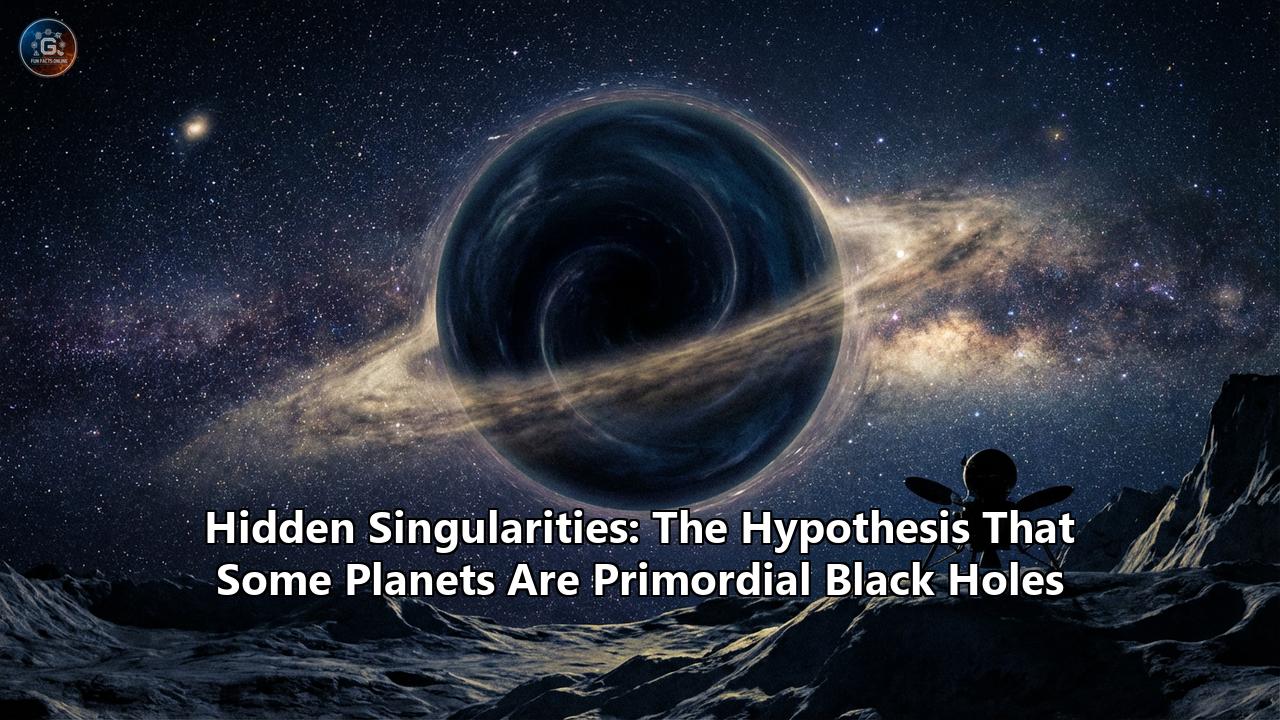
The frozen reaches of our solar system, far beyond the orbit of Neptune, have long whispered of a presence—a gravitational ghost herding the icy bodies of the Kuiper Belt into strange, clustered orbits. For nearly a decade, astronomers have hunted this "Planet Nine," calculating its mass to be five to ten times that of Earth and predicting a cold, gaseous super-Earth lurking in the dark. But despite sensitive sky surveys and tireless scanning, the object remains invisible. It emits no infrared heat, reflects no sunlight, and offers no silhouette against the starry background.
In 2019, a radical hypothesis emerged from the halls of theoretical physics that turned the search on its head. What if we haven't found Planet Nine because it isn't a planet at all? What if the object shaping our solar system is a relic from the dawn of time—a Primordial Black Hole (PBH) no larger than a grapefruit?
This hypothesis does more than offer a solution to a local orbital puzzle; it bridges the gap between planetary science and the deepest mysteries of cosmology, potentially offering the first concrete evidence for the identity of dark matter. From the high-tech mirrors of the upcoming Vera C. Rubin Observatory to the theoretical swarms of nanocraft proposed to visit it, the hunt for this "hidden singularity" has become one of the most thrilling scientific detective stories of the 21st century.
Part I: The Ghost in the Solar System
To understand why serious scientists are considering a black hole in our backyard, we must first understand the anomaly that demanded its existence. The story of Planet Nine is not one of direct observation, but of gravitational footprints left in the sand.
The Anomalous Alignment
The outer solar system is populated by Trans-Neptunian Objects (TNOs)—icy debris left over from the formation of the planets. Most of these, like Pluto, follow predictable paths. However, as astronomers began discovering more distant objects, a peculiar pattern emerged. A handful of "Extreme TNOs" (ETNOs), such as Sedna, 2012 VP113, and Leleākūhonua, share strangely clustered orbits.
Their perihelia (closest approach to the Sun) occur in the same quadrant of the solar system, and their orbital planes are tilted at similar angles. If these objects were randomly distributed, the odds of such a clustering occurring by chance would be approximately 1 in 500. It was as if a conductor were guiding an invisible orchestra.
In 2016, Caltech astronomers Konstantin Batygin and Mike Brown—the man famous for "killing" Pluto—published a landmark paper proposing a culprit: a massive perturber, a ninth planet, roughly ten times the mass of Earth, orbiting on a highly eccentric path some 400 to 800 Astronomical Units (AU) from the Sun. (For context, Pluto averages about 39 AU).
The Missing Planet
The "Planet Nine" hypothesis was elegant. It explained not just the clustering, but also the high inclination of certain objects and even the subtle tilt of the Sun’s axis relative to the planets. The race was on. Astronomers assumed Planet Nine was a "Super-Earth" or "Mini-Neptune," a class of planet common in the galaxy but missing from our own solar system.
Teams around the world scoured archival data from the WISE mission (Wide-field Infrared Survey Explorer) and the Subaru Telescope. A planet of that mass, even cold and distant, should emit a faint heat signature—leftover energy from its formation slowly leaking out as infrared radiation.
Years passed. Surveys covered the most likely orbital paths. Nothing was found. The constraints tightened. If Planet Nine existed, it had to be colder or smaller than standard models predicted, or perhaps hiding in the busy background of the Milky Way’s galactic plane. Or, as physicists Jakub Scholtz and James Unwin proposed in late 2019, it might be something else entirely.
Part II: The Primordial Hypothesis
"What if Planet Nine is a Primordial Black Hole?" The title of the paper by Scholtz (Durham University) and Unwin (University of Illinois at Chicago) was provocative, but the physics behind it was sound.
Born in the Big Bang
When we think of black holes, we typically imagine stellar-mass black holes—the corpses of massive stars that collapsed under their own gravity. These are minimum 3 to 5 times the mass of the Sun. But in the 1970s, Stephen Hawking and Bernard Carr theorized a different kind of black hole.
In the first fraction of a second after the Big Bang, the universe was a hot, dense soup of energy. It was not perfectly uniform; quantum fluctuations created tiny pockets of slightly higher density. If a pocket was dense enough, it could collapse directly into a black hole before a star ever formed. These are Primordial Black Holes (PBHs).
Unlike stellar black holes, PBHs can come in any size. They could be as small as a proton or as massive as a galaxy. However, Hawking radiation—the quantum process by which black holes slowly evaporate—imposes a limit. PBHs smaller than a mountain (about $10^{15}$ grams) would have evaporated by now, ending their lives in a flash of gamma rays. But those heavier than a large asteroid would still be here today, lurking silently in the cosmos.
The Grapefruit Singularity
Scholtz and Unwin looked at the mass required to explain the Planet Nine anomalies: 5 to 10 Earth masses. This sits comfortably within a "window" of allowed PBH masses that haven't been ruled out by other observations (like microlensing or cosmic microwave background distortion).
If you were to take 5 Earth masses of matter and crush it into a black hole, the resulting event horizon would be shockingly small.
- Mass: ~5 Earths
- Diameter: ~9 centimeters (roughly the size of a grapefruit or a bowling ball).
This tiny size explains why we haven't seen it. A 9-centimeter sphere at 500 AU reflects zero sunlight. It has no surface to heat up. It is the ultimate stealth object. Yet, gravitationally, it acts exactly like a 5-Earth-mass planet. To a distant TNO like Sedna, gravity is gravity; it doesn't care if the source is a rocky world or a singularity.
Capture Probability
One of the main criticisms of the planetary Planet Nine hypothesis is the "capture problem." How does a solar system acquire a massive super-Earth at such a wide orbit? It couldn't have formed there (not enough material). It must have been ejected from the inner solar system or captured from a passing star. Both scenarios are statistically unlikely.
Scholtz and Unwin calculated the probability of the Sun capturing a rogue free-floating planet versus capturing a PBH. Surprisingly, the odds were comparable. If the galaxy is teeming with PBHs (a potential explanation for dark matter), then the Solar System capturing one of them is a plausible event in its 4.6-billion-year history.
Part III: Lighting Up the Dark
If the object is a black hole, conventional telescopes are useless. We cannot see it. But that doesn't mean it's undetectable. In 2020, following the excitement of the PBH hypothesis, Harvard astronomers Amir Siraj and Avi Loeb proposed a method to catch the invisible intruder: Accretion Flares.
The Oort Cloud Fuel
Planet Nine resides in the Oort Cloud, a vast, spherical shell of icy comets surrounding our solar system. While space is empty, it's not perfectly empty. The Oort Cloud is populated by trillions of small, icy bodies.
Siraj and Loeb calculated that a 5-Earth-mass black hole would occasionally plow through this debris field. It wouldn't need to hit a large comet directly. The black hole's gravity would capture small icy rocks, dust, and gas from the interstellar medium. As this material falls toward the event horizon, it accelerates to near light speed, heats up due to friction, and emits a sudden, bright burst of radiation—a flare.
The Vera C. Rubin Observatory
This is where the next generation of astronomy comes in. The Vera C. Rubin Observatory, currently nearing completion in Chile, will conduct the Legacy Survey of Space and Time (LSST). It is a "movie camera" for the universe, scanning the entire southern sky every few nights.
According to Siraj and Loeb's calculations:
- The PBH should encounter enough material to produce a detectable flare a few times per year.
- These flares would last for days or weeks.
- Because Rubin/LSST scans the sky so frequently, it is the perfect instrument to catch these transient flashes.
If Rubin starts detecting unexplainable "sparks" in the outer solar system that move along a consistent orbital track, we may have our smoking gun. A planet wouldn't flare; a black hole would.
Part IV: The Hawking Radiation Paradox
Why not look for the black hole's own glow? As mentioned, black holes emit Hawking radiation. The smaller they are, the hotter and brighter they are.
However, a "Planetary Mass" PBH poses a frustrating paradox. It is too heavy to be bright, and too light to be active.
- Too Heavy: A 5-Earth-mass black hole has a Hawking temperature of near absolute zero ($0.004$ Kelvin). It emits less radiation than the cosmic microwave background. It is effectively frozen and dark.
- Too Light: It is not massive enough to have a stable, bright accretion disk like the supermassive black holes in galactic centers (Quasars). It only flares when it eats.
Thus, we rely on the environment—impacts and interactions—rather than the object's intrinsic emissions.
Part V: A Fleet of Nanocraft
In May 2020, theoretical physicist Edward Witten, a titan of string theory and a Fields Medalist, proposed a more direct, if futuristic, approach. If we can't see the black hole, we must feel it.
Witten suggested using technology similar to the Breakthrough Starshot initiative. The idea is to launch a swarm of hundreds or thousands of miniature spacecraft—weighing only grams each—accelerated to 1% of the speed of light (roughly 3,000 km/s) using powerful ground-based lasers.
The Gravitational Net
You don't need to hit the black hole (which is tiny). You just need to fly near it.
- The fleet would be launched toward the general sector where the TNOs suggest Planet Nine is hiding.
- As the probes travel, they continuously broadcast simple "ping" signals back to Earth.
- If a probe passes within a certain distance of the PBH, the black hole's gravity will warp spacetime, causing a Shapiro Delay—a measurable time delay in the signal reaching Earth.
- By analyzing the timing of the pulses from thousands of scattered probes, we could triangulate the location of the invisible mass.
While the technology for Starshot is still in development, the proposal highlights the shift in thinking: from passive observation to active exploration of the dark sector.
Part VI: Microlensing and the Roman Telescope
While Rubin looks for flares and Witten dreams of probes, a third method relies on the bending of light: Gravitational Microlensing.
When a massive object passes in front of a distant background star, its gravity acts as a lens, magnifying the star's light for a brief period. The duration of this brightening depends on the mass of the lens.
- A star might cause a lensing event lasting weeks.
- A planet might cause one lasting hours or days.
- A PBH would look exactly like a rogue planet in a microlensing event.
The OGLE Anomalies
The Optical Gravitational Lensing Experiment (OGLE) has been monitoring millions of stars for years. In 2019, they released data showing an excess of short-duration microlensing events. These were interpreted as a population of "free-floating planets" (rogue planets) in the Milky Way.
However, the PBH proponents argue that these events are consistent with Earth-mass and super-Earth-mass black holes. The distinction is difficult to make with ground-based telescopes because the atmosphere blurs the image.
Enter Nancy Grace Roman
The Nancy Grace Roman Space Telescope (launching ~2027) will change the game. It will perform a high-cadence microlensing survey from space.
- Astrometric Microlensing: Unlike ground telescopes that just see the brightness change, Roman is precise enough to see the background star's apparent position shift as the lens passes.
- Mass Measurement: This allows for a precise calculation of the lens's mass and distance.
- The Statistic Test: While Roman can't tell if an individual 5-Earth-mass lens is a rock or a hole, it can measure the statistical distribution. If it finds way more "rogue planets" than planetary formation models predict, it would strongly support the existence of a PBH population.
Part VII: The Mars Wobble (2024-2025 Context)
As research continued into the mid-2020s, a new detection vector emerged closer to home. In late 2024, researchers from MIT and other institutions proposed that we don't need to look to the Kuiper Belt to find evidence of PBHs; we can look at Mars.
If PBHs are the dark matter, they are not just sitting in the outer solar system; they are swarming through the galaxy. Statistically, "asteroid-mass" PBHs ($10^{17}$ to $10^{20}$ grams) should fly through the inner solar system fairly often (once per decade).
Using decades of high-precision telemetry from Mars landers and orbiters (like Viking, Pathfinder, Curiosity, and Perseverance), scientists can model the exact orbit of Mars to within centimeters. A PBH flyby would exert a tiny gravitational tug, causing a "wobble" in Mars' orbit that deviates from the predictions of standard physics.
Recent papers (2025) suggest that re-analyzing old ephemeris data could reveal these "ghost tugs." While a Planet-Nine-sized PBH is too rare to fly by Mars, the smaller asteroid-mass cousins (the dark matter candidates) might be detectable this way, lending credence to the idea that the universe is teeming with these invisible objects.
Part VIII: Exoplanets or Impostors?
The implications of the hypothesis extend beyond our solar system. In 2025, a paper titled "The Potential Impact of Primordial Black Holes on Exoplanet Systems" raised a disturbing question: Have we already discovered PBHs and misidentified them as planets?
We detect most exoplanets indirectly, via the Radial Velocity method (the star wobbling due to the planet's gravity) or the Transit method (the planet blocking light).
- The Radial Velocity Impostor: A 5-Earth-mass PBH orbiting a star would cause the exact same wobble as a 5-Earth-mass Super-Earth. If the object doesn't transit (doesn't pass in front of the star), we have no way of knowing its radius. We just assume it's a planet.
- The Transit Gap: If we look at a sample of exoplanets detected by wobble, and we find that a suspicious number of them never transit (even statistically accounting for inclination), it might suggest those objects have no surface area to block light. They are black holes.
This theory suggests that our catalogs of "Super-Earths" might be contaminated with "Primordial Black Holes." It forces a re-evaluation of exoplanet demographics. Are some of those habitable-zone worlds actually singularities?
Part IX: The Dark Matter Connection
The stakes of the Planet Nine PBH theory are astronomical. If Planet Nine is a black hole, it solves the longest-standing problem in cosmology: What is Dark Matter?
For decades, the leading theory for Dark Matter has been WIMPs (Weakly Interacting Massive Particles). But despite billions of dollars spent on underground detectors (like Xenon1T) and particle colliders (LHC), not a single WIMP has been found. The failure to find the particle has driven a renaissance in the PBH theory.
If the universe is filled with PBHs, they would behave exactly like cold dark matter. They have mass, they interact only via gravity, and they don't emit light.
- LIGO's Contribution: The gravitational wave observatories (LIGO/Virgo) have detected mergers of black holes with masses (20-30 Solar Masses) that are slightly puzzling for stellar evolution, leading some to suggest those too are PBHs.
- The Unified Theory: Finding a PBH in our solar system would be the "Rosetta Stone." It would prove they exist. It would imply that the 85% of the universe's mass we call "Dark Matter" is just ordinary matter collapsed into holes during the Big Bang.
It would mean we are not surrounded by exotic, ghostly particles, but by a sea of ancient, invisible "stones."
Part X: Conclusion – A Universe of Hidden Singularities
The hypothesis that some planets are primordial black holes is a testament to the fluidity of modern astrophysics. It challenges our definitions. In the orbital dynamics of the solar system, mass is mass. A planet and a black hole are functionally identical dancers on the gravitational stage.
As we move toward the late 2020s, the Vera C. Rubin Observatory stands ready to open its eyes. If it catches a flare in the dark, or if the Roman Telescope spots a lens with no light, our picture of the solar system will shatter. We will have to accept that we share our home not just with rocks and gas giants, but with a piece of the Big Bang itself—a tiny, ancient monster prowling the frozen wastes beyond Pluto.
Whether Planet Nine turns out to be an icy super-Earth or a grapefruit-sized singularity, the search itself pushes the boundaries of our technology and our imagination. But if it is a black hole, it will be the most profound discovery since the realization that the Earth is not the center of the universe. It will mean that the dark, empty spaces between the stars are not empty at all, but filled with the invisible remnants of creation.
Further Reading & Technical Context
For those interested in the deep science, the key papers driving this narrative include:
- Batygin & Brown (2016): Evidence for a Distant Giant Planet in the Solar System. (The original orbital clustering paper).
- Scholtz & Unwin (2020): What if Planet 9 is a Primordial Black Hole? (The seminal paper proposing the PBH hypothesis).
- Siraj & Loeb (2020): Observing Primordial Black Holes via Accretion Signals. (The proposal for using LSST/Rubin to find flares).
- Witten (2020): Searching for a Black Hole in the Outer Solar System. (The spacecraft swarm proposal).
- Niikura et al. (2019) & Mróz et al. (2024): Constraints on Earth-mass primordial black holes from OGLE. (The microlensing data).
- Tran et al. (2024/2025): Close Encounters of the Primordial Kind. (The Mars wobble and inner solar system flyby study).
The hunt is on. The night sky is hiding secrets, and for the first time in history, we have the tools to drag them into the light.
Reference:
- https://www.sci.news/physics/primordial-black-holes-solar-system-planets-13268.html
- https://www.universetoday.com/articles/primordial-black-hole-flybys-could-alter-exoplanet-orbits
- https://www.semanticscholar.org/paper/The-Potential-Impact-of-Primordial-Black-Holes-on-Brown-He/62bdf6d27ad0cf20fb9e6390fb1fc2560682d188
- https://arxiv.org/abs/2507.05389
- https://arxiv.org/abs/2312.13249
- https://www.universetoday.com/articles/roman-space-telescope-will-be-hunting-for-primordial-black-holes
- https://scitechdaily.com/from-the-dawn-of-time-hunting-for-primordial-black-holes-with-nasas-roman-space-telescope/
- https://math.mit.edu/research/highschool/primes/materials/2022/Brown-He-Unwin.pdf
- https://www.space.com/nancy-grace-roman-primordial-black-hole-detection
- https://www.forbes.com/sites/brucedorminey/2020/07/11/is-planet-9-actually-a-primordial-black-hole/
- https://www.sci.news/astronomy/planet-nine-primordial-black-hole-08628.html
- https://www.universetoday.com/articles/maybe-a-fleet-of-tiny-spacecraft-could-help-detect-a-primordial-black-hole-planet-9
- https://www.techtimes.com/articles/251058/20200713/hidden-primordial-black-hole-solar-system-case-mysterious-planet-9.htm
- https://arxiv.org/abs/2004.14192
- https://astrobites.org/2025/02/11/roman-pbhs/
- https://www.universetoday.com/articles/if-planet-9-is-a-primordial-black-hole-we-might-be-able-to-see-flares-when-it-consumes-comets