
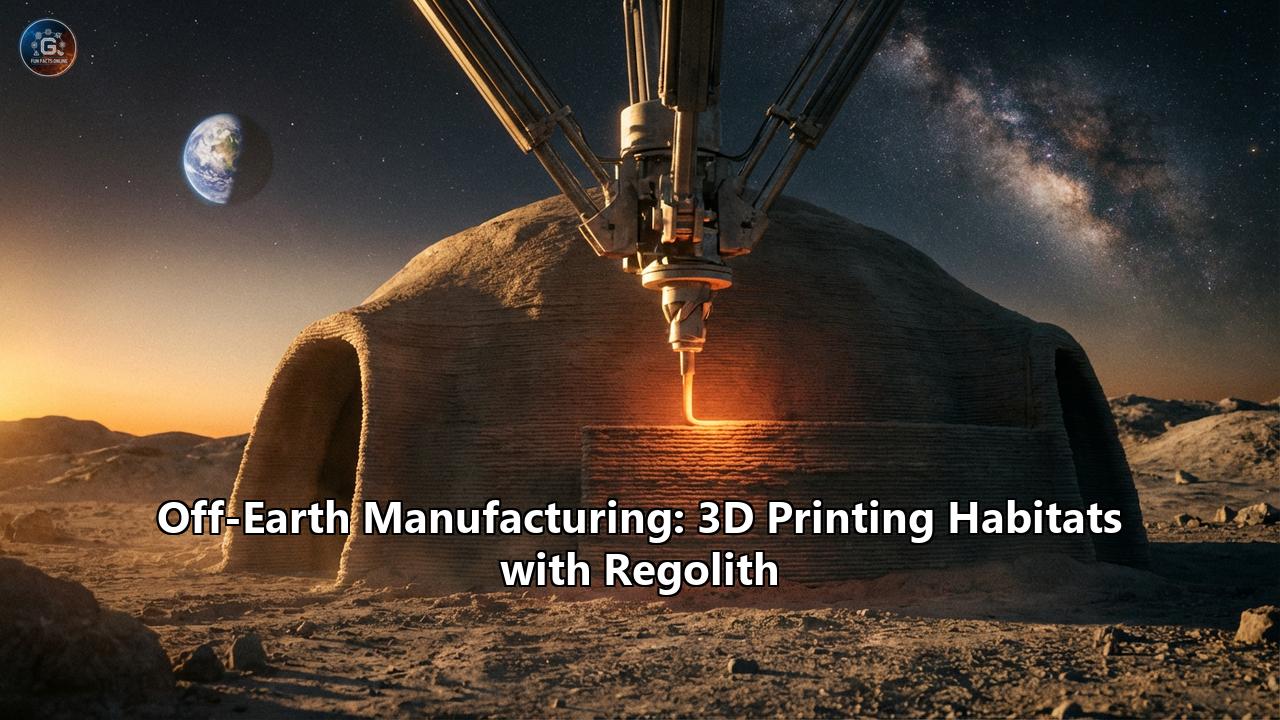
For decades, the vision of human expansion into the cosmos has been tethered to a daunting mathematical reality: the rocket equation. To escape Earth’s gravity, a spacecraft must carry an immense amount of propellant. For every ten pounds of rocket, roughly ninety pounds of propellant are required. This tyrannical ratio means that launching heavy, pre-fabricated steel, concrete, or composite building materials from Earth to the Moon or Mars is prohibitively expensive, costing anywhere from thousands to over a million dollars per kilogram depending on the destination. If humanity is to establish a permanent, sustainable presence on other celestial bodies, we must abandon the idea of bringing our homes with us. Instead, we must build them when we get there, using the very ground beneath our boots.
Welcome to the era of Off-Earth Manufacturing (OEM) and In-Situ Resource Utilization (ISRU). At the convergence of advanced robotics, materials science, and additive manufacturing lies the ultimate solution to extraterrestrial colonization: 3D printing habitats using local cosmic dirt, known as regolith.
This paradigm shift is actively transitioning from science fiction to engineering fact. Space agencies including NASA, the European Space Agency (ESA), and China’s CNSA, alongside private aerospace companies and architectural firms, are currently developing, testing, and scaling autonomous 3D printers capable of turning alien soil into fortified, radiation-shielded, and thermally insulated human habitats.
By marrying the ancient human tradition of building with local earth to cutting-edge autonomous robotics, we are laying the literal foundation for a multi-planetary future.
The Cosmic Concrete: Understanding Regolith
Before a habitat can be printed, one must understand the ink. In the context of space exploration, this "ink" is regolith—the layer of unconsolidated solid material covering the bedrock of a planet or moon. Unlike Earth soil, which is rich in organic matter, moisture, and shaped by aeolian (wind) and fluvial (water) erosion, extraterrestrial regolith is a harsh, alien substance forged by billions of years of meteorite impacts and solar radiation.
Lunar RegolithThe surface of the Moon is blanketed in a fine, powdery dust mixed with rocky fragments. Because the Moon lacks an atmosphere and liquid water, its regolith has never been weathered. The particles are jagged, sharp, and highly abrasive, resembling microscopic shards of glass. Furthermore, due to the constant bombardment of solar radiation, lunar dust holds a strong electrostatic charge, causing it to cling stubbornly to spacesuits, solar panels, and machinery. While dangerous to mechanical joints and human lungs, this same regolith is a treasure trove for construction. It is rich in silicates and metal oxides (such as iron, titanium, and aluminum). When properly processed, it can be fused into glass-like ceramics, pressed into bricks, or mixed with binders to form a space-grade concrete.
Martian RegolithMars presents a different, yet equally fascinating, materials profile. Martian regolith is primarily composed of basaltic rock, heavily oxidized iron (which gives the planet its trademark red hue), and clay minerals. Unlike the Moon, Mars has a thin atmosphere and a history of liquid water, meaning its soil is slightly more weathered and contains traces of water ice, particularly near the poles. However, Martian soil is also laden with toxic perchlorates, requiring careful handling or chemical remediation before it can be used safely in proximity to human life. Still, the abundance of basalts makes it an ideal candidate for manufacturing high-strength basalt fibers, a crucial reinforcement material in extraterrestrial construction.
The Mechanics of Extraterrestrial 3D Printing
Building on Earth usually relies on Portland cement, water, and steel rebar. In the vacuum of the Moon or the freezing, low-pressure environment of Mars, traditional wet concrete would flash-boil, freeze, and sublimate almost instantly. Therefore, engineers have had to invent entirely new methods of additive manufacturing tailored to off-Earth environments.
There are currently three primary methodologies dominating the race to 3D print off-Earth habitats: Sintering/Melting, Polymer-Binder Extrusion, and Molten Salt Electrolysis.
1. Sintering and Melting: Cooking the Soil
Sintering is the process of compacting and forming a solid mass of material by heat or pressure without melting it to the point of liquefaction. On the Moon, where raw energy from the sun is abundant and unimpeded by an atmosphere, directed energy can be used to fuse regolith particles together.
- Solar Sintering: ESA has extensively studied the use of massive Fresnel lenses to capture and concentrate raw sunlight into a high-powered beam. By directing this focal point onto a bed of lunar regolith, the intense heat (often exceeding 1,000°C) melts the silicates, leaving behind a solid, glassy structure. Robotic rovers could slowly drive across the lunar surface, continuously melting the sand into paved roads, landing pads, and interlocking habitat bricks.
- Selective Laser Melting (SLM): Similar to solar sintering but using an internally generated laser, SLM offers high precision. Germany's MOONRISE project, supported by a €4.74 million grant, is currently developing a machine-learning-supported compact laser system designed to fit on a lunar lander. This system aims to autonomously melt regolith into structural components and is targeting a lunar demonstration on an Astrobotic lander by late 2026. ESA’s PAVER project also uses powerful lasers to melt simulated lunar soil into glassy surfaces, specifically engineered to create landing pads that will prevent the dangerous "sandblasting" effect caused by rocket exhaust hitting loose dust during descent.
- Microwave Sintering: Perhaps the most promising breakthrough in regolith processing is microwave sintering. Lunar regolith has unique dielectric properties that make it exceptionally good at absorbing microwave energy. When exposed to microwaves at 2.45 GHz, the regolith undergoes "volumetric heating"—it cooks from the inside out. This is a massive advantage in the extreme cold of space. If you try to heat lunar soil with a laser, the surface radiates heat away instantly into the vacuum, causing extreme temperature gradients, thermal stress, and cracking. Microwaves bypass this by heating the internal volume, creating a stable, molten core that cools evenly into a remarkably strong, void-free ceramic. Institutions like The Open University are currently developing advanced 3D microwave print heads that can extrude and fuse regolith continuously, paving the way for large-scale structure fabrication.
2. Polymer-Binder Extrusion: The Bioplastic Approach
While sintering uses raw heat, extrusion methods mix regolith with a binder to create a paste that can be pumped through a robotic nozzle, much like a traditional Earth-bound 3D concrete printer.
Because bringing traditional cements to Mars is economically unfeasible, companies like AI SpaceFactory have pioneered the use of biopolymers. For their NASA Centennial Challenge-winning MARSHA habitat, AI SpaceFactory developed a proprietary space-grade material mixing basalt fibers extracted from Martian rock with polylactic acid (PLA)—a renewable bioplastic that can be synthesized from plants grown in Martian greenhouses.
This regolith-biopolymer composite is revolutionary. When subjected to NASA’s rigorous barrage of pressure, smoke, and impact tests, this 3D-printed material proved to be two to three times stronger than standard concrete in compression, and five times more durable in freeze-thaw conditions. Furthermore, it is a thermoplastic; it can be melted down, recycled, and reprinted if a habitat needs to be modified or repaired. In 2024, AI SpaceFactory and NASA's Kennedy Space Center achieved a historic milestone by successfully 3D printing this composite in a freezing vacuum chamber (-200°C), simulating the brutal conditions of the lunar South Pole.
3. Molten Salt Electrolysis and Conductive Printing
Beyond just building walls, habitats need power grids, sensors, and communications. A Denmark-coordinated ESA project is currently investigating the extraction of functional metals from regolith for 3D printing electronics. Through a process called molten salt electrolysis (developed by Metalysis), regolith is heated to 1,000°C. Oxygen is stripped away (which can be collected for astronaut life support or rocket fuel), leaving behind a metal-rich, electrically conductive powder. This powder is then converted into printable conductive inks, enabling autonomous robots to 3D print wiring, antennas, and circuitry directly onto the walls of the lunar habitat.
Architectural Design for the Alien Frontier
Architecture on Earth is dictated primarily by gravity, wind, and rain. On the Moon and Mars, buildings are not just shelters; they are highly complex machines designed to keep humans alive in an environment actively trying to kill them. The shift to 3D printing has forced a radical reimagining of space architecture.
The Pressurization ProblemBecause there is a vacuum on the Moon and only a wisp of an atmosphere on Mars, any human habitat must be heavily pressurized from the inside. Traditional science fiction often depicted lunar and Martian bases as low-lying domes. However, domes are structurally inefficient for containing internal pressure, often requiring heavy, tension-bearing materials.
Enter the vertical egg. AI SpaceFactory’s MARSHA (Mars Habitat) completely rethought extraterrestrial structural engineering. By utilizing an upright, elongated egg shape, MARSHA minimizes the mechanical stresses at the base and the top, safely containing the internal atmospheric pressure while maintaining a minimal footprint.
Radiation and MicrometeoritesWithout a thick atmosphere or a protective global magnetic field, the surface of the Moon and Mars are bombarded by galactic cosmic rays (GCRs), solar particle events, and micrometeorites traveling at hyper-velocity speeds. To protect human DNA from radiation degradation, habitat walls must be exceptionally thick. 3D printing allows for the construction of multi-layered, topologically optimized walls. Printers can create walls with internal honeycomb structures, providing massive radiation shielding and impact absorption while using the minimum amount of regolith necessary.
Thermal Fluctuations and Dual-Shell DynamicsTemperatures on the Moon swing violently from 120°C in direct sunlight to -130°C in the shade, and Martian temperatures can plummet to -100°C at night. Such dramatic thermal cycling causes materials to expand and contract rapidly, leading to structural fatigue. To combat this, modern 3D printed habitat designs employ a dual-shell system. The outer regolith shell absorbs the brunt of the radiation, micrometeorite impacts, and temperature swings. A physical gap separates it from the inner shell, which contains the pressurized living quarters. This architectural decoupling ensures the habitable zone remains thermally stable and physically secure, completely unbeholden to the expansion and contraction of the outer shield.
Human-Centric DesignIsolation and confinement in a hostile environment pose massive psychological risks to astronauts. Previous space architecture, like the International Space Station, prioritized pure utility, resulting in claustrophobic, wire-strewn, machinery-dominated corridors. 3D printing allows architects to design for human mental health. Multi-level vertical habitats offer high ceilings, diffuse light, and distinct separation of workspaces, wet-labs, and sleeping quarters. By integrating windows robotically placed during the printing process, astronauts are provided with panoramic views of the alien landscape, fostering a connection to their environment rather than a feeling of entombment.
Key Players and Visionary Timelines
The race to print the first off-Earth habitat has catalyzed a new space economy, driven by fierce competition and deep-pocketed governmental contracts.
ICON and Project OlympusTexas-based construction tech company ICON has been a dominant force in this sector. Having already revolutionized terrestrial construction with their Vulcan 3D printers—building affordable housing communities and military barracks on Earth—ICON secured a $57 million NASA contract in 2022 to develop Project Olympus. Olympus is a comprehensive space construction system designed to utilize lunar and Martian regolith. ICON’s approach focuses on advanced laser and microwave sintering to build catenary arches—structures that are entirely in compression, perfect for the low-gravity environment of the Moon. ICON is targeting an early uncrewed test structure build on the lunar surface as early as 2026, setting the stage for the Artemis Base Camp. Furthermore, ICON printed the Mars Dune Alpha at NASA's Johnson Space Center—a 1,700-square-foot habitat where crews are currently participating in the CHAPEA (Crew Health and Performance Exploration Analog) missions, simulating year-long stays on Mars.
ESA and the Moon VillageThe European Space Agency, in collaboration with architectural heavyweights like Foster + Partners, has championed the "Moon Village" concept. Rather than a single base, the Moon Village is an open-architecture, international collaboration model. ESA's vision heavily features autonomous rovers that gather regolith, mix it with binding salts or utilize concentrated solar energy, and 3D print protective cellular shields over inflatable pressure vessels. Recent field tests at the ESA-DLR LUNA facility in Cologne, Germany, during the 2025 Space Resources Challenge, saw teams from across the globe successfully demonstrate robotic systems capable of autonomously digging, sorting, and processing lunar simulant.
China's ILRSThe Sino-led International Lunar Research Station (ILRS) is advancing at a rapid pace. China’s Chang’e 8 mission, slated for 2028, carries a specific mandate to test ISRU technologies. The mission will attempt to melt lunar regolith and 3D print basic structural bricks directly on the lunar south pole, laying the groundwork for a permanent robotic, and eventually human, base in the 2030s.
Earthly Applications: Bringing the Cosmos Home
While the immediate goal of regolith 3D printing is to secure humanity's foothold in the stars, the technological dividends are already paying out on Earth. The rigid constraints of space—zero waste, minimal energy usage, high autonomy, and the use of unrefined, local dirt—are exactly the parameters needed to solve the terrestrial housing and climate crises.
The global construction industry is one of the largest contributors to greenhouse gas emissions, primarily due to the production of Portland cement. By translating extraterrestrial polymer-binder extrusion to Earth, companies are pioneering new eco-habitats. AI SpaceFactory’s TERA project (Terrestrial Analog) is built using the same biodegradable, crop-based biopolymers and basalt composites designed for Mars. These structures are deeply sustainable; they can be composted back into the earth at the end of their lifecycle, completely eliminating the massive waste generated by unrecyclable concrete.
Furthermore, the autonomous robotic systems developed to print landing pads on the Moon can be deployed to disaster zones on Earth. Imagine an autonomous 3D printer airdropped into a region devastated by an earthquake or tsunami. Without needing supply lines of lumber or steel, the printer could scoop up local debris and soil, mix it with a synthesized binder, and print emergency shelters, hospitals, and structural retaining walls within hours.
The Foundation of a Multi-Planetary Future
Off-Earth Manufacturing and the 3D printing of habitats using regolith represent a profound evolutionary leap. We are transitioning from a species that merely visits space, bringing all our earthly provisions with us in fragile aluminum cans, to a species that can live off the land of the cosmos.
Through laser melting, microwave volumetric heating, and biopolymer extrusion, the hostile, razor-sharp dust of the Moon and the rusted, toxic sands of Mars are being tamed. They are being transformed from life-threatening hazards into the very shields that will protect human life. As the 2020s give way to the 2030s, and the first autonomous printers touch down on the lunar South Pole, they will begin a silent, robotic ballet—extruding layer after layer of melted regolith. In doing so, they will print not just habitats, but the dawn of humanity’s permanent presence among the stars.
Reference:
- https://spacefactory.ai/marsha
- https://www.renderhub.com/blog/how-3d-printing-is-shaping-exploration-beyond-earth
- https://www.researchgate.net/publication/375912121_Regolith_sintering_and_3D_printing_for_lunar_construction_An_extensive_review_on_recent_progress
- https://www.satnow.com/community/3d-printing-in-space-manufacturing-on-the-moon-and-mars
- https://medium.com/predict/nasa-and-esa-advance-on-lunar-construction-5035b039a912
- https://3druck.com/en/
- https://publications.rwth-aachen.de/record/723143/files/723143.pdf
- https://www.eplus3d.com/advancements-in-lunar-regolith-3d-printing-a-key-to-sustainable-moon-base-construction.html
- https://www.archdaily.com/916888/ai-spacefactory-wins-nasas-3d-printed-mars-habitat-challenge
- https://www.eucass.eu/doi/EUCASS2019-0917.pdf
- https://www.hou.usra.edu/meetings/lpsc2014/eposter/1137.pdf
- https://university.open.ac.uk/science/physical-science/sites/www.open.ac.uk.science.physical-science/files/files/Lim%20-%20SI4%20Invesigating%20role%20microwave%20sintering.pdf
- https://www.cnet.com/pictures/this-3d-printed-mars-habitat-could-be-your-new-home-in-space-marsha-ai-spacefactory/
- https://spacefactory.ai/
- https://www.esa.int/Science_Exploration/Human_and_Robotic_Exploration/Second_Space_Resources_Challenge_from_concept_to_reality_at_LUNA
- https://all3dp.com/4/nasa-awarded-marsha-project-brings-space-age-architecture-to-mars/