
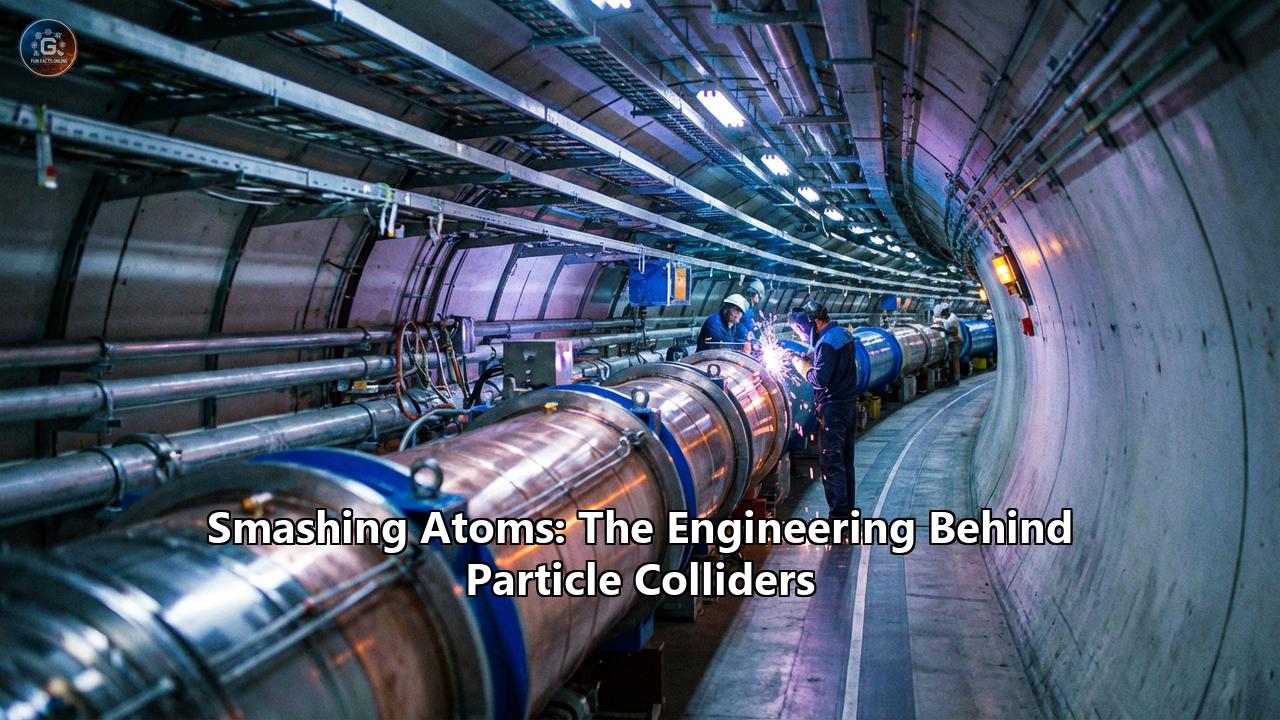
If the Great Pyramid of Giza represents the pinnacle of ancient architectural ambition, the modern particle collider is its technological equivalent—a monument not to the afterlife, but to the fundamental laws of reality. Stretching for dozens of kilometers beneath the Earth's surface, these machines are the most complex scientific instruments ever constructed by human hands. They are where the infinitesimally small meets the incomprehensibly massive.
When we talk about "smashing atoms," the phrase barely scratches the surface of the orchestrated mechanical, electrical, and computational ballet required to make it happen. To accelerate subatomic particles to 99.9999991% the speed of light and collide them head-on requires engineering environments that defy nature. Inside a modern collider, you will find temperatures colder than deep space, magnetic fields tens of thousands of times stronger than the Earth's, and an interior vacuum emptier than the void between the stars.
Yet, building a particle collider is not just an exercise in extreme physics; it is a masterclass in civil, mechanical, cryogenic, and software engineering. It is a story of how pushing the boundaries of human knowledge forces us to invent new technologies that eventually reshape our everyday world.
The Physics of the Smash: Why We Build Them
To understand the engineering, one must first understand the goal. A particle collider is essentially a time machine. According to the Big Bang theory, the universe began as an infinitely hot, infinitely dense point of pure energy. As the universe expanded and cooled, that energy condensed into matter, forming the fundamental particles—quarks and electrons—that eventually built protons, atoms, stars, and us.
By colliding protons at unimaginable speeds, physicists recreate the exact conditions of the universe just fractions of a second after the Big Bang. But they do not smash particles just to break them into smaller pieces, like a child smashing a clock to see its gears. They rely on Albert Einstein’s most famous equation: $E=mc^2$.
Energy and mass are two sides of the same coin. When two protons collide at near-light speeds, their kinetic energy is so immense that they annihilate each other, melting into a microscopic fireball of pure, concentrated energy. Out of this primordial flash, the energy immediately freezes back into new matter. The higher the energy of the collision, the heavier and more exotic the new particles that can be summoned into existence. This is how the elusive Higgs boson was discovered in 2012; it is too heavy and unstable to exist naturally in our cold modern universe, but it can be briefly coaxed out of the quantum vacuum by the brute force of a collider.
Achieving this requires scaling up energy to levels that challenge the limits of modern engineering.
Forging the Racetrack: Civil Engineering Deep Underground
You cannot place a massive particle accelerator in the middle of a bustling city above ground. The ambient radiation, the sheer size of the machine, and the need for absolute geological stability dictate that these machines belong subterranean.
The Large Hadron Collider (LHC) at CERN—the European Organization for Nuclear Research, situated on the Franco-Swiss border—resides in a circular tunnel 27 kilometers in circumference, buried an average of 100 meters underground. The tunnel was originally excavated in the 1980s for an earlier machine, using tunnel boring machines (TBMs) that chewed through the bedrock and glacial moraine of the Geneva basin.
But why a circle? Early accelerators were linear, firing particles straight into a target. However, achieving massive energies in a straight line requires a machine that is impractically long. By bending the particle beam into a circle, engineers can pass the same particles through the accelerating hardware millions of times a second, continuously pumping energy into them with each lap until they reach the desired velocity.
The Challenge of the Future Circular Collider (FCC)
As we look to the future, the engineering demands are growing exponentially. To reach the next frontier of physics—energies up to 100 TeV, compared to the LHC's 14 TeV—CERN is proposing the Future Circular Collider (FCC). This colossal machine will require a new tunnel 90.7 kilometers in circumference, passing beneath Lake Geneva, the Rhône River, and the foothills of the Alps.
Constructing the FCC represents a civil engineering challenge of global proportions. The depth of the tunnel will vary from 50 meters under the Rhône to a staggering 500 meters beneath the Alpine topography. Extensive geological surveys, utilizing seismic lines and deep boreholes, have been deployed to map the subterranean limestone and "molasse" (a type of soft sedimentary rock) to ensure watertight, stable excavation.
Perhaps the most fascinating engineering solution to emerge from the FCC studies is the commitment to the circular economy. Excavating a 90.7-kilometer tunnel will generate approximately 9 to 15 million cubic meters of excavated molasse rock. Rather than treating this as waste, CERN launched the "Mining the Future" international competition to find innovative ways to reuse this material. Engineers and materials scientists are developing techniques to transform the molasse into sustainable concrete, bricks, and agricultural soil stabilizers, ensuring that the construction of the world's largest physics experiment actively reduces the carbon footprint of the local construction industry.
The Ultimate Void: Engineering Nothingness
Once the tunnel is dug, the immediate challenge inside the machine is keeping the racetrack clear. Protons traveling at near-light speeds cannot afford to hit stray air molecules; even a single collision with an oxygen atom would scatter the beam, blinding the delicate detectors and potentially causing catastrophic heat spikes in the surrounding machinery.
To solve this, a particle collider requires an Ultra-High Vacuum (UHV) system. In fact, the LHC does not have one vacuum system; it has three.
- The Beam Vacuum: The 54 kilometers of pipes where the two counter-rotating proton beams travel must be kept at a pressure of $10^{-10}$ to $10^{-11}$ millibars. This is a vacuum as empty as interstellar space, and about ten times emptier than the surface of the Moon.
- The Cryomagnet Insulation Vacuum: Because the machine operates at incredibly cold temperatures, a vacuum is used as a thermal insulator (much like a high-tech Thermos flask) to prevent room-temperature heat from seeping into the cryogenic systems. The volume of this insulation vacuum is around 15,000 cubic meters—large enough to fill the central nave of a cathedral.
- The Helium Distribution Vacuum: A separate vacuum line insulates the pipes carrying the liquid helium that cools the machine.
Achieving pressures this low requires more than standard mechanical pumps. Engineers employ a technique called cryopumping. When the walls of the beam pipe are cooled to near absolute zero, residual gas molecules simply freeze to the metallic surface, physically adsorbing onto the cold bore.
For the sections of the accelerator that remain at room temperature, engineers utilize Non-Evaporable Getter (NEG) coatings. Born out of research at CERN, these are specialized metallic alloys applied to the inside of the vacuum chambers. When heated during a conditioning phase, the NEG coating activates and acts like a chemical sponge, actively bonding with and trapping any stray gas molecules that bounce against it.
The Big Chill: Cryogenics and Superfluidity
You cannot accelerate and steer beams of high-energy particles using standard copper wires and electromagnets. The electrical resistance would generate so much heat that the cables would melt in seconds, and the power bill would bankrupt small nations. The solution is superconductivity—the phenomenon where certain materials, when cooled to extreme temperatures, lose all electrical resistance.
To make the magnets superconducting, the collider must be transformed into the largest refrigerator in the universe. The entire 27-kilometer ring of the LHC is cooled to 1.9 Kelvin (-271.3°C), a temperature colder than the ambient microwave background radiation of deep space.
Achieving and maintaining this temperature is a marvel of cryogenic engineering. The coolant of choice is liquid helium. However, at 1.9 Kelvin, helium transitions into a state of matter known as superfluid (He II). In a superfluid state, helium exhibits zero viscosity and near-infinite thermal conductivity. This is vital for the collider. If a microscopic structural flaw or a stray particle causes a tiny localized spike in temperature inside a magnet, the superfluid helium instantly conducts the heat away, preventing a "quench"—a rapid, dangerous chain reaction where the magnet violently loses its superconducting state and dumps its massive electrical energy as heat.
The scale of the cryogenic system is staggering. The LHC utilizes over 130 tonnes of liquid helium, circulated by massive industrial turbocompressors and cold boxes distributed in caverns around the ring. The system relies on the Joule-Thomson effect and precisely engineered turboexpanders spinning on magnetic bearings to strip thermal energy away from the gas until it liquefies. Understanding the fluid dynamics of superfluid helium inside complex niobium-titanium cable architectures remains a highly active field of mechanical engineering.
The Muscle: Superconducting Magnets
If the vacuum is the clear road, and cryogenics provide the environment, the superconducting magnets are the steering wheel. Protons traveling at light speed naturally want to travel in a straight line. Forcing them to curve around a 27-kilometer track requires magnetic fields of immense strength.
The LHC utilizes 1,232 main dipole magnets, each 15 meters long and weighing 35 tonnes. These dipoles generate a magnetic field of 8.3 Tesla—over 100,000 times stronger than the Earth's magnetic field. They are wound from cables made of Niobium-Titanium (NbTi) filaments. Inside these cables flows an astonishing electrical current of 11,600 Amperes. Because the wire is superconducting, this massive current flows without losing a single watt of energy to electrical resistance.
But bending the beam is only half the battle. Because the protons all have a positive charge, they naturally repel each other. Left unchecked, the beam would widen and disperse into the walls of the vacuum pipe. To combat this, engineers use quadrupole magnets. Acting like optical lenses, quadrupoles focus the beam. By alternating quadrupoles that squeeze the beam vertically with those that squeeze it horizontally (a configuration known as a FODO lattice), the beam is continually disciplined into a cross-section narrower than a human hair by the time it reaches the collision points.
The mechanical forces at play inside these magnets are terrifying. The interaction between the 11,600 Amperes of current and the 8.3 Tesla magnetic field creates an outward electromagnetic bursting force of hundreds of tonnes per meter of magnet length. If the internal coils move by even a fraction of a millimeter, friction will generate enough heat to destroy the superconducting state. To prevent this, the coils are clamped inside massive, non-magnetic stainless steel "collars" under immense mechanical pre-tension, forging an assembly that behaves as a single, ultra-rigid monolith.
The Heartbeat: Radiofrequency (RF) Cavities
Magnets guide the particles, but they do not make them faster. Acceleration is the job of the Radiofrequency (RF) cavities.
Located in a specific sector of the collider, RF cavities are hollow, bulbous chambers made of highly pure superconducting niobium. Inside these cavities, an alternating electrical field oscillates at exactly 400 Megahertz (400 million times a second).
When a proton enters the cavity, the electric field is aligned to pull it forward, giving it a massive kick of energy. By the time the proton passes through the center of the cavity, the field flips, pushing it from behind to give it another boost as it exits.
These RF cavities are not just responsible for accelerating the beam to its top energy; they organize the beam into "bunches." A continuous stream of protons would be inefficient, so the RF fields naturally sculpt the beam into discrete packets. The LHC circulates about 2,800 bunches per beam, with each bunch containing over 100 billion protons, spaced exactly 25 nanoseconds apart. The total stored energy of the beam is 350 Megajoules—roughly the kinetic energy of a 400-tonne high-speed train traveling at 150 km/h, but contained within a microscopic thread of invisible matter.
The Eyes: Gigantic Detectors
When the two counter-rotating beams are finally crossed at four designated intersection points, the magic happens. But perceiving particles that exist for a billionth of a trillionth of a second requires the most complex cameras ever built: the particle detectors.
At the LHC, there are four main experiments: ATLAS, CMS, ALICE, and LHCb. These are not just scientific instruments; they are architectural behemoths. The ATLAS detector is housed in a subterranean cavern large enough to fit the nave of Notre Dame Cathedral. It is 46 meters long, 25 meters high, and weighs 7,000 tonnes. Its counterpart, the CMS (Compact Muon Solenoid) detector, is smaller in volume but incredibly dense, weighing 14,000 tonnes—more than the Eiffel Tower.
A detector is engineered like a multi-layered mechanical onion, with each layer designed to trap and measure a specific type of particle:
- The Inner Tracker: Made of tens of millions of microscopic silicon pixels and microstrips, this layer is closest to the collision. It tracks the curved paths of electrically charged particles as they fly outward in the strong magnetic field.
- The Electromagnetic Calorimeter (ECAL): Built from heavy, transparent crystals (like lead tungstate), this layer catches and completely stops light particles like electrons and photons, measuring their total energy.
- The Hadron Calorimeter (HCAL): Made of alternating layers of dense metal (brass or steel) and plastic scintillators, this massive layer stops heavier particles like protons and neutrons.
- The Muon Spectrometer: Muons are heavy cousins of the electron that punch through the dense calorimeters like bullets through tissue paper. The outermost layer of the detector is a vast array of gas-filled chambers that trace the path of these elusive muons.
To identify a particle like the Higgs boson, physicists cannot see it directly. Instead, they look at the tracker and calorimeter data to piece together the specific combination of photons, muons, and electrons that the Higgs boson decayed into.
The Brain: The Worldwide LHC Computing Grid (WLCG)
The engineering of a collider does not stop at physical hardware; it extends into the digital realm. Inside detectors like ATLAS and CMS, particle bunches cross each other 40 million times every second. Each collision event creates a spray of thousands of particles, generating roughly one megabyte of data. If every event were recorded, the LHC would produce 40 terabytes of data per second. No storage system on Earth can handle that.
To solve this, the detectors utilize physical hardware "triggers"—custom-built, ultra-fast electronic circuits that decide within microseconds whether a collision is boring or interesting. This drops the rate from 40 million to 100,000 events per second. A massive on-site server farm running complex algorithms then further filters this down to about 1,000 events per second.
Even after this brutal filtration, the LHC generates over 100 petabytes of permanent data every year. Storing and analyzing this data requires a computational paradigm shift: The Worldwide LHC Computing Grid (WLCG).
Conceived to handle unprecedented data volumes, the WLCG celebrated its 20th anniversary in late 2025 as the largest distributed computing collaboration in history. It operates on a tiered structure. The data originates at "Tier 0" (the CERN data center), where it receives its first processing pass. From there, dedicated high-bandwidth optical networks distribute the data to 14 "Tier 1" massive supercomputing centers across North America, Europe, and Asia. These Tier 1 centers distribute the data further to over 150 "Tier 2" academic computing facilities worldwide.
Today, the WLCG combines over 1.4 million CPU cores and more than 1.5 exabytes (1.5 billion gigabytes) of storage across 170 sites in 42 countries. It runs over two million analytical tasks every single day, with global data transfer rates routinely exceeding 260 gigabytes per second. This federated approach ensures that the 12,000 physicists analyzing the data have near real-time access to the computational horsepower required to find the proverbial needle in a cosmic haystack.
The Next Frontier: High-Luminosity and Beyond
Particle physics is a field defined by a relentless drive forward. The current LHC is an engineering marvel, but its capabilities are already being pushed to their absolute limits. In mid-2026, the LHC will enter its third Long Shutdown (LS3), embarking on a massive, multi-year civil and mechanical upgrade program to transform the machine into the High-Luminosity LHC (HL-LHC).
Luminosity is the measure of how many collisions occur over a given time. By tightening the beam focus, the HL-LHC aims to increase the number of collisions by a factor of ten. When it re-starts for "Run 4" in 2030, the HL-LHC will deliver a staggering 140 collisions per bunch crossing, up from the current average of 40 to 60.
To achieve this, engineers are introducing radical new technologies. The standard NbTi quadrupoles near the detectors are being replaced by advanced Niobium-Tin ($Nb_3Sn$) superconducting magnets. Niobium-tin is incredibly brittle—like baking a magnet out of glass—but it allows the magnetic fields to be pushed beyond the 8-Tesla barrier, up to 11.5–12 Tesla.
Additionally, the HL-LHC will utilize revolutionary "Crab Cavities." Because the two proton beams cross at a slight angle to avoid colliding everywhere at once, the particle bunches don't hit exactly head-on. Crab cavities use radiofrequency fields to literally rotate the particle bunches sideways just before the collision point, ensuring they collide perfectly flush, before rotating them back as they exit.
Looking even further ahead, beyond the mid-century, lies the aforementioned Future Circular Collider (FCC). If authorized by the global scientific community, the 90-kilometer FCC will initially operate as an electron-positron "Higgs factory" (FCC-ee) in the 2040s, before transitioning into a monstrous 100-TeV hadron collider (FCC-hh) in the 2070s. This machine will require scaling up the $Nb_3Sn$ magnet technology to achieve unprecedented 16-Tesla magnetic fields, forcing a complete reimagining of cryogenic cooling efficiency and civil infrastructure.
Alternative proposals also exist, such as the International Linear Collider (ILC) in Japan, or the radical concept of a Muon Collider. Muons are point-like fundamental particles (unlike protons, which are messy bags of quarks), meaning a muon collision dumps 100% of its energy into the creation of new particles. However, muons decay into radiation in 2.2 microseconds. Engineering a machine that can capture, cool, accelerate, and collide muons before they vanish from existence is widely considered the ultimate "holy grail" of accelerator physics.
The Spin-Offs: From the Cosmos to the Clinic
A common question aimed at colossal physics projects is one of utility: Why spend billions of dollars to find subatomic particles that have no direct application in daily life?
The answer lies in the engineering. The technological leaps required to build particle colliders cannot be achieved with off-the-shelf components. We must invent the future to build these machines, and those inventions inevitably cascade into society.
The World Wide Web and Distributed Computing
The most famous spin-off of particle physics is the World Wide Web. Invented in 1989 by Tim Berners-Lee at CERN, it was originally created simply to allow physicists operating different accelerators and detectors to share documents and data seamlessly across different computer networks. Today, the Web is the foundation of modern human civilization. Similarly, the innovations born from the Worldwide LHC Computing Grid (WLCG)—such as handling petabytes of distributed data—have heavily influenced the architecture of modern commercial cloud computing.
Medical Marvels: Healing with Hadrons
Perhaps the most profound impact of accelerator engineering is in the field of medicine. Of the roughly 30,000 particle accelerators in operation worldwide today, more than half are used in hospitals and clinics.
Traditional radiation therapy for cancer uses linear accelerators (LINACs) to fire high-energy X-rays (photons) into tumors. However, X-rays deposit energy along their entire path, damaging healthy tissue in front of and behind the tumor.
Particle physics offered a better way: Proton and Hadron Therapy. Thanks to a quirk of quantum physics known as the Bragg Peak, heavy charged particles like protons and carbon ions travel through human tissue while depositing very little energy. But exactly at the end of their track, right as they stop, they dump their maximum destructive energy. By tuning the accelerator to precisely match the depth of the tumor, oncologists can eradicate deep-seated, complex cancers—such as ocular melanoma or pediatric brain tumors—without harming the delicate surrounding brain tissue. The complex gantries and super-cooled magnets developed for high-energy physics are now being miniaturized to fit inside standard hospital wings.
Diagnostic Imaging
When you undergo a PET scan (Positron Emission Tomography), you are directly utilizing antimatter. Cyclotrons—compact circular accelerators—are used daily in hospitals to bombard targets and produce short-lived radioactive isotopes like Fluorine-18. When injected into the body, these isotopes emit positrons (the antimatter equivalent of electrons). As the positron meets an electron in the patient's body, they annihilate, emitting a pair of photons that the scanner detects. This creates a high-resolution, real-time 3D map of cellular metabolism, crucial for detecting cancer metastasis, Alzheimer's, and heart disease.
The Future of Materials
The ultra-high vacuum techniques, precision NEG coatings, and cryogenic handling pioneered at colliders are finding their way into the manufacturing of next-generation semiconductors and quantum computers. Synchrotron light sources—circular accelerators designed specifically to bleed off brilliant, focused X-rays—are acting as super-microscopes, allowing biologists to map the atomic structure of viruses and develop new vaccines with unprecedented speed.
There is even active research into using laser-driven plasma wakefield accelerators. By firing high-intensity lasers into a plasma, physicists can create a massive electric field "wake" (like a speedboat moving through water) that can accelerate particles to immense energies in mere centimeters, rather than kilometers. If successful, this could reduce the size of a medical particle accelerator from a multi-story building to a tabletop device, democratizing advanced cancer treatments worldwide.
The Pinnacle of Human Engineering
Smashing atoms is not a brute-force endeavor. It is a symphony of exactitudes. It requires aligning the physics of the infinitely small with the engineering of the monumentally massive.
A particle collider is a place where millions of kilometers of superconducting wire are chilled to temperatures colder than the depths of space; where the vacuum of the beam pipe is emptier than the lunar surface; where thousands of computers scattered across continents act as a single digital brain.
As humanity prepares for the High-Luminosity upgrades of the 2030s and dreams of the 100-kilometer colliders of the late 21st century, the engineering challenges will only grow steeper. But in striving to answer the most esoteric questions in the universe—Where do we come from? What is dark matter? How does gravity truly work?—we are forced to forge technologies that elevate the human condition here and now. The cathedral of modern science stands not just to uncover the secrets of the cosmos, but to push the limits of what is physically possible to build.
Reference:
- https://physicsworld.com/a/physics-for-our-future-the-five-spin-offs-from-physics-research-that-will-most-alter-our-everyday-lives/
- https://indico.cern.ch/event/1439855/contributions/6460871/attachments/3045660/5381453/WLCG%20input%20to%20ESPP%202025%20.pdf
- https://cerncourier.com/a/tunnelling-to-the-future/
- https://vvzapi.ch/unit/44822
- https://indico.cern.ch/event/1408515/contributions/6506642/attachments/3069969/5431233/250520_TWA_FCC_week_plenary.pdf
- https://www.leybold.com/en/knowledge/blog/how-vacuum-impacts-the-worlds-largest-most-powerful-particle-collider
- https://www.tunnel-online.info/en/artikel/tunnel_-3685260.html
- https://home.cern/news/news/cern/innovation-managing-excavated-materials-fcc-contribution-circular-economy
- https://www.lhc-closer.es/taking_a_closer_look_at_lhc/0.high_vacuum
- https://www.home.cern/science/engineering/vacuum-empty-interstellar-space
- https://www.leybold.com/en-us/knowledge/blog/the-main-cern-vacuum-systems-explained
- https://agenda.infn.it/event/49152/contributions/282693/attachments/144104/219047/251216%20-%20WLCG%20Evolution%20-%20ATLAS%20Italia.pdf
- https://www.hpcwire.com/off-the-wire/cern-celebrates-2-decades-of-global-scientific-computing-with-wlcg/
- https://www.home.cern/science/computing/grid
- https://www.ilf.com/news/publications/?download-id=315140
- https://en.wikipedia.org/wiki/Worldwide_LHC_Computing_Grid
- https://proceedings.jacow.org/e08/papers/weobm04.pdf
- https://pubmed.ncbi.nlm.nih.gov/21676897/
- https://accel-link.ca/particle-accelerator/particle-accelerator-applications/accelerators-for-medicine/